
Tag Archives: merchant service

Zotapay Review

Zotapay Review

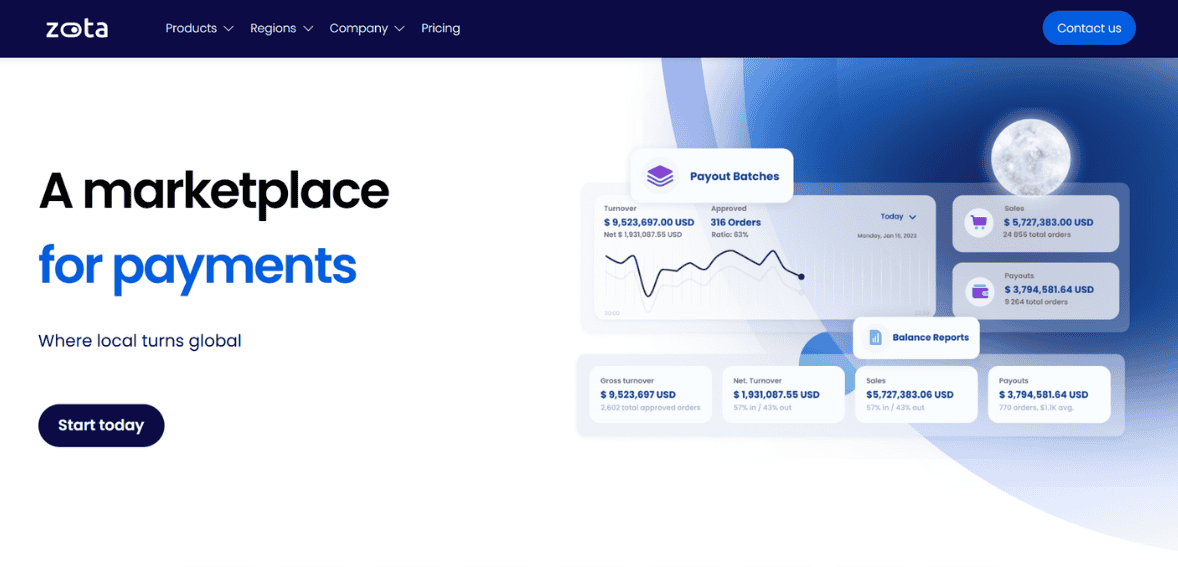
Zotapay is a global payment service provider designed to help businesses accept and send payments across multiple regions through a single integration. It operates as an aggregated payment platform that connects merchants with a wide network of acquirers, local payment providers, and financial institutions. This model allows the company to offer a broad range of payment methods while reducing the operational complexity that typically comes with cross border commerce. Over time, Zotapay has positioned itself as a reliable option for businesses aiming to reach emerging markets where traditional card acceptance may be limited or where customer payment behaviors vary significantly. Lets read more about Zotapay Review.


The platform focuses on enabling frictionless international transactions while also supporting regional businesses that need broader payment access. Its value lies in simplifying multi market expansion, centralizing settlement flows, and providing tools for secure and streamlined payment processing. Zotapay operates under regulated environments and follows strict compliance frameworks, which makes it suitable for industries needing in depth verification. However, this also means its onboarding requirements can be detailed and dependent on a merchant’s risk profile.


Ultimately, Zotapay functions as a bridge between merchants and various payment partners. It aims to remove barriers linked to regional restrictions, fragmented settlement processes, and limited payment coverage. While it offers an efficient pathway into diverse markets, its effectiveness depends on merchant needs, available local partners, and industry suitability.

How Zotapay’s Aggregated Payment Model Works | Zotapay Review

Zotapay uses an aggregated model that links merchants to multiple payment partners through a single integration. Instead of connecting separately to several acquirers, banks, and payment channels, merchants integrate once with Zotapay’s API. The platform then routes transactions through suitable local partners depending on the customer’s region, preferred payment method, or compliance rules. This setup helps merchants navigate diverse payment ecosystems, especially in markets where financial infrastructure or card penetration is limited.


The aggregated model enables Zotapay to offer a wide range of payment solutions without requiring merchants to manage individual partner relationships. For companies expanding into emerging markets, this shortens implementation time and reduces administrative complexity. It also allows Zotapay to adjust payment routing internally without needing new integration work from the merchant side. However, because the model depends on third party providers, performance and approval rates may vary across regions.


Merchants using the platform access local acquiring, card processing, bank transfers, and alternative payment methods through a unified workflow. The model also simplifies reporting and reconciliation since all payment activity passes through a centralized system. While this approach improves efficiency, it may reduce the level of control merchants have over specific acquiring agreements or settlement terms.


Zotapay’s aggregated model is beneficial for businesses seeking broad coverage without managing multiple integrations. It works best for merchants who value convenience and global access over highly customized acquirer level setups.

Supported Payment Methods Across Regions

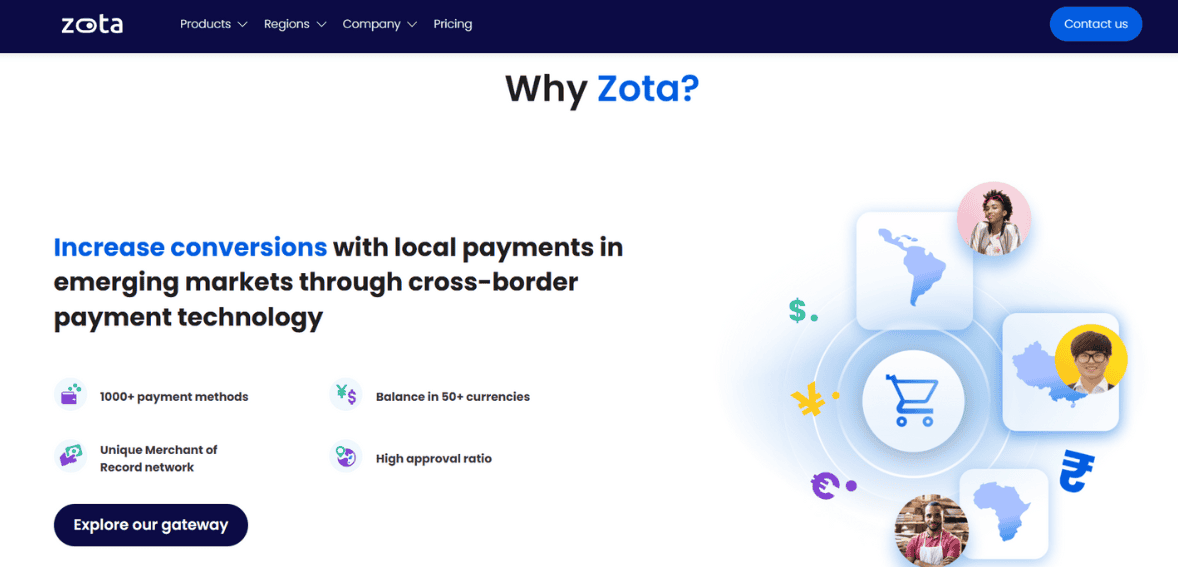
Zotapay supports an extensive list of payment methods suitable for diverse markets. The platform covers traditional card networks such as Visa and Mastercard, but its core strength lies in alternative payment options commonly used across Asia, Latin America, Africa, and Eastern Europe. These include local bank transfers, regional online banking channels, eWallets, digital vouchers, and cash based online payment tools.


In markets where card penetration is low or consumer behavior favors non card payments, this diversity helps merchants increase transaction acceptance. Local payment methods often enable faster settlement and reduce the friction associated with international card processing. They also accommodate customers who prefer digital bank transfers or local payment apps over global card brands.


The specific payment methods available to a merchant depend on factors such as business location, customer geography, and risk classification. Since Zotapay operates through various partners, the list of supported payment options may evolve as new partnerships form or regulatory environments shift.


While this flexibility is an advantage, merchants must assess which payment methods align with their audience before finalizing integration. Some methods work better for certain industries or regions. Overall, Zotapay offers strong multi region payment coverage suitable for businesses targeting wider online audiences.

Cross Border Payment Capabilities and Regional Reach

Zotapay supports cross border operations through its network of payment partners in multiple regions. It is particularly strong in areas where alternative payment methods dominate or where financial systems require localized infrastructure. These regions include parts of Asia Pacific, Latin America, Eastern Europe, and Africa. By partnering with local institutions, Zotapay facilitates compliant and region specific payment routing.


The platform offers multi currency acceptance, international settlement options, and localized routing based on customer location. Merchants can accept payments in one currency and settle in another, subject to agreements with acquiring partners. This is helpful for global businesses aiming to centralize operations even when serving customers in different markets.


Regional reach allows merchants to expand without establishing individual relationships with local banks or navigating complex regulatory environments. However, because each region has unique financial rules, service availability may differ. In tightly regulated markets, operational consistency may require ongoing adjustments to partner integrations.


Zotapay’s cross border capabilities make it valuable for merchants seeking international expansion, although performance depends on regional connectivity and local partner infrastructure. It offers strong coverage for growth oriented businesses but requires clarity on which markets and currencies are supported during onboarding.

Merchant Onboarding and Compliance Requirements

Zotapay has a detailed onboarding process that emphasizes regulatory compliance and risk evaluation. Merchants must submit business documentation including KYC and KYB details, shareholder information, financial records, and descriptions of their business model. High risk sectors or merchants with complex structures may undergo deeper examination.


The review process helps Zotapay evaluate merchant suitability based on industry risk, regulatory expectations, and partner requirements. Industries involving higher fraud exposure, chargeback rates, or regulatory scrutiny may require additional documentation. As a result, onboarding timelines vary depending on the nature of the business.


Compliance is central to Zotapay’s operations. The platform aligns with AML guidelines, global financial regulations, and regional licensing standards. Merchants must follow these rules to operate through Zotapay’s network. Some industries may face restrictions depending on acquiring partner policies, making early eligibility discussions important.


Despite the thorough process, onboarding provides clarity regarding supported payment methods, settlement options, and operational boundaries for each business. This helps merchants plan their setup accurately. While detailed, the onboarding framework ensures transparency and regulatory alignment from the start.

Payment Processing Workflows and Technology Stack

Zotapay’s technology framework enables streamlined transaction routing, authorization, reconciliation, and settlement. Merchants integrate through APIs that allow payments to be processed seamlessly across websites, apps, and online platforms. Once integrated, transaction routing occurs internally, directing payments to appropriate partners based on customer location and payment type.


The workflow includes authorization checks, fraud filtering, routing logic, and settlement management. Automated rules support improved approval rates by matching each transaction to the most suitable local partner. Fraud prevention tools operate in real time to detect suspicious activity and reduce risks associated with chargebacks or unauthorized payments.


The system also supports automated settlement batching, which ensures timely fund movement according to merchant agreements. Developers benefit from clear API documentation, sandbox environments, and structured testing procedures that help validate payment flows before launch.


While the technology offers scalability and consistency, its performance depends partly on partner infrastructure in each region. Some payment methods or markets may experience varying approval rates or settlement speeds. Nevertheless, the stack is suitable for businesses needing broad payment coverage without managing multiple direct integrations.
Zotapay Review

Security Standards and Regulatory Compliance

Security is a core element of Zotapay’s operating framework. The platform complies with PCI DSS requirements, ensuring that cardholder data is encrypted and handled securely throughout the payment lifecycle. Additional protections include tokenization, secure transmission protocols, and strict data storage controls to limit exposure to internal or external threats.


Zotapay also monitors transactions continuously to identify unusual activity and prevent fraud. AML and KYC checks support compliance with local and international regulatory standards. These safeguards help build trust with financial partners and ensure that merchants maintain strong operational integrity.


Because the company works across multiple jurisdictions, it must follow regional financial regulations that can vary widely. This requires ongoing alignment with local compliance rules, especially in markets with stringent data protection or financial oversight laws. As a result, merchants benefit from a regulated payment environment but must also meet strict onboarding and operational requirements.


Zotapay’s compliance approach ensures that sensitive data is protected and that transactions meet industry standards. This emphasis on regulation makes the platform reliable but also requires merchants to maintain consistent transparency and adherence to compliance expectations.

Dashboard, Reporting, and Analytics Features

Zotapay provides a merchant dashboard that enables real time visibility into payment performance. The interface consolidates transaction data from various acquiring partners, allowing businesses to monitor activity across all connected markets. Through the dashboard, merchants can view successful transactions, declined payments, refunds, and chargeback activity.


Reporting tools include downloadable transaction histories, settlement summaries, reconciliation files, and currency specific breakdowns. These help businesses maintain financial clarity when handling high volumes or operating across multiple markets. Filters allow merchants to analyze performance by region, payment method, or time period.


Analytics features provide insights into customer behavior, approval rates, and payment trends. This helps businesses refine their checkout flows or adjust payment method priorities. Because the platform aggregates data from multiple partners, the dashboard reduces the complexity typically associated with multi region reporting.


The depth of available reporting may vary depending on the data supplied by acquiring partners. In some markets, partners may offer limited transparency in specific metrics. For merchants needing advanced analytics, external tools may be used alongside Zotapay’s reporting system.


Overall, the dashboard offers a practical and unified way to track payment operations, providing clarity and operational control for businesses handling cross border transactions.

Merchant Management Tools and Customization Options

Zotapay offers various tools that help merchants manage checkout flows and integrate payment capabilities. These include hosted payment pages, embedded forms, payment widgets, and customizable elements that allow businesses to maintain brand consistency. Hosted pages reduce PCI obligations, while embedded solutions provide more control over the customer experience.


Merchants can customize branding, layout, and form elements depending on the integration method they choose. Payment widgets offer simplified deployment for businesses that do not require full API customization. These options accommodate different levels of technical expertise and business requirements.


Additional management tools include dispute handling interfaces, user permission controls, and resources for reconciliation. Developers gain access to integration documentation, sandbox setups, and test environments to refine payment flows before going live.


Customization depth varies by integration level. Hosted solutions prioritize simplicity, while API based integrations support more advanced configurations. Overall, Zotapay’s tools balance flexibility with usability, catering to both small businesses and enterprises looking for structured control over their payment processes.
Zotapay Review

Payouts, Mass Payments, and Global Disbursement Tools

Zotapay enables merchants to send payouts across various regions through its aggregated partner network. Businesses can make single disbursements or manage bulk payouts for activities such as commissions, refunds, partner settlements, or operational payments. The platform supports multiple currencies depending on regional availability.


Payouts are initiated and tracked through the merchant dashboard, which provides information about transaction status, settlement timelines, and currency movement. The system includes verification checks to align with AML and compliance standards. This ensures that payouts remain secure and compliant with local financial regulations.


The mass payment feature simplifies large scale operations for businesses handling frequent or repetitive disbursements. However, availability varies based on regional partners and the industry type of the merchant. Settlement times may also differ depending on the recipient’s geographic location.


Merchants should confirm payout capabilities during onboarding to understand currency options, timelines, and any region specific restrictions. Overall, Zotapay’s payout tools support global operational needs but rely on partner infrastructure for final delivery and performance.

Industry Fit and Suitable Business Types

Zotapay works with a wide range of industries, especially businesses that require cross border payment access or alternative payment coverage. It is well suited for eCommerce platforms, digital services, subscription businesses, marketplaces, and companies operating in regions with evolving payment landscapes.


The platform can support higher risk industries depending on underwriting outcomes. Eligibility depends on industry regulations, risk exposure, and partner policies. Merchants in sensitive sectors may need to undergo additional review before approval.


Zotapay is particularly useful for merchants targeting markets where bank transfers, digital wallets, and local payment apps are preferred over cards. Businesses seeking centralized reporting across multiple countries also benefit from the platform’s aggregated structure.


However, companies that require specialized acquiring setups or extremely granular control over routing may find the aggregated model less flexible. For them, direct acquirer relationships might offer more customization. For most businesses that prioritize accessibility and multi region reach, Zotapay provides a balanced and scalable solution.

Pricing Structure and Cost Transparency

Zotapay’s pricing varies based on industry type, risk level, payment methods, and regional settlement structures. Because the platform works through multiple acquiring partners, its pricing is not fixed and is usually customized for each merchant. Common costs include per transaction fees, currency conversion charges, cross border fees, and additional charges for certain payment methods.


Some merchants may also encounter setup or integration fees depending on the complexity of their payment workflow. High risk categories typically face higher pricing due to increased compliance and chargeback exposure. Regional partners may influence pricing depending on local regulatory costs or infrastructure.


Merchants should request detailed pricing during onboarding to understand how fees apply across different markets and payment methods. Transparent communication helps avoid unexpected costs, especially for businesses operating in regions with dynamic financial rules.


While Zotapay can offer competitive rates relative to its coverage, businesses seeking fixed pricing models may need to adapt to the variability of its aggregated structure. Each merchant’s final pricing depends heavily on their industry, volume, and geographic distribution.

Customer Support, Technical Assistance, and Service Quality

Zotapay offers support through account managers, technical specialists, and documentation resources. Merchants receive assistance during onboarding to understand payment coverage, integration steps, and compliance expectations. Technical support helps resolve integration challenges and optimize transaction routing.


Support levels may vary depending on the merchant’s size, industry, and transaction volume. Businesses operating across multiple regions often rely on dedicated account managers to coordinate communication with acquiring partners. Clear documentation helps developers work through integration requirements independently.


Response times and issue resolution speeds depend on the service agreement established during onboarding. Merchants with time sensitive operations should clarify support expectations to ensure proper alignment.


Overall, Zotapay’s support framework is practical and helpful for both technical and operational needs. Its effectiveness depends partly on coordination with regional partners and the complexity of the merchant’s setup.

Pros and Cons of Using Zotapay

Zotapay provides strong advantages for merchants needing access to alternative payment methods and emerging markets. Its aggregated model simplifies global expansion by connecting businesses to multiple acquiring partners through a single integration. The platform also offers centralized reporting, payouts, and settlement tools, making it easier to manage multi region operations.


Security and compliance standards are well established, giving merchants a structured environment for handling sensitive payments. The focus on regulated operations provides reliability, especially for businesses that require strict data protection.


However, the aggregated model has limitations. Performance may vary depending on partner infrastructure in each region. Merchants may have less control over specific acquiring agreements, and pricing can differ widely based on partner fees. Onboarding may be detailed, particularly for higher risk industries.


Zotapay is ideal for businesses prioritizing global reach, alternative payments, and simplified integrations. It may not be the best fit for merchants seeking highly customized acquiring setups or fully standardized pricing.

FAQs

1. Is Zotapay suitable for high risk merchant categories?

Zotapay supports various industries, including some high risk categories, but approval depends on underwriting and partner policies. Suitability varies by region and business type.

2. What types of payments does Zotapay support?

Zotapay offers card payments, bank transfers, alternative payment methods, eWallets, and region specific solutions. Availability depends on the merchant’s industry and target markets.

3. Can Zotapay handle global payouts?

Yes. Zotapay supports single and bulk payouts in multiple currencies, although settlement times and availability depend on regional partners.

Worldline Review

Worldline is a big player in the payments universe. This review will give a balanced view of the company: who they are, how they work, what are their strengths and weaknesses, what’s to come. Not to promote the company but to dissect their model, performance, strategy and risks so you can make your own judgement. In an age of digital payments, e-commerce and financial infrastructure, companies like Worldline are at the crossroads of technology, regulation and commerce; so their story is relevant. This review will cover the company’s history and evolution, business model, market position, financials, technology and innovation, geographical presence, regulatory environment, reputation and controversies, SWOT analysis, strategic outlook, stakeholder impact and conclusion. Lets read more about Worldline Review.

Company Background & Evolution | Worldline Review

Worldline has its roots in the early 1970s and has gone through several phases of growth, consolidation and strategic repositioning. Founded in 1972 as part of a French payments and transaction processing company, it became part of Atos SE and was later spun out as an independent company. Key milestones include the acquisition of European payment services companies such as SIX Payment Services in 2018 to strengthen its presence in merchant acquiring and payments infrastructure. As of mid 2020s, Worldline is present in dozens of countries and serves merchants, financial institutions, governments and corporations. The company has been through heavy acquisition, technology integration, global expansion and service diversification. But this rapid growth also brought integration complexity and exposure to many markets and regulatory environments. Understanding this history is key to understanding the business model and strategy.

Business Model & Core Services

Worldline’s business model is based on providing payments and transaction-processing services across multiple segments. The company has three main service lines: Merchant Services, Financial Services and Mobility & e-Transactional Services. In Merchant Services, Worldline supports merchants (in-store and online) by acquiring transactions, providing terminals or online payment platforms and servicing the acceptance process. The Financial Services segment serves banks and issuers with card issuing, processing, ATM networks and outsourcing of financial transaction services. The Mobility & e-Transactional segment supports non-payment digital transactions such as e-ticketing, mobility solutions, identity services or e-documents. By offering end-to-end payments infrastructure, Worldline captures value from multiple points in the transaction chain. Revenue comes from transaction volumes, platform subscriptions, hardware (terminals) sales or leases and outsourcing services. The model benefits from network effects, fixed cost efficiencies through scale and diversification across geographies and services. But global networks, fintech disruptors and local acquirers put pressure on the model and evolving regulatory costs for compliance and data protection.

Strategic Growth & Acquisition Strategy

Growth for Worldline has been driven largely by acquisitions and partnerships. The company’s expansion strategy involved acquiring complementary capabilities and integrating them to achieve scale. This approach allowed Worldline to rapidly gain market share, broaden its product offering, and strengthen its competitive position. Notable deals such as the acquisition of SIX Payment Services and Ingenico have been pivotal. However, acquisition-driven growth carries inherent risks: integration of different corporate cultures, legacy systems, and operational frameworks can be challenging. Worldline’s success depends not only on acquiring but on successfully assimilating these businesses while maintaining profitability and service quality. In the payments industry, scale provides both defensive and offensive advantages; helping the company defend against competitors and strengthen its market share. Partnerships and joint ventures also play a key role, especially in emerging markets, enabling access to local networks and regulatory licenses. As of recent years, the company has shifted focus toward organic growth, efficiency improvements, and cost optimization, recognizing that synergy realization and disciplined integration are essential for sustainable success.

Worldline Review

Market Position & Competitive Landscape

Worldline operates in a highly competitive sector where global processors, card networks, fintechs, and regional players constantly compete. Among the key competitors are FIS, Fiserv, Global Payments, Adyen, and Stripe, all of whom offer overlapping or adjacent services. Within Europe, Worldline has carved out a leadership position, particularly in merchant acquiring and payment infrastructure. Its extensive merchant base, partnerships with major banks, and end-to-end services give it a strong foundation. Yet, competition remains intense. Margin pressure continues to rise as digital-first players leverage software efficiency, while merchants increasingly expect omnichannel, data-rich payment solutions. Moreover, the emergence of embedded payments and open banking threatens to disrupt traditional acquirer economics. To maintain its edge, Worldline must continuously innovate, improve customer experience, and reduce operational costs. Its position as a European payments champion provides scale and credibility, but maintaining that leadership amid global digital transformation will require agility, investment in new technology, and proactive risk management.

Financial Performance & Key Metrics

Worldline reported FY 2024 revenue of approximately €4.63 billion, a modest organic growth of about 0.5%. Adjusted EBITDA stood at €1.07 billion, representing a margin of roughly 23%, while free cash flow reached €201 million, or 19% of adjusted EBITDA. However, the company also reported a net loss of nearly €297 million in 2024, reflecting restructuring and impairment costs. In Q1 2025, revenue fell to €1.07 billion, a 2.3% decline compared with Q1 2024, largely due to flat performance in Merchant Services and weakness in Financial Services. These figures illustrate a company with strong scale and positive cash generation but struggling with profitability and growth momentum. Analysts have pointed to factors like slower hardware shipments, integration costs, and macroeconomic headwinds as constraints. The company’s near-term financial outlook remains cautious as it works to restore profitability, strengthen liquidity, and maintain investor confidence. Its success will hinge on operational efficiency, disciplined spending, and recovery in merchant transaction volumes.

Technology, Innovation & Product Portfolio

Worldline’s strength lies in its technological backbone and comprehensive product ecosystem. The company offers a blend of hardware and software products, including POS terminals, online gateways, and secure transaction platforms. Its systems are built for reliability, compliance, and scalability, catering to millions of daily transactions across sectors. Innovation efforts have centered on expanding e-commerce capabilities, integrating new payment methods such as digital wallets and instant transfers, and providing merchants with analytics, reconciliation, and fraud detection tools. The company’s investments in cybersecurity, real-time analytics, and modular architecture reflect a move toward more agile, API-driven systems. Furthermore, its Mobility & e-Transactional Services unit extends beyond payments into digital identity and ticketing, demonstrating diversification potential. However, maintaining technology leadership demands continuous investment and modernization of legacy platforms. The competition’s faster innovation cycles, especially among fintechs and neobanks, underscore the need for agility. Overall, Worldline’s technology ecosystem remains robust, but modernization speed and service innovation will determine its future relevance.

Global Presence & Geographic Strategy

Worldline’s operations span over 50 countries, but its strongest foothold remains in Europe, particularly France, Germany, Switzerland, and the Benelux region. The acquisitions of SIX Payment Services and Ingenico expanded its presence across Northern and Eastern Europe, making it one of the continent’s largest payment processors. Beyond Europe, Worldline has been cautiously entering Asia-Pacific, Latin America, and parts of Africa through partnerships and local subsidiaries. Its global expansion strategy balances scale with prudence; focusing on markets with regulatory openness, strong digital adoption, and sustainable growth potential. Nevertheless, global diversification brings challenges such as compliance variation, FX exposure, and the need for region-specific customization. Worldline’s ability to adapt to local consumer behavior and integrate with regional payment systems determines its success outside Europe. The company’s global reach enhances revenue stability and positions it as a bridge between mature and emerging markets, though maintaining operational consistency across regions remains an ongoing test of execution.

Regulatory, Risk & Compliance Considerations

Operating in a regulated industry, Worldline faces constant scrutiny from financial authorities across its markets. Compliance with frameworks such as GDPR, PCI-DSS, PSD2, AMLD, and various national banking laws is essential for maintaining licenses and trust. The company employs rigorous risk management systems to monitor transaction integrity, detect fraud, and ensure anti-money-laundering compliance. However, the broad geographic scope exposes it to varying regulatory standards, requiring significant investment in compliance infrastructure. Regulators continue to tighten oversight on payment processors, especially around merchant onboarding and cross-border fund flows. Non-compliance could lead to penalties, reputational damage, or restrictions on business activities. Recent events have underscored the importance of risk governance for Worldline, pushing management to strengthen its frameworks and internal audits. While the company’s size allows it to absorb regulatory costs, its long-term stability will depend on transparent practices, effective supervision, and continuous improvement in risk management.

Worldline Review

Reputation, Challenges & Controversies

Worldline has recently faced serious reputational challenges that have shaken investor confidence. Reports surfaced in 2025 alleging lapses in oversight related to certain high-risk merchants and potential deficiencies in anti-money-laundering processes. These controversies led to a significant stock decline and regulatory investigations, particularly within its Belgian subsidiary. The company also faced internal restructuring pressures as it attempted to stabilize margins and control costs. In response, Worldline has emphasized governance reforms, compliance investments, and a renewed focus on transparency. Despite these corrective steps, the reputational damage has been significant, compounded by broader industry skepticism following several high-profile fintech failures. The firm’s future credibility will depend on how effectively it addresses compliance concerns, communicates with regulators, and rebuilds trust with clients. While its core operations remain intact, such incidents highlight the delicate balance between growth and risk control in financial services, where oversight missteps can quickly overshadow technical and commercial strengths.

SWOT Analysis (Strengths, Weaknesses, Opportunities, Threats)

Worldline’s primary strengths include its vast European scale, integrated services, and proven ability to handle high transaction volumes with reliability. Its diversified business model; spanning merchants, financial institutions, and mobility services, creates resilience and cross-sector synergies. However, weaknesses persist in the form of integration complexity, reputational risk, and uneven profitability. The company’s reliance on hardware and legacy infrastructure also slows innovation relative to younger fintechs. Opportunities lie in expanding real-time payments, open banking, subscription billing, and analytics-driven value-added services. As global digital commerce grows, Worldline can leverage its infrastructure to capture new transaction flows. Yet, threats are significant: increased regulation, aggressive competition, cybersecurity vulnerabilities, and the lingering impact of reputational issues. The balance between capital discipline and innovation investment will shape the company’s ability to convert opportunities into long-term gains.

Strategic Outlook & Future Directions

Worldline’s management has signaled a strategic reset focused on cost efficiency, asset divestment, and disciplined growth. The company plans to simplify its structure, divest non-core assets, and focus on improving profitability through operational efficiency. Simultaneously, it seeks to regain market confidence through governance reforms and stronger compliance oversight. Growth opportunities will come from expanding in digital payments, contactless solutions, and B2B e-commerce. The company also plans to enhance automation and data analytics capabilities across operations. However, the next few years will be critical for rebuilding margins and investor trust. Success will depend on clear execution, transparent communication, and measurable progress in cash flow generation. In essence, Worldline stands at a crossroads: either transform its operational efficiency into a sustainable competitive edge or risk losing ground to faster, more agile payment innovators. The direction it takes will determine whether it remains a European leader or becomes a consolidation target.

Implications for Stakeholders

For merchants, Worldline’s comprehensive services offer convenience, scalability, and integration across online and offline channels. However, clients must assess factors like service quality, fee structures, and compliance reliability before committing to long-term relationships. For investors, Worldline presents both potential and caution. Its scale and infrastructure are assets in a growing digital payments market, but reputational challenges and execution risks remain major concerns. Investors will watch for improved profitability, steady cash flows, and leadership accountability. For regulators and partners, the company’s evolution will be an indicator of how large payment firms adapt to tightening oversight while maintaining innovation. A successful turnaround could re-establish confidence in Europe’s payment infrastructure landscape, whereas continued missteps could reinforce calls for stricter regulation. Across all stakeholder groups, trust, transparency, and consistency will define how effectively Worldline sustains its role in the payments value chain.

Conclusion

Worldline remains a cornerstone of Europe’s payments infrastructure, with deep technological capabilities and a broad service portfolio. Yet, its journey in recent years reflects the complexity of scaling a global financial technology enterprise. The combination of modest growth, regulatory scrutiny, and reputational headwinds has challenged its long-held leadership position. Still, the fundamentals; a vast merchant network, stable cash generation, and experience in managing critical payments infrastructure; provide a strong foundation for recovery. The company’s success will depend on its ability to strengthen governance, modernize technology, and deliver consistent value to clients and shareholders. In the coming years, execution and transparency will define whether Worldline emerges stronger from its current turbulence or remains burdened by legacy issues. The payments industry rewards innovation and accountability, and Worldline’s future will hinge on how well it balances both.

FAQs

Q1. What differentiates Worldline from other payment processors?

Worldline’s differentiation comes from its broad service scope; merchant acquiring, issuing services, and e-transactional solutions; combined with a dominant European presence and robust infrastructure. Its ability to offer end-to-end solutions across physical and digital channels makes it distinct, though maintaining agility amid fintech disruption is key to preserving that advantage.

Q2. What are the biggest risks facing Worldline right now?

The company’s major risks include regulatory and reputational exposure, ongoing integration challenges from acquisitions, margin pressures, and increased competition. Additionally, macroeconomic slowdown and potential compliance missteps could further strain profitability and investor sentiment.

Q3. How is Worldline planning to grow over the next 3–5 years?

Worldline aims to focus on organic growth, divest non-core assets, strengthen compliance frameworks, and expand its digital payment and data-driven service offerings. Its medium-term plan emphasizes operational efficiency, modernization of technology, and restoration of profitability through disciplined execution and transparent communication.

SecurePay Review


SecurePay is an Australian-based payment gateway that provides businesses with secure, reliable, and efficient ways to process online and recurring transactions. Founded in 1999 and owned by Australia Post, SecurePay has built a strong reputation in the financial technology sector by focusing on simplicity and safety. It enables businesses to accept payments online through credit and debit cards, digital wallets, and alternative payment methods. Over the years, it has evolved to become one of the country’s most recognized payment processors, catering to a broad range of enterprises; from startups to large corporations. Lets read more about SecurePay Review.


SecurePay’s mission is rooted in enabling seamless payment experiences for both merchants and customers. The platform offers a complete suite of tools that go beyond just accepting payments; it also covers fraud prevention, reporting, and integrations with e-commerce platforms. Its foundation under Australia Post ensures reliability, compliance, and adherence to local regulatory standards, adding a layer of trust to its operations. For many Australian businesses, SecurePay represents a dependable partner that combines technological capability with the credibility of a long-standing national institution.

Company Background and Evolution | SecurePay Review

SecurePay was founded as a payment service provider under Australia Post to simplify online payments for businesses in the early days of digital commerce. Initially focused on online card processing, the company expanded to include recurring billing, tokenization and advanced fraud management. Being part of Australia Post gives us a unique advantage in terms of regulatory confidence and national reach.


As digital commerce grew in Australia, SecurePay adapted by introducing modern APIs, better integration and improved user experiences. We also built compatibility with major e-commerce platforms, because we’re all about scalability and user convenience. Over the years SecurePay has become a key player in Australia’s digital payments infrastructure, servicing both traditional and digital first businesses.


Our evolution shows how a legacy service can remain relevant in a fast changing fintech landscape. SecurePay balances compliance and innovation, our technology stack is aligned to global payment trends but grounded in Australian market needs. This has positioned us as a trusted option for merchants looking for local expertise and international performance.

Product Overview and Key Offerings

SecurePay’s product lineup caters to a wide variety of business needs, ranging from online payment processing to recurring billing solutions. Its Online Payments feature allows businesses to accept Visa, Mastercard, American Express, and other payment methods securely. Additionally, the Virtual Terminal lets merchants process payments manually, offering flexibility for call centers or remote billing scenarios.


The platform also includes Recurring Billing, a key tool for subscription-based businesses that need automated payment cycles. This feature ensures smooth management of customer renewals and reduces manual intervention. SecurePay’s FraudGuard adds an essential security layer, detecting and preventing suspicious transactions before they impact businesses.


Another noteworthy aspect is its compatibility with third-party tools and plug-ins. SecurePay integrates seamlessly with e-commerce platforms like Magento, WooCommerce, and Shopify, providing businesses with multiple avenues to accept payments without complex setups. For developers, it offers detailed API documentation and sandbox environments to customize integrations.


Overall, SecurePay’s offerings strike a balance between ease of use and robust functionality. Businesses can tailor the platform to their needs, whether managing a small online store or operating a large-scale enterprise system. Its emphasis on flexibility and reliability makes it an all-in-one payment solution for merchants looking for a unified approach to payment management.

SecurePay for Online Businesses

SecurePay is a household name among online retailers in Australia for its seamless integration and reliability. The gateway allows for customisable checkout pages so merchants can design customer experiences that reflect their brand while maintaining high security. With support for major credit cards and alternative payment methods, SecurePay lets businesses cater to all customer types.


For e-commerce platforms, SecurePay has plugins that make integration with Shopify, BigCommerce and WooCommerce a breeze. Merchants get quick setup and automatic sync with their online store. Tokenisation and recurring billing are particularly useful for subscription based models, while FraudGuard ensures safe transactions even during peak sales.


SecurePay also supports payment gateways that handle domestic and international transactions so businesses can expand beyond Australian markets. With real-time reporting and reconciliation tools, merchants can see their sales and track payments. For small to medium sized online businesses the platform is reliable and transparent in its fees. It gives you the core of online payment management without the complexity so you can focus on growth and customer engagement.

SecurePay Review

SecurePay for In-Person and Hybrid Businesses

While SecurePay is primarily known for its online payment capabilities, it also supports hybrid business models that blend physical and digital sales channels. Through its virtual terminal and integration options, merchants can process payments securely without requiring dedicated hardware. This makes it especially useful for service providers, phone order systems, or mobile-based businesses.


Although SecurePay does not specialize in traditional in-person POS terminals, it complements physical sales through integrations with third-party systems that manage in-store payments. Businesses with both retail and online operations can unify their payment data for better financial tracking and reporting. This integrated approach allows for consistent customer experiences across different touchpoints.


For businesses transitioning to omnichannel operations, SecurePay’s flexibility helps reduce the technical friction of managing multiple systems. It simplifies settlement processes, ensuring that payments from all sources are consolidated efficiently. While not a full-scale in-person POS provider, SecurePay effectively bridges the gap between online and offline payment environments. Its tools enable small retailers and service providers to expand their reach without overhauling their payment infrastructure.

Integration and API Capabilities

SecurePay has a documented API for developers who want control and customisation. The API can be integrated with various systems including e-commerce platforms, CRM tools and billing software. Developers can use SecurePay’s RESTful API to manage payments, refunds and recurring payments while keeping data secure with tokenisation and encryption.


The company has a sandbox environment for testing integrations before going live which is super useful for businesses building custom applications. Their integration libraries are available in common programming languages so you can embed payment functionality into your website or mobile app. In addition to APIs SecurePay has plug-ins for popular platforms like Shopify, Magento and WooCommerce. This reduces the need for technical expertise so it’s accessible to startups and established businesses.


While their API documentation is comprehensive some users note that the system may not have the same level of customisation as global providers. But for most Australian businesses SecurePay’s developer ecosystem has all the tools to build a reliable and compliant payment experience. It’s a developer friendly option that fits with local infrastructure.

Security, Compliance, and Fraud Prevention

Security remains one of SecurePay’s strongest pillars. The platform is fully PCI DSS compliant, ensuring that sensitive customer data is encrypted and protected during every transaction. SecurePay employs SSL encryption, tokenization, and secure authentication mechanisms to prevent unauthorized access and data breaches.


One of its standout security features is FraudGuard, an intelligent fraud management tool that helps merchants detect and block suspicious activities. FraudGuard analyzes transactional patterns in real time, reducing the risk of chargebacks and fraudulent orders. For businesses handling high transaction volumes, this feature provides significant peace of mind.

Because SecurePay operates under Australia Post, it is also governed by strict financial and data protection regulations, further reinforcing its reliability. Regular audits and compliance checks ensure that it meets both national and global standards.


While no payment gateway is entirely immune to risks, SecurePay’s layered security measures and proactive fraud detection systems make it one of the safer choices in the market. It combines national regulatory confidence with advanced technological safeguards, giving businesses and customers alike a sense of trust and assurance.

Pricing and Fees

SecurePay follows a transparent pricing model designed to suit different business sizes. It typically charges a flat transaction fee per processed payment, with variations based on card type and payment volume. There are no hidden costs, which helps businesses forecast expenses accurately. The standard pricing includes a setup fee, transaction fees, and a small monthly account charge for ongoing access.


Businesses that process larger volumes may be eligible for custom pricing, negotiated directly with SecurePay’s sales team. The platform’s fee structure is competitive within the Australian market, especially given the backing of Australia Post and its reputation for stability. While the pricing is straightforward, some users note that SecurePay’s fees for international transactions can be slightly higher than global competitors like Stripe or PayPal. However, the benefit lies in its local customer service, domestic settlement, and compliance with Australian banking systems.


Overall, SecurePay offers a fair balance between cost and value. Its transparent approach ensures there are no unexpected surprises for merchants, making it a trustworthy choice for businesses seeking predictable payment processing expenses.

User Experience and Interface Design

SecurePay’s interface is built with simplicity and clarity in mind. The merchant dashboard provides an organized view of transactions, settlements, and reports, making it easy to track business performance. The layout is clean, functional, and optimized for both desktop and mobile use.


For non-technical users, the intuitive navigation and detailed help resources make daily operations straightforward. Reporting tools allow merchants to filter transactions, monitor chargebacks, and export data seamlessly. SecurePay also supports integration with accounting tools, improving financial visibility for business owners.


From a technical standpoint, the interface facilitates smooth interaction with APIs and plug-ins, allowing developers to configure integrations without complications. Although the design might not be as modern as global competitors, its functional reliability and minimal learning curve make it accessible to all user types.


User feedback often highlights SecurePay’s stability and responsiveness over flashy aesthetics. The platform focuses on performance and dependability rather than visual frills, resulting in a consistent and professional user experience that prioritizes function over form.

SecurePay Review

Customer Support and Service Reliability

SecurePay’s customer support network is one of its key differentiators. Backed by Australia Post, the company offers local support through phone, email, and online ticketing. Merchants appreciate being able to reach a real person within Australian business hours; a feature often missing from international providers.


The platform’s documentation and online help center provide clear, step-by-step guidance for troubleshooting and integration. Additionally, SecurePay ensures high uptime reliability, with robust systems that minimize transaction delays or outages. While users generally report positive experiences, some note that advanced technical inquiries may take longer to resolve. However, the quality of responses and the personalized support make up for these occasional delays.


In terms of service reliability, SecurePay maintains strong performance consistency. It processes payments efficiently and settles funds promptly, ensuring minimal disruption to business operations. The overall reliability of its infrastructure, combined with dedicated support, reinforces its appeal to Australian businesses that value local accountability.

Pros of Using SecurePay

SecurePay’s major advantages stem from its reliability, compliance, and strong local presence. Being part of Australia Post gives it an inherent layer of trust and credibility. The platform’s transparent pricing, PCI DSS compliance, and fraud prevention systems make it suitable for businesses prioritizing safety and simplicity.


Another key strength is its integration ecosystem. Whether through APIs or plug-ins, SecurePay connects easily with popular e-commerce and accounting systems. Its user-friendly dashboard and real-time reporting tools enhance operational visibility, making it easier for merchants to stay on top of financial performance.


Local support is another standout benefit. Businesses can access quick assistance without dealing with timezone gaps or foreign support centers. Additionally, SecurePay’s ability to manage recurring payments and multi-channel transactions provides flexibility across industries. Overall, the platform is best suited for Australian businesses seeking a dependable and compliant gateway with excellent domestic support. It excels in reliability, transparency, and customer trust; three areas that continue to define its long-standing market position.

Cons and Limitations

Despite its strengths, SecurePay is not without limitations. One of the most common concerns among users is its limited focus outside Australia. For businesses operating internationally, transaction fees and settlement times may not be as competitive as those of global payment giants. The interface, while user-friendly, lacks some of the advanced customization options that modern fintech solutions offer. For instance, merchants seeking detailed analytics or API-level modifications might find SecurePay slightly restrictive.


Additionally, the absence of dedicated in-person payment hardware means businesses must rely on third-party POS systems for offline transactions. This could add an extra layer of complexity for those seeking a single unified solution.

Customer feedback also suggests that while support is prompt and helpful, documentation for complex integrations could be improved. Nonetheless, these drawbacks are relatively minor when weighed against its overall dependability. SecurePay remains a solid choice for businesses prioritizing local service and security over global scalability.

Ideal Business Types for SecurePay

SecurePay is particularly well-suited for small to medium-sized businesses, e-commerce retailers, and service providers that operate primarily within Australia. It’s an excellent choice for organizations that value local customer support and straightforward payment management. Subscription-based businesses benefit from its recurring billing tools, while online stores appreciate its seamless platform integrations.


Nonprofits, educational institutions, and membership-based organizations also find value in SecurePay due to its stable processing, transparent pricing, and reliability in handling recurring donations or payments. Businesses that handle sensitive data, such as healthcare or financial services, can rely on its compliance framework to maintain security and trust.


For larger enterprises, SecurePay’s scalability and API access enable deeper integration with internal systems. However, global brands seeking extensive international payment coverage might find its reach limited compared to multinational gateways. Overall, SecurePay fits businesses that want a dependable, regulation-compliant, and easy-to-use payment solution backed by a trusted national brand.

Final Verdict

SecurePay stands as a dependable and secure payment gateway built for Australian businesses that prioritize trust, compliance, and ease of use. Its backing by Australia Post lends unmatched credibility, and its offerings; from online payments to fraud prevention; cater to a wide range of industries. While it may not compete directly with global players on international coverage or advanced analytics, SecurePay’s local expertise, transparent pricing, and responsive support make it a standout option in its market segment.


Its straightforward integration process and reliable infrastructure allow businesses to operate efficiently with minimal disruption. In 2025, as payment technologies evolve rapidly, SecurePay continues to hold relevance by focusing on what matters most to merchants: safety, reliability, and consistent performance. For businesses operating in or targeting the Australian market, it remains one of the most trustworthy choices available.

FAQs

1. Is SecurePay suitable for international businesses?

It primarily serves Australian businesses, but it does support international payments. However, global transaction fees may be higher than competitors like Stripe or PayPal.

2. Does SecurePay integrate with major accounting or e-commerce platforms?

Yes, it integrates with popular platforms like Shopify, WooCommerce, Magento, and accounting tools like Xero, allowing for smooth payment and reconciliation processes.

3. What makes SecurePay different from other Australian payment gateways?

SecurePay’s key differentiators are its ownership by Australia Post, strong compliance framework, reliable local support, and transparent pricing; all of which make it a trusted choice for Australian merchants.

Merchant One Review

Merchant One Review

Merchant One is a well-established credit card processing company that provides businesses with a range of tools to manage transactions efficiently. Over the years, it has positioned itself as a payment solutions provider catering primarily to small and medium-sized enterprises, though it also works with larger organizations. Its value proposition lies in making electronic payments more accessible, whether through point-of-sale systems, ecommerce gateways, or mobile readers. Lets read more about Merchant One Review.


The payments industry has undergone tremendous change in the last two decades, with consumer preferences shifting from cash to card, and more recently, toward digital wallets. Companies like Merchant One have grown alongside this shift, offering technology and service bundles that simplify complex aspects of accepting payments. Instead of focusing exclusively on hardware or software, Merchant One combines both, creating an ecosystem that supports modern businesses.


While the company highlights flexibility and customer service as its strengths, it also operates in a crowded market where transparency and reliability are key decision-making factors for merchants. 

Company Background and History | Merchant One Review

Founded in 2002, Merchant One is headquartered in Miami, Florida, and has grown steadily to become a recognizable name in the payment processing industry. The company started with a goal to simplify how small businesses accept card payments at a time when setting up merchant accounts was often complicated and expensive. Over time, its client base expanded to include retailers, restaurants, service providers, and ecommerce businesses.


One of the reasons Merchant One has been able to maintain a presence in a highly competitive sector is its ability to adapt to new technologies and industry standards. From the introduction of EMV chip cards to the rise of mobile payments and contactless transactions, the company has consistently updated its offerings. By doing so, it has aligned itself with the expectations of both merchants and their customers.


Today, Merchant One claims to serve more than 350,000 businesses across different industries. This reach demonstrates not just longevity but also the ability to scale its operations. For many merchants, particularly those without large budgets, the appeal of a provider that understands the needs of smaller enterprises has been central to Merchant One’s growth. Its continued investment in partnerships and technology reinforces its role as a stable, mid-tier player in the U.S. payment ecosystem.

Partnership with Fiserv and Clover Systems

One of Merchant One’s biggest strengths is its partnership with Fiserv, a global leader in financial services technology. Fiserv provides the backbone infrastructure that enables secure and reliable transactions. For merchants, this partnership translates into confidence that their provider is backed by one of the most established names in the industry.


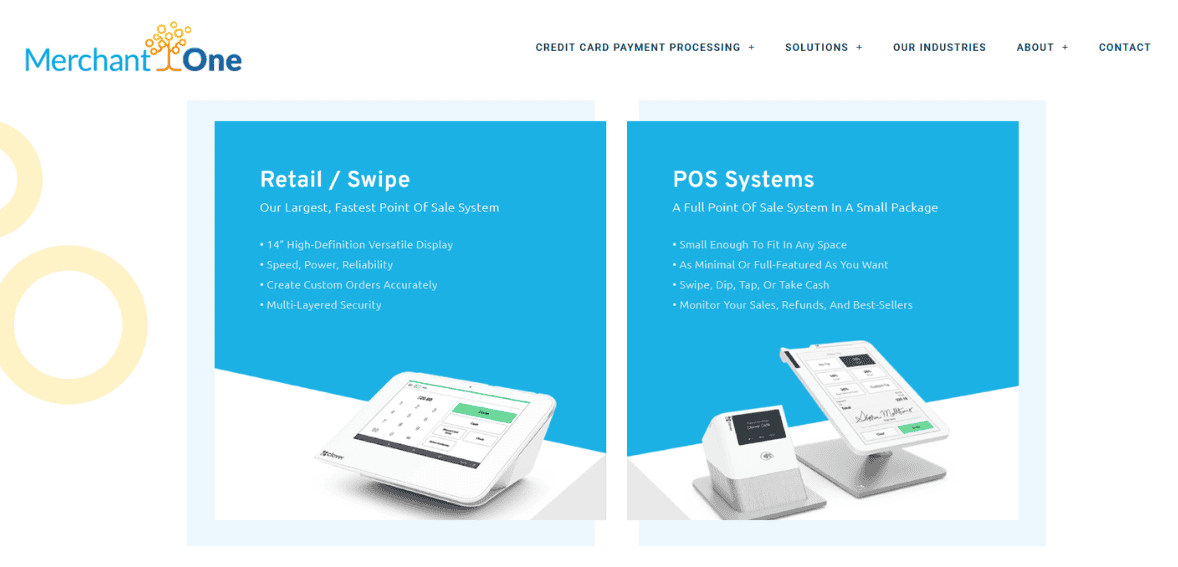
Through this relationship, Merchant One is able to offer Clover POS systems, which are among the most popular in the U.S. Clover hardware includes countertop terminals, mobile devices, and full POS stations that support everything from payment acceptance to inventory management. The availability of these systems gives Merchant One a competitive edge because it can provide tools that scale with a business’s growth.


Having access to Fiserv’s technology also ensures compliance with security regulations and the ability to handle large transaction volumes. This makes Merchant One suitable not just for small shops but also for mid-sized businesses with higher processing demands. While many independent sales organizations (ISOs) in the payment space struggle with credibility, Merchant One benefits from being tied to a trusted global processor. This affiliation reinforces reliability and helps mitigate concerns about operational risks.

Merchant One Review

Products and Services Overview

Merchant One’s portfolio covers a broad spectrum of payment solutions designed to serve different business models. At the core, it offers merchant accounts that allow businesses to accept credit and debit card payments. Beyond that, its services include:


Point-of-Sale Systems: A range of Clover terminals and stations for in-store payments.

Mobile Payment Tools: Card readers and mobile apps for accepting payments on the go.

Ecommerce Solutions: Secure payment gateways and virtual terminals for online businesses.

Recurring Billing: Options for subscription-based businesses to automate payments.

Gift Cards and Loyalty Programs: Tools that help merchants engage and retain customers.


The diversity of services shows that Merchant One is not restricted to traditional brick-and-mortar retail. It has made efforts to ensure ecommerce merchants and mobile service providers have access to the same infrastructure as physical stores. This breadth of offerings is a selling point for businesses that may evolve over time — for instance, a retailer adding an online store can expand within Merchant One’s ecosystem instead of switching providers.

Merchant One Pricing Structure

Pricing in the payment processing industry is often one of the most challenging areas for businesses to evaluate, and Merchant One is no exception. The company advertises competitive rates, though exact fees depend on business type, volume, and risk profile. Typical charges include interchange fees, per-transaction fees, and monthly service costs.


Merchant One has been noted for offering customized quotes, which means pricing is not always transparent upfront. For some businesses, this flexibility can be an advantage, as rates may be tailored to their specific processing needs. For others, the lack of standard pricing may feel opaque compared to flat-rate processors. Additionally, there have been reports of early termination fees and equipment lease agreements, which are important to clarify before signing a contract.


While Merchant One positions itself as an affordable option for small and medium-sized businesses, it is essential for merchants to read contracts carefully. Understanding monthly minimums, PCI compliance fees, and potential cancellation penalties is crucial. Like many traditional merchant service providers, its pricing model is more complex than newer fintech competitors, but it can be cost-effective for businesses processing significant volumes.

Hardware and Technology Options

A significant component of Merchant One’s value comes from its hardware offerings. By reselling Clover devices, it provides merchants with access to one of the most widely used POS ecosystems. Clover devices are known for their sleek design, reliability, and ability to integrate business management tools beyond payment acceptance.


Options include handheld readers like Clover Flex, countertop solutions like Clover Station, and simple mobile readers for businesses on the move. These devices are designed to handle a variety of payment types, including chip cards, contactless payments, and mobile wallets like Apple Pay and Google Pay.


The integration of technology extends to reporting and analytics. Many Clover devices come with built-in apps that help track sales, manage employees, and oversee inventory. This means that for businesses looking for more than just payment acceptance, Merchant One offers solutions that contribute to operational efficiency. While the hardware is an attractive feature, merchants should evaluate costs carefully, as device leases can add to long-term expenses.

Security and Compliance Standards

Security is a non-negotiable factor in payment processing, and Merchant One emphasizes compliance with industry standards. The company ensures that all accounts meet PCI DSS (Payment Card Industry Data Security Standard) requirements, which are designed to protect cardholder data.


Fraud prevention tools are also part of its services, offering merchants safeguards against chargebacks and suspicious transactions. Through its partnership with Fiserv, Merchant One can rely on advanced encryption and tokenization technologies that minimize risks during payment transmission.


However, compliance does come with associated costs. Merchants should confirm whether PCI compliance fees are part of their monthly charges. Failure to maintain compliance can result in penalties, so it is important that businesses understand their responsibilities. Overall, Merchant One delivers the level of security expected from a reputable provider, but merchants must stay proactive in ensuring ongoing compliance to avoid unexpected fees.

Onboarding and Application Process

Merchant One’s onboarding process is designed to be straightforward, though as with most merchant service providers, approval depends on business type and risk level. The application requires basic information such as business details, estimated transaction volumes, and processing history.


One of the company’s selling points is fast approvals. In many cases, accounts can be set up within 24 hours, allowing businesses to begin accepting payments quickly. This is particularly beneficial for new merchants who need to start operations without delays.


That said, some merchants have reported that the contract terms can be confusing at the outset. Clarity around pricing, equipment leases, and cancellation fees is essential before finalizing the application. Businesses should also be prepared for underwriting checks, which may take longer if the business falls into a higher-risk category. Overall, the process is competitive compared to other traditional providers but requires attention to detail from applicants.

User Experience and Ease of Use

Day-to-day usability is where Merchant One delivers tangible value for merchants. The systems provided, especially Clover POS, are known for intuitive interfaces that simplify training for employees. Features such as touchscreen navigation, integrated reporting, and digital receipts contribute to a smoother checkout process for customers.


For ecommerce merchants, the virtual terminal and gateway solutions are also designed with ease of use in mind. Businesses can process transactions online securely and manage them through centralized dashboards. Having consolidated reporting tools helps businesses monitor sales trends and customer behaviors, aiding better decision-making.


That said, some of the more advanced features may require additional apps or software, which can add to costs. While the base experience is user-friendly, merchants should evaluate whether they need premium add-ons or integrations. Overall, Merchant One provides a balance between functionality and simplicity, making it suitable for businesses without extensive technical expertise.

Customer Support and Service Quality

Customer support is a critical factor when choosing a payment processor, and Merchant One emphasizes its 24/7 availability. Merchants can access support via phone, email, and live chat, ensuring that technical issues or service interruptions are addressed quickly.


Many customers appreciate the responsiveness of Merchant One’s support team, especially during onboarding. However, reviews are mixed, with some merchants reporting difficulties in resolving billing disputes or contract-related concerns. This suggests that while the company has invested in accessible support channels, the quality of resolutions may vary depending on the issue.


For businesses that rely on uninterrupted payment processing, the assurance of around-the-clock support is a positive. Still, prospective merchants should research user experiences to understand potential challenges in areas like contract cancellations or fee disputes.

Merchant One Review

Reputation and Market Presence

Merchant One has built a sizable presence, serving over 350,000 businesses nationwide. Its affiliation with Fiserv adds credibility, while its longevity in the market signals stability. On platforms such as the Better Business Bureau (BBB), Merchant One holds accreditation, though ratings reflect a mix of positive and critical feedback.


Satisfied customers often highlight the reliability of payment systems and responsive onboarding support. On the other hand, complaints commonly revolve around contract terms, unexpected fees, or challenges with cancellation. These are not uncommon in the payment industry but are important considerations for merchants making a choice.


Market presence alone indicates that Merchant One is a trusted provider for many businesses. However, prospective clients should balance this reputation with a clear understanding of contractual obligations. Transparency remains a recurring theme when assessing the company’s overall image.

Advantages of Using Merchant One

Merchant One offers several benefits that appeal to a wide range of merchants. Its partnership with Fiserv provides access to secure, scalable infrastructure, while Clover POS systems offer modern hardware and business management tools. The ability to serve both in-store and online merchants makes it versatile.


Another advantage is the speed of account setup, which can be completed in as little as 24 hours. This is attractive for businesses needing to launch quickly. The company also provides 24/7 support, which is reassuring for merchants who cannot afford downtime.


Flexibility in services, such as recurring billing and loyalty programs, further enhances its appeal. For businesses that want more than basic payment acceptance, these add-ons provide opportunities to improve customer engagement. Ultimately, Merchant One’s strengths lie in its adaptability, industry credibility, and ability to provide a comprehensive package of solutions.

Limitations and Criticisms

Like many traditional payment processors, Merchant One has its drawbacks. One of the most common criticisms is the lack of transparent pricing. Customized quotes can make it difficult for businesses to compare rates upfront, and unexpected fees have been reported by some merchants.


Contract terms are another area of concern. Early termination fees and equipment lease agreements can lock businesses into longer commitments than anticipated. This may be challenging for newer businesses that need flexibility.


Customer service, while accessible, has received mixed reviews. Some merchants report excellent experiences, while others note difficulties in resolving disputes. The inconsistency highlights the need for businesses to carefully evaluate support quality.


Overall, Merchant One provides strong services but requires merchants to exercise diligence. Reading contracts thoroughly and asking detailed questions before signing can help mitigate many of the common complaints.

Who Should Consider Merchant One?

Merchant One is best suited for small to medium-sized businesses that need flexible payment options and reliable hardware. Retailers, restaurants, and service providers that value Clover POS systems may find Merchant One an attractive choice. Ecommerce businesses can also benefit from its secure gateways and virtual terminals.


However, businesses that prioritize flat-rate pricing and complete transparency may find newer fintech providers more appealing. Merchant One’s model is more traditional, which works well for merchants processing higher volumes but may feel restrictive for startups or businesses with uncertain cash flow.


In summary, Merchant One is a strong option for businesses seeking a balance between established infrastructure and versatile services. Those willing to navigate its contracts and pricing structures may find it to be a long-term partner in payment processing.

Conclusion and Final Thoughts

Merchant One has established itself as a reputable provider in the competitive payment processing market. Its partnership with Fiserv and use of Clover POS systems ensure that merchants receive reliable, modern tools. The breadth of services, from in-store payments to ecommerce and mobile processing, highlights its versatility.


At the same time, the company’s limitations in transparency and contract flexibility are important considerations. Businesses must weigh the benefits of secure, scalable infrastructure against the potential challenges of fees and long-term agreements.


For many merchants, Merchant One provides a dependable way to accept payments and manage business operations. With careful evaluation of terms, it can serve as a valuable partner in navigating today’s complex payment landscape.

FAQs

Q1. Does Merchant One require a long-term contract?

Yes, Merchant One typically requires a contract that may include early termination fees. While some merchants report flexibility, it is essential to review terms carefully to understand the commitment involved.

Q2. What types of businesses benefit most from Merchant One?

Merchant One is well suited for retailers, restaurants, service providers, and ecommerce businesses. It is particularly useful for small to medium-sized companies that need a mix of in-store and online payment tools.

Q3. How does Merchant One compare with newer fintech providers?

Compared to fintech companies offering flat-rate pricing, Merchant One provides more traditional, customized pricing. This can be cost-effective for higher-volume businesses but may lack transparency for smaller merchants. Its advantage lies in its established infrastructure and partnership with Fiserv.

Worldpay Review

Worldpay Review

Worldpay is one of the most well known payment processors, serving millions of merchants worldwide. Born as a card payments pioneer, the company has evolved into a global leader over decades of innovation. Today Worldpay operates across multiple regions, allowing businesses to accept payments in-store, online and through mobile channels and support multiple currencies and payment methods. From small shops to multi-nationals, businesses rely on its infrastructure for secure and efficient transactions. Lets read more about Worldpay Review.


The company’s scale and reliability makes it attractive to large enterprises. However, like most big processors, Worldpay isn’t without its downsides. Some merchants like its global reach, others don’t like its pricing complexity, long term contracts and inconsistent service.

Company History and Evolution | Worldpay Review

Worldpay’s history goes back to the 1980s when it was founded in the UK to help businesses accept card payments in a market just starting to adopt electronic transactions. Over time it expanded internationally and became one of the biggest brands in payment processing, driven by technology, a strong customer base and growing demand for secure solutions.


A turning point came in 2019 when Fidelity National Information Services acquired Worldpay for over $40 billion, creating one of the largest fintech companies in the world. The acquisition gave Worldpay access to FIS’s resources and scale. In 2023 FIS announced it would spin off Worldpay, reaffirming its position as a standalone payment processor.


These corporate changes show Worldpay’s ability to adapt in a fast changing industry. With the rise of digital wallets, mobile payments and fintech challengers, Worldpay has consistently updated its offerings to stay relevant. However, changes in ownership and structure leave some merchants uncertain about its long term stability and pricing models.

Core Payment Processing Services

At its core Worldpay allows businesses to accept payments in multiple ways, from card-present transactions at the point of sale to online and mobile wallet payments. The company processes billions of transactions every year, that’s how big and robust its infrastructure is.


Brick and mortar merchants benefit from its in-store solutions for chip, swipe and contactless payments. Online sellers get a robust payment gateway, recurring billing tools and international acceptance through multi-currency processing. Mobile capabilities also extend Worldpay’s reach to retail and delivery services.Fraud screening and security is built into its processing, merchants are protected from chargebacks and unauthorized transactions. Smaller businesses may find it more complex than newer competitors but Worldpay has depth, customization and scale.

Worldpay Review

Merchant Account Features

Worldpay uses the traditional merchant account model, so businesses get a dedicated account for payment processing. This is better for high volume merchants. Detailed reporting is a big plus. Merchants can analyze transaction data, track sales trends and reconcile settlements with precision; useful for complex businesses. Analytics also shows peak sales periods and preferred payment methods.


Settlement times are quick, funds are in a few days, some merchants report occasional delays. Chargeback tools are available but vary by industry and volume. Contract requirements are key. Many Worldpay accounts have long term agreements with early termination fees; not good for merchants who want flexibility. While the account features are robust, businesses need to weigh those against the contract commitments.

Pricing and Fees

Pricing is one of Worldpay’s biggest controversies. Unlike newer providers who advertise flat fees, Worldpay uses interchange-plus or tiered pricing. Interchange-plus is considered transparent but can be overwhelming for merchants who don’t speak processing jargon.


In addition to per-transaction fees, merchants may have monthly, annual or gateway fees. PCI compliance or non-compliance fees may also apply; some businesses are surprised by these. Multi-year contracts with auto-renewal clauses add to the complexity with penalties for early termination. For big volume businesses, negotiated rates and economies of scale can make pricing competitive. Smaller businesses struggle with the lack of transparency and potential hidden fees. Careful contract review and a full fee breakdown is essential before committing.

Hardware and POS Systems

Worldpay has a wide range of payment hardware and POS systems for different industries. For retailers, countertop terminals support chip, swipe and contactless. For mobile merchants, portable and wireless terminals connect via Wi-Fi or cellular. Smartphone compatible readers are low cost and flexible. Their POS software goes beyond payments to include inventory management, customer tracking and reporting; useful for retail and hospitality. Worldpay hardware also integrates with many 3rd party apps; more flexibility for businesses.


The downside is cost. Hardware costs can be high and some merchants are locked into long term leases. But the overall range of POS solutions is competitive and suitable for businesses from small shops to national chains.

Online and E-commerce Capabilities

For online businesses, Worldpay’s e-commerce tools are a strong selling point. Its payment gateway supports multiple currencies and methods, integrates with platforms like Shopify, WooCommerce, and Magento, and accepts digital wallets such as Apple Pay, Google Pay, and PayPal. Recurring billing is another strength, making it an excellent fit for subscription-based models. Fraud prevention measures add an additional layer of protection for both merchants and customers.


Still, smaller businesses may find the system harder to configure without technical expertise, and fees for online payments can be higher compared to flat-rate competitors. Nevertheless, for global reach and recurring billing needs, Worldpay’s online capabilities are robust.

Security and Compliance Standards

Worldpay maintains strong security standards, including PCI DSS compliance, tokenization, and encryption. These measures protect sensitive cardholder data during storage and transmission. Real-time fraud monitoring powered by machine learning helps detect unusual activity, though configuration may require technical support.


Merchants must stay compliant to avoid additional fees, which can be a burden for small businesses lacking IT resources. Still, Worldpay’s security practices are aligned with industry best practices, giving merchants confidence in the safety of their transactions.

Worldpay Review

Integrations and API Flexibility

Worldpay’s APIs and integration tools allow businesses to connect payment processing with third-party platforms, custom applications, ERP systems, and accounting tools. This flexibility benefits enterprises needing complex or tailored solutions.


Advanced functions such as tokenized payments, subscription billing, and multi-currency processing make global expansion easier. However, the integration process can be more technical than with newer, developer-focused platforms, creating challenges for smaller merchants without in-house expertise.

Customer Support and Service Quality

Merchant feedback on Worldpay’s customer support is mixed. Large businesses often benefit from dedicated account managers, while smaller merchants sometimes report long wait times or difficulty resolving issues.


The company provides multiple support channels, along with tutorials and compliance guides, though these may not always substitute for timely human assistance. Onboarding can be smooth for some merchants but lengthy for others, depending on business size and complexity.

Pros of Using Worldpay

Global reach with multi-currency support.

Comprehensive services covering in-store, online, and mobile payments.

Strong security and fraud prevention.

Advanced features such as recurring billing, analytics, and API integrations.

Cons and Limitations

Complex and sometimes opaque pricing.

Long-term contracts with early termination fees.

Inconsistent customer support experiences.

Significant hardware and leasing costs.

Ideal Business Types for Worldpay

Worldpay is best suited to mid-sized and large businesses that process high transaction volumes or operate internationally. Enterprises benefit from negotiated rates, global reach, and advanced tools such as recurring billing. Small businesses or startups may find the complex pricing, contracts, and equipment costs prohibitive. For them, simpler, flat-rate providers may be a better fit.

Final Verdict

Worldpay stands out as a global payment processor with decades of experience, advanced security, and a comprehensive suite of tools. It is particularly attractive to enterprises and international businesses that prioritize scale, global reach, and sophisticated features. At the same time, its complexity, long-term commitments, and inconsistent support can make it less appealing for small merchants seeking straightforward, flexible solutions. Ultimately, Worldpay remains a reliable partner for businesses that value infrastructure and global capabilities, but it is not the best fit for everyone.

FAQs

Q1. Is Worldpay suitable for small businesses?

Yes, but many small businesses find the pricing complexity and contracts challenging compared to flat-rate providers. Careful cost evaluation is recommended.

Q2. Does Worldpay support international payments?

Absolutely. It supports multiple currencies and operates in numerous countries, making it ideal for global businesses.

Q3. What are Worldpay’s biggest drawbacks?

Complex pricing, long-term contracts, and variable customer support are the most common concerns, particularly for smaller merchants.

USAePay Review

USAePay Review

USAePay has been in the payments industry for over 20 years and offers merchants a gateway solution that balances security, integration flexibility and compliance. Acquired by NMI (Network Merchants, LLC) the platform continues to evolve under new ownership but maintains the brand identity. Designed to support all types of businesses from small eCommerce shops to large enterprises USAePay gives merchants the tools to process payments across multiple channels. Its long history of uptime, customization and data security has kept it competitive in a rapidly changing payments landscape. Lets read more about USAePay Review.


As a bridge between a merchant’s POS system or website and their chosen payment processor USAePay allows credit cards, debit cards and alternative payments. Unlike gateways tied to specific processors, USAePay lets merchants connect to their existing merchant accounts so they can choose their processing partner. Its developer friendly reputation comes from a robust API that supports custom payment workflows. But with NMI’s acquisition some merchants are wondering what’s next with pricing and direction. This review will go over USAePay’s features, pros, cons and overall value to help business owners decide if it’s still a good choice.

Company Background and Industry Position | USAePay Review

Founded in 1998 and based in Glendale, California, USAePay is one of the older players in the payment gateway space. Its longevity shows it can adapt to changes in payment technologies, compliance standards and merchant demands. Unlike newer fintech companies, USAePay has weathered industry changes like EMV chip cards, mobile commerce and stricter PCI DSS compliance requirements.


The acquisition by NMI in 2021 was a strategic move to combine the companies’ resources, integrations and global reach. While NMI is known for a technology first approach, USAePay has continued to serve its existing customer base while gradually integrating into NMI’s ecosystem. This has given merchants access to more features while keeping the same interface and workflow of USAePay.


In today’s crowded payment gateway space, USAePay is a versatile and technically sound option. It’s ideal for merchants who want to control their merchant account relationships but still want a secure, feature rich gateway. Not marketed as aggressively as PayPal or Stripe, USAePay has built a loyal following among businesses that need robust integrations and high volume processing.

Core Features of USAePay

USAePay has many features designed for flexibility and security. The gateway accepts credit cards, debit cards and ACH payments so customers have multiple payment options. One of its biggest strengths is compatibility with hundreds of shopping carts, POS systems and software platforms so businesses can keep their existing infrastructure and add payment processing seamlessly.


The platform also has recurring billing for subscription based services or membership organizations. Merchants can automate billing cycles, design invoice templates and manage stored payment information securely. Plus, its reporting features allow real time transaction monitoring, settlement summaries and long term sales analysis.


Security is a big deal with PCI DSS compliance, tokenization and encryption built in. Merchants get fraud prevention filters that can be customized by IP address, card details or country to reduce chargebacks. And with its developer friendly API, USAePay balances out of the box user friendly tools with highly customizable options for businesses that need deeper integrations.

Payment Gateway Functionality

At its core, USAePay functions as a secure and efficient payment gateway, bridging the gap between merchants and processors with speed and reliability. Transactions are authorized and settled within seconds, supporting all major card brands including Visa, Mastercard, American Express, and Discover, as well as ACH/eCheck payments. This wide compatibility ensures that businesses of all sizes can offer their customers multiple payment options. Flexibility is further enhanced through support for keyed-in transactions, swiped card payments via compatible readers, and online transactions through hosted checkout pages that can be branded to match a merchant’s website.


For eCommerce businesses, USAePay provides seamless integrations with popular shopping cart platforms, helping maintain a smooth checkout experience without redirecting customers away from the store. Developers can also take advantage of its robust API, embedding advanced payment functionality directly into websites, apps, or custom systems. This capability is particularly valuable for businesses with specialized workflows, such as recurring billing, split payments, or multi-currency processing.


Security remains a top priority, with features like tokenization and point-to-point encryption ensuring sensitive cardholder data is never exposed. Built-in fraud detection filters add another layer of protection, helping merchants identify and block suspicious transactions before they cause harm. Collectively, these features make USAePay a reliable, scalable, and versatile solution for payment processing across in-person, online, and mobile environments.

USAePay Review

Security and Compliance Standards

Security has long been one of USAePay’s defining attributes. The platform complies with PCI DSS standards and employs tokenization to replace card data with secure identifiers, lowering the risk of breaches. End-to-end encryption ensures sensitive data remains protected from entry point to processor.


Merchants benefit from customizable fraud prevention tools, including the ability to block specific IPs, regions, or card numbers. Enhanced verification measures such as AVS and CVV checks provide additional layers of protection at checkout. These tools are particularly beneficial for businesses in regulated industries where compliance is critical.

By combining advanced encryption, tokenization, and adaptable fraud controls, USAePay delivers merchants the confidence to process payments securely. Its longstanding reputation for prioritizing security has been key to its credibility in the payments space.

Integration Capabilities and API Access

Integration flexibility is one of USAePay’s strongest advantages, making it a highly adaptable payment gateway for businesses of all sizes. With hundreds of prebuilt integrations covering shopping carts, point-of-sale systems, and accounting platforms, merchants can connect the gateway with their existing tools without major disruption or added complexity. Popular eCommerce platforms such as Magento, WooCommerce, and Shopify are fully supported, ensuring a seamless checkout experience for online customers. Beyond retail-focused systems, USAePay also integrates with ERP and CRM solutions, which is particularly valuable for larger organizations that require payment processing to align with broader business operations.


For businesses that need more tailored workflows, USAePay provides a comprehensive API along with SDKs in multiple programming languages. These developer tools allow teams to build advanced payment functions directly into websites, mobile apps, or custom systems. Capabilities include batch transaction processing, split payments between multiple parties, and recurring billing automation for subscription-based services. For merchants who prefer simplicity, hosted payment forms are available, offering a quick way to add secure, branded checkout pages with minimal technical effort.

By offering both plug-and-play integrations and developer-level customization, USAePay delivers the flexibility to support small online stores, midsize businesses, and large enterprises with complex and specialized workflows.

Mobile Payment Solutions

Modern businesses demand mobile functionality, and USAePay delivers with iOS and Android apps. Merchants can process payments on the go; ideal for service providers, event vendors, or field teams. The app supports manual entry, card swipes through mobile readers, and instant receipt delivery by email or SMS. Users can also manage refunds and customer records directly from their mobile devices.


USAePay’s mPOS solutions are EMV-compliant, ensuring chip card security for mobile transactions. The app syncs with the main USAePay account, ensuring data remains consistent across all channels. This unified approach helps businesses maintain accurate reporting regardless of where the payment takes place, meeting customer expectations for convenience and speed.

USAePay Review

Recurring Billing and Subscription Management

Recurring billing is one of the most valuable features for subscription-driven businesses, and USAePay provides a comprehensive billing module designed to automate the process. Merchants can set up flexible payment cycles on weekly, monthly, or annual schedules, reducing the need for manual oversight and cutting down on administrative workload. By securely storing customer payment details through tokenization, the system eliminates the need for repeated data entry, ensuring both convenience and enhanced security.


The billing platform also supports customizable customer profiles, giving businesses the ability to tailor billing rules to match different subscription models or service tiers. Automated email reminders can be configured to notify customers of upcoming payments, while built-in dunning management helps recover failed or overdue transactions. This not only protects revenue but also minimizes churn by keeping customers engaged.


Merchants can create and send professional, branded invoices with embedded payment links, making it easy for customers to pay instantly from their preferred device. For industries that rely heavily on recurring revenue; such as SaaS providers, fitness centers, membership organizations, and nonprofits; these features deliver a centralized, efficient billing solution. With automation, security, and flexibility combined, USAePay enables businesses to maintain steady cash flow while improving the overall customer experience.

Reporting and Analytics Tools

Merchants gain real-time visibility into payment activity through USAePay’s reporting tools. The dashboard provides transaction histories, batch logs, and settlement reports that can be filtered by method, status, or customer account. This helps merchants monitor performance, detect anomalies, and reconcile finances.


Reports can be exported to integrate with accounting systems like QuickBooks or Xero, streamlining bookkeeping. Consolidated reporting across multiple channels ensures businesses maintain a complete view of their revenue streams, supporting better financial planning and strategy.

Customer Support and Service Quality

USAePay offers support through multiple channels: phone, email, and help desk ticketing so you can reach out in the way that works best for you. Support is available during business hours and while we don’t have native 24/7 support, response times are generally fast and helpful. For most day-to-day issues you can expect timely resolution from knowledgeable reps who know the technical and operational details of the platform.


Beyond human support, USAePay has a robust library of self-service resources. A comprehensive knowledge base covers common topics, troubleshooting guides and best practices for setup and ongoing use. For developers and technical teams, API documentation is available so you can implement advanced payment features or resolve integration questions without waiting for live support.


Some users have noted that extended support hours would be especially helpful for businesses with international operations or those that process payments outside of US business hours. But the combination of business hour support and online documentation gives you a solid framework to work with. This balance ensures you can keep running smoothly and have resources to fall back on when things go wrong.

Pricing Structure and Fees

USAePay’s pricing model generally includes setup fees, monthly gateway charges, and per-transaction costs. Since accounts are often provisioned through resellers, pricing varies. Some providers bundle USAePay with merchant accounts, while others offer it as a standalone integration.


Additional costs may apply for advanced features like recurring billing or fraud tools. Compared to competitors, these fees are not excessive but can impact smaller businesses with lower transaction volumes. The lack of transparent, standardized pricing; unlike providers such as Stripe; means merchants should request detailed quotes to understand their true costs. For larger businesses, the security and flexibility often justify the investment.

Pros of Using USAePay

✓ Strong security with tokenization and encryption
✓ Wide range of integrations with shopping carts and POS systems
✓ Developer-friendly API and SDKs
✓ Recurring billing and subscription support
✓ Reliable, real-time transaction processing and reporting

Cons and Potential Limitations

✗ Pricing varies depending on resellers
✗ Some advanced features add extra costs
✗ Limited brand recognition compared to major competitors
✗ No built-in 24/7 support
✗ May be complex for very small businesses without technical resources

Ideal Business Types for USAePay

USAePay works best for mid-sized and larger businesses that require technical flexibility and strong integration options. Its recurring billing capabilities benefit subscription-based services, while its mobile and online solutions make it ideal for eCommerce and service industries. Sectors like SaaS, retail, and membership organizations are well-suited for its features.


Smaller businesses can use USAePay, but may find simpler gateways with flat-rate pricing more cost-effective. Ultimately, USAePay fits merchants who prioritize long-term reliability, security, and technical control rather than low-cost simplicity.

FAQs

Q1: Is USAePay suitable for small businesses?

Yes, small businesses can use USAePay, but its advanced integrations and features are often better suited to mid-sized or growing merchants. Simpler providers may be more cost-effective for very small businesses with basic needs.

Q2: Does USAePay support international payments?

Primarily serving U.S.-based merchants, USAePay can process international transactions depending on the merchant account and supported currencies. Businesses should verify details with their reseller for global transactions.

Q3: How does USAePay compare to gateways like Authorize.Net or Stripe?

USAePay offers functionality similar to Authorize.Net, with strong security and recurring billing. Compared to Stripe, it provides more flexibility in choosing merchant accounts but lacks standardized pricing and branding strength. Merchants with technical teams may prefer USAePay’s customization, while those seeking simplicity may lean toward Stripe.

Stax Review

Stax Review

Stax is a subscription based payment processing platform that’s an alternative to the percentage fee model most merchant service providers use. Unlike traditional processors that charge a percentage of each transaction on top of interchange fees, Stax charges a flat monthly fee and passes interchange costs to the merchant without markup. This model is great for businesses with high transaction volume as it can save them a lot of money in the long run. Lets read more about Stax Review.


The platform can handle in-person, online and mobile payments so it’s a great solution for businesses that operate in multiple sales channels. It has a suite of tools for POS transactions, e-commerce integration, invoicing, recurring billing and advanced reporting. By combining payment acceptance with value added features like analytics Stax becomes more than just a transaction processor it becomes a central hub for payment management.


But while Stax has a more cost effective pricing model for some businesses it’s not for every type of merchant. Low volume businesses may find the subscription cost outweighs the benefits. And while the platform has a lot of integrations there may be a learning curve for users who are not familiar with advanced payment tools. Overall Stax has carved out a niche in the payment industry by offering an alternative pricing model and a full service solution.

Company Background and Market Position | Stax Review

Stax, originally launched as Fattmerchant in 2014, was founded with the goal of simplifying payment processing and making it more transparent for business owners. The company rebranded to Stax in 2021, aligning its image with a broader vision to serve a diverse range of industries and offer a complete payment ecosystem. Headquartered in Orlando, Florida, Stax has grown rapidly, gaining recognition for its innovative approach to merchant services and its flat-fee subscription model.


In the competitive payment processing market, Stax differentiates itself by targeting established businesses that process significant monthly volumes. While many payment processors focus on startups and smaller merchants with a pay-as-you-go model, Stax appeals to companies seeking predictable costs and more control over their processing fees. This focus allows Stax to compete not only with traditional merchant service providers but also with payment technology companies offering integrated solutions.


The company has secured a position as a disruptor in the payments space, often highlighted in industry publications for its unique pricing structure. Its customer base spans retail, hospitality, healthcare, professional services, and e-commerce businesses. While Stax is still growing its brand recognition compared to larger processors like Square or PayPal, it has cultivated a strong reputation among users who value cost transparency and advanced reporting features.

The rebranding effort and ongoing feature expansions suggest that Stax is aiming for a stronger foothold in the mid-market segment while continuing to refine its service offerings for a broad range of industries.

Core Features Overview

Stax has more than payment acceptance. The platform supports multiple payment methods: credit cards, debit cards, ACH, mobile wallet (Apple Pay and Google Pay). So you can accommodate customer’s payment preferences no matter how they want to pay.


In addition to payment acceptance, Stax has POS for in person transactions, online checkout for e-commerce businesses and invoicing for service based businesses. Recurring billing for subscription based businesses. Reporting and analytics dashboard to consolidate transaction data so you can see sales trends, payment performance and customer behavior.


One of Stax’s strengths is its integrations. The platform can connect to accounting software, e-commerce platforms and CRM tools so you can have smoother workflows and less manual data entry. For businesses with custom needs Stax also has API access to build custom payment experiences.


Security is another focus. Tokenization, encryption and PCI DSS compliance. Stax is a payment management platform not just a processor. While the features are a plus, it may require more setup and training than simpler payment tools so it’s better for businesses that are willing to invest in using all the features.

Stax Review

Subscription-Based Pricing Model

Stax’s subscription-based pricing is one of its most notable differentiators. Instead of charging a percentage markup on top of interchange fees, the company offers a flat monthly fee, which varies depending on the plan and features selected. Interchange rates; the base fees set by card networks; are passed directly to the merchant without additional percentage charges from Stax.


This model can be highly advantageous for businesses processing large transaction volumes because it eliminates the compounding effect of percentage-based markups. For example, a company processing $100,000 per month in credit card sales might save significantly compared to a processor charging 2–3% on top of interchange.


However, the model may be less cost-effective for low-volume merchants. A business processing only a few thousand dollars in monthly transactions might find the subscription fee outweighs the savings from lower per-transaction costs. Stax’s pricing structure also requires business owners to understand their average processing volume and compare it against traditional percentage-based pricing to determine potential savings.


While the subscription model offers cost predictability, it does not remove all fees. Merchants still pay the interchange rates set by card issuers, as well as fees for certain optional services. Additionally, hardware costs for POS terminals or card readers may be separate. Overall, the pricing model is most beneficial for businesses confident in their transaction volume and looking for a transparent, predictable approach to payment processing costs.

POS Capabilities

The Stax POS is designed for in-person transactions across various industries: retail, hospitality, healthcare and professional services. It accepts EMV chip cards, contactless payments and magnetic stripe transactions so customers have options to pay. Hardware options include countertop terminals, mobile readers and tablet based systems so businesses can choose the setup that fits their business.


Beyond payment processing the POS software integrates with inventory management tools so you can track stock levels in real time and get automated alerts to reorder. For businesses with multiple locations the system can consolidate sales data into a single dashboard so management and reporting is streamlined.


Customizable receipt options, tipping features and integration with customer loyalty programs enhance the customer experience. The POS can also do partial payments, split bills and store credit so it’s good for restaurants, service providers and retail stores.


While the POS has a lot of functionality some users may find the hardware investment is high especially for advanced setups. And while Stax provides training resources there is a learning curve for staff not familiar with modern POS systems. Overall the POS is good for established businesses looking for a robust and scalable in-person payment solution that integrates with other Stax tools.

E-Commerce and Online Payment Tools

Stax includes a suite of e-commerce capabilities aimed at businesses selling products or services online. The platform integrates with popular online store builders such as Shopify, WooCommerce, and BigCommerce, allowing merchants to maintain their existing storefronts while using Stax as the payment processor. These integrations help streamline the checkout process and ensure secure transactions.


For businesses without a dedicated e-commerce site, Stax offers hosted payment pages that can be branded to match the company’s identity. This option allows merchants to start accepting online payments quickly without extensive web development. The system supports multiple payment types, including credit cards, debit cards, ACH transfers, and digital wallets, catering to a variety of customer preferences.


Recurring billing functionality is also available for subscription-based services or membership programs. Invoicing tools enable businesses to send digital bills that customers can pay online, reducing reliance on paper invoices and manual processing.


Security is a key consideration in e-commerce, and Stax addresses this with encryption, tokenization, and PCI-compliant processes. While the platform provides strong features for online selling, it is worth noting that it does not attempt to replace full-scale e-commerce platforms; rather, it complements them by acting as the underlying payment engine. Businesses seeking an all-in-one site builder may need to integrate Stax with third-party solutions. Overall, the e-commerce tools are well-suited for companies that value secure, flexible, and integration-friendly payment processing.

Invoicing and Recurring Billing Features

Stax’s invoicing and recurring billing is designed for service based businesses, subscription providers and organizations with membership models to manage payments better. The invoicing tool allows merchants to create professional branded invoices and send to customers via email or shareable links. Customers can then pay directly from the invoice using their preferred payment method.


Recurring billing supports automated payment schedules so you don’t have to follow up manually and minimize late payments. You can set billing intervals – weekly, monthly or annually and customize payment reminders. For customers this provides a convenient and predictable payment experience especially for services like fitness memberships, software subscriptions or professional retainers.


The invoicing system integrates with the Stax dashboard so you can track payment status, view overdue accounts and generate reports on receivables. This gives you better cash flow visibility and follow up on outstanding balances. ACH payment options can also reduce processing costs for recurring transactions compared to credit cards.


While the invoicing and recurring billing is robust, it may not have all the advanced automation of specialized billing platforms. Businesses with complex subscription models or multi tiered pricing may need more customization. But for most small to medium sized businesses, Stax’s tools provide a way to manage client billing without using separate invoicing software and consolidate payment operations in one platform.

Integrations and API Flexibility

One of Stax’s strengths is its integration ecosystem, which connects with various third-party applications to extend functionality. Businesses can link Stax to accounting software such as QuickBooks or Xero, ensuring payment data flows seamlessly into financial records. This reduces manual entry, minimizes errors, and improves bookkeeping efficiency.


E-commerce integrations with platforms like Shopify, WooCommerce, and Magento allow for streamlined online sales processing. For customer relationship management, Stax can connect with tools like Salesforce and HubSpot, enabling businesses to link payment data with customer profiles for more informed marketing and service strategies.


For companies with specific needs, Stax offers API access that allows developers to create custom payment experiences, embed checkout forms, or build tailored reporting dashboards. This flexibility makes Stax appealing to tech-savvy businesses or those with unique operational workflows. The availability of integrations means that Stax can fit into existing software stacks rather than requiring a complete overhaul of business systems. However, setting up and optimizing these integrations may require technical expertise, especially for API-based customizations.


Overall, the integration and API capabilities position Stax as a scalable solution that can adapt to different industries and workflows. Businesses that value interconnected systems and process automation will likely find these features to be a significant advantage over more closed payment platforms.

Analytics and Reporting Tools

Stax offers built-in analytics and reporting tools that go beyond simple transaction logs. The platform’s dashboard consolidates sales data across all payment channels, giving businesses a complete picture of their financial performance. Merchants can view real-time transaction activity, identify top-selling products or services, and monitor revenue trends over specific timeframes.


Customizable reports allow users to filter data by location, payment method, or customer type. These insights can support strategic decisions, such as identifying peak sales periods or optimizing staffing levels based on transaction volume. Additionally, payment performance metrics; like authorization rates and chargeback trends; help merchants monitor operational health and take corrective actions when needed.


For accounting and compliance purposes, the reporting system enables easy export of transaction data in formats compatible with financial software. This streamlines reconciliation processes and ensures accurate financial records.

While Stax’s analytics tools are strong for general business management, they may not replace dedicated business intelligence platforms for organizations requiring deep data modeling or predictive analytics. Still, for most small and mid-sized businesses, the built-in reporting strikes a balance between usability and actionable insights.


By combining payment processing data with key performance indicators, Stax helps businesses move beyond transactional records and into informed decision-making. The result is greater visibility into the factors driving revenue, enabling more effective operational and marketing strategies.

Security and Compliance Standards

Security is a central focus for Stax, given the sensitive nature of payment data. The platform is fully compliant with the PCI DSS, which sets requirements for the secure handling of cardholder information. Stax uses encryption and tokenization to protect data during transmission and storage, reducing the risk of breaches.


Tokenization replaces sensitive card details with secure, non-reversible tokens, meaning actual card data is never stored on merchant systems. This reduces liability in the event of a security incident. Additionally, Stax’s systems are regularly audited to ensure adherence to compliance protocols. For merchants, PCI compliance can be a complex process, but Stax provides tools and guidance to help meet these requirements. This includes self-assessment questionnaires, security scans, and best-practice recommendations.


The platform also supports features like fraud detection and chargeback management, which help identify suspicious transactions and mitigate disputes. While no system can completely eliminate the risk of fraud, these measures add multiple layers of protection for both merchants and customers.


Businesses that prioritize security will find that Stax meets industry standards while also offering practical tools to maintain compliance. However, merchants must still ensure that their internal practices; such as employee training and device security; align with PCI guidelines, as the platform cannot control every aspect of the payment environment.

Stax Review

Customer Support and Service Quality

Stax offers multiple support channels, including phone, email, and live chat. The company also provides an online knowledge base with articles, guides, and FAQs covering common setup and troubleshooting topics. For more complex issues, merchants can reach out to support representatives during extended business hours, with some plans offering priority assistance.


User feedback on customer service is mixed. Some customers praise Stax for quick response times and knowledgeable staff, particularly during onboarding. Others report delays in resolving technical issues or inconsistent follow-up, which can be a concern for businesses that rely on timely payment processing. In addition to reactive support, Stax offers onboarding assistance to help new customers set up accounts, integrate software, and configure payment hardware. This proactive approach can reduce the initial learning curve and minimize disruptions during transition from a previous provider.


The quality of customer support can vary depending on plan level, with higher-tier subscriptions often receiving faster or more personalized service. Businesses considering Stax should evaluate their support expectations and ensure their chosen plan meets those needs. Overall, while Stax’s support infrastructure is robust in terms of available channels and resources, consistency in response quality could be an area for further improvement to match the expectations of enterprise-level clients.

Pros of Using Stax

Flat monthly subscription pricing can reduce costs for high-volume merchants.

Interchange-plus structure with no percentage markup adds transparency.

Versatile payment acceptance across in-person, online, and mobile channels.

Strong integration capabilities with accounting, e-commerce, and CRM tools.

Robust reporting and analytics for data-driven decision-making.

PCI-compliant security with tokenization and encryption.

Invoicing and recurring billing features included in the platform.

Cons and Potential Limitations

Monthly subscription fees may be costly for low-volume businesses.

Requires accurate volume assessment to determine cost-effectiveness.

Learning curve for businesses new to advanced payment platforms.

Mixed customer support experiences reported by users.

Limited native e-commerce site-building capabilities.

Some advanced subscription billing models may require third-party tools.

Ideal Business Types for Stax

Stax is particularly well-suited for established businesses that process significant monthly transaction volumes and seek predictable payment processing costs. Retail stores, restaurants, healthcare practices, professional service firms, and membership-based organizations can all benefit from its flat-fee model, especially if they operate across multiple sales channels.


E-commerce businesses that already use platforms like Shopify or WooCommerce will appreciate Stax’s integration capabilities, while service providers will find value in the invoicing and recurring billing features. However, small businesses with low transaction volumes may find that the subscription fees outweigh potential savings. Similarly, companies seeking an all-in-one website builder or highly specialized industry tools may need to supplement Stax with other software.


In short, Stax works best for businesses that prioritize cost transparency, have consistent or growing transaction volumes, and are willing to leverage its integrations and reporting tools for operational improvement.

FAQs

Q1. Is Stax suitable for small businesses or only larger enterprises?

Stax can work for both, but its subscription model is generally most cost-effective for medium to large businesses with higher monthly processing volumes. Smaller merchants should carefully compare projected savings against the subscription cost.

Q2. How does Stax differ from traditional payment processors?

Unlike traditional processors that add a percentage markup to interchange rates, Stax charges a flat monthly subscription fee and passes interchange costs directly to the merchant without extra markup.

Q3. What types of support channels are available for Stax users?

Stax provides phone, email, and live chat support, along with a self-service knowledge base. Some subscription tiers offer priority or extended support hours.

PayTrace Review

PayTrace Review

PayTrace is a payment gateway for B2B merchants, especially those with high value transactions. Unlike broader platforms that serve many industries, PayTrace focuses on industries like healthcare, legal services, wholesale distribution and manufacturing. Its value is in tools that reduce processing costs, increase payment security and simplify back end payment workflows. Lets read more about PayTrace Review.


Since 2004 PayTrace has been known as the go to company for businesses that use Level II and Level III credit card processing. These enhanced data tools allow companies to qualify for lower interchange rates when accepting corporate and purchasing cards. For high volume B2B sellers this alone can be a big savings.


PayTrace is a web based platform so users can manage transactions from any internet enabled location. This makes it a good fit for distributed teams and companies without a central office. But it’s not for every business. Retailers, restaurants and other businesses that need modern POS systems may find its features too narrow.


Rather than trying to be an all in one platform, PayTrace does one job extremely well. For businesses that need secure, invoice driven and remote payments it’s a powerful specialized solution.

Platform Usability and Interface Experience | PayTrace Review

PayTrace has a clean and simple interface. The dashboard has clearly labeled tools for payments, customer data, invoices and reports. It’s not flashy or modern but it’s functional and easy to use. For those without in-house IT support this is a plus. Key tasks like processing payments, issuing refunds or setting up recurring billing can be done with minimal effort. The learning curve is low so small businesses and service providers can get up and running quickly.


But users who prefer modern, mobile optimized designs may find the interface a bit old school. Customization options are limited and there is no mobile app. You can access through a mobile browser but performance may not be as good as dedicated mobile first tools. This setup is best for desktop use in an office environment.


Overall PayTrace’s usability is geared towards its target market; businesses that value accuracy and efficiency over design.

Core Payment Features and Capabilities

PayTrace includes features designed specifically for B2B and service-based companies. Its virtual terminal allows merchants to manually enter card details for remote transactions, such as phone or email orders. ACH payment support gives additional flexibility by enabling direct bank transfers. One of the standout features is its ability to support Level II and Level III data. By passing detailed transaction data like invoice numbers and tax breakdowns to card networks, businesses can reduce interchange fees. This is particularly useful for those processing large corporate transactions.


Recurring billing is also supported, allowing for automated payments tied to subscriptions or payment plans. Email invoicing with secure payment links enables businesses to collect payments without requiring in-person contact. Tokenization ensures that sensitive cardholder data is stored securely using unique identifiers. This allows for future payments without compromising security. However, PayTrace does not provide POS hardware, so it is not suitable for in-store retail environments.


These features make PayTrace well-suited for professional service providers, remote businesses, and those handling invoice-based workflows.

Screenshot 2025-07-14 192854

Security and Compliance Standards

Security is a key component of PayTrace’s platform. It is fully PCI DSS compliant, which ensures that cardholder data is handled in accordance with strict industry standards. Transactions are encrypted and stored using secure data protocols. The platform also uses tokenization, replacing card details with unique tokens. This reduces the risk of data breaches and ensures that merchants do not need to store sensitive information on their own systems.


Merchants can configure filters to detect and prevent fraud. Tools like AVS and CVV checks are standard, helping reduce chargeback risks. The system also maintains detailed audit logs of user activity, providing internal oversight for companies with multiple staff members. Although it may not offer artificial intelligence-based fraud detection, the existing security framework is strong and practical. PayTrace focuses on providing stable and proven protection measures for service-oriented businesses.

B2B and High-Ticket Processing Advantages

PayTrace’s biggest advantage is for high value transactions. B2B merchants processing large orders through corporate or government cards can benefit from Level II and III data, which reduces interchange rates. By submitting additional transaction information such as item descriptions or customer codes merchants can get better rates on commercial card payments. This can save wholesalers, industrial suppliers, law firms or professional service providers a lot of money.


The platform is also designed for remote payment workflows. Whether transactions are through email, over the phone or via invoice, PayTrace’s virtual terminal and billing tools are built for these types of processes. Stored payment profiles and recurring billing make account management a breeze. With built in reporting tools merchants have better visibility into customer payments and outstanding balances.

PayTrace is for businesses that want an easy, secure and cost effective way to handle large B2B transactions.

Virtual Terminal and Invoicing Tools

The virtual terminal is a key feature of PayTrace, allowing users to enter card details directly through a web interface. This is especially useful for service-based businesses and B2B companies that accept payments by phone or email. Merchants can input transaction data, include optional customer details, and attach Level II or III data when needed. This simple but effective process supports secure remote billing.


The invoicing feature allows businesses to send secure email links for payment. Each invoice can be customized with notes, due dates, and other relevant details. These links offer a professional and user-friendly way to collect payments. Recurring billing can also be set up easily within the dashboard. Billing intervals can be customized, and customers are notified automatically as payments are processed.

Although the platform does not offer downloadable invoice PDFs by default, its tools are well-suited for businesses that prioritize simplicity and security in their billing workflows.

Shopping Cart and E-Commerce Integrations

PayTrace is not designed as a full e-commerce solution but can be integrated with online stores using APIs and third-party plugins. Platforms like Magento, WooCommerce, and Shopify can connect to PayTrace, typically with some developer support. Real-time payment processing is available, and Level II/III data can be passed during transactions where applicable. This is a rare capability in many e-commerce platforms and makes PayTrace useful for B2B sellers using private portals or custom order systems.


For custom builds, PayTrace offers a REST API with detailed documentation. While the platform is developer-friendly, businesses may need technical help to implement complex integrations. There is no built-in storefront or native shopping cart tool, so merchants must rely on external software for these functions. This is not a disadvantage for PayTrace’s target market but may limit its appeal for online-only retailers.

CRM and ERP Integration Support

PayTrace integrates with CRM and ERP systems so you can tie payment processing to customer management and accounting. It connects to QuickBooks directly or through Connex and Zapier. These integrations automate payment reconciliation and reduce manual errors.


NetSuite and Microsoft Dynamics ERP systems can also be integrated, some may require middleware or custom API work. This is great for larger businesses that have centralized systems. CRM support is not as deep as platforms that focus on customer engagement. But basic functionality like recurring billing and stored card profiles is good for managing client accounts.


PayTrace is best for businesses that already use other software and want to add payment functionality to their system.

Screenshot 2025-07-14 192930

Reporting and Analytics Functionality

The reporting tools offered by PayTrace are designed to help businesses monitor payments, track trends, and stay on top of reconciliations. While not visually sophisticated, the reports are detailed and practical. Merchants can generate reports by date, payment method, customer, or staff member. These include transaction summaries, refund logs, chargeback activity, and batch settlements.


Custom reports can be exported in formats like Excel or CSV. This makes it easier for businesses to import data into accounting or ERP platforms. Recurring billing and ACH transaction reports are also available. Audit trails track every action taken on the platform, which is especially useful for multi-user environments. This improves transparency and supports better internal oversight.


The reports may lack dashboard-style visualizations but are more than sufficient for operational accuracy and financial management.

Customer Support and Training Resources

PayTrace provides customer support through phone, email, and live chat. The support team is based in the U.S. and is generally known for being helpful and knowledgeable. Hours of operation align with standard business times. Training is offered through an online knowledge base with guides, FAQs, and video tutorials. These materials are written clearly, making them accessible for users with minimal technical expertise.


Additional resources include webinars and training programs for sales partners and agents. This shows a commitment to educating all stakeholders in the PayTrace ecosystem. There is no 24/7 support currently. Businesses that operate around the clock may need to consider this when evaluating the platform. For complex setups, outside technical help may be required. Still, the available support is effective for most users, especially those operating within regular business hours.

Pricing Structure and Cost Transparency

PayTrace has a simple pricing model. Full pricing details are usually handled by resellers or ISOs but the structure is the same. Merchants pay a monthly gateway fee, usually between $20-$50. A per-transaction fee of $0.10-$0.25 applies. Standard interchange fees and processor markups are added on top of that.


The real savings come from Level II and Level III data processing. Businesses that qualify for lower interchange rates through detailed transaction reporting can save a lot. There may be setup or integration fees depending on how you use the platform. Businesses connecting to CRMs or building API integrations should ask about these fees upfront.


Most resellers don’t require long term contracts but this can vary. Be sure to review the contract with any provider before signing up.

Ideal Business Types for PayTrace

PayTrace is built for specific use cases. It excels in B2B environments where large invoices, recurring clients, and commercial card payments are common. Ideal users include wholesalers, healthcare providers, accountants, law firms, and service-based businesses. These industries benefit from Level III processing and appreciate the platform’s cost-saving and efficiency tools.


Retailers, restaurants, and businesses relying on card readers or mobile payments may find PayTrace too limited. It does not offer hardware for in-person checkout or mobile POS functionality. Businesses without technical staff may also find advanced integrations challenging. While daily operations are simple, building connections to other systems may need outside help. For companies focused on secure, high-value transactions and back-office automation, PayTrace provides clear advantages.

Final Verdict: Is PayTrace Worth It?

PayTrace is a focused solution that serves a clearly defined business need. If your business handles high-ticket, invoice-based payments and accepts commercial cards, the platform can offer real value through savings and efficiency. Its Level II and Level III data support is a major advantage, as are its virtual terminal, ACH options, and integration flexibility. While it lacks mobile apps or flashy design, it delivers dependable tools for back-office operations. For B2B service providers and remote-first businesses, PayTrace is a practical, secure, and cost-effective choice.

FAQs

Q1. Is PayTrace suitable for small retail businesses or startups?


PayTrace is best suited for B2B and service-oriented companies. Retail businesses or startups requiring POS systems may find it too specialized.


Q2. Can PayTrace help reduce processing fees with Level III data?


Yes. By using Level II and Level III data, businesses can access lower interchange rates on commercial card transactions, which helps reduce overall fees.


Q3. Does PayTrace integrate with QuickBooks or other accounting software?


Yes. PayTrace supports integrations with QuickBooks and other platforms through direct connections or third-party tools, making reconciliation easier.