
Tag Archives: payment processing

OrbitalPay Review

OrbitalPay Review

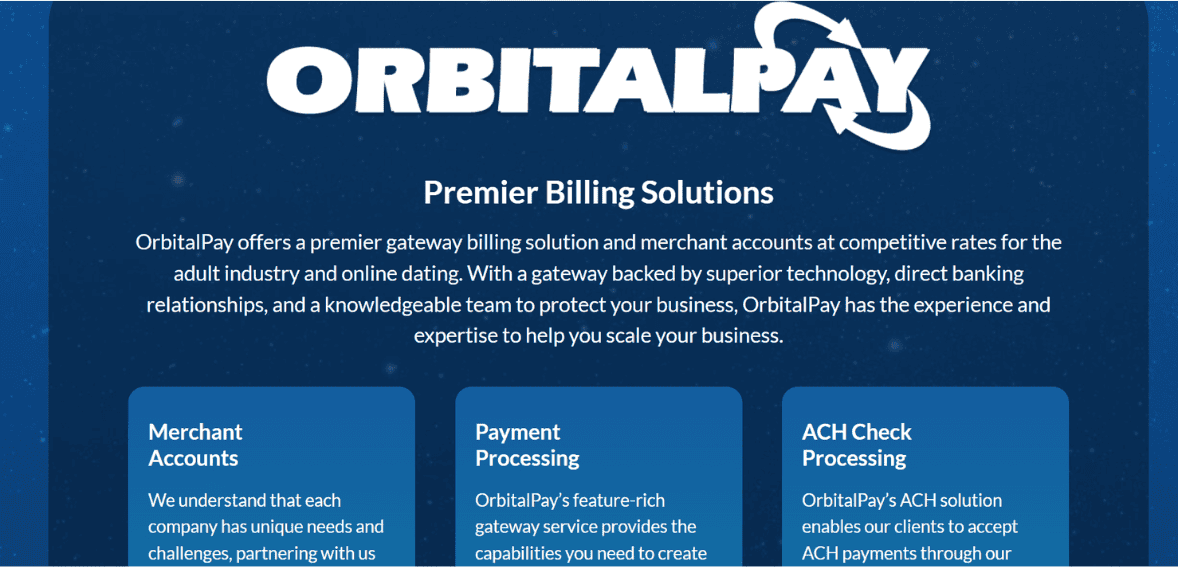
OrbitalPay is an independent payment processing company that has built its market identity around a specific and underserved commercial need: reliable, experienced payment processing for industries that mainstream processors routinely decline. The company has been described as a trusted payments partner for the adult industry and online dating for more than 25 years, placing its founding in the late 1990s at a time when internet-based adult content was first emerging as a commercial market and finding payment processing was already becoming a significant operational challenge for operators in that space. Lets read more about OrbitalPay Review.


Prior to continuing further, however, we must address an important naming issue affecting the research of this business entity. There are two separate entities using the Orbital brand name in the payments industry, and it is important not to confuse these businesses. OrbitalPay (orbitalpay.com) is the independent high-risk payment processor being reviewed in this study, while the Orbital Payment Gateway is a completely different product offered by Chase Paymentech; the payments processing division of JPMorgan Chase Bank.


These two companies are unrelated. It is very common for the search results and the review site lists of the two firms to be mixed up, so merchants conducting their due diligence should ensure they are looking at the right company before forming any conclusions based on any review found.


OrbitalPay’s focus on adult entertainment and online dating makes it unique from other generic high-risk processors reviewed in this series. As opposed to positioning itself as a high-risk processor offering services to a variety of markets, including adult among others, OrbitalPay builds its entire business and product offerings specifically around adult and online dating, gaining unique expertise in this field.

Company Background and Market Position | OrbitalPay Review

OrbitalPay has operated as a payment processing specialist for the adult industry for over 25 years, which places its founding in the late 1990s during the period when the commercial internet was first enabling widespread adult content distribution and when mainstream payment processors were already implementing their first restrictions on the category. Building sustained operations in this sector over that duration requires genuine and specific expertise in the compliance, banking relationships, and operational patterns of the adult industry rather than the general high-risk processing capability that many processors claim.


OrbitalPay has direct banking relationships in place to ensure the best possible rates for your business, and international banking relationships to help with offshore processing. The emphasis on direct banking relationships rather than ISO resale relationships reflects a positioning as a company with genuine acquiring infrastructure rather than one that routes transactions through a standard upstream processor. For adult industry merchants who have experienced the instability of processing arrangements that depend on a mainstream processor’s tolerance for their industry, direct banking relationships provide a more durable foundation for the payment processing relationship.


OrbitalPay has international banking connections for assistance in offshore processing because of the fact that the adult industry merchants do need international acquiring solutions in cases where their domestic banking connections are hard to maintain. The willingness of particular offshore banking regions to provide acquisition services of adult content has traditionally been higher compared to that of the US domestic banking region and an offshore processor can provide its merchants with opportunities that purely domestic processors cannot.


The adult entertainment and dating market served by OrbitalPay is one of the most challenging markets in terms of payment processing: high rates of chargebacks have always been a structural part of the business, rules of the card networks regarding the adult content are highly specific and should be carefully managed, the appetite of banks is lower than that for other industries, and there are legitimate merchants and fraudsters within the merchant base.

Core Payment Processing Capabilities

OrbitalPay accepts payments via multiple credit card types and ACH, with options to pay online, through a virtual terminal, and through recurring billing. The payment method coverage addresses the standard acceptance requirements of online adult and dating businesses, which primarily operate in digital environments where card-not-present and recurring billing transactions dominate the payment mix.


Credit and debit card processing covers the major card networks for card-not-present online transactions. Given the adult industry’s specific relationship with card network rules around content categorization, merchant category codes, and the disclosure requirements associated with adult content processing, the expertise of a specialist processor in managing these network-level requirements is a meaningful operational advantage over a generalist processor that treats adult processing as a standard card-not-present account with unusual content.


ACH processing provides the bank transfer payment option that some customers prefer to card payment, and that carries lower per-transaction costs than card interchange for merchants with sufficient ACH volume. The availability of ACH alongside card processing through a single provider relationship reduces the operational complexity of managing separate ACH and card processing arrangements.


OrbitalPay has an automated clearing house software and device that can process checks online and manually. It can deduct the amount directly from the customer’s account and credit it to the merchant’s account. Manual check processing capability, while less relevant for the primarily digital adult content market, extends the platform’s payment type coverage to the full range of customer payment preferences rather than being limited to card and ACH.


Recurring billing is specifically highlighted as a core capability, which reflects the subscription model that dominates the commercial adult content and online dating industries. Membership sites, subscription video platforms, and premium dating services all depend on automated recurring charge management that reliably processes monthly, weekly, or annual subscription fees without requiring customers to re-authorize each charge.

The OrbitalPay Gateway

The OrbitalPay Gateway enables billing through multiple accounts with just one gateway admin, which is a practically important feature for adult industry operators who may manage multiple merchant accounts across different content types, geographic markets, or brand identities from a single administrative interface rather than logging into separate systems for each account relationship.


OrbitalPay transactions are processed with no lag time, one to two seconds maximum, with real-time reporting and notifications. Transaction speed is a customer experience factor in online subscription checkout flows where a slow payment response creates perceptible friction at the moment of purchase decision, and one to two second authorization response times are consistent with competitive standards for eCommerce payment processing.


OrbitalPay has plug-ins compatible with the most commonly used shopping cart software and an API for incorporation into the shopping cart software. Compatibility with shopping carts is critical for merchants who create subscription and pay per view eCommerce systems within the existing eCommerce frameworks, rather than developing the entire payment system. Availability of plug-ins means that there will be no need to make extra efforts for technical integration of the platform.


A virtual terminal feature enables processing of payments via a web browser in the absence of specific payment equipment. It is necessary for businesses of the adult industry in case of customer service transactions, telephone transactions, or any transaction when the information from the client’s card is manually entered.
OrbitalPay Review

Recurring Billing and Subscription Management

Recurring billing is the commercial backbone of most adult content and online dating businesses, and OrbitalPay’s explicit emphasis on this capability reflects its deep understanding of the industry’s operational requirements. The subscription model, where customers pay a monthly or annual fee for ongoing access to content or platform features, creates a specific set of payment management needs that differ from transaction-by-transaction eCommerce.


Automated charge scheduling eliminates the manual effort of initiating each billing cycle, which at scale across thousands of active subscribers would be operationally impractical without automation. The system manages the charge schedule according to each subscriber’s specific billing date, handles pro-rated charges when subscription timing does not align with calendar month boundaries, and processes renewals automatically without requiring customer action.


Payment failure management is one of the most commercially relevant functions of subscription billing management. In the case of failed subscription payment due to expiring cards, lack of funds, and other issues, a subscription billing system is supposed to retry automatically, update card information in case of replacement cards using the Account Updater system, and notify merchants about repeated payment failures that need customer involvement. How much of this process is automated by OrbitalPay’s subscription billing system and how much requires manual merchant involvement is an important capability issue.


Chargeback management is especially important for recurring billing in the adult industry where the structural chargeback rate is higher compared to typical eCommerce and where account limits on chargebacks from the card networks may cause account termination. The integration of subscription billing management with chargeback prevention tools such as proper billing description policy, ease of cancellation options, and record keeping for possible disputes has a direct impact on the sustainability of merchant relationship with a processor.

Mobile Payment Solutions

OrbitalPay’s mobile solutions are perfect for plumbers, electricians, carpenters, landscape artists, delivery riders, builders, trade shows, and taxi service providers, among others. This mobile payment positioning, describing traditional field service industries, is somewhat incongruous with OrbitalPay’s primary adult industry focus, and likely reflects general payment processor language applied to mobile features rather than a significant actual market segment for OrbitalPay within these traditional field service categories.


More relevant to OrbitalPay’s actual client base is mobile payment processing for adult industry events, conventions, and in-person purchase scenarios that complement the primarily online business models of their merchant customers. The adult entertainment industry includes brick-and-mortar venues, conventions, and live event formats where in-person card acceptance is operationally necessary alongside the dominant online business.


The mobile solution extends card acceptance to these in-person scenarios through smartphone or tablet-based payment acceptance, allowing adult industry merchants to process card payments at their physical or event locations through the same processor relationship that handles their online subscription billing rather than requiring a separate merchant account for in-person transactions.

International Processing and Offshore Banking

OrbitalPay has international banking relationships to help with offshore processing, which is one of the most commercially significant capabilities for adult industry merchants facing domestic banking restrictions. US-based banking institutions have historically applied restrictive policies to adult content merchant accounts, driven by reputational considerations, regulatory scrutiny, and internal risk management frameworks that make domestic acquiring for adult merchants difficult to obtain and maintain.


International and offshore banking relationships provide adult industry merchants with acquiring options that are not subject to the same domestic banking restrictions, allowing them to process transactions through banking jurisdictions where the regulatory and reputational environment is more accommodating to the adult content category. The specific jurisdictions and banking relationships that OrbitalPay has in place are not disclosed publicly, which is standard practice for processors whose international banking arrangements represent proprietary business relationships rather than publicly verifiable claims.


Regarding international processing ability at OrbitalPay, the key questions would be about which specific currencies and countries are processed, which are the available settlement currency choices, and how international bank relations impact the authorization success rate of transactions in comparison to domestic US acquiring. The questions should be directly asked during the sales process and not assumed from generic information about the company’s international bank relations.


Multi-currency processing ability, which is a consequence of the international processing ability, becomes crucial for adult content and dating services as their clients are distributed all over the world. The system that works only for the US audience fails to provide an additional source of revenue by servicing European, Asian, and other international customers.

Fraud Prevention and Risk Management

Fraud prevention is an operational priority for adult industry payment processors that differs in character from standard eCommerce fraud management. The adult industry faces specific fraud patterns including card testing, where fraudsters use adult subscription sites to test stolen card validity before larger fraudulent purchases elsewhere, and friendly fraud, where customers make legitimate purchases and then dispute them on their bank statement to avoid charges they are embarrassed to acknowledge.


The customer profile management function described in reviews of the platform transforms credit card numbers into digital tokens, preventing raw card data from being stored in accessible systems. The tool that analyzes whether the customer is actually the person placing the order based on transaction history addresses account takeover fraud where stolen credentials are used to access subscription accounts. Geolocation shows where the customer is located, and risk scoring evaluates individual transaction risk based on multiple data signals simultaneously.


Address Verification Service and CVV matching provide standard card-not-present fraud prevention tools that catch basic fraud attempts where the fraudster does not have access to the full set of card credentials required to pass both checks. The combination of AVS, CVV, geolocation, transaction history analysis, and risk scoring creates a layered fraud prevention approach that addresses multiple fraud vector types rather than relying on any single check.


For adult industry merchants specifically, the ability to configure fraud rules that reflect the specific risk profile of their business model and customer base is more valuable than generic rule sets optimized for retail eCommerce. A fraud system that flags every international transaction as suspicious would generate excessive false positives for an adult content business with a globally distributed subscriber base, while a system calibrated for the actual risk patterns of that business would protect against genuine fraud without blocking legitimate international customers.

Pricing and Transparency

OrbitalPay does not publish its fees, rates, and pricing. There is no information about any additional transaction fees. There are no reports about any hidden charges. The absence of published pricing is standard for high-risk payment processors and reflects the genuine variability in processing costs based on industry category, chargeback history, processing volume, and the specific banking relationships involved in each merchant account.


For adult industry merchants, processing rates are structurally higher than standard low-risk merchant rates due to the elevated risk premium that acquiring banks charge for this category. The specific markup above interchange varies based on the individual merchant’s chargeback history, the content categories involved, the processing volume, and the specific acquiring bank relationship. Merchants with established track records of low chargebacks and high volume typically negotiate better rates than new entrants with no processing history.


Reserve requirements are standard for adult industry accounts, where processors retain a percentage of processed volume as security against chargeback liability. The specific reserve percentage, reserve cap, and release schedule are commercially significant parameters that affect the merchant’s effective working capital and should be clearly documented in the written merchant agreement before account activation.


Merchants evaluating OrbitalPay should request a complete written fee schedule covering transaction rates for each payment type, monthly platform fees, chargeback fees, reserve requirements, and any fees specific to the international processing capabilities they intend to use. Comparing the all-in effective cost against alternative high-risk processors for the adult industry, including CCBill and Segpay which are the most established specialist alternatives, provides the appropriate competitive context for evaluating OrbitalPay’s commercial terms.

Security and PCI Compliance

Orbital Payment Gateway is PCI Level 1 compliant. Note that this specific reference is to Chase Paymentech’s Orbital product rather than to OrbitalPay, the independent processor that is this review’s subject. For OrbitalPay specifically, PCI DSS compliance is a prerequisite for any processor handling cardholder data commercially, and the company’s description of its security infrastructure references tokenization of card numbers and standard security protocols.


For adult industry merchants, the security of stored cardholder data has specific sensitivity beyond the standard PCI compliance obligation. Adult content subscription databases contain information that customers have a particularly strong privacy interest in protecting, and a data breach that exposed the identity of adult content subscribers would have reputational consequences for affected individuals that differ in character from, for example, the exposure of a retail transaction record. The security infrastructure protecting cardholder data within OrbitalPay’s systems has the same formal PCI compliance requirements as any other processor, but the stakes of a security failure are heightened by the nature of the merchant category.


Merchants should ask specifically about the security measures protecting not only cardholder data but also the broader merchant account credentials and customer subscription records, since the full scope of data security relevant to an adult content subscriber relationship extends beyond the payment card data specifically.
OrbitalPay Review

Strengths, Limitations, and Who It Is Best For

OrbitalPay’s genuine strengths are concentrated in the specific area of its market focus. Over 25 years of operational experience in adult and online dating payment processing represents genuine expertise in the compliance requirements, chargeback patterns, banking relationships, and operational dynamics of these industries that a generalist processor beginning to serve the category cannot replicate. The direct banking relationships that underpin the processing capability, the international banking options for offshore processing, the subscription billing specialization that reflects how these businesses actually collect revenue, and the fraud prevention tools calibrated for adult industry risk patterns all reflect genuine investment in the operational reality of the merchant base OrbitalPay serves.


The limitations are primarily those inherent to any specialist high-risk processor. Pricing requires direct engagement and will reflect the elevated risk premium of the adult category. Reserve requirements lock up working capital. The absence of published pricing and terms requires careful contract review before signing. The platform’s depth outside its core adult and dating specialization is not established in the available independent review record.


The naming confusion with Chase Paymentech’s Orbital Payment Gateway is a practical nuisance for merchants conducting research rather than a substantive concern, but it underscores the importance of confirming specifically which entity is being evaluated before drawing conclusions from any review source.


OrbitalPay is best suited for adult content operators, online dating platforms, webcam and live streaming businesses, and similar digital entertainment businesses that need an experienced processing partner with genuine adult industry expertise, stable banking relationships, and subscription billing infrastructure optimized for the recurring revenue models that dominate these categories. Merchants in standard industries or high-risk categories outside the adult space would find more appropriate alternatives among the other processors reviewed in this series.

FAQs

Q1. Is OrbitalPay the same as Chase Paymentech’s Orbital Payment Gateway, and why do they appear together in search results?


These are two completely separate companies with no affiliation. OrbitalPay, accessible at orbitalpay.com, is an independent payment processor that has specialized in adult entertainment and online dating payment processing for over 25 years. Orbital Payment Gateway is a proprietary payment gateway product developed and operated by Chase Paymentech, the payment processing division of JPMorgan Chase Bank, and is available exclusively to merchants who have Chase Paymentech merchant accounts. 


The similarity in name has caused the two entities to appear together in search engine results and on payment review aggregation sites, which creates genuine confusion for merchants researching either company. When conducting due diligence on either company, verify the corporate entity, the website domain, the ownership structure, and the target market described in any review before attributing the review’s content to the correct company. Chase’s Orbital gateway is a mainstream, large-institution product available to standard merchants. OrbitalPay is a specialist high-risk processor focused on adult and dating industries.


Q2. What makes OrbitalPay specifically suited to the adult industry compared to general high-risk processors?


Over 25 years of operation exclusively within the adult and online dating sectors has given OrbitalPay operational expertise in the specific payment challenges of these industries that general high-risk processors cannot match. This includes knowledge of the card network rules that specifically apply to adult content merchant category codes, banking relationships with acquiring institutions that have established appetite for adult industry accounts rather than tolerating them reluctantly, familiarity with the chargeback patterns that characterize adult subscriptions including the friendly fraud and embarrassment-driven dispute patterns that differ from standard eCommerce fraud, and subscription billing infrastructure specifically designed for the membership and recurring access model that most adult and dating platforms use. 


General high-risk processors that serve dozens of restricted categories may be willing to open an adult merchant account but lack the deep institutional knowledge of how to manage that account type effectively over time, which can result in account instability, insufficient chargeback management support, and eventually account termination from processors whose risk models were not calibrated for the adult industry’s specific profile.


Q3. What should an adult content merchant ask OrbitalPay before signing a merchant agreement?


Before signing any merchant agreement with OrbitalPay or any other adult industry processor, merchants should request and review several specific items. First, the complete written merchant agreement including contract length, automatic renewal provisions, and early termination fee if any. Second, a complete and itemized fee schedule covering the transaction rate for each payment type, any monthly platform or service fees, chargeback fees, and reserve requirements including the reserve percentage, total reserve cap, and the specific timeline and conditions for reserve release. Third, the specific acquiring bank or banks that will process their transactions, since the stability of the banking relationship directly affects the stability of the merchant account. 


Fourth, the international processing capabilities applicable to their specific account, including which currencies and countries are supported, what the settlement options are, and whether offshore banking is required for their content category. Fifth, the specific billing descriptor that will appear on their customers’ credit card statements, since adult content billing descriptors affect both customer recognition and chargeback rates. Sixth, the chargeback management support available from OrbitalPay including any tools for monitoring chargeback rates, assistance with chargeback representment, and notification processes when chargeback rates approach card network thresholds.


OpenEdge Review

OpenEdge is a payment processing platform designed to help businesses accept, manage, and secure electronic payments across multiple channels. Rather than functioning as a standalone point-of-sale system, it serves as a payment technology solution that integrates with business management software used in industries such as healthcare, dental care, veterinary practices, specialty retail, automotive services, education, and professional services. Lets read more about OpenEdge Review.


One of OpenEdge’s defining characteristics is its emphasis on integrated payments. Instead of requiring businesses to use separate systems for payment processing and day-to-day operations, the platform connects directly with compatible practice management, enterprise resource planning (ERP), and business management software. This approach allows payment information to flow automatically between systems, reducing manual data entry while helping maintain more accurate financial records.


The platform supports a wide range of payment methods, including credit cards, debit cards, contactless payments, and digital wallet transactions where supported. Businesses can also process recurring payments, card-on-file transactions, online payments, and in-person payments depending on their software integration and service package.


Security is another major focus of OpenEdge. Features such as tokenization, encryption, and PCI compliance tools are intended to help businesses protect customer payment information while reducing the burden of handling sensitive card data internally.


OpenEdge is primarily aimed at organizations that process payments regularly and want those transactions to become part of their broader operational workflow. Instead of simply acting as a payment gateway, the platform seeks to integrate payment acceptance with scheduling, billing, customer management, and financial reporting. For businesses already using compatible software solutions, this integrated approach may improve operational efficiency by minimizing duplicate work and simplifying payment management across different departments.

Key Features of OpenEdge | OpenEdge Review

OpenEdge offers a collection of payment processing tools that extend beyond basic card acceptance. Its primary strength lies in combining payment technology with software integrations that support everyday business operations.

One of the platform’s most important features is integrated payment processing. Rather than requiring employees to manually enter payment information into separate accounting or management systems, OpenEdge synchronizes payment data with compatible software. This can reduce administrative work while helping minimize errors caused by duplicate data entry.


The platform supports multiple payment channels, allowing businesses to accept in-person, online, mobile, and recurring payments depending on their implementation. Card-present and card-not-present transactions are both supported, giving organizations flexibility in how they serve customers.


OpenEdge also includes secure payment storage through tokenization. Instead of storing sensitive card numbers directly, payment information is replaced with secure tokens that can be used for future transactions such as recurring billing or stored payment methods. This can simplify repeat payments while improving overall security.


Reporting tools provide transaction histories, payment summaries, settlement information, and reconciliation support. These reports can help businesses monitor payment activity and identify discrepancies more efficiently.


Security features such as point-to-point encryption (P2PE), PCI compliance assistance, and fraud reduction tools are integrated into the platform. These capabilities are particularly valuable for organizations that process a high volume of transactions or operate in industries with strict regulatory requirements.


Depending on the business software being used, OpenEdge may also support electronic invoicing, payment links, customer payment portals, automated receipts, recurring billing schedules, and integrated financing options. However, not every feature is available with every software integration, so the overall experience may vary based on the specific business application connected to the platform.


Overall, OpenEdge’s feature set focuses less on offering numerous standalone tools and more on creating a payment ecosystem that works alongside existing business software.

Getting Started with OpenEdge

The onboarding experience with OpenEdge differs from many consumer-focused payment platforms because it is generally implemented through software vendors or authorized partners rather than being set up entirely through self-service registration.


Businesses typically begin by selecting OpenEdge through a compatible software provider or by working directly with an implementation specialist. During setup, payment processing is configured to work alongside the organization’s existing business management software, ensuring that payment information can be synchronized correctly.


Compared with simpler payment processors that can be activated within minutes, OpenEdge may require additional planning. Businesses often need to configure payment terminals, establish merchant accounts, verify banking information, and complete PCI compliance requirements before processing live transactions.


While this implementation process may take longer, it often results in a more customized setup that aligns with the organization’s operational workflow. Businesses with multiple locations, specialized billing procedures, or industry-specific software may benefit from the additional configuration options available during onboarding.


Training requirements also vary depending on the complexity of the business. Employees who primarily process customer payments generally face a relatively short learning curve, while administrators responsible for reporting, reconciliation, or payment management may require more detailed training.


One advantage of OpenEdge’s integrated approach is that staff members can often continue working within software they already know instead of switching between multiple independent systems throughout the day. This familiarity may reduce long-term training requirements even if the initial implementation takes longer.


Overall, getting started with OpenEdge involves more preparation than many entry-level payment processors. However, organizations seeking a tightly integrated payment environment may find that the additional setup effort contributes to smoother day-to-day operations once the system is fully configured.

User Interface and Overall Experience

The overall user experience of OpenEdge depends significantly on the business software it is integrated with. Since the platform functions primarily as an embedded payment solution, users often interact with payment features through their existing management software rather than through a separate OpenEdge application.


For many businesses, this integrated approach creates a more streamlined workflow. Employees can process payments while viewing customer records, appointments, invoices, or orders without switching between multiple systems. This can save time during busy periods and reduce opportunities for manual errors.


The payment interface itself is generally straightforward, with clear prompts for processing transactions, refunds, voids, and payment confirmations. Most routine payment tasks require only a few steps, making them relatively easy for front-office staff or customer service teams to learn.


Administrative functions such as settlement reports, payment history, transaction searches, and reconciliation tools may involve additional menus depending on the specific implementation. Organizations with higher transaction volumes may appreciate the ability to search historical payments and review detailed transaction records efficiently.


One potential limitation is that user experience is not entirely consistent across every software integration. Since OpenEdge works with numerous third-party business applications, interface design and workflow can differ depending on which software a business uses. Some integrations may offer deeper functionality and smoother navigation than others.


Overall, the platform prioritizes operational efficiency over visual design. Businesses looking for highly customizable dashboards or modern consumer-style interfaces may find certain areas relatively functional rather than visually polished. However, organizations focused on reliable payment workflows are likely to value the practical design and seamless integration more than appearance alone.

Payment Processing Performance

Reliable payment processing is one of the most important aspects of any payment platform, and OpenEdge is designed to provide consistent transaction handling across multiple payment environments.


The platform supports a variety of payment methods, including major credit cards, debit cards, EMV chip cards, contactless payments, and digital wallets where supported by compatible hardware and software. Businesses can also process recurring payments, card-on-file transactions, and online payments depending on their service configuration.


Transaction authorization generally occurs quickly under normal network conditions, allowing customers to complete purchases without significant delays. Integrated payment processing also enables transaction information to update customer accounts automatically, reducing the need for manual reconciliation after payments are completed.


Another advantage is payment consistency across different channels. Businesses that accept both in-person and remote payments can often manage those transactions within a unified payment environment rather than maintaining separate systems.


Settlement timelines vary according to merchant agreements, banking institutions, and processing schedules. Like most payment processors, OpenEdge follows standard settlement procedures rather than offering universal same-day funding for every business.


Refund processing, voids, partial payments, recurring billing, and stored payment methods are supported through compatible software integrations, giving businesses flexibility when managing customer accounts.


Performance ultimately depends on stable internet connectivity, compatible hardware, and proper software integration. Businesses using outdated systems or unsupported software may not experience the same level of efficiency as organizations with fully optimized implementations.


Overall, OpenEdge delivers dependable payment processing that emphasizes integration and workflow automation rather than simply acting as a standalone card processor.

Reporting and Business Insights

OpenEdge includes reporting and transaction management tools that help businesses monitor payment activity without relying entirely on separate accounting systems. Rather than offering advanced business intelligence software, the platform focuses on providing payment-related data that supports financial reconciliation and operational decision-making.


Users can typically access transaction histories, settlement reports, batch summaries, refunds, voids, and payment status information through their integrated software or OpenEdge reporting interface. Having this information centralized makes it easier to verify payments, investigate discrepancies, and reconcile daily transactions with bank deposits.


For businesses handling large transaction volumes, searchable payment records can save considerable administrative time. Staff can locate individual payments using customer names, transaction dates, invoice numbers, or payment amounts, depending on the software integration. This can be particularly useful when responding to customer inquiries or resolving payment disputes.


Another practical benefit is automated synchronization between payment data and compatible business management software. Since payment information is transferred directly into the system, organizations may spend less time manually updating invoices or financial records. This can improve reporting accuracy while reducing administrative overhead.


The depth of reporting, however, largely depends on the third-party software integrated with OpenEdge. Some business applications provide comprehensive financial dashboards and custom reporting, while others offer only standard payment summaries. Companies seeking highly advanced analytics, predictive insights, or visual business intelligence dashboards may still require dedicated reporting platforms alongside OpenEdge.


Overall, OpenEdge provides reliable payment reporting that supports day-to-day financial management. While it is not designed to replace enterprise analytics software, its reporting capabilities are generally sufficient for monitoring transactions, improving reconciliation, and maintaining accurate payment records within an integrated business environment.

Customer Support and Service Quality

Customer support plays an important role in any payment processing platform, particularly because payment issues can directly affect business operations and customer satisfaction. OpenEdge provides support through a combination of direct assistance, implementation partners, and software vendors, although the exact experience may vary depending on how a business purchases the service.


Many businesses first receive support from the software provider that integrates OpenEdge into their practice management or business system. Since these vendors understand both the software and the payment workflow, they are often well positioned to troubleshoot integration-related issues. More technical payment processing concerns may then be escalated to OpenEdge when necessary.


Support channels generally include phone assistance, online resources, documentation, and customer service representatives. Businesses may also have access to onboarding assistance during implementation, helping staff configure payment terminals, complete merchant setup, and understand system functionality.


Documentation and training materials can help users become familiar with payment processing features, security requirements, and transaction management. Organizations implementing OpenEdge across multiple locations may particularly benefit from structured onboarding resources.


One consideration is that support experiences can differ based on the reseller, software vendor, or implementation partner involved. While some businesses report responsive service, others may experience additional steps before reaching the appropriate technical team because multiple organizations are involved in the support process.


As with many enterprise-oriented platforms, OpenEdge’s support model is designed around long-term business relationships rather than quick self-service solutions. Businesses that value personalized implementation assistance may appreciate this approach, while organizations expecting immediate direct support for every issue should understand how responsibilities are shared between OpenEdge and their software provider before making a decision.

OpenEdge Review

Pricing and Overall Value

OpenEdge does not publicly publish standardized pricing for all businesses, making it more difficult to compare costs directly with many modern payment processors that advertise flat-rate transaction fees online. Instead, pricing is generally customized based on factors such as business size, industry, transaction volume, payment methods, software integrations, and merchant requirements.


Businesses typically receive a tailored quote after discussing their processing needs with an authorized representative or software partner. This customized pricing model can benefit organizations with specialized requirements, although it also means potential customers may need to spend additional time evaluating proposals before making a decision.


Beyond transaction fees, businesses should consider other potential costs associated with payment processing. Depending on the agreement, expenses may include payment terminals, implementation services, merchant account setup, monthly service fees, PCI compliance programs, or hardware maintenance. Since these costs vary between merchants and software providers, reviewing the complete pricing structure before signing a contract is important.


The overall value of OpenEdge depends less on obtaining the lowest processing rate and more on the operational efficiencies created through software integration. Businesses that eliminate manual payment entry, reduce reconciliation work, and automate recurring billing may recover part of their investment through improved productivity rather than transaction savings alone.


For smaller businesses with simple payment requirements, lower-cost payment processors offering transparent flat-rate pricing may provide a more straightforward solution. Conversely, organizations with complex workflows, industry-specific software, or high transaction volumes may find greater value in OpenEdge’s integrated approach despite potentially higher implementation costs.


Ultimately, evaluating OpenEdge requires looking beyond processing fees alone. Considering workflow improvements, administrative savings, security features, and integration capabilities provides a more balanced picture of its overall return on investment.

Pros and Cons of OpenEdge

Like most payment processing platforms, OpenEdge offers several notable strengths while also presenting limitations that prospective users should consider before making a decision.


One of its biggest advantages is integrated payment processing. By connecting directly with compatible business management software, OpenEdge helps reduce duplicate data entry and allows payment information to flow automatically into customer accounts, invoices, and financial records. This integration can improve efficiency and reduce administrative errors for organizations that process payments frequently.


Security is another strong point. Features such as tokenization, point-to-point encryption, and PCI compliance support demonstrate a clear focus on protecting sensitive payment information. Businesses operating in regulated industries may particularly appreciate these capabilities.


The platform also supports multiple payment methods, recurring billing, stored payment credentials, and transaction reporting, allowing businesses to manage payments across different channels within a unified system.


However, OpenEdge is not without drawbacks. Pricing transparency is limited because businesses generally need to request customized quotes instead of reviewing publicly available rates. This can make comparisons with competing payment processors more challenging.


The implementation process may also require more time than simpler payment solutions, especially for organizations integrating multiple software systems or locations. Smaller businesses seeking quick setup and minimal configuration may find the onboarding process more involved than expected.


Additionally, the overall user experience depends heavily on the third-party software being used. Since OpenEdge functions primarily as an integrated payment platform, interface quality and available features can vary between software vendors.


Overall, OpenEdge is best viewed as a specialized integrated payment solution rather than a universal payment processor. Businesses that value automation and software integration are likely to benefit most, while those seeking basic standalone payment acceptance may find simpler alternatives better suited to their needs.

Who Should Use OpenEdge?

OpenEdge is designed primarily for businesses that want payment processing to become a seamless part of their existing operational workflow rather than functioning as an independent system. Organizations already using compatible business management software are generally the strongest candidates for the platform.


Healthcare providers, dental practices, veterinary clinics, specialty retailers, automotive service businesses, educational institutions, and professional service firms often process payments alongside appointments, invoices, customer records, or recurring billing. In these environments, integrated payment processing can reduce administrative work by automatically linking transactions with existing customer information.


Businesses handling recurring payments or storing customer payment credentials may also benefit from OpenEdge’s tokenization and security features. Automated payment workflows can improve convenience for both staff and customers while supporting stronger payment data protection.


Larger organizations or businesses operating multiple locations may find value in centralized payment reporting, standardized security practices, and integration with enterprise software. These capabilities can help maintain consistent payment processes across different offices or branches.


On the other hand, OpenEdge may not be the ideal choice for every business. Small merchants with straightforward payment needs, limited transaction volumes, or no requirement for software integration may find less expensive payment processors easier to implement and manage. Companies that primarily sell online may also prefer eCommerce-focused payment platforms offering built-in shopping cart tools and developer-friendly customization.


Ultimately, OpenEdge is best suited for organizations seeking long-term operational efficiency through integrated payments rather than businesses simply looking for a basic credit card processing solution. Evaluating existing software systems, payment workflows, and administrative requirements is essential when determining whether the platform is the right fit.

How OpenEdge Compares to Other Payment Processing Solutions

OpenEdge competes in a different segment of the payment processing market than many well-known providers such as Stripe, Square, or PayPal. While those platforms often emphasize quick account setup, online payment acceptance, and developer-friendly tools, OpenEdge focuses on deep integration with business management software used in industry-specific environments.


One of OpenEdge’s primary advantages is workflow integration. Businesses can process payments directly within their existing practice management or operational software, reducing the need to switch between multiple applications. This level of integration can significantly improve efficiency for organizations where payments are closely connected to appointments, invoices, or customer records.


In contrast, many standalone payment processors prioritize flexibility and rapid deployment. They often provide transparent pricing, online account creation, and extensive support for eCommerce businesses or small merchants that do not require complex software integrations.


From a security perspective, OpenEdge offers enterprise-grade features such as tokenization, point-to-point encryption, and PCI compliance support that compare well with many established payment providers. However, security capabilities across major payment processors have become increasingly sophisticated, making this less of a unique differentiator than workflow integration.


Pricing comparisons are more difficult because OpenEdge generally provides customized quotes rather than publicly listing standardized processing rates. Businesses considering multiple providers should evaluate total implementation costs, ongoing service fees, integration benefits, and operational savings instead of comparing transaction fees alone.


The right choice ultimately depends on business requirements. Organizations seeking integrated payment workflows within specialized business software may find OpenEdge more suitable, while businesses prioritizing simplicity, rapid deployment, or extensive online commerce features may be better served by alternative payment platforms.

Final Verdict

OpenEdge is best understood as an integrated payment technology platform rather than a conventional standalone payment processor. Its greatest strength lies in connecting payment acceptance with everyday business operations, allowing organizations to process transactions within the software they already use to manage customers, appointments, billing, and financial records.


Throughout this review, the platform demonstrates several clear advantages. Integrated workflows help reduce manual data entry, security features align with modern payment protection standards, and support for multiple payment methods gives businesses flexibility in how they accept customer payments. These capabilities can contribute to greater operational efficiency, particularly for organizations processing large numbers of transactions every day.


At the same time, OpenEdge is not the right fit for every business. The implementation process is generally more involved than that of many modern payment processors, pricing is not fully transparent without requesting a quote, and overall user experience depends significantly on the third-party software with which it is integrated. Businesses seeking a simple plug-and-play payment solution may find alternative providers easier to evaluate and deploy.


For organizations already using compatible business management software, however, OpenEdge offers a compelling value proposition. The operational benefits created through automation, integrated reporting, and streamlined payment workflows may outweigh the additional setup effort and customized pricing model.


Overall, OpenEdge earns positive marks as a specialized payment platform built for integrated business environments rather than for universal payment processing. Businesses considering the platform should evaluate how well it fits their existing software ecosystem, operational needs, and long-term growth plans before making a final decision.

Frequently Asked Questions

What types of businesses commonly use OpenEdge?

OpenEdge is widely used by businesses that rely on integrated payment processing, including healthcare providers, dental practices, veterinary clinics, specialty retailers, automotive service businesses, educational organizations, and professional service firms. It is particularly beneficial for businesses that want payment information to flow directly into their existing management software.

Does OpenEdge support recurring and stored payments?

Yes. Depending on the software integration and merchant setup, OpenEdge supports recurring billing, card-on-file transactions, and secure tokenization. These features allow businesses to process repeat payments while reducing the need to store sensitive card information directly.

Is OpenEdge suitable for small businesses?

It can be, but suitability depends on business needs. Small businesses that require integrated payment processing with compatible software may benefit from OpenEdge. However, merchants looking for simple payment acceptance with minimal setup and transparent flat-rate pricing may find other payment processors more appropriate.

OmniFund Review

OmniFund Review

OmniFund is a payment processing and accounts receivable automation platform that has served B2B and B2C businesses since 2005. Operating under GTB, which stands for GotoBilling, and headquartered in the United States, OmniFund has built its market identity around a specific operational problem: helping businesses of all sizes streamline their accounts receivable and accounts payable operations by combining payment acceptance, electronic invoicing, e-statements, and accounting software integration into a single platform. The company’s tagline, Payments as a Platform, reflects a positioning that goes beyond pure transaction processing toward comprehensive AR workflow automation. Lets read more about OmniFund Review.


Before proceeding with any substantive evaluation, it is necessary to clarify a naming confusion that affects online research for this company. There are two entirely separate businesses using the OmniFund name. The first, which is the subject of this review, is the B2B payment processing and AR automation platform operating under GTB and accessible at gotobilling.com and omnifund.com, serving businesses including clinics, nonprofits, retail shops, and professional services companies.


The second is a completely unrelated algorithmic trading and portfolio management platform that also uses the OmniFund name, with a tier-based subscription structure serving individual investors. These two companies have no relationship with each other. Any merchant conducting research should verify that the OmniFund they are evaluating is the payment processing platform rather than the investment technology service.


OmniFund the payment processor serves organizations ranging from small startups to Fortune 500 companies and explicitly targets mid-size businesses, small businesses, enterprise clients, freelancers, nonprofits, government entities, and startups. Specific sectors represented in its user base include healthcare practices, nonprofit organizations, retail businesses, and professional services firms.

Company Background and Market Position | OmniFund Review

OmniFund has operated under the GTB corporate umbrella since its founding in 2005, positioning itself as an industry leader in secure payment technology for businesses of any size. The company’s longevity, spanning two decades without the major ownership changes or acquisitions that have reshaped many competing processors, is itself a form of market credibility. Staying relevant and serving a growing client base across twenty years in the payment processing industry requires genuine product maintenance and customer satisfaction that one-time successes or marketing-driven acquisition cannot sustain.


The Payments as a Platform branding reflects OmniFund’s competitive differentiation from pure payment gateways that handle transaction processing without addressing the broader workflow context in which those transactions occur. For businesses where payment processing is one step in a larger AR management cycle that includes invoice generation, statement delivery, customer communication, and accounting reconciliation, a platform that handles all of these steps through a single integrated system reduces the number of vendor relationships, data transfers, and manual reconciliation steps required compared to managing each function through separate tools.


OmniFund serves clients in diverse sectors with notably different payment workflow requirements. Healthcare practices managing patient billing and recurring payments have different operational needs than nonprofit organizations managing fundraising and event ticket sales, which differ again from B2B professional services companies managing corporate accounts payable relationships. The fact that OmniFund’s review base includes all of these sectors suggests the platform has built sufficient flexibility to serve meaningfully different payment workflows rather than optimizing narrowly for a single industry.


The company’s support site at support.gotobilling.com and the GTB branding that appears in company responses to user reviews indicates that the GTB corporate entity is the operating structure behind the OmniFund brand, and businesses researching the company should be aware that GTB and OmniFund refer to the same organization.

Core Payment Processing Capabilities

OmniFund provides payment processing across credit cards, debit cards, ACH electronic checks, and eChecks, covering the primary payment types that B2B and B2C businesses typically need to accept from their customers. The platform processes all major credit card networks, giving merchants broad coverage for the card types their customers carry.


ACH processing is a particularly important capability for OmniFund’s target market. B2B payments, recurring subscription billing, and higher-value transactions where the lower per-transaction cost of ACH is commercially meaningful relative to card interchange fees all benefit from reliable ACH infrastructure. OmniFund’s explicit emphasis on ACH alongside card processing reflects an understanding of the payment mix that its target business customers actually use rather than treating ACH as a secondary afterthought to card acceptance.


Recurring payment automation is one of the platform’s most clearly marketed capabilities, designed for businesses managing regular billing cycles for subscriptions, memberships, installment plans, or any relationship where the same customer is charged on a schedule. Automated recurring payments reduce the manual effort involved in managing regular billing and decrease the late payment risk that manual collection creates, which are commercially meaningful benefits for businesses where predictable cash flow is a management priority.


The platform supports online bill payment through a customer-facing portal, allowing customers to view and pay their balances digitally rather than mailing checks or calling in card details. For businesses that still receive a significant portion of payments by check or phone, the customer portal provides a self-service digital alternative that reduces administrative processing costs while giving customers a more convenient payment experience.


Mobile payment capability extends the platform’s reach to in-person and field-based payment scenarios, and the text-to-pay feature allows businesses to send payment links directly to customers’ mobile phones, enabling payment completion from the customer’s own device without requiring them to navigate to a website or open a separate application.

Level II and Level III B2B Processing

Level II and Level III processing capability is one of OmniFund’s specific technical differentiators that is particularly relevant for its B2B client base. As covered in earlier reviews in this series, Level II and Level III processing capture enhanced transaction data for corporate and government purchasing card transactions, qualifying those transactions for lower interchange rates than standard Level I processing.


Level II processing adds customer codes, tax amounts, and tax identification data. Level III processing adds complete line-item detail including product codes, quantities, unit prices, and item descriptions. For B2B merchants whose customers regularly use purchasing cards to pay invoices, the interchange rate differential between Level I and Level III processing can exceed one percentage point, generating meaningful monthly savings at any significant B2B transaction volume.


OmniFund’s explicit marketing of Level II and Level III processing reflects an understanding of its B2B client base’s payment environment. Standard consumer-focused payment processors often do not support Level III processing or require additional configuration and cost to access it. Making Level III available as part of the standard platform for B2B clients who need it positions OmniFund favorably for this specific segment relative to more consumer-centric alternatives.


For healthcare practices and professional services firms that bill insurance companies, corporate entities, or government clients who pay through purchasing cards, the Level III capability can generate cost savings that materially offset the platform subscription cost. Businesses in these segments should specifically model their corporate and government card volume against the interchange rate differential available through Level III relative to their current processing costs.

Electronic Invoicing and Statement Delivery

The electronic invoicing and statement delivery capabilities are central to OmniFund’s AR automation positioning and represent one of the platform’s most consistently praised features in user reviews. The ability to generate and deliver invoices and statements electronically, with embedded payment links that allow customers to pay directly from the invoice or statement, addresses the specific inefficiency of the traditional invoice-mail-check cycle that many B2B businesses still manage.


Automated statement delivery with an embedded payment portal removes multiple manual steps from the standard accounts receivable process. Rather than printing statements, mailing them, waiting for customers to write and mail checks, and then manually recording and reconciling received payments, the automated workflow generates the statement, delivers it electronically, captures payment when the customer clicks through, and records the payment against the correct invoice automatically.


The reduction in manual reconciliation effort is the most quantifiable operational benefit, and it is specifically cited in independent reviews as a daily time saving for finance teams. When payment data flows automatically from OmniFund into the connected accounting software rather than requiring staff to re-enter payment information from bank deposits or checks, the time previously spent on data entry becomes available for higher-value financial management activities.


Customer self-service through the payment portal gives customers the ability to pay on their schedule, which often accelerates payment timing relative to the mailed statement process where customers must actively initiate payment through a different channel. When payment requires minimal effort from the customer, the number of customers who pay promptly tends to increase.

QuickBooks and Accounting Software Integration

QuickBooks integration is one of OmniFund’s most frequently mentioned features in user reviews and marketing materials, and it reflects the accounting software reality of its target market. QuickBooks, in its Desktop and Online versions, is the dominant accounting software platform for small and medium-sized businesses in the United States, and a payment processor that does not integrate with QuickBooks creates a manual data entry requirement for a large portion of its potential customer base.


OmniFund provides QuickBooks Plugins for QuickBooks Desktop Enterprise and Pro, covering the versions that many established businesses use for their accounting. The Sync to QuickBooks feature connects payment data to the accounting record automatically, so transactions processed through OmniFund appear in QuickBooks without requiring manual entry. The support for QuickBooks Desktop back to version 2004, noted in product listings, reflects a commitment to serving businesses that use older versions of the software rather than forcing upgrades as a condition of integration.


For businesses that run their accounting in QuickBooks and want payment processing that flows seamlessly into their existing records, this integration is often the primary selection criterion. A payment processor that requires manual data transfer between the payment system and QuickBooks creates daily reconciliation work that compounds in cost and error risk over time, and eliminating that manual step through a direct integration is a recurring operational benefit that justifies preference for integrated solutions over potentially cheaper standalone processors.


The ability to process credit cards natively within QuickBooks through the OmniFund integration, rather than processing in OmniFund and separately recording the transaction in QuickBooks, represents the tightest integration point that the platform offers for QuickBooks users.

EMV, Mobile, and In-Person Payment Capabilities

OmniFund extends beyond electronic billing and online payment acceptance to cover in-person card acceptance through EMV technology support, giving businesses with physical transaction environments the same integrated AR platform for their in-person sales as for their online and invoice-based billing.


EMV chip card acceptance provides the fraud liability protection associated with chip-authenticated transactions, which has been the standard expectation for in-person card acceptance since the October 2015 liability shift. The compatibility with EMV-enabled hardware allows merchants to process in-person transactions through the same OmniFund platform that handles their electronic invoicing and online payments, maintaining consistent transaction records and reporting across all payment channels.


Mobile payment capability allows merchants to process transactions through mobile devices, which is useful for field service businesses, healthcare providers collecting co-pays at the point of care, event-based businesses, and any operation where payment collection occurs outside a fixed office or retail environment. The combination of mobile acceptance with the electronic invoicing and QuickBooks sync capabilities means that a mobile transaction flows into the same AR system as an electronic invoice payment, maintaining reporting consistency across payment channels.


Text-to-pay functionality allows businesses to send payment links directly to customers via text message, providing a payment option that reaches customers where they are rather than requiring them to visit a website or check email. For businesses with customer bases that are more responsive to text than email, or for urgent payment collection scenarios, text-to-pay provides a direct and frictionless payment path.

Security and PCI Compliance

OmniFund positions security as a primary value proposition, describing itself as providing world class security for sensitive consumer data and noting that clients enjoy reduced data security liability. The platform is PCI compliant, meeting the Payment Card Industry Data Security Standards required for entities handling cardholder data, and the data security liability reduction for clients reflects the standard benefit of using a PCI-certified processor where cardholder data is handled within the processor’s certified environment rather than the merchant’s own systems.


Point-to-point encryption protects cardholder data from the moment of capture through processing, ensuring that card details are never transmitted in plain text across the communication chain. Tokenization replaces sensitive card data with non-sensitive tokens for storage and recurring transaction use, which is particularly important for OmniFund’s recurring billing use case where customer payment details are stored for automated future charges.


Fraud detection and prevention features are included in the platform at no additional charge, which the platform specifically highlights as a differentiator from processors that charge separately for fraud protection tools. The inclusion of baseline fraud prevention without extra fees is a meaningful commercial benefit for smaller businesses that might otherwise forego paid fraud tools to manage costs.


The direct connection to payment networks cited in OmniFund’s marketing materials refers to the acquiring relationships that allow the platform to process transactions without requiring an intermediate gateway, which can improve processing speed and reduce the number of entities that handle transaction data in transit.

OmniFund Review

Reporting, Analytics, and Dashboard Functionality

OmniFund provides transaction reporting and analytics through its merchant dashboard, covering the standard financial oversight needs of businesses managing AR operations. Transaction summaries, payment history by customer, and reporting across payment channels are accessible through the dashboard interface, which users consistently describe as clear and easy to navigate.


The dashboard design receives specific positive mentions in independent reviews for its clarity and the absence of repetitive data entry requirements, which reflects a user experience orientation appropriate for the finance staff and business owners who use it daily rather than a developer-focused interface that prioritizes technical capability over usability. When the dashboard delivers clear transaction summaries without requiring users to re-enter or reorganize data, the daily administrative burden of payment management is reduced.


Decline management reporting is specifically cited in independent reviews as a useful feature, with one reviewer noting that OmniFund provides useful information in instances where a payment is declined, allowing their system to respond appropriately by either representing the declined payment or informing the customer. For businesses managing recurring payments at scale, having clear visibility into declined transaction details is essential for maintaining collection rates without creating friction for customers whose cards have expired or been replaced.


The integration between OmniFund’s reporting and the QuickBooks accounting sync means that reports generated within OmniFund reflect the same data that appears in the accounting system rather than requiring reconciliation between two separate views of the same transaction history.

Customer Support and User Experience

Customer support at OmniFund receives consistently positive feedback across the independent review record, which is notably more uniform than the mixed support experiences documented for many of the larger processors reviewed in this series. Multiple reviewers specifically describe support as responsive and note that the team reacts to user feedback and implements solutions quickly, which reflects a service culture more typical of owner-operated or smaller businesses than of large enterprise software companies.


The ease of use assessment is the most consistent positive across all review sources. Users describe the platform as simple to navigate and fast to process transactions, requiring no user guide to get started. This ease-of-use assessment from actual users is a meaningful operational indicator, particularly for businesses where the staff processing payments are not dedicated payment technology specialists and need an interface that is straightforward enough to learn and use without extensive training.


The session timeout complaint, noted as the most consistent minor criticism in the review record, describes the platform logging users out after a relatively short period of inactivity, which creates minor friction in workflows where staff step away from the platform briefly during a billing session and must log back in to continue. This is a minor user experience issue rather than a functional limitation, but its consistency across reviews suggests it reflects a genuine friction point that users notice repeatedly.


The healthcare clinic reviews specifically describe integration with ChiroHD and other clinical management software, with users noting that the platform fits their clinical workflow for patient billing and that the customer experience with OmniFund’s support team is excellent. This sector-specific positive feedback confirms that the platform is genuinely functional for healthcare billing contexts rather than technically eligible but practically misaligned.

Nonprofit and Government Capabilities

OmniFund explicitly serves nonprofit organizations and government entities alongside commercial businesses, and the platform’s use cases in these sectors are specifically documented in independent reviews. A G2 reviewer notes using OmniFund for fundraising for a nonprofit organization, covering ticket purchases, auction bids, and donation collection.


For nonprofits managing event-based fundraising alongside regular donation collection and membership billing, the combination of online payment acceptance, recurring billing for regular donors and members, and electronic invoicing for event registrations covers the payment workflow needs of most nonprofit billing scenarios. The ease of use that characterizes user feedback is particularly relevant for nonprofits where staff are often generalists managing multiple functions rather than dedicated payment processing specialists.


Government and municipal clients are referenced in the platform’s marketing materials, with the description covering local municipalities as clients. Government payment collection involves specific compliance and audit documentation requirements that differ from standard commercial billing, and OmniFund’s explicit targeting of government clients suggests the platform has addressed these requirements rather than serving government entities through a standard commercial product that happens to be used by a government organization.

Strengths, Limitations, and Who It Is Best For

OmniFund is a well-positioned, operationally effective platform for its specific target market: businesses that need payment processing integrated with accounts receivable workflow automation, electronic invoicing, and accounting software reconciliation rather than pure transactional payment processing. The platform’s consistent positive feedback on ease of use, support responsiveness, and the time-saving impact of automated reconciliation through QuickBooks integration reflects genuine product-market fit for the small to mid-sized businesses it serves. Level II and Level III B2B processing capability, multi-channel payment acceptance across cards, ACH, and text-to-pay, included fraud prevention at no additional charge, and two decades of operational stability are all genuine strengths.


The limitations are primarily scope-based rather than quality-based. OmniFund is not designed for high-volume enterprise payment processing at global scale, for complex multi-currency or cross-border payment flows, for developer-first custom payment integrations requiring extensive API customization, or for businesses whose primary need is point-of-sale hardware rather than electronic billing and AR automation. The platform’s strength is in the B2B and service-based billing workflow rather than in retail card acceptance or sophisticated payment orchestration.


The session timeout issue, while minor in isolation, reflects the kind of user experience friction that a mature platform should be able to address through a settings preference, and its persistence across reviews suggests it has not been prioritized for resolution despite consistent user feedback.


OmniFund is best suited for small to mid-sized B2B businesses, professional services firms, healthcare practices, nonprofits, and service companies whose primary payment workflow involves electronic invoicing, recurring billing, and AR management connected to QuickBooks accounting. Businesses that process meaningful volumes of corporate and government purchasing card transactions will find the Level II and Level III capability particularly valuable. The platform is less appropriate for retail-first businesses whose primary need is POS hardware, for businesses requiring extensive international payment coverage, or for technical teams building custom payment experiences through flexible APIs.

FAQs

Q1. How is OmniFund the payment processor different from OmniFund the investment platform, and how can I verify which one I am researching?


These are two completely separate companies with no relationship to each other that happen to share the same name. OmniFund the payment processor operates under GTB, which stands for GotoBilling, and its primary web presence is at gotobilling.com, with the support site at support.gotobilling.com. It has been in the payment technology space since 2005 and serves businesses including healthcare practices, nonprofits, and B2B companies for billing and AR automation. OmniFund the investment platform is an algorithmic trading and portfolio management service with a tier-based subscription model starting at approximately ten dollars per month for individual investors.


When researching either company, verify the specific business activity described in reviews, the URL of the company website, and the nature of the products discussed. If a review mentions transaction processing, ACH, QuickBooks integration, electronic invoicing, or healthcare billing, it is describing the payment processor. If a review mentions trading strategies, portfolio management, or investment returns, it is describing the unrelated investment platform.


Q2. What makes OmniFund’s QuickBooks integration different from using QuickBooks Payments directly?


QuickBooks Payments is Intuit’s own payment processing service built natively into QuickBooks, which provides seamless data flow between transactions and accounting records. OmniFund’s QuickBooks integration provides a different set of trade-offs that may suit some businesses better than the native QuickBooks Payments product. OmniFund offers processing rates that some users describe as competitive compared to alternatives, Level II and Level III B2B processing capability that can reduce interchange costs on corporate and government card transactions, ACH processing alongside card processing in a single platform, and the broader AR automation workflow including electronic invoicing and e-statements that extends beyond pure payment processing.


QuickBooks Payments has the advantage of native integration and the Intuit brand, but it may not offer the same Level III processing depth, the same AR workflow automation features, or the same flexibility in connecting to payment types beyond standard cards and ACH. Businesses should evaluate both based on their specific card mix, whether they process significant B2B purchasing card volume, and whether the AR automation capabilities beyond pure transaction processing provide value relative to the cost difference if any.


Q3. Is OmniFund appropriate for healthcare practices, and does it handle specific healthcare billing requirements?


OmniFund is used by healthcare practices including chiropractic offices, as confirmed by multiple independent reviews that specifically mention integration with clinical management software including ChiroHD and other EMR systems. The platform handles recurring patient billing, co-pay collection, and the standard payment collection workflows of healthcare practices that bill patients directly for services.


The ease of use feedback from healthcare reviewers suggests the platform is accessible to clinical staff who manage billing alongside other responsibilities rather than dedicated billing specialists. However, OmniFund is a payment processing and AR automation platform rather than a dedicated healthcare billing system. It handles the payment collection aspect of healthcare billing but does not replace specialized medical billing software, insurance claims processing, or HIPAA-specific patient data management systems that some healthcare practices require.


Practices that need a platform specifically designed around healthcare billing workflows, including insurance claims, EOB processing, and patient balance management after insurance, should evaluate whether OmniFund’s general-purpose AR platform meets their full requirements or whether a healthcare-specific billing system is more appropriate for their operational context.

Nuvei Review


Nuvei is an international fintech firm based in Montreal whose success is characterized by the firm’s robust growth strategy and acquisitions and thus one of the important players in the world of fintech currently. Founded by Philip Fayer, who still serves as the Chairman and CEO of the company, in 2003, Nuvei started off building its reputation in payment processing in highly risky and complex verticals before making some major moves that have expanded its potential customer base substantially such as acquiring SafeCharge in 2019 at a price of 889 million dollars for its advanced European gateway and iGaming payment solutions capabilities; going public in the Toronto Stock Exchange in 2020 and the Nasdaq in 2021; and finally, most importantly, announcing its acquisition of Payoneer in June 2026 at a price of 2.75 billion dollars, resulting in a merged firm generating around 3 billion dollars annually in revenues and 500 billion dollars in annual payment volumes across 2.4 million clients. Lets read more about Nuvei Review.


The acquisition, if successful as discussed above, will mark the beginning of an unprecedented growth in the potential addressable market for Nuvei. Payoneer is the global leader in cross-border payments solutions provider for freelancers, small and medium businesses, and e-commerce merchants that require payment receipt and management from international marketplaces and clients. The integration of Payoneer’s mass market cross-border capabilities with Nuvei’s enterprise payment capabilities will provide a platform with the ability to provide payment services from enterprise-level gaming companies all the way down to the individual merchant collecting marketplace payouts.


The current state of Nuvei prior to the closing of the Payoneer acquisition is one that connects businesses to customers in over 200 countries, accepts 150 different currencies, and provides over 700 alternative payment methods with 50 countries providing local acquiring. The company is well positioned with its scalable technology for the iGaming, regulated sports betting, eCommerce, financial services, travel, and marketplace verticals among others.

Company Background and Market Position | Nuvei Review

Philip Fayer founded Nuvei in 2003 in Montreal, and the company’s early years were spent building payment infrastructure for demanding clients in categories that required sophisticated risk management, local payment method depth, and multi-jurisdictional compliance expertise. This heritage in complex, high-volume verticals shaped the platform’s architecture and the company’s approach to product development in ways that remain visible today.


The 2019 acquisition of SafeCharge for 889 million dollars was the defining strategic move of Nuvei’s growth into a global enterprise platform. SafeCharge had built a strong position in European card processing and iGaming payment technology, and its addition gave Nuvei direct acquiring infrastructure in Europe, a sophisticated gateway that handled complex payment routing, and a credible iGaming client roster that complemented Nuvei’s existing North American presence. The SafeCharge brand has since been fully absorbed into the Nuvei identity.


After going public on the TSX in September 2020, the company added a listing on the Nasdaq stock exchange in November 2021, which facilitated capital accessibility and public accountability that further fueled investment activities and acquisition. The following privatization in 2023, when Nuvei was acquired by Advent International in a deal worth 6.3 billion Canadian dollars, allowed the company to get rid of quarterly reporting pressure of being publicly traded while maintaining operational and strategic scope.


The 2026 acquisition of Payoneer worth 2.75 billion dollars in June 2026 is the biggest and strategically most important deal in the history of Nuvei. The merged company will offer merchants a one-stop shop to receive, store, and process payments across 190+ countries, including stablecoin payments. After the completion, the merged platform will have more than 2.4 million customers. The deal is subject to regulatory approval, and the completion of the deal is likely to significantly impact the relationship between Nuvei and its merchants.

Core Payment Processing Capabilities

Nuvei’s payment processing infrastructure handles credit and debit card transactions across all major card networks alongside a genuinely extensive range of alternative payment methods. The 700-plus alternative payment method coverage, which compares favorably to Worldpay’s approximately 300 methods and Paysafe’s approximately 260, reflects sustained investment in local method integrations across markets where domestic payment preferences differ significantly from international card network dominance.


The local acquiring capability in 50 markets provides direct relationships with domestic banking infrastructure in each market, which drives higher authorization rates and lower per-transaction costs compared to cross-border acquiring arrangements that route all transactions through a single external acquirer regardless of the cardholder’s home market. For businesses with significant transaction volume in specific geographic markets, local acquiring in those markets is a meaningful commercial advantage that reduces declines, reduces interchange costs, and improves the consistency of the settlement experience.


Real-time payments processing, multi-currency support across 150 currencies, and omnichannel payment solutions covering both online and in-person transaction environments give Nuvei the coverage needed to serve businesses whose payment operations span multiple channels and geographies through a single infrastructure relationship. Omnichannel consistency, where payment data from different channels flows into the same reporting and reconciliation environment, reduces the administrative complexity of managing multi-channel payment operations.


ACH payments and credit card processing on one platform is specifically noted in G2 reviews as a key benefit for US merchants who need both payment types handled through a single relationship rather than maintaining separate ACH and card processing arrangements. The inclusion of both within a single platform simplifies reconciliation, reduces vendor management overhead, and creates consistent reporting across payment types.

The SafeCharge Heritage and iGaming Specialization

The SafeCharge acquisition’s most enduring legacy is the depth of Nuvei’s iGaming payment infrastructure, which has made the platform what independent iGaming payment analysis describes as the enterprise iGaming PSP with the broadest capability set tracked, scoring the highest iGaming fit and security combination of any reviewed provider.


Nuvei serves Bet365, DraftKings, and FanDuel, the three largest operators at the very top of the iGaming volume pyramid. These client relationships are validation that no review metric can fully replicate: getting the highest-volume sports betting and online gaming operators globally to use a single payment platform validates not only the breadth of local payment method coverage but also the reliability, authorization optimization, and regulatory compliance capability that operating in licensed gambling jurisdictions requires.


There are six iGaming platform connectors available out of the box for SoftSwiss, EveryMatrix, Bragg, Altenar, BetConstruct, and Slotegrator, thus making the implementation task easier for gaming operators using such platforms and taking into account that they take a substantial part of the iGaming technology market share. There are four similar connectors provided by Paysafe. The fact that there are connectors for major iGaming platforms indicates real commitment to the workflow of iGaming companies, rather than just providing a payment gateway that operates technically and requires extensive customization efforts for each deployment.


The credential for legal sports betting in the United States that includes licensing according to the state-by-state regulatory regime is a very specific technical credential and one that not many payment service providers have bothered to acquire. The involvement of Nuvei in the US regulated sportsbooks demonstrates both the market size and the effort involved.

Nuvei Review

Authorization Optimization and AI Routing

Authorization optimization is one of Nuvei’s most commercially valuable and differentiated capabilities for high-volume merchants, and it addresses one of the most commercially significant problems in payment processing: declined transactions that represent lost revenue rather than genuine fraud or inability to pay.


Nuvei’s AI-driven routing system analyzes transaction characteristics in real time and directs each transaction through the acquiring path most likely to result in a successful authorization, based on machine learning models trained on the transaction patterns of Nuvei’s merchant portfolio across 200-plus markets. The routing decision considers card type, issuing bank behavior, transaction amount, currency, and geographic factors simultaneously, selecting the optimal acquiring path dynamically rather than sending every transaction through a fixed single acquirer.


The authorization optimization feature makes an immediate contribution to revenues for those merchants whose decline rates are sizable. For a business in the iGaming space processing 1 million dollars per month with 10% authorization rate optimization through AI-based routing, the contribution to revenues from the improvement will be 100,000 dollars per month in increased processing success rate. For the eCommerce merchants processing high volumes of payments in international markets where the differences in authorization rates of local acquiring and cross-border acquiring are substantial, the accumulated effect of routing optimization through millions of transactions can become a significant competitive cost advantage.


FX optimization is one of the currency management features reducing the cost of multi-currency operations. The point here is in ensuring that currency conversion takes place when optimal, not according to the rates set up by individual acquiring partnerships. An example of 0.5% to 1.5% FX markup mentioned above in the enterprise iGaming analysis is cited as the most narrow range of FX markup among enterprise PSPs.

Card Issuing and Embedded Finance

Nuvei’s card issuing capability allows businesses to issue customizable virtual and physical cards to their users, employees, or customers, with data-driven insights into spending behavior and spending controls configurable to specific use cases. Card issuing within the same platform as payment acceptance and payout disbursement creates a closed-loop financial infrastructure for platforms that want to manage the full money movement lifecycle from receipt through holding to spend.


The embedded finance services including digital banking, referenced in Nuvei’s platform description, extend the potential business model for platforms building on Nuvei infrastructure beyond pure payment processing into broader financial services embedding. This positioning aligns with the direction of the fintech industry broadly, where software platforms increasingly capture more financial services revenue per customer by embedding banking, lending, and payment capabilities alongside their core software product.


The Payoneer acquisition, pending close, will substantially extend this embedded finance positioning. Payoneer’s mass-market multi-currency accounts, local collection capabilities, and marketplace payout infrastructure give Nuvei the consumer-accessible financial services layer that its enterprise payment platform lacks, and the combined entity will be positioned to serve both the large enterprise merchant and the individual seller receiving marketplace payouts through the same infrastructure umbrella.

Agentic Commerce Infrastructure

One of the more forward-looking product developments Nuvei has announced is its agentic commerce infrastructure, targeting initial availability in the second half of 2026. The platform is building protocol compatibility, a KYA registry, agent risk scoring, network certifications, and a developer sandbox to support AI-agent-initiated transactions, all on the Level 1 PCI-certified infrastructure and risk and fraud tooling Nuvei already operates at scale.


Agentic commerce, where AI agents initiate purchases, manage recurring services, or execute financial transactions on behalf of human users, represents an emerging category of payment flow that existing payment infrastructure was not designed to accommodate. The specific challenges include carrying a verifiable mandate confirming that the agent is authorized to act on behalf of the human, managing the risk profile of agent-initiated transactions which differs from standard human-initiated flows, and clearing transactions across appropriate rails for agent-generated purchases.


Whether agentic commerce develops as rapidly and at the scale that Nuvei and others are anticipating is genuinely uncertain. However, the investment in infrastructure for this category, rather than treating it as a feature addition to an existing product, reflects a serious technological bet from a well-resourced company that serves clients at the frontier of payment volume and complexity.

Pricing Structure and the Billing Complaint Pattern

Nuvei does not publish standard pricing, and the pricing structure varies by market, payment method, transaction volume, and the specific contract negotiated for each merchant relationship. For enterprise and high-volume clients, pricing is custom and negotiated, with the economics reflecting the specific capabilities engaged and the volume committed.

A realistic total cost of ownership for an enterprise iGaming operator processing one million dollars monthly across European cards, LATAM local methods, and US sportsbook is estimated at 20,000 to 40,000 dollars monthly before the reserve capital impact, based on publicly available iGaming payment analysis from February 2026.

The rolling reserve of 5% to 10% held for six months, which locks up 50,000 to 100,000 dollars of capital per one million dollars of monthly volume, is a structurally significant cash flow consideration for operators at any scale. The reserve terms are described as lighter than Worldpay’s 8% to 15% for six months or Paysafe’s 7% to 12% for six months, which provides comparative context for the iGaming operator evaluating reserve requirements across providers.

For small and medium-sized merchants, the billing complaint pattern documented in Software Advice reviews is a materially serious concern. A documented complaint describes fees for specialized reports being added without request and then reappearing after reversal, a 35-dollar base monthly fee appearing despite a contract specifying zero dollars, the loyalty team asserting they have the right to change the contract to add fees whenever they want as long as it is noted on the statement, and a 300-dollar early termination fee charged to a merchant who attempted to close an account within the window specified in the statement for penalty-free cancellation.


Another reviewer describes being charged 45 dollars monthly for PCI non-compliance rather than the stated 35 dollars, discovering this only when downloading a statement, and having the company initially refuse a refund before agreeing to refund only 18 months of overcharges rather than the full amount charged, which the reviewer characterized as admitted theft with partial remediation. These documented billing practices reflect a pattern that small and medium-sized merchants should weigh seriously, understanding that the contract terms, fee change provisions, and early termination practices documented in these complaints apply to the same merchant agreement framework that governs all Nuvei accounts regardless of size.

Security and Compliance

Nuvei holds Level 1 PCI DSS certification, the highest tier available for payment service providers, covering its processing infrastructure and data handling practices. Point-to-point encryption, tokenization, and advanced fraud prevention tools are standard components of the platform’s security architecture, providing the layered data protection expected from a processor of Nuvei’s scale and the regulated sectors it serves.


The fraud prevention and risk management capabilities are described as sophisticated across multiple independent assessments, with AI-driven fraud detection that analyzes transaction patterns across Nuvei’s global merchant portfolio providing a threat intelligence advantage proportional to the breadth and diversity of the transaction data being analyzed. For iGaming and financial services clients where fraud exposure is structurally elevated, the quality of fraud management tooling is a meaningful selection criterion that Nuvei’s review record generally supports positively.


Compliance coverage across multiple regulated markets, including regulated gambling jurisdictions and financial services markets with specific payment institution licensing requirements, is a specific and documented investment area that distinguishes Nuvei from payment providers that operate primarily in less regulated commercial contexts. The US state-by-state sports betting licensing framework, the EU payment institution licences, and the Australian financial services licences that support Nuvei’s global operations represent regulatory infrastructure that took years and significant investment to assemble and that cannot be replicated quickly by new market entrants.

Nuvei Review

Customer Support

Customer support at Nuvei presents a divided picture that mirrors many of the enterprise payment platforms reviewed in this series. Enterprise and high-volume clients with dedicated account management relationships describe responsive, knowledgeable support that proactively addresses issues and provides expertise on payment optimization. The account manager described in one G2 review as having incredible knowledge and guidance, with the integration described as seamless, reflects the high-touch account management experience that enterprise-tier Nuvei relationships are designed to deliver.


The support experience for smaller merchants is documented as meaningfully worse. Setup complexity for smaller businesses is noted as a concern, and customer support response times during peak periods as slower. The billing dispute complaints documented on Software Advice describe support teams asserting rights to add fees mid-contract, initially refusing refunds for documented overcharges, and applying early termination fees during cancellation windows that were specifically communicated as penalty-free. These documented experiences with support during billing disputes represent a specific and serious service quality failure that differs from the general response time and availability concerns that characterize most processor support complaints.


The Syspro ERP partnership announced in May 2026, which embeds Nuvei payment processing directly into Syspro’s ERP platform for manufacturers and distributors, reflects the B2B commercial integration strategy that Nuvei is pursuing alongside its consumer-facing payment acceptance capabilities. Whether partners like Syspro mediate the support relationship for their mutual clients in ways that improve the experience compared to direct Nuvei support is a practical question for businesses considering Nuvei through an ISV or platform partnership channel.

Strengths, Limitations, and Who It Is Best For

Nuvei delivers at enterprise scale what no comparable competitor offers through a single integration: 700-plus payment methods, local acquiring in 50 markets, AI-driven authorization optimization, six pre-built iGaming platform connectors, and US state sports betting licensing. The iGaming client roster of Bet365, DraftKings, and FanDuel validates this capability at the very top of the volume pyramid. The pending Payoneer acquisition will add mass-market cross-border infrastructure that makes the combined entity relevant across a far broader commercial spectrum than Nuvei serves today. The security infrastructure, PCI Level 1 certification, and compliance coverage in regulated markets are genuine competitive assets built over years of investment.


The limitations are real and must be weighed honestly against those strengths. The billing complaint pattern for smaller merchants, covering mid-contract fee additions, overcharge disputes with partial remediation, and early termination fee application during communicated penalty-free windows, represents documented systemic concerns rather than isolated incidents. Pricing is enterprise-grade, requires sales engagement, and includes reserve requirements that lock up material capital for high-volume merchants. Setup complexity is a documented friction point for smaller businesses. Customization flexibility is limited relative to more developer-centric alternatives.


The businesses best positioned for Nuvei are large iGaming operators and regulated sports betting platforms processing high volumes across multiple markets where local method breadth, authorization optimization, and regulatory licensing are non-negotiable requirements; enterprise eCommerce and marketplace businesses for whom a single integration covering 700-plus payment methods in 200-plus markets justifies the premium pricing; financial services and insurtech companies that need sophisticated payment infrastructure with compliance coverage in regulated jurisdictions; and, pending the Payoneer close, the combined entity will extend genuine value to cross-border commerce businesses of all sizes through Payoneer’s mass-market infrastructure.

FAQs

Q1. What does the Nuvei acquisition of Payoneer mean for businesses that currently use either platform?


Nuvei announced the acquisition of Payoneer for 2.75 billion dollars in June 2026, with the combined company expected to generate approximately three billion dollars in annual revenue and process more than 500 billion dollars in annual payment volume for more than 2.4 million customers across 190-plus countries. The transaction was announced with regulatory approval as a condition to close, meaning the combination is not yet final as of the time of this review’s research. For current Nuvei enterprise clients, the addition of Payoneer’s cross-border SMB infrastructure expands the combined platform’s total addressable market without materially changing the enterprise payment capabilities that current Nuvei clients use. 


For current Payoneer users, the combination with Nuvei’s enterprise payment technology, local acquiring in 50 markets, and 700-plus alternative payment method coverage could meaningfully expand what is available to them through a single platform relationship. Businesses currently using either platform should monitor communications from their respective account teams about integration timelines, any planned product or pricing changes, and the specific implications for their account type as the transaction progresses toward close.


Q2. How does Nuvei’s pricing compare for a mid-sized eCommerce merchant versus a large iGaming operator?


The pricing experience at Nuvei differs significantly between enterprise-tier clients and smaller merchants, and this difference appears in both the rate structure and the billing practices documented in independent reviews. For enterprise iGaming operators processing one million dollars or more monthly across multiple markets, published analysis from February 2026 suggests a realistic total cost of 20,000 to 40,000 dollars monthly plus reserve capital of 50,000 to 100,000 dollars on one million dollars of monthly volume, with FX markup of 0.5% to 1.5% described as the tightest range among enterprise PSPs in the iGaming sector. 


For smaller eCommerce merchants, the pricing structure and billing practices are less favorably characterized in the documented complaint record, with mid-contract fee additions, base monthly fees appearing despite zero-dollar contract terms, and resistance to refunding overcharges all documented in Software Advice reviews. Mid-sized merchants who do not have the negotiating leverage of high-volume enterprise accounts should specifically request written confirmation of all fees applicable to their account, ask about fee change provisions in the contract, and verify the specific early termination terms before signing any agreement with Nuvei.


Q3. Is Nuvei appropriate for a small business, or is it primarily designed for enterprise-scale merchants?


Nuvei’s platform capabilities are designed and priced for enterprise and mid-market businesses rather than small businesses with simple payment needs. The setup complexity is documented as a friction point for smaller businesses, and the billing complaint pattern from smaller accounts suggests a commercial model whose terms and practices create material risk for businesses that cannot actively monitor their statements and dispute unexpected charges. The 700-plus payment methods, local acquiring in 50 markets, AI authorization optimization, and iGaming platform integrations represent capabilities whose value is most fully realized by high-volume merchants operating across multiple markets and payment methods simultaneously. 


A small domestic eCommerce business that primarily accepts standard credit cards from a single country does not benefit from most of what distinguishes Nuvei from simpler, more straightforwardly priced alternatives, and the billing pattern documented for smaller Nuvei accounts represents unnecessary commercial risk for businesses that would be better served by providers with more transparent pricing and less complex contractual fee change provisions. The pending Payoneer acquisition may eventually create a more accessible product tier for smaller businesses through Payoneer’s existing SMB infrastructure, but that combination has not yet closed.

National Merchants Association Review

National Merchants Association Review

National Merchants Association, commonly abbreviated as NMA, is a payment processing company and self-described merchant advocacy organization founded in 2004 by Heather Altepeter and headquartered in Las Vegas, Nevada. The company serves both standard and high-risk businesses, with particular emphasis on industries that mainstream processors routinely decline, including nutraceuticals, CBD, travel, debt collection, and subscription billing. Public business databases list NMA’s annual revenue at roughly 81 million dollars as of 2025 with approximately 45 employees, positioning it as a mid-sized specialist in the high-risk processing segment rather than a large national acquirer. Lets read more about National Merchants Association Review.


The name and marketing positioning of NMA require honest scrutiny before any substantive review. The National Merchants Association is fairly deceptive with its advertising and sales processes. The company’s name and marketing materials sometimes make it sound as though it is a non-profit business. That is not the case. NMA is a for-profit company whose purpose is to make money. This observation from an independent reviewer is the appropriate starting point for any merchant evaluating NMA: the advocacy and membership language that characterizes the company’s branding reflects a marketing choice rather than a structural distinction from other for-profit payment processors.


That said, NMA does provide genuinely useful payment processing services to businesses in high-risk categories that have limited alternatives, and the advocacy positioning, however commercially motivated, includes some real member benefits including account optimization services and educational resources. 

Company Background and Market Position | National Merchants Association Review

NMA was founded in 2004 in Las Vegas, Nevada by Heather Altepeter, and operates as a merchant services and advocacy organization marketing itself to both standard and high-risk businesses. The organization positions itself as an advocate for merchants to reduce processing fees, and this advocacy framing extends into its membership model, educational resources, and the language used throughout its marketing materials.


NMA also positions itself as an advocate group for its merchant members, lobbying on payment-industry issues and offering members educational resources alongside processing accounts. The Public advocacy dimension, including trade show participation and industry lobbying, adds a layer of organizational activity that distinguishes NMA from purely transactional ISOs, though it does not change the fundamental nature of the commercial relationship between NMA and its merchant customers.


The company operates as a payments acquirer rather than a pure ISO reselling another processor’s infrastructure, which gives it somewhat more direct control over underwriting decisions and account management than a standard ISO that depends entirely on the upstream processor’s decisions. NMA is also eyeing expansion of omnichannel sales distribution, looking for new agents in different verticals with different risk profiles, and working with existing agents to incentivize portfolio diversification. This stated strategy of diversifying across risk profiles reflects a commercial acknowledgment that concentration in high-risk categories creates portfolio vulnerability when card network rules shift or specific industry categories face regulatory pressure.


The company employs around 45 people, which means the organizational capacity for the merchant support functions it markets, including account optimizers who evaluate and maintain merchant accounts, is necessarily limited. Merchants should factor this scale into their expectations for dedicated ongoing account management.

Core Payment Processing Services

NMA processes major debit and credit cards for a variety of businesses, including high-risk sectors. Their services include EMV card readers, POS solutions, EBT, NFC processing, e-check processing, eCommerce solutions, fraud protection, access to payment gateways, QuickBooks integration, and recurring billing.


Payment service offerings cover the traditional payment acceptance capabilities for most merchants. Traditional payment acceptance for both physical and online businesses through POS systems, virtual terminals, and payment gateways involves the acceptance of EMV chip, magnetic stripe, and NFC contactless payments such as Apple Pay and others. The mobile/wireless payments service offering helps merchants accepting card payments in their field-based environment.


Payment service offerings such as ACH/eCheck processing in addition to card acceptance are useful for high-risk merchants in areas such as debt collection and B2B services where some customers prefer bank transfer payments or merchants fall in categories that restrict card acceptance making ACH payments the main option for collecting payment from customers.


Recurring billing service offering is targeted towards subscription-based businesses as an indication of how NMA targets high-risk segments of the subscription commerce that has high levels of chargebacks. Gateway and QuickBooks integration are part of the payment processing capability to integrate with eCommerce platforms/shopping carts and accounting software respectively.

The ATRI Technology and CertifyPCI

NMA offers proprietary tools including the Advanced Transaction Routing Interface, branded as ATRI, and CertifyPCI as part of its technology differentiation from pure-play ISOs that resell standard gateway infrastructure without proprietary enhancements.


The Advanced Transaction Routing Interface is described as providing advanced processing capabilities for merchants, though the specific mechanics of how the routing optimization works, which processing paths it routes between and on what criteria, are not extensively detailed in publicly available documentation. The concept of intelligent routing, directing transactions through the acquiring path most likely to result in authorization, is a genuine and valuable capability for high-risk merchants whose decline rates at any single processor can be material. Whether NMA’s ATRI delivers meaningful authorization rate improvement relative to standard single-path processing is something merchants should ask specifically about, with requests for documented authorization rate improvement data before treating it as a differentiating factor.


CertifyPCI addresses the PCI DSS compliance management challenge that small and medium-sized businesses without dedicated IT resources often find difficult to navigate independently. The tool is positioned as helping merchants maintain compliance without requiring specialized expertise, which addresses a genuine operational need, particularly for high-risk merchants whose compliance obligations are the same as standard merchants despite the additional processing complexity they navigate.


NMA is currently working on three other technology developments to offer merchants greater performance, throughput, and enhanced security, though specific details of these developments are not publicly disclosed beyond this general statement.

The Membership Model and Member Benefits

To utilize NMA’s services, merchants first have to pay a monthly membership fee. This can range between 19.95 and 69.95 dollars based on the services selected. This membership fee structure distinguishes NMA from standard payment processors where monthly account fees cover operational costs directly rather than being framed as membership dues with associated benefits.


As the holder of a merchant account from NMA, the merchant will become a member of their organization. Apart from the payment processing services offered by NMA, members of this organization will benefit from savings opportunities, educational services, industry advocacy, among others. The exact value of the benefits that are derived from membership cannot be quantified independently since it depends on how actively a merchant member utilizes them. Education and industry advocacy are valuable aspects for a merchant that actively participates in them, but they do not impact the business model of the processing relationship in any way.


The account optimizer service offered by NMA, which involves the evaluation of merchant accounts by the NMA representatives with the goal of offering the best solutions and best rates possible, will be a valuable offering if delivered continuously. Monthly optimization of merchant accounts with the goal of making sure that merchants pay the lowest rates possible can be viewed as a valuable cost management offering rather than just maintenance of accounts. It remains to be seen whether this process of optimization takes place for most of the merchant accounts, or if it serves only a marketing purpose.

High-Risk Industry Coverage

NMA claims to be a leader in high-risk credit card processing, and the industries it explicitly serves span a broad range of restricted and higher-risk categories. According to the company, high-risk merchants are judged by their credit, product, method, ticket size, or volume.


High-risk industries mentioned in the marketing of NMA’s payment processing services include nutraceuticals and dietary supplements, CBD and hemp-based products, travel and vacation businesses, debt collectors, subscription billing companies, credit repair services, adult entertainment, online gambling and gaming-related business operations, and many more eCommerce industries viewed suspiciously by card processors and normal banking institutions.


Merchants from such categories who cannot secure processing services from established providers or are skeptical about the stability of accounts with processors such as PayPal and Stripe find a valid solution in NMA’s acceptance to provide payment processing services to these industries. The problem, however, as seen throughout this review, is that the commercial conditions of obtaining these services, which involve pricing, length of contract period, and cancellation fee, among other factors, have created a significant number of merchant complaints.


Merchants of high-risk industries will be required to pay slightly more for their processing than usual. Such an assertion is correct and expected, considering the higher cost of processing and reserves associated with higher-risk merchant industries.

Pricing Structure and Transparency Problems

National Merchants Association does not publish its processing rates on its public website. The company describes its pricing model as interchange-plus, meaning a merchant pays the card networks’ interchange fees plus a markup negotiated with NMA, and states that member accounts are reviewed each month with the stated goal of keeping merchants at the lowest available effective rate. Specific per-transaction percentages and per-item fees are presented to applicants on a quote-by-quote basis after an underwriting review, and NMA does not commit to a published rate card.


According to user reviews and expert analysis, standard-risk merchants typically see interchange-plus pricing with a small basis-point markup, while high-risk accounts can see materially higher effective rates that vary by vertical and processing volume. NMA does not publicly disclose monthly account fees, statement fees, PCI compliance fees, equipment costs, early termination provisions, or reserve requirements.


We suspect that National Merchants Association may be engaging in billing practices that contain hidden fees or inconsistencies. This specific concern from an independent payment industry analyst reflects the pattern documented across merchant reviews: the gap between the pricing presented during sales conversations and the actual fees that appear on monthly statements has been a recurring source of merchant complaint.


High-risk applicants are commonly required to fund a rolling reserve as a condition of approval. Rolling reserves, where a percentage of processed volume is held back for a defined period as security against chargebacks, are a standard and legitimate feature of high-risk merchant accounts. The concern is not the existence of reserves but the degree to which the specific reserve percentage, reserve cap, and release timeline are clearly disclosed and documented in writing before the merchant agrees to the account terms.

Contract Terms: The Advertised versus Actual Discrepancy

The contract terms at NMA contain one of the most clearly and consistently documented discrepancies between advertised terms and actual practice in any processor reviewed in this series.


The National Merchants Association advertises one-year contracts with a 99 dollar early termination fee. But in practice, they tend to utilize three-year contracts with an early termination fee of 395 dollars or even more. This discrepancy between the advertised one-year contract with a 99 dollar ETF and the actual three-year contract with a 395 dollar ETF is documented across multiple independent review sources and represents a specific and material misrepresentation that has generated a significant share of the merchant complaints associated with NMA.


There have been several online complaints about NMA promising one-year contracts while actually signing merchants up for three-year contracts with a hefty cancellation fee. The mechanism by which this discrepancy occurs, whether through deliberate misrepresentation by independent sales agents, unclear contract documentation, or other means, does not change its practical impact on merchants who discover after signing that their actual contract terms differ from what they were told.


All of the company’s contracts include a monthly membership fee. These range between 19.95 and 69.95 dollars per month on top of transaction fees, representing a fixed monthly cost that accumulates over the contract term regardless of transaction volume.


The independent sales agent distribution model that NMA uses to sell its products is directly connected to the contract term discrepancy complaints. Merchants who encountered misleading terms during the sales process describe interactions with independent agents rather than NMA employees, and the agent relationship creates accountability ambiguity about which party is responsible for misrepresentations. Merchants evaluating NMA should request the complete written contract before signing and verify that the specific terms documented in writing match what they have been verbally promised, including the contract length, the early termination fee, and all monthly fees.

Legal History and Active Litigation

NMA’s legal history is more extensive than most payment processors reviewed in this series, and it reflects both the company’s active pursuit of its own legal claims and its status as a defendant in merchant complaints.


NMA filed a seven-count civil suit against Commercial Bank of California in Los Angeles County Superior Court on December 8, 2021, alleging breach of written contract, breach of the covenant of good faith and fair dealing, unjust enrichment, and unfair business practices over the bank’s handling of merchant reserve funds and confidential merchant information. NMA pursued roughly 280 million dollars in damages. The original action was dismissed without prejudice, and NMA refiled the matter in February 2023 in Los Angeles County Superior Court. The scale of the claimed damages, 280 million dollars, is notable and reflects significant commercial stakes in the dispute with the bank partner.


Merchant X LLC filed a federal complaint against NMA and additional defendants in the US District Court for the Central District of California in 2022, alleging breach of contract and related claims arising out of the parties’ processing relationship. NMA also filed a federal civil action naming Priority Payment Systems, LLC as defendant in the US District Court for the Northern District of Georgia in 2024, indicating active commercial litigation on multiple fronts simultaneously.


One documented merchant complaint from an independent review forum describes an NMA sales agent in Bakersfield who left no paperwork, resulting in a merchant’s cousin being enrolled in a lease for wireless and countertop terminals without their awareness. The reviewer noted that this agent had done this to numerous merchants and that affected parties were seeking a class action suit and contacting legal groups that had previously pursued leasing company cases.

Security and PCI Compliance

NMA offers fraud protection and PCI compliance tools as part of its service offering, with the CertifyPCI proprietary tool specifically designed to help merchants manage their PCI compliance obligations. For small and medium-sized businesses without dedicated IT security staff, compliance management tools that reduce the complexity of annual self-assessment questionnaires and technical requirements are a practical benefit.


Standard fraud prevention capabilities including transaction monitoring and chargeback management tools are offered, which are essential for high-risk merchants whose chargeback rates are structurally elevated and whose continued payment processing access depends on keeping chargebacks within card network thresholds.
 

NMA’s status as a payments acquirer rather than a pure ISO means that its relationship with the underlying banking and processing infrastructure gives it some degree of direct control over risk management decisions, which can benefit high-risk merchants who need a processor capable of making nuanced underwriting judgments rather than applying rigid automated rules.

Customer Support and Complaint Patterns

Many of these complaints reference the deceptive sales tactics that NMA uses to lure merchants into contracts with terms they didn’t realize they were accepting. Some merchants have also complained about NMA’s poor customer service, hidden fees, and the difficulty of canceling service with the company.


The common concerns identified across NMA’s complaint record include unexpected or high cancellation fees, undisclosed transaction or monthly fees, automatic contract renewals, unfulfilled promises of refunds or rebates, and challenges in resolving issues through customer service. Rates can differ greatly between merchants, and difficult cancellation processes have been consistently noted.


The 24/7 customer support that NMA markets sits against this documented pattern of customer service complaints, suggesting the support availability does not translate consistently into effective resolution of complex account issues. For merchants with straightforward operational questions, the support infrastructure may be adequate. For merchants navigating billing disputes, cancellation requests, or reserve fund concerns, the documented experience suggests a more frustrating process.

Strengths, Limitations, and Who It Is Best For

National Merchants Association offers genuine payment processing access for high-risk industries that have limited alternatives. For businesses in nutraceuticals, CBD, travel, subscription billing, debt collection, and similar categories, having a processor willing to serve them at all is a meaningful commercial necessity rather than a preference.


The interchange-plus pricing model, when actually delivered and clearly documented, is more favorable than tiered pricing. The account optimizer service and monthly review commitment, if substantively conducted, represent a more active account management approach than the passive relationship most ISOs maintain. The zero setup fee is a genuine commercial benefit at the point of account opening.


The limitations are substantial and consistently documented across multiple independent sources. The advertised one-year contract with a 99 dollar ETF versus the actual three-year contract with a 395-plus dollar ETF discrepancy is the most serious documented concern and represents a specific and material gap between marketing and practice. Pricing opacity across transaction fees, monthly membership fees, reserve requirements, and PCI compliance charges requires active and detailed upfront negotiation rather than passive acceptance.


The independent sales agent model creates accountability gaps between what is promised during sales and what is documented in contracts. The legal history, including the 280 million dollar claim against a bank partner and merchant complaints naming NMA as a defendant, reflects a more contentious operating history than most processors of comparable size. Customer service quality in complex dispute resolution has generated consistent complaints.


The merchants best positioned to consider NMA are those in high-risk categories who have been declined elsewhere and whose processing options are genuinely limited, who conduct thorough contract review before signing and negotiate all terms explicitly in writing, who actively monitor their monthly statements against documented fee disclosures, and who establish written cancellation procedures and calendar their contract renewal dates at the point of signing. Merchants with standard risk profiles, those who prioritize pricing transparency and contract flexibility, and those who cannot commit to active ongoing account monitoring are better served by processors with more favorable standard terms.

FAQs

Q1. Is National Merchants Association a non-profit advocacy organization or a for-profit payment processor?


National Merchants Association is a for-profit payment processing company, not a non-profit organization. The company’s name, its membership language, and its positioning as a merchant advocacy group can create the impression of a non-profit or industry association structure, but NMA is a commercial business whose primary purpose is generating revenue from payment processing services.


The advocacy activities, including trade show participation and industry lobbying, are genuine components of the organization’s activities, but they exist alongside and in support of the commercial payment processing business rather than as the primary organizational mission of a non-profit advocacy group.


Merchants evaluating NMA should approach the relationship as they would any for-profit payment processor, conducting the same due diligence around contract terms, pricing transparency, and complaint history rather than extending additional trust based on the advocacy and membership framing.


Q2. What is the actual contract length and early termination fee at NMA, and why do these differ from what is advertised?


NMA’s marketing materials have advertised one-year contracts with a 99 dollar early termination fee, but multiple independent review sources and documented merchant complaints consistently indicate that actual contracts are three years in length with an early termination fee of 395 dollars or more. This discrepancy is one of the most documented and consistent complaints associated with NMA.


The mechanism appears to involve independent sales agents who communicate the more favorable advertised terms verbally during the sales conversation, while the written contract that the merchant signs contains the longer term and higher ETF.


Merchants evaluating NMA should request the complete written contract before signing and verify specifically that the contract length is the one they were verbally quoted, that the early termination fee matches the amount communicated during sales, and that all monthly fees including membership dues and any potential liquidated damages provisions are clearly identified. Any term that differs between verbal representation and written documentation should be resolved in the written contract before signing rather than after.


Q3. What should a high-risk merchant know about reserve requirements when applying to NMA?


Rolling reserves are a standard and expected feature of high-risk merchant accounts, and merchants applying to NMA for high-risk processing should anticipate that a reserve requirement will be part of their account approval conditions. A rolling reserve involves the processor holding back a percentage of each transaction’s proceeds for a defined period, typically 90 to 180 days, as security against potential chargebacks and refunds.


The specific reserve percentage, the total cap on reserves held, and the timeline for reserve release are the three parameters that most directly affect a merchant’s cash flow, and all three should be explicitly documented in the written agreement before signing. NMA does not publicly disclose reserve requirements, and the specific terms for any merchant account are determined through the underwriting process.


Merchants should ask specifically about the reserve percentage that will apply to their account, the maximum total amount that can be held in reserve at any time, and the specific conditions under which reserves are released, requesting these terms in writing as part of the account agreement rather than accepting verbal assurances that may not be honored if the processing relationship becomes contentious.

Lightspeed Payments Review

Lightspeed Payments Review

Lightspeed Payments is the integrated payment processing service embedded within Lightspeed Commerce’s cloud-based POS ecosystem. Rather than a standalone payment processor competing for merchants independently, Lightspeed Payments is designed to work as the payment layer within Lightspeed’s retail, restaurant, and golf POS platforms, creating a unified commerce experience where the POS software and payment processing share the same data environment, reporting infrastructure, and hardware configuration. Lets read more about Lightspeed Payments Review.


Lightspeed Commerce, Inc. is a Canadian technology company listed on the Toronto Stock Exchange and the New York Stock Exchange under the ticker LSPD, founded in Montreal in 2005 by Dax Dasilva. The company has grown through an aggressive acquisition strategy that brought in Kounta for Australian hospitality market access, Vend for New Zealand retail, ShopKeep for US SMB retail, Ecwid for eCommerce capabilities, and Upserve for restaurant analytics, among others. Lightspeed Payments was introduced as a proprietary payment service to complement and monetize this POS footprint, positioning the company to capture payment revenue from its existing software customer base rather than routing that revenue to third-party processors.

Company Background and Market Position | Lightspeed Payments Review

Lightspeed Commerce began as a retail POS software company and spent its first decade focused on building commerce management tools for small and medium-sized businesses across retail and hospitality. The company’s growth model was built on acquiring complementary software businesses, expanding geographic coverage, and deepening vertical specialization in retail, restaurant, and golf management.


The decision to launch Lightspeed Payments represented a strategic shift: rather than remaining a software business that partnered with payment processors, Lightspeed moved to capture the payment processing revenue generated by its own merchant base. This integrated payments model, where the POS and payments come from the same vendor, follows the pattern established by Square and Toast and reflects the recognition that payment processing margins can substantially increase the revenue per merchant for a POS software company.


Lightspeed Payments launched in the United States and Canada first, with the Australia rollout following through the Kounta subsidiary, which had been acquired in October 2019. The Australian expansion of Lightspeed Payments became legally contentious when Tyro Payments, the fintech whose EFTPOS terminals were used by Kounta merchants, filed proceedings against Kounta in the Supreme Court of New South Wales in September 2023 alleging breach of contract. The court found in Tyro’s favor in November 2023, and a 10 million dollar settlement followed in February 2024.


Today Lightspeed Commerce describes itself as a platform powering businesses in approximately 100 countries, with significant merchant concentrations in the United States, Canada, Australia, New Zealand, the United Kingdom, and continental Europe. Lightspeed Payments is available in the US and Canada, with payment capabilities in other markets delivered through partnerships with local payment providers rather than through the proprietary Lightspeed Payments product directly.

Core Payment Processing Capabilities

Lightspeed Payments processes credit and debit card transactions across all major card networks including Visa, Mastercard, American Express, and Discover. The service supports all major transaction types: in-person card-present transactions through Lightspeed’s integrated hardware, online transactions through eCommerce integrations, and card-not-present transactions through the virtual terminal functionality.


Methods for accepting payments include the use of the EMV chip card, the magnetic stripe, and contactless NFC payments that cover both the use of contactless cards as well as mobile wallets like Apple Pay and Google Pay. A full range of current consumer payment methods is covered, providing up-to-date support in line with standard customer behavior within the retail and hospitality industry sectors.


The system used for processing payments by Lightspeed Payments is operated by Lightspeed itself and is not licensed from a single third-party provider. This provides the Lightspeed company with increased control over their own process and an opportunity to create a tight integration between payment information and POS system data. The above factor is the only technical benefit associated with having a proprietary payment system as compared to using another vendor’s payment technology.


Lightspeed supports offline payment processing, with transactions being stored until a network is available and processed later when the connection is established again. This feature allows a seamless transaction flow in cases where network reliability is not guaranteed, eliminating the need for additional hardware or manual record-keeping.

Integrated POS and Payments Architecture

The core value proposition of Lightspeed Payments is its integration with Lightspeed’s POS software, and understanding this integration is essential to evaluating whether the payment service is worth its cost relative to alternatives. When payment processing and POS software come from the same vendor, the data generated by each function flows into the same environment without requiring export, import, or reconciliation steps between separate systems.


In practice this means that a sale processed through Lightspeed Payments is simultaneously a transaction record in the payment system and an inventory movement in the POS system, a data entry in the customer’s purchase history, an input to the real-time analytics dashboard, and a revenue figure in the business performance reports. Each of these connections exists automatically rather than requiring manual linking or a custom integration, and the elimination of that manual work is the primary operational benefit of the integrated approach.


For retail businesses, the inventory management integration is particularly valuable. Lightspeed Retail POS includes one of the more sophisticated inventory management systems available in the SMB POS market, covering product variants, bundles, serialized items, purchase ordering, and preloaded product catalogs with more than eight million items through NuORDER integration. When payment processing flows through the same system, inventory adjustments triggered by sales are immediate and automatic rather than dependent on a data sync between separate systems.


For restaurant businesses, the SkyTab-competing Lightspeed Restaurant platform connects table management, order routing, kitchen display communication, and split payment handling through the same integrated environment. Payment splits, tip handling, and course management that require real-time coordination between the POS and the payment system are handled within a single coherent application rather than across two vendor relationships that need to communicate reliably.

Lightspeed Payments Review

Pricing: Transaction Rates and Monthly Fees

Lightspeed Payments charges a flat rate of 2.6% plus 10 cents per in-person transaction and 2.9% plus 30 cents for online transactions. These rates are straightforward and competitive relative to the market for integrated POS payment processing, sitting in the same range as Square’s flat-rate structure and below the effective rates many merchants pay under tiered pricing arrangements with traditional processors.


The monthly subscription fees for the Lightspeed POS software are separate from the payment processing rates. Lightspeed Retail POS plans start at 109 dollars per month for the Basic plan, 179 dollars for the Core plan, and 339 dollars for the Plus plan, with annual billing offering approximately 20% savings. Restaurant and golf plans are priced separately. These subscription fees are for the POS software and apply regardless of which payment processor is used.


The significant pricing dynamic that merchants need to understand is the third-party processor surcharge. Merchants who choose to use a payment processor other than Lightspeed Payments are charged a substantially higher subscription rate for the POS software, with independent reviewers noting that Lightspeed charges additional monthly fees of up to 400 dollars for using external processors. This structure creates a financial incentive, or depending on perspective a financial penalty, for using a third-party processor rather than Lightspeed Payments, even if the merchant has an existing processor relationship or can negotiate better rates elsewhere.


This third-party processor surcharge is one of the most consistently noted concerns in independent evaluations of Lightspeed. Merchants with high processing volumes who could potentially negotiate better interchange-plus rates with a third-party processor need to model whether the processing fee savings exceed the additional monthly POS software cost before making that decision. For high-volume merchants, the math may favor the third-party processor despite the surcharge. For lower-volume merchants, the flat-rate structure of Lightspeed Payments is likely competitive, and the convenience of the integrated system may justify accepting the flat rate rather than negotiating separately.

Hardware and Terminal Ecosystem

Lightspeed Payments operates through Lightspeed’s integrated hardware ecosystem, which includes iPad-based POS configurations and a range of accessories designed to work within the Lightspeed POS environment. Hardware is ordered through Lightspeed’s online store, with individual product pricing publicly available.


The Mobile Tap V2 card reader, priced at 79 dollars, provides contactless, chip, and swipe card acceptance through a compact device compatible with smartphone and tablet configurations. The Universal Tablet Stand at 89 dollars provides a customer-facing display configuration with a swivel base for transaction review and contactless payment at the counter. Full iPad and desktop hardware kit pricing is quote-based rather than published, reflecting the variable nature of multi-component POS setup costs.


The hardware system is specially designed for Lightspeed systems as opposed to hardware-agnostic. This implies that the merchants will only be able to use the Lightspeed card readers and not any other card readers in conducting transactions through Lightspeed Payments. This restriction in the hardware is a compromise since it ensures that the software and hardware function compatible but at the cost of some restrictions in merchants’ choice of hardware.


There is a provision of the functionality of a customer-facing display that allows for customers to see their transaction details and make payments based on those details as opposed to blindly paying for amounts presented to them. This feature is especially crucial in the hospitality industry since customers might not have had an opportunity to see their bills prior to payment.

Omnichannel and eCommerce Integration

Lightspeed Payments connects in-store and online payment processing within Lightspeed’s unified commerce platform, allowing merchants to manage payments across physical and digital channels through a single integrated environment. The eCommerce capabilities, significantly strengthened through the Ecwid acquisition, allow merchants to sell online with payment processing through Lightspeed Payments, maintaining consistent data flow between in-store and online transactions in the reporting and inventory management systems.


The online transaction processing feature of Lightspeed Payments is applicable to merchants who use Lightspeed eCommerce software, and the 2.9% plus 30 cents online rate applies to card transactions conducted via the eCommerce channel. The relationship between the two inventories online and in-store implies that an item purchased online impacts the inventory record in the same way an item bought at the store does, preventing duplication or inventory mismatch due to lack of synchronization between the two channels.


When it comes to multi-locations, cloud technology adopted by Lightspeed allows for centralizing payment processing and sales activities across various locations through a unified reporting interface. Centralized access to this type of information can provide retailers and restaurant chains with a tangible benefit when analyzing the performance of different stores and managing inventory levels as well as promotions centrally.


Lightspeed Payments, being integrated with the loyalty program capability within the POS, helps to unify the customer experience during purchasing by providing an opportunity for tracking their spending behavior and earning rewards and then redeeming them through the same system used for payment processing, thus avoiding additional scanning of loyalty cards and account lookup procedures at checkout.

Geographic Availability and International Limitations

Lightspeed Payments is available in the United States and Canada only as of 2026. This is a meaningful geographic limitation for merchants operating internationally or evaluating Lightspeed for locations outside North America.

In Australia and New Zealand, Lightspeed’s hospitality merchants use the platform that was formerly Kounta, now branded as Lightspeed Restaurant in those markets. Payment processing in these markets is handled through integrations with local payment providers rather than through the proprietary Lightspeed Payments product, and the specific payment terms, rates, and hardware available differ from the North American offering.


In European markets, Lightspeed serves merchants through its retail and restaurant POS platforms with payment processing handled through regional partnerships. Merchants evaluating Lightspeed for European deployments should ask specifically about the payment options and terms applicable to their country, as they will not be the same as the Lightspeed Payments product available in North America.


For multinational merchants considering Lightspeed for a presence across the US, Canada, and other markets simultaneously, the geographic inconsistency of the payment offering means that the integrated payments experience available in North America may not be replicated in non-North American locations. This is a practical consideration for any business planning international operations within a single POS ecosystem rather than a concern for merchants operating exclusively in North America.

The Tyro Dispute and Australian Market Context

The legal dispute between Tyro Payments and Kounta, Lightspeed’s Australian subsidiary, is relevant context for understanding how Lightspeed Payments was introduced in Australia and what that introduction cost in financial and reputational terms.


Tyro Payments, a major provider of EFTPOS terminals for Australian hospitality businesses, had a contractual agency relationship with Kounta under which Kounta directed its merchants toward Tyro terminals for payment processing. Following the Lightspeed acquisition of Kounta in 2019, Lightspeed developed its own payment processing product and began marketing it to merchants in Australia, including to merchants who were already Tyro customers through their Kounta POS relationship.


Tyro filed proceedings in the Supreme Court of New South Wales in September 2023, alleging that Kounta had breached its contractual non-solicitation obligations to Tyro by marketing the competing Lightspeed Payments service to Tyro’s merchant base. Tyro further alleged that Kounta imposed additional fees on merchants who used the Lightspeed POS software but chose to retain their Tyro payment terminals rather than switching to Lightspeed Payments, effectively creating a financial incentive for merchants to switch payment processors in a direction that benefited Lightspeed at Tyro’s expense.


The Supreme Court of NSW found in Tyro’s favor in November 2023, issuing a restraint preventing Kounta from soliciting Tyro merchants to switch to Lightspeed Payments. Kounta filed an appeal, but in February 2024 the parties settled, with Kounta paying Tyro 10 million dollars in damages, dropping the appeal, and agreeing to a continuing restriction on merchant solicitation until September 2024 applying to Kounta, Lightspeed Commerce, Inc., and Vend Limited.


The outcome of this dispute is directly relevant to Australian merchants evaluating Lightspeed’s payment products. The court finding and settlement confirm that the manner in which Lightspeed Payments was introduced to Australian merchants through the Kounta channel involved conduct that breached contractual obligations and was found by a court to be inappropriate. Merchants should factor this context into their evaluation of how Lightspeed manages its commercial interests in payment processing relationships.

Reporting and Analytics

One of the most genuine strengths of the Lightspeed Payments integration is the unified reporting environment it enables. When payment processing and POS software data share the same infrastructure, the reporting available to merchants reflects their complete business picture rather than requiring separate reports from separate systems to be manually combined.


Real-time analytics across multiple locations and sales channels are accessible through Lightspeed’s dashboard from any internet-connected device. Sales performance by product, category, time period, employee, and location can be viewed alongside payment method breakdown, refund activity, and transaction counts without any additional data integration steps. For multi-location retailers and restaurant groups, this consolidated view supports the operational decision-making that benefits from timely, complete data.


The advanced reporting functionality offered by higher-tier levels of the plan features customer behavior tracking, product performance analysis, as well as periodical comparisons that can help businesses track their seasonal trends and see how certain changes impacted their results. In terms of the link between inventory tracking and sales reporting, users benefit from having visibility into both processes and can make better-informed decisions when it comes to buying stock.


The reporting functionality is often noted in the best reviews because it is considered an extremely useful feature that helps merchants see the true benefits of working with the cloud-based solution, such as convenient access from anywhere using different devices, multi-location management capabilities, and detailed reports that go down to product level. Merchants that worked in the hospitality or retail industry but used different systems for POS and payments before would especially appreciate how streamlined the process became.

Lightspeed Payments Review

Customer Support

Lightspeed offers 24/7 chat support as a standard feature, with phone support and dedicated account management available at higher plan tiers. The breadth of self-service support resources including documentation, onboarding guides, video tutorials, and webinars is consistently noted positively in user reviews, with one independent reviewer describing Lightspeed as a platform where you are certainly not going to feel lost at any point given the volume and quality of available guidance.


The support model reflects Lightspeed’s positioning as a platform for more established small and medium-sized businesses rather than casual or first-time operators. The depth of documentation assumes that users are building a real commerce operation and need substantive guidance on advanced features, not just basic setup instructions. For merchants who value comprehensive self-service resources alongside responsive live support, the Lightspeed support model compares favorably to competitors who provide thinner documentation and rely primarily on phone support.


Where the support experience becomes more complicated is in multi-product deployments that span acquired platforms. Merchants using Lightspeed in markets where the underlying technology came from an acquired company, such as Australia and New Zealand where the Kounta heritage is still present, may encounter some fragmentation in support quality depending on which aspects of their deployment are handled by legacy infrastructure versus the consolidated Lightspeed platform. This is a transitional issue that should diminish as the platform consolidation progresses, but it is worth asking about specifically during the evaluation process.


The back-office setup complexity noted in multiple independent reviews is a fair counterbalance to the positive support feedback. Lightspeed’s feature depth means that initial configuration involves more decisions and steps than simpler POS systems, and merchants who underestimate the setup effort may find the learning curve steeper than expected even with good support resources available.

Strengths, Limitations, and Who It Is Best For

Lightspeed Payments is genuinely strong when evaluated as what it is designed to be: the payment layer within a comprehensive, cloud-based, omnichannel commerce platform for retail and hospitality businesses that have grown beyond the needs of basic POS systems. The flat-rate pricing at 2.6% plus 10 cents in-person and 2.9% plus 30 cents online is competitive for the integrated POS market segment. 


The unified data architecture that connects payment processing, inventory management, customer profiles, loyalty, and analytics through a single platform is a real operational advantage that reduces manual reconciliation, improves data quality, and supports better business decisions. The 24/7 support, comprehensive documentation, multi-location management, and omnichannel capabilities are genuine strengths relative to simpler alternatives.


The limitations are equally real and documented. Geographic availability of Lightspeed Payments is limited to the United States and Canada, which constrains its value for merchants with international operations. The third-party processor surcharge of up to 400 dollars per month creates a financially coercive dynamic that reduces merchant flexibility and has been noted critically by independent evaluators. Pricing increases quickly with additional registers, locations, and add-ons, making the total cost of ownership for complex multi-location deployments materially higher than the base plan rates suggest.


The Tyro dispute and its 10 million dollar settlement raises questions about how Lightspeed manages its payment processing commercial interests in markets where existing partnership obligations exist. And for smaller, simpler businesses, the platform’s depth may be more than is needed at a cost that does not match the operational complexity being managed.


The merchants best positioned to benefit from Lightspeed Payments are established small and medium-sized retailers in the US and Canada operating one or more locations with meaningful inventory complexity, hospitality businesses that need a restaurant POS platform with integrated payment processing across table service and counter service environments, multi-location businesses that want consolidated reporting across all sites in a single cloud-based environment, and merchants who value the operational simplicity of a single vendor relationship for POS software and payment processing over the maximum possible pricing flexibility.

FAQs

Q1. Can Lightspeed merchants use a third-party payment processor instead of Lightspeed Payments, and what does that cost?


Yes, Lightspeed merchants can use third-party payment processors with Lightspeed’s POS software, but the financial penalty for doing so is significant. Merchants who choose a processor other than Lightspeed Payments are charged a substantially higher monthly subscription rate for the POS software, with independent reviewers noting additional fees of up to 400 dollars per month compared to the rate available to merchants using Lightspeed Payments. 


This surcharge structure means that a merchant considering a third-party processor needs to calculate whether the savings from better negotiated processing rates exceed the additional monthly software cost before making that choice. For high-volume merchants who process significant monthly transaction values, the better rates potentially available through an interchange-plus arrangement with a third-party processor may justify the surcharge.


For lower-volume merchants, the all-in economics typically favor Lightspeed Payments despite the flat rate being potentially above what high-volume merchants could negotiate. Any merchant evaluating this trade-off should model both scenarios at their actual processing volume before deciding.


Q2. Is Lightspeed Payments available in Australia, and what happened with the Tyro Payments legal dispute?


Lightspeed Payments as a proprietary product is available in the United States and Canada only. In Australia and New Zealand, Lightspeed serves merchants through its Lightspeed Restaurant and Lightspeed Retail platforms, which were originally built on the Kounta and Vend technology acquired in 2019, with payment processing handled through local payment provider integrations rather than the proprietary Lightspeed Payments product. 


The Tyro Payments legal dispute arose from Lightspeed’s attempt to introduce its own payment service in Australia through the Kounta subsidiary. Tyro, whose EFTPOS terminals were used by Kounta’s merchant base, filed proceedings alleging that Kounta had breached contractual obligations by marketing Lightspeed Payments to Tyro merchants and imposing additional fees on merchants who retained Tyro terminals rather than switching to Lightspeed.


The Supreme Court of NSW found in Tyro’s favor in November 2023, and in February 2024 Kounta settled, paying Tyro 10 million dollars in damages and dropping its appeal. Australian merchants using Lightspeed’s POS platform should ask specifically about the current payment processing options available to them and the terms applicable to each option, understanding that the payment offering in Australia has been shaped by this legal context.


Q3. How does Lightspeed Payments compare to Square for a small retail business choosing between the two?


The comparison between Lightspeed Payments and Square for a small retailer depends heavily on the complexity of the business and the stage of its growth. Square’s key advantages are pricing simplicity, zero monthly software fees for its base plan, broad hardware compatibility, and an onboarding experience designed for businesses at the very beginning of their retail journey. 


Lightspeed Payments’ advantages are deeper inventory management, stronger multi-location support, more advanced reporting and analytics, better integration with wholesale ordering platforms like NuORDER, and a platform that scales more naturally to the operational complexity of an established multi-location retailer. For a business just starting out with simple inventory and a single location, Square’s lower total cost and simpler setup make it the more practical starting point. 


For a business with meaningful inventory complexity, multiple locations, or the operational sophistication to benefit from Lightspeed’s advanced features, the additional monthly cost of the Lightspeed platform may be justified by the operational efficiency and data quality improvements it enables. The flat processing rates of both platforms are broadly similar, with Lightspeed at 2.6% plus 10 cents in-person and Square at 2.6% plus 10 cents in-person matching almost exactly, meaning the processing cost comparison is not a differentiating factor and the decision is driven by the software capabilities and total monthly cost at the merchant’s specific volume and location count.

Inovio Payments Review

Inovio Payments occupies a focused and deliberate position in the payment processing landscape: a cloud-based, eCommerce-first payment gateway built specifically for merchants who need global scalability, high-risk industry acceptance, and intelligent authorization optimization. Headquartered in Woodland Hills, California, Inovio operates as a subsidiary of North American Bancard, one of the largest independent sales organizations in the United States, and draws on more than 25 years of payment gateway experience through its predecessor company, Argus Payments. Lets read more about Inovio Payments Review.


The platform was not meant to compete with companies like Square or Stripe for the casual small business merchant looking for the easiest way possible to integrate with card readers. On the other hand, Inovio focuses on an entirely different market; it is geared towards businesses whose operations fit in a more difficult-to-place market segment, merchants who deal with customers from all around the world, software providers requiring flexibility and programmability within their payment gateway, and merchants who have subscription-based businesses requiring complex recurring billing management.


Intelligent transaction routing for better authorization rates, a willingness to support more risky merchant segments turned down by other processors, and global payment infrastructure making it possible for merchants to price and receive payments in nearly any foreign currency and settle in the merchant’s base currency comprise the foundation of Inovio’s value proposition. This review will evaluate the extent of Inovio’s performance on these key aspects as well as shed light on the relationship between Inovio and North American Bancard.

Company Background and Market Position | Inovio Payments Review

Inovio Payments traces its origins to Argus Payments, a payment gateway company founded by Conal Cunningham, who continues to serve as the company’s general manager. Argus Payments built its reputation as a technically capable, eCommerce-focused gateway with particular expertise in card-not-present transactions and international payment processing. The company operated independently until 2014, when North American Bancard acquired it and absorbed it into the NAB ecosystem.


In 2016, North American Bancard rebranded Argus Payments as Inovio, a name and identity that reflected a deliberate repositioning toward technology-forward payment gateway services with an emphasis on intelligent processing and global scalability. The Inovio brand has been consistently invested in since the rebrand, with product development focused on authorization optimization tools, international currency support, developer API quality, and high-risk merchant acceptance.


North American Bancard is a significant processor in the US market, processing billions of dollars in annual transactions across hundreds of thousands of merchant accounts. Its scale provides Inovio with access to processing relationships and acquiring bank connections that a standalone gateway company of similar size would struggle to replicate. It also introduces the considerations that come with any NAB-affiliated relationship, which are covered separately in the pricing and contract sections of this review.


Inovio’s market position is genuinely differentiated from generalist processors. By explicitly targeting card-not-present eCommerce, high-risk merchant categories, international payment acceptance, and subscription billing, the platform competes not against Square or Clover but against specialized gateways like Authorize.net, NMI, and dedicated high-risk processors. Within that competitive set, Inovio’s intelligent routing capabilities and currency breadth are meaningful differentiators worth taking seriously.

Core Payment Gateway Capabilities

Inovio’s core product is a payment gateway, and it is important to be precise about what that means in the context of how the company is positioned. A payment gateway handles the secure transmission and routing of transaction data between a merchant’s website or application and the acquiring bank or processor that actually moves the money. Inovio is the gateway layer, not the acquiring layer, which means merchants engaging with Inovio are working with a technology provider that routes to acquiring relationships rather than a direct acquirer that holds the merchant account itself.


Payment gateway provides credit and debit card processing across all the major card networks, ACH acceptance, and growing acceptance of alternative payment mechanisms such as cryptocurrencies and stablecoins that cater to the increasing consumer need for non-traditional payment options especially in digital commerce scenarios. These include acceptance of all credit cards such as Visa, MasterCard, American Express, Discover, and Diners Club, thus offering full coverage of major credit card networks.


Innovative transaction processing via cloud technology means that the payment gateway operates using Inovio cloud servers as opposed to locally installed hardware or software. This enables the payment gateway to provide enough scalability and redundancy needed by eCommerce merchants that experience unexpected surges in the volume of transactions being handled.


Virtual POS feature enables merchants to process payments via web and telephone without the use of specialized hardware, a capability that is helpful especially for service merchants as well as business-to-business merchants who conduct payment processing away from the typical eCommerce checkout page. Virtual POS provides full card-present transaction capabilities over the web using just a computer and internet connection.

Intelligent Transaction Routing and Transaction Recycling

The most technically distinctive elements of Inovio’s platform are its Intelligent Transaction Routing, Transaction Recycling, and Auto Account Updater capabilities. These three features work together to address one of the most commercially significant problems in eCommerce payment processing: declined transactions that represent lost revenue rather than genuine fraud or cardholder non-payment intent.


Intelligent Transaction Routing directs each transaction through the acquiring path most likely to result in approval, based on real-time data about transaction characteristics, card type, issuing bank behavior, and historical approval patterns across Inovio’s processing network. Rather than routing every transaction through a single acquiring relationship regardless of the likelihood of approval at that specific bank for that specific card type, intelligent routing selects the optimal path dynamically. For merchants in higher-risk categories where decline rates at any single acquirer can be material, the improvement in authorization rates that routing optimization delivers has a direct revenue impact.


Transaction Recycling involves the automatic retrying of a transaction that fails to go through the first time due to a recoverable issue by using alternative routes of transaction authorization. Soft declines are the result of the card being valid and the customer having enough money to pay for a purchase, but the transaction gets denied due to a temporarily or procedurally related issue such as communication failure or a velocity flag. Transaction Recycling uses intelligent means to determine whether or not a decline is recoverable and tries again to capture the missed revenue.


Auto Account Updater solves the particular issue of customers getting new cards as a result of their old cards expiring or their accounts being compromised or closed down. The process entails receiving the new details from the issuing bank through account updating services offered by the card networks and updating the stored token so that recurring billing can be continued uninterrupted. This particular capability allows subscription businesses to save significant amounts of revenue due to lower rates of involuntary churn.

High-Risk Merchant Acceptance

One of Inovio’s most explicit and consistent differentiators from mainstream payment processors is its willingness to serve merchants in higher-risk categories. The platform openly markets to industries that standard processors routinely decline, and it describes its own positioning as designed for higher than standard risk, with more data and experience than other payment processors in managing elevated-risk transaction environments.


Industries that Inovio explicitly serves include adult entertainment, credit repair services, nutraceuticals and dietary supplements, subscription box businesses, travel and vacation services, gaming and gambling-adjacent categories, and other specialty eCommerce sectors that mainstream processors typically exclude from their underwriting criteria. For merchants in these categories who have struggled to find a reliable payment processor willing to maintain a long-term relationship with their business, Inovio’s openness to these sectors is a genuine practical benefit rather than a marketing claim.


The reason high-risk acceptance matters beyond simple eligibility is processing quality. A processor that reluctantly accepts a high-risk merchant but applies generic fraud rules, low processing limits, and standard risk management tools to an account with a fundamentally different risk profile than standard retail will generate excessive false positive declines, account holds, and terminations. Inovio’s claim to bring more data and experience to high-risk processing reflects an understanding that managing these accounts well requires purpose-built tools and risk models calibrated to the specific transaction patterns of each industry type.


Merchants in elevated-risk categories should still approach the onboarding process with clear documentation of their business model, transaction history, and chargeback management practices. Inovio’s willingness to serve high-risk businesses does not mean that any merchant in any category will be approved without review, and the quality of the underwriting conversation will depend significantly on how thoroughly a merchant can demonstrate their approach to managing the risks inherent in their business model.

International Payment Processing and Multi-Currency Support

International payment capability is a core strength of the Inovio platform and one of the areas where it most clearly differentiates from processors whose global coverage is limited to accepting international cards without meaningful currency or routing intelligence behind it.


Inovio supports pricing and transaction acceptance in up to 179 different currencies, allowing merchants to display prices in a customer’s local currency and accept payment in that currency rather than requiring customers to transact in US dollars and absorb the foreign exchange cost and uncertainty on their side. Exchange rates are updated daily based on foreign exchange market conversions, providing current and accurate pricing for international customers without requiring manual rate management by the merchant.


Merchants get settled in their home currency irrespective of the currency used by the buyer, with Inovio converting the currency behind the scenes. In this way, the foreign exchange risk management burden is alleviated for the merchant and, at the same time, provides an international customer with the comfort of viewing and paying the price in their currency.


Inovio’s acquiring network for processing international payments integrates with processors, acquiring banks, and payment service providers from all around the globe. The ability of this network to intelligently route payments through different acquiring banks based on various factors is only possible with the existence of such a network and such a network is exactly what is needed for intelligent routing to be valuable internationally. Different cards will have different best routing scenarios depending on the country they come from, and intelligent routing is only possible if a merchant uses several acquiring networks.


An eCommerce merchant serving international clientele may benefit from local currency pricing, intelligent routing through global acquiring relationships, and reduced friction from using a familiar checkout process in their currency.

Inovio Payments Review

Hosted Checkout and Payment Page Options

Inovio offers multiple integration approaches for merchants implementing payment acceptance on their websites or applications, accommodating both technical teams building custom experiences and operators who want a functional, secure checkout without significant development investment.


Hosted checkout pages provide a fully managed checkout environment hosted on Inovio’s PCI-compliant servers. Merchants redirect customers to this hosted page for payment entry, keeping sensitive card data entirely off the merchant’s own systems and dramatically reducing the merchant’s PCI DSS compliance scope. Hosted pages can be configured and customized to reflect the merchant’s branding, maintaining visual continuity with the merchant’s website while the security and compliance infrastructure operates behind it.


For merchants who want to maintain complete control over the checkout experience and embed payment collection within their own application or website, the Gateway API provides full integration flexibility. Developers can build entirely custom payment flows, design their own payment forms, and handle the checkout interaction natively within their own environment, with card data encrypted at the client side before being transmitted to Inovio’s servers. This approach requires the merchant to manage their own PCI compliance for the page rendering the payment form but provides maximum flexibility for checkout design and user experience.


Third-party shopping cart integrations are available for merchants operating on established eCommerce platforms. Inovio integrates with WooCommerce, PrestaShop, and Magento, covering three of the most widely used open-source eCommerce platforms. For merchants already running stores on these platforms, the integration path involves installing the Inovio payment module rather than building a custom integration from scratch, which significantly reduces the technical lift of connecting an existing store to the gateway.

Recurring Billing and Subscription Management

Subscription billing and recurring payment management is a significant focus area for Inovio and one of the platform’s genuinely strong product areas. The subscription billing capability is designed to automate payment collection for businesses operating any model that involves regular charges, whether monthly software subscriptions, membership fees, installment payment plans, or any other recurring revenue structure.


Automated recurring payments eliminate the manual billing effort involved in charging customers on a schedule, reducing the administrative overhead and the risk of missed charges that manual billing creates. Billing intervals are fully configurable, supporting daily, weekly, monthly, and annual charge cycles, as well as custom intervals for businesses whose billing schedules do not conform to standard calendar periods.


Tokenization underpins the subscription billing architecture. Customer card data is replaced with a secure token at the point of initial enrollment, and all subsequent recurring charges are processed against that token rather than the raw card details. This means the merchant never needs to store sensitive card data in their own systems for recurring use, and PCI compliance obligations for stored card data are managed through Inovio’s certified infrastructure rather than the merchant’s own environment.


The combination of subscription billing with Transaction Recycling and Auto Account Updater creates a complete involuntary churn prevention system. Failed charges are retried intelligently, updated card details are applied automatically when cards are replaced, and subscription billing schedules continue without manual intervention or customer friction. For subscription businesses where churn rate directly drives valuation and revenue predictability, having these three capabilities working together through a single integrated system is a genuine operational advantage relative to platforms that require separate tools for each function.

Developer Tools and API Flexibility

For ISVs, developers, and technical teams building payment capabilities into software applications or custom checkout environments, the quality of Inovio’s API and developer tooling is one of the most important evaluation criteria. The platform has invested meaningfully in this area, and the developer experience reflects a genuine understanding of what technical teams need rather than a minimal documentation-only afterthought.


The Gateway API supports flexible integration across any programming language, which eliminates the constraint that language-specific SDKs impose on development teams whose preferred stack is not on a limited supported list. The developer portal at developer.inoviopay.com provides use case-specific documentation organized around common integration scenarios, including accepting payments, setting up recurring billing, connecting CRM systems, processing in multiple currencies, and implementing 3D Secure authentication. Sample code is provided for each use case, reducing the time from initial API exploration to working integration.


The API architecture supports the full payment lifecycle: authorization, capture, void, refund, and recurring charge management are all available through the same API surface, maintaining consistency across payment operations rather than requiring different integration approaches for different transaction types. CRM integration is specifically called out as a supported use case, reflecting an understanding that merchants managing customer relationships through tools like Salesforce or HubSpot benefit from having payment data visible within the same environment as their customer records.


White-label capability is available through Inovio’s partner program, allowing ISVs and platform businesses to embed Inovio’s payment infrastructure behind their own branding. This enables software companies to offer payment processing as a native feature of their platform without merchants needing to be aware of Inovio’s involvement in the background. The partner program is described as a collaboration where the partner controls the direction while Inovio provides the infrastructure, which reflects the embedded payments model that has become central to the SaaS industry.

Inovio Payments Review

Security and Fraud Prevention

Security is a foundational element of the Inovio platform, and the company’s approach to payment security covers both the baseline compliance requirements and the operational fraud management tools that merchants in higher-risk categories particularly need.


Inovio holds PCI DSS Level 1 certification, the highest level available, covering its gateway infrastructure and data handling practices. Point-to-point encryption protects card data from the moment it enters the payment system through the point at which it reaches the acquiring processor, ensuring that sensitive data is never transmitted in plain text at any stage of the transaction flow. Tokenization replaces card data with non-sensitive tokens for storage and recurring use, eliminating the risk of stored card data exposure from a merchant-side breach.


3D Secure 2.0 authentication is supported, providing the modern authentication framework that shifts fraud liability away from the merchant for successfully authenticated online transactions. This is particularly relevant for international merchants operating in markets where strong customer authentication is a regulatory requirement, and for any merchant processing high-value online transactions where the additional authentication layer provides meaningful chargeback protection.


The fraud prevention toolset includes merchant-configurable blacklists, address verification options, and velocity rules that identify and block suspicious transaction patterns including brute-force card testing attacks. These configurable rules give merchants the ability to tune fraud protection to their specific risk profile rather than relying on a fixed set of generic rules that may generate excessive false positives for legitimate transactions in their specific industry.


Advanced risk-mitigation tools identify suspicious activity before fraud occurs rather than relying solely on post-transaction chargeback analysis. Automated chargeback management tools assist merchants in navigating the dispute resolution process, which is particularly valuable in higher-risk categories where chargeback rates are structurally elevated and the administrative burden of managing disputes manually is disproportionate.

Pricing Structure and Fees

Pricing at Inovio is not published publicly, which is a consistent point of criticism from merchants who prefer to understand cost structures before entering a sales conversation. All pricing requires direct engagement with the Inovio sales team, and rates are customized based on business type, transaction volume, industry risk profile, and the specific product configuration required.


The absence of public pricing is more understandable in the context of Inovio’s target market than it would be for a generalist processor. High-risk merchants by definition have elevated processing costs that vary significantly by industry category, transaction profile, and chargeback history, and a published rate card would be misleading rather than informative for a merchant base with this level of variation in risk characteristics. International processing also involves currency conversion costs and acquiring relationship fees that vary by market, making a simple published rate structure genuinely inadequate to represent the actual cost for any specific merchant.


Inovio’s parent company, North American Bancard, has received documented criticism for misleading rates and undisclosed fees across its broader merchant services business. Independent payment industry analysts have consistently noted that NAB-affiliated accounts require careful contract review and active statement monitoring to identify fee additions and rate changes that may not have been clearly communicated at signing. Whether this pattern specifically applies to Inovio merchant accounts is less clearly documented given the limited volume of public Inovio complaints, but the NAB relationship is context that merchants should factor into their due diligence.


Early termination fees apply to Inovio accounts, which means merchants should understand the commitment period and exit cost before activating service. The specific ETF amount and contract length should be confirmed in writing during the sales process rather than assumed based on industry averages.

Contract Terms and the North American Bancard Context

Contract terms at Inovio inherit the considerations that come with the North American Bancard relationship, even though Inovio operates with a dedicated sales team and somewhat distinct identity within the NAB ecosystem. Merchants should approach the contract review process with the same rigor they would apply to any NAB-affiliated agreement.


North American Bancard has a documented history of merchant complaints around fee increases applied mid-contract through email notification provisions, monthly minimums that were not clearly disclosed at signup, and cancellation processes that generated disputes about whether proper notice had been given. These patterns are consistent with the standard merchant services industry complaint taxonomy but appear with sufficient regularity in NAB-specific feedback to warrant explicit mention here.


For Inovio specifically, the limited volume of public complaints is partly attributable to the company’s relatively modest name recognition outside the high-risk and eCommerce processor specialist community, and partly to the fact that the 2016 rebrand from Argus Payments reset the complaint history associated with the predecessor brand. The absence of documented complaints should not be interpreted as a guarantee of clean commercial practices, particularly given the NAB parent context.


Merchants signing with Inovio should request the full written agreement before activation, confirm the contract term length, identify the early termination fee and the specific conditions under which it applies, understand the fee change provisions and how much notice is required before a rate increase takes effect, and establish the written cancellation process and required notice period before it becomes necessary to use it.

Reporting and Analytics

Inovio provides a merchant portal with real-time reporting and analytics tools that cover the core operational data requirements for managing payment activity and subscription performance. Real-time transaction data is accessible through the portal with instant alerts deliverable to mobile devices, giving merchants visibility into payment activity as it occurs rather than requiring end-of-day or end-of-period reporting cycles.


Standard reports cover transaction history by date range, payment method, and transaction type. Settlement reporting tracks the flow from authorization through capture and settlement to funding, which is particularly important for merchants who need to reconcile payment data with their accounting systems on a regular basis. Subscription billing reports provide visibility into active plans, billing status, payment success rates, and revenue by subscription tier, which are the operational metrics that subscription business managers need to identify churn risk and revenue trends.


The ability to identify daily, weekly, monthly, and yearly trends through configurable reporting periods is included as a standard feature, allowing merchants to track performance over time and identify seasonal patterns or anomalies without requiring manual data aggregation. For merchants using Inovio’s international currency support, reporting in both transaction currency and settlement currency provides clarity on the foreign exchange conversion applied to each transaction.


Advanced business intelligence capabilities beyond the operational reporting included in the standard portal would require data export to external analytics tools. Inovio’s reporting is designed for payment management rather than comprehensive business analytics, which is appropriate for a payment gateway product but means merchants with sophisticated analytics requirements should evaluate whether the available data export options support their external analytics workflows.

Strengths, Limitations, and Who It Is Best For

Inovio Payments is a technically capable, globally oriented payment gateway with genuine differentiation in three specific areas: intelligent authorization optimization through routing and recycling, meaningful acceptance of higher-risk merchant categories with purpose-built risk management, and comprehensive international currency support that goes beyond simple multi-currency acceptance to genuine global processing optimization. These three capabilities address real and specific merchant problems that many competing gateways handle inadequately, and for merchants whose needs align with these strengths, Inovio is a credible and technically serious option.


The limitations are equally real. Pricing opacity requires direct sales engagement and leaves merchants without the ability to self-serve through the evaluation process. The North American Bancard parent relationship introduces documented concerns about fee transparency and contract management practices that merchants should investigate rather than assume are not applicable to Inovio accounts. The platform is eCommerce and card-not-present focused, meaning merchants who primarily operate physical retail environments will find the hardware and in-store POS capabilities comparatively thin relative to dedicated retail processors.


The merchants best positioned to benefit from Inovio are eCommerce businesses in higher-risk categories that have struggled with mainstream processor rejections or account terminations, subscription and membership businesses that need sophisticated recurring billing management combined with churn prevention tools, online retailers with significant international customer bases who need local currency checkout and global routing optimization, and ISVs and platform developers who need a flexible, white-label gateway with language-agnostic API integration. Standard low-risk retail merchants with simple payment needs will find the platform’s depth exceeds their requirements, and its pricing opacity and parent company considerations create unnecessary friction relative to more straightforward alternatives.

FAQs

Q1. Is Inovio Payments the same as North American Bancard, and what does the NAB relationship mean for merchants?


Inovio Payments is a subsidiary of North American Bancard, one of the largest independent merchant services organizations in the United States. Inovio operates as a distinct brand and product within the NAB ecosystem, with its own dedicated sales team, gateway infrastructure, and customer-facing identity. The company’s predecessor, Argus Payments, was acquired by NAB in 2014 and rebranded as Inovio in 2016. 


For merchants, the NAB relationship means that the acquiring infrastructure and some of the contract terms and practices that govern Inovio accounts are influenced by NAB’s broader business practices. NAB has received documented criticism from independent payment industry analysts for fee transparency issues and contract management practices. Merchants evaluating Inovio should conduct thorough contract review, request written confirmation of all fees before signing, and monitor their monthly statements actively, applying the same diligence they would to any NAB-affiliated processor.


Q2. Can Inovio Payments work for a business that has been declined by mainstream processors due to its industry category?


Inovio explicitly positions itself as a solution for merchants in harder-to-place categories and describes its platform as designed for higher than standard risk. Industries that Inovio actively serves include adult entertainment, credit repair, nutraceuticals, travel, subscription businesses with high chargeback exposure, and other categories that mainstream processors like Stripe or Square routinely decline.


Acceptance is not automatic and requires the standard underwriting review, during which merchants will benefit from presenting clear documentation of their business model, their chargeback management practices, and their transaction history. Inovio’s authorization optimization tools, including Intelligent Transaction Routing and Transaction Recycling, are specifically calibrated for higher-risk transaction profiles where decline rates at any single acquirer can be significant, which means the platform is not simply willing to accept these businesses but is technically equipped to serve them more effectively than a standard processor applying generic risk management.


Q3. How does Inovio’s multi-currency support work, and does the merchant need to manage foreign exchange exposure?


Inovio supports pricing and payment acceptance in up to 179 currencies, allowing merchants to display prices and accept transactions in a customer’s local currency without requiring the customer to transact in US dollars. The merchant sets their pricing in the platform at whatever base currency their business operates in, and Inovio applies daily-updated exchange rates to present the equivalent local currency price to international customers at checkout. 


When a customer pays in their local currency, Inovio handles the currency conversion through its global acquiring network and settles the equivalent amount in the merchant’s home currency. The merchant receives a single settlement in their native currency regardless of which currencies their international customers paid in, eliminating the foreign exchange management burden from the merchant’s operations.


Exchange rate risk between the time of transaction and the time of settlement exists as it does in any currency conversion arrangement, and merchants with material international revenue who want to manage that exposure precisely should discuss the specific settlement timing and conversion methodology with the Inovio sales team before finalizing their integration.

Exact Payments Review

Exact Payments has quietly carved out a specific and defensible niche in the crowded payment processing industry. Rather than competing head-to-head with generalist processors like Stripe or Square, the company has focused its energy on a narrower but increasingly valuable problem: helping SaaS businesses embed payments directly into their platforms without the costly, time-consuming process of building payment infrastructure from scratch. Lets read more about Exact Payments Review.


Founded in 1999 and headquartered across Scottsdale, Arizona and Vancouver, Canada, Exact Payments has spent over two decades refining its approach to payment technology. In 2020, private holding company Platform Partners LLC acquired a controlling stake, bringing in payments industry veteran Phil Levy as CEO, a move that signaled a sharper strategic focus on the SaaS and embedded payments market.


Today, the platform processes over one billion transactions and more than $150 billion in gross payment volume annually, serving clients that include Cineplex, Allianz, Levi’s, and Carfax. These are not small, experimental deployments; they represent real-world, high-volume payment operations running on Exact’s infrastructure.

Company Background and Market Position | Exact Payments Review

Exact Payments was founded in 1999, making it one of the longer-standing players in the digital payments space; a fact that tends to get overlooked given how much attention goes to newer fintech entrants. The company operated for over two decades building payment technology before a significant ownership change in late 2020, when Platform Partners LLC, a Houston-based private holding company, acquired a controlling interest.


That acquisition brought meaningful leadership changes. Phil Levy was appointed CEO, bringing over 20 years of payments industry experience from companies including Fiserv/First Data, Elavon, Silicon Valley Bank, and Chase Paymentech. Rahul Gupta, another industry veteran with senior roles at Fiserv and RevSpring, joined as Chairman of the Board. The original founders, Peter Fahlman, Brian Archer, and Gersham Meharg, retained equity and continued contributing to software development, operations, compliance, and security.


This leadership structure reflects a company that blends institutional payments knowledge with the technical depth of its founding team. It’s a combination that matters when evaluating whether a payments platform is built on solid fundamentals or assembled quickly to chase market trends.


In terms of market positioning, Exact Payments occupies a focused lane: payment facilitation technology for SaaS businesses. It is not trying to be everything to everyone. Its processor integrations in the US and Canada, including Elavon, Fiserv, Global Payments/TSYS, Chase Canada, and Moneris, give it strong regional coverage while maintaining the reliability that enterprise clients expect. For businesses operating primarily in North America, this network is a practical strength rather than a limitation.

Core Payment Processing Capabilities

At its foundation, Exact Payments handles the essential mechanics of electronic payment processing: transaction authorization, clearing, and settlement. These are the unglamorous but mission-critical functions that every merchant depends on daily, and getting them right consistently matters far more than headline features.


The platform supports credit and debit card processing across major card networks, giving merchants broad coverage for consumer payment preferences. Beyond card payments, Exact payments also supports ACH transactions, a capability that becomes particularly valuable for SaaS platforms managing subscription billing, invoicing, or B2B payment flows. ACH typically carries lower transaction costs than card payments, making it an attractive option for businesses processing high volumes of recurring charges.


What sets apart Exact’s payment processing services is how simplicity outweighs complexity. It is designed for seamless handling of regular payment processes as opposed to complex features that come with added risk. While such an approach may seem simplistic, it is actually what most SaaS companies want as payment processing should run flawlessly in the background and not be at the forefront of their operations.


Exact also boasts 99.99% uptime and transaction processing time of less than one second, which makes for impressive metrics among software companies that suffer user churn in case of failed payments. Such metrics are made possible by the platform’s present client portfolio, which comprises several big players from the entertainment, insurance, retail, and automotive industries. For firms that consider reliable payments to be the bare minimum requirement, Exact can boast strong core payment processing services.

PayFac-as-a-Service: The Core Differentiator

If there is one area where Exact Payments genuinely stands apart from many of its competitors, it is the PayFac-as-a-Service model. Payment facilitation, or “PayFac”, allows a software platform to act as a master merchant, onboarding sub-merchants under its umbrella and processing payments on their behalf. Historically, becoming a PayFac required significant capital investment, compliance overhead, and technical infrastructure. Exact Payments removes most of that barrier.


Through its PayFac-as-a-Service offering, SaaS companies can offer payment acceptance to their own customers without registering as a full Payment Facilitator themselves. Exact handles the compliance, underwriting, risk management, and processor relationships in the background. The SaaS platform gets the benefits, increased product stickiness, a new revenue stream from payment margins, and a better end-user experience, without taking on the full regulatory burden.


Exact claims this model can increase a customer’s lifetime value by up to five times, which is a significant assertion. The logic is sound: when payments are embedded directly into a software workflow, customers are less likely to churn, and platforms earn revenue on every transaction processed. It transforms payments from a cost center into a profit driver.

The onboarding process for sub-merchants is handled through Exact’s Onboarding API. Platforms submit merchant application data programmatically, automated underwriting evaluates the application in near real-time, and a webhook notification confirms approval, meaning new merchants can be live and processing payments within hours rather than days. For SaaS companies scaling their merchant base quickly, this automation is a genuine operational advantage worth taking seriously.

Supported Business Types and Industries

Exact Payments positions itself primarily as a solution for SaaS companies, but the underlying payment infrastructure supports a broad range of business types and industries. Its client list spans entertainment (Cineplex), insurance (Allianz), retail (Levi’s), and automotive data (Carfax), a cross-section that demonstrates the platform’s versatility across different transaction environments and business models.


For SaaS platforms serving vertical markets, think property management software, healthcare scheduling tools, field service applications, or legal practice management systems, Exact’s embedded payments model is particularly well-suited. These platforms often have captive user bases that would benefit from integrated payment acceptance, but the operators lack the resources or expertise to build payment infrastructure independently.


Merchants who have traditional needs when it comes to money transfer solutions may also take advantage of the solution provided by Exact Payments to process cards and ACH payments. It is only fair to note that the service might not be perfect for some types of companies. Specifically, those involved in industries that may be considered risky, like gaming, adult-related services, specific nutraceuticals or firearm sales, might not benefit from this service because the merchant will go through underwriting procedures.


International payment processing, which involves unique requirements from other countries, might not be an option for merchants on this platform. The fact is that Exact Payments relies on North American processors, meaning that the company only serves businesses within the US and Canada. Again, it is nothing extraordinary considering the size of this provider, but it is something that should be taken into account.

API and Developer Tools

For SaaS companies evaluating Exact Payments, the quality of developer tooling is often the most important deciding factor. A payments platform that is difficult to integrate, poorly documented, or unstable under load creates downstream problems that are expensive to fix. Exact’s approach here reflects a genuine investment in the developer experience, though with some caveats worth noting.


The platform offers a modern REST API architecture that covers the full payments lifecycle, from merchant onboarding and payment acceptance through to funding, reconciliation, and reporting. A single API integration is designed to give SaaS platforms access to the complete infrastructure stack, which reduces the technical complexity of managing multiple vendor relationships.


Exact also offers a sandbox full-stack testing environment, where development teams can perform rigorous testing before going into production. This isn’t just an extra offering – a comprehensive sandbox testing environment will drastically lower the chances of payment problems after a launch and give confidence to engineering teams when making iterations. Add an open developer portal and round-the-clock technical support provided by professional developers to the mix, and Exact’s developer offering can be seen as pretty decent compared to its competitors.


Lastly, Exact offers low-code payment forms for platforms looking to add payment functionality with minimal coding effort. This serves as an option for small-scale SaaS providers or companies operating with limited development capabilities. However, if a business needs highly tailored payment functionality or has any other special cases, extensive development work might still be required. Overall, Exact’s developer offerings are good, yet somewhat limited compared to fully developer-centric solutions such as Stripe.

In-Person and Online Payment Solutions

Exact Payments supports payment acceptance across both physical and digital environments, which matters for SaaS platforms whose end-merchants operate in omnichannel settings. The platform covers the standard range of in-person payment methods, chip cards, contactless payments, and magnetic stripe transactions, ensuring compatibility with modern consumer preferences without requiring merchants to retire older hardware immediately.


For online transactions, the platform offers hosted payment pages, ecommerce checkout integrations, and payment gateway connectivity. These tools allow businesses to accept payments through websites and digital platforms without exposing sensitive cardholder data in the process. Tokenization and encryption handle the security layer, keeping compliance obligations manageable for merchants who may not have dedicated security teams.


A virtual POS feature extends payment acceptance to remote or phone-based transactions, which is useful for service businesses, B2B operations, or any merchant that occasionally needs to process a payment outside a standard checkout environment. Payment buttons and invoice-based payment links further expand the range of collection methods available.


Where Exact’s omnichannel coverage becomes particularly valuable is in SaaS contexts where a software platform’s merchants operate across multiple sales channels. A field service software company, for example, might need its users to accept payments in-person at a job site, online through a customer portal, and via invoiced billing, all through a single integrated system. Exact’s infrastructure can support that combination without requiring separate provider relationships. That said, merchants with highly sophisticated in-store POS requirements, such as full inventory management or advanced retail analytics, may find the hardware and POS feature set more functional than feature-rich.

Onboarding and Merchant Account Management

One of the more practical strengths of the Exact Payments platform is the onboarding experience, particularly for SaaS companies managing large numbers of sub-merchants. Traditional payment processor onboarding is notoriously slow, manual reviews, paper-based documentation, and multi-day approval windows are common complaints in the industry. Exact’s approach addresses this directly.


The Onboarding API allows SaaS platforms to submit merchant application data programmatically. Once submitted, Exact’s automated underwriting system evaluates the application and returns a near real-time decision. Upon approval, a webhook notification delivers account credentials, and the merchant is live and ready to process payments, in many cases within the same business day. For platforms scaling their customer base rapidly, this automation eliminates a significant operational bottleneck.


From the point of view of a sub-merchant manager, there are means for controlling merchant operations, managing account statuses, and addressing compliance issues in a more convenient manner. For PayFac arrangements, platform operators take upon themselves some responsibility in regard to how onboarded merchants act.


One of those cases when merchants need to ensure they do their homework is in connection with automation-based decisions and associated underwriting rules and risks levels. Automation makes merchant onboarding very quick, however, in some cases, standardized criteria may not work well, so businesses or sub-merchants that fall into a gray area should contact Exact’s team rather than use the automated process. On the whole, onboarding is really an asset of this solution and a strong competitive advantage because other platforms tend to follow the conventional process to onboard their customers.

Pricing Structure and Fees

Pricing transparency is one of the most common friction points in the payment processing industry, and Exact Payments is not entirely immune to this criticism. Like many B2B payment platforms, Exact does not publish a standard rate card publicly. Pricing is negotiated based on factors including transaction volume, business type, integration model, and the specific processor relationship involved.


For SaaS platforms using the PayFac-as-a-Service model, the revenue dynamic is somewhat different from traditional merchant processing. The SaaS platform earns a margin on transactions processed through its embedded payments integration, essentially taking a share of the payment revenue generated by its own customers. Exact facilitates this revenue-sharing structure, which can make the economics attractive for platforms with sufficient transaction volume.


For merchants using Exact for standard payment processing, pricing models may include interchange-plus structures or tiered pricing depending on the agreement. Interchange-plus is generally more transparent, merchants pay the actual card network cost plus a fixed processor markup, while tiered pricing can simplify billing but sometimes obscures the true cost of specific transaction types.


Merchants and platform operators should request full fee breakdowns before signing agreements. This includes monthly platform fees, per-transaction charges, gateway fees, chargeback fees, and any compliance-related costs. The absence of a public pricing page means that comparison shopping requires direct outreach, which adds friction to the evaluation process. That is a legitimate limitation worth acknowledging, particularly for smaller businesses that want pricing certainty upfront. Working with a knowledgeable account representative who can walk through the full cost structure is the best way to navigate this.

Contract Terms and Merchant Agreements

Contract terms in the payment processing industry deserve careful attention, and Exact Payments is no exception to this general caution. While the platform offers genuine operational value, the legal and commercial terms of any merchant agreement should be reviewed thoroughly, ideally with input from someone familiar with payments contracts, before committing.


Key areas to scrutinize include contract length, automatic renewal clauses, and early termination fees. Some processors lock merchants into multi-year agreements that automatically renew unless the merchant provides written cancellation within a narrow window. Exit fees for breaking these agreements can be material, particularly for businesses with high transaction volumes. Understanding these terms upfront prevents unpleasant surprises later.


For SaaS platforms operating under a PayFac-as-a-Service arrangement, the contractual relationship is more complex than a standard merchant agreement. The platform operator takes on certain responsibilities around sub-merchant compliance and risk management, and the agreement should clearly define what those obligations are and where Exact’s responsibilities begin and end.


One positive aspect is that Exact’s leadership team has deep industry experience, which typically means a more professionally structured onboarding and contracting process than smaller, less established processors. However, professionalism does not automatically mean favorable terms, merchants should still negotiate where possible, particularly around fee caps, termination provisions, and service level commitments. Startups and early-stage SaaS companies in particular should pay close attention to flexibility provisions, since growth trajectories can shift quickly and being locked into unsuitable terms can create avoidable friction.

Alpha Card Services Review

Security, Compliance, and Fraud Prevention

Security is a non-negotiable baseline for any payment platform, and Exact Payments meets the industry’s highest certification standard: PCI DSS Level 1 Service Provider status. This is the most stringent level of Payment Card Industry Data Security Standard compliance available, and achieving it requires rigorous independent audits, ongoing monitoring, and demonstrated adherence to comprehensive data security controls. For businesses evaluating payment partners, this certification provides meaningful assurance.


Beyond the certification, Exact employs tokenization and encryption as standard data protection mechanisms. Tokenization replaces sensitive cardholder data with non-sensitive tokens, meaning that even if a system is compromised, actual card details are not exposed. Encryption protects data in transit, reducing interception risk during the transmission of payment information.


The platform also supports 3D Secure 2.0, the authentication protocol used to verify cardholder identity during online transactions. This reduces fraud liability for merchants in online environments and improves the authentication experience compared to the original 3D Secure standard, which was often criticized for friction-heavy checkout flows.


Fraud management tools are available through the platform, though the depth of customization varies. Standard transaction monitoring and risk scoring are included, but merchants with highly specific fraud rule requirements, such as those operating in high-ticket or cross-border environments, should evaluate whether the built-in tooling meets their needs or whether additional fraud solutions are required.


Overall, Exact’s security posture is solid and industry-appropriate. It does not cut corners on foundational compliance, which is ultimately what matters most. Businesses in regulated industries or those handling sensitive customer data will find the platform’s security infrastructure adequate for standard operational requirements.

Reporting, Analytics, and Dashboard Features

For merchants and SaaS platform operators, access to clear and timely financial reporting is essential for day-to-day operations, reconciliation, and strategic decision-making. Exact Payments provides a reporting portal that covers the core data needs most businesses encounter regularly, though it is more operationally focused than analytically sophisticated.


Standard reporting features include transaction summaries, settlement reports, and chargeback tracking. These are the bread-and-butter outputs that finance teams and operations managers rely on for daily reconciliation and month-end close processes. The reporting portal is designed to be accessible to non-technical users, which reduces the operational dependency on developer involvement for routine financial oversight.


For SaaS platforms managing multiple sub-merchants, consolidated reporting becomes particularly important. The ability to view payment activity across an entire merchant portfolio, rather than logging into individual accounts, saves significant time and reduces the risk of overlooked discrepancies. Exact’s platform supports this consolidated view, which is a practical advantage for operators managing high sub-merchant counts.


Where the platform’s reporting capability is more limited is in the area of advanced analytics and business intelligence. Deep cohort analysis, revenue forecasting, or customizable analytics dashboards are not the primary focus of Exact’s reporting tools. Businesses that require sophisticated data analysis will likely need to export transaction data into separate BI tools or data warehouses. This is not an unusual limitation for a payments platform, most processors prioritize operational reporting over analytics depth, but it is worth factoring in for data-driven teams. For standard financial tracking and reconciliation, the reporting tools are functional and reliable.

Customer Support and Technical Assistance

Customer support is often where payment platforms reveal their true character. Marketing promises are easy to make; responsive, knowledgeable support during a live payment issue is far harder to deliver consistently. Exact Payments distinguishes itself here by emphasizing technical support staffed by experienced engineers rather than generalist customer service representatives.


The platform offers 24/7 technical support, which is an important commitment for businesses whose payment operations run around the clock. Payment failures at 2am on a weekend are not hypothetical events, they happen, and having access to technically capable support at that moment can make a meaningful difference to both the merchant and their end customers.


For SaaS platforms implementing Exact’s payment integration, post-sale technical support from engineers with deep product knowledge is particularly valuable. Integration projects inevitably encounter edge cases and unexpected behaviors, and the ability to get precise technical guidance, rather than generic troubleshooting scripts, accelerates resolution.


That said, support quality can vary depending on the scale and nature of the client relationship. Large enterprise clients or SaaS platforms with high transaction volumes are likely to receive more dedicated account management attention. Smaller operators may rely more heavily on general support channels, where response times and issue resolution quality can be less consistent. Prospective clients should ask specifically about support SLAs, escalation paths, and what dedicated account management looks like at their expected transaction volume. Onboarding support, the critical period when integration issues are most likely, is reportedly a strength, with Exact’s team described as highly responsive during implementation phases.

Strengths, Limitations, and Who It’s Best For

Exact Payments is a well-constructed platform for a specific and growing use case: helping SaaS companies embed payments into their products and activate a high-margin revenue stream without the complexity of becoming a full Payment Facilitator independently. In that lane, it performs genuinely well. The PayFac-as-a-Service model is coherent, the technical infrastructure is reliable, and the leadership team has the industry experience to navigate the compliance and processor relationships that underpin the whole operation.


The 99.99% uptime commitment, sub-one-second transaction response times, and PCI DSS Level 1 certification represent a serious operational foundation. These are not marketing embellishments, they reflect real infrastructure investment and are corroborated by the caliber of clients the platform serves.


The limitations are real but contextual. Pricing lacks public transparency, which adds friction to the evaluation process. Contract terms require careful review. The reporting and analytics tools serve operational needs well but are not designed for advanced business intelligence. International coverage is limited to the US and Canadian markets, which will not suit every business. And the platform’s depth of customization, while adequate for most SaaS use cases, falls short of what highly specialized or complex deployments might require.


The ideal customer for Exact Payments is a SaaS company operating in a vertical market, property management, healthcare administration, automotive services, entertainment, or similar, that wants to offer embedded payment acceptance to its customers, unlock payment revenue, and do so without building payment infrastructure in-house. For that profile, Exact Payments is a credible, proven option that deserves serious consideration alongside other embedded payments providers.

FAQs

Q1. Is Exact Payments only for SaaS companies, or can traditional merchants use it too?

Exact Payments is primarily designed and marketed for SaaS companies and software platforms looking to embed payment capabilities into their products through a PayFac-as-a-Service model. However, the underlying payment infrastructure also supports traditional merchants needing standard card and ACH processing.


That said, traditional merchants seeking a simple standalone payment processor may find that Exact’s feature set and pricing model are oriented more toward platform operators than individual business owners. It is worth having a direct conversation with Exact’s sales team to clarify whether their offering is the right fit for a non-SaaS use case before proceeding.

Q2. How long does it take to get onboarded and start accepting payments through Exact Payments?

For SaaS platforms using the PayFac-as-a-Service model, Exact’s automated onboarding process is one of its notable strengths. Sub-merchant applications submitted via the Onboarding API are reviewed through an automated underwriting system that delivers near real-time decisions.


In many cases, a newly onboarded sub-merchant can be live and processing payments within the same business day. For the SaaS platform itself, the initial integration timeline depends on technical complexity, but Exact’s REST API, sandbox environment, and 24/7 engineering support are designed to accelerate the implementation process. Straightforward integrations can often be completed within a few weeks.

Q3. Does Exact Payments support international transactions and multiple currencies?

Exact Payments’ current infrastructure and processor partnerships are concentrated in the United States and Canada, covering integrations with Elavon, Fiserv, Global Payments/TSYS, Chase Canada, and Moneris. This makes it a strong choice for North American businesses, but it is not currently positioned as a global payments platform.


Merchants or SaaS platforms with significant transaction volume outside North America, particularly in Europe, Asia-Pacific, or Latin America, should carefully assess whether Exact’s geographic coverage meets their needs. For businesses that anticipate international expansion as part of their growth strategy, it is worth discussing roadmap plans directly with Exact and evaluating whether supplementary payment providers may be required.

EVO Payments Review

Digital payments have become a fundamental part of how modern businesses operate. Whether it is a retail store accepting card payments at a counter or an online brand processing transactions across countries, payment systems now sit at the centre of business operations. What businesses need today is not just the ability to accept payments, but a reliable system that connects customers, banks, and platforms without friction. This is where payment processors come into the picture. Lets read more about EVO Payments Review.


Among the many players in this space, EVO Payments has built a presence as a global payment technology provider. It positions itself as a partner for businesses that want to accept payments across channels while maintaining security and compliance. However, the payment processing industry is highly competitive, and providers often appear similar on the surface. This makes it important to look beyond basic claims and understand how a platform performs in practical use.

What is EVO Payments? | EVO Payments Review

EVO Payments is a payment processing company that provides businesses with the ability to accept and manage electronic transactions. Its services cover a wide range of payment environments, including in-store, online, and mobile channels. At its core, the company connects merchants to financial institutions and card networks, enabling secure and efficient payment processing.


This platform is geared toward catering to companies of various types, ranging from small-time retailers to big organizations that operate across several regions. The platform provides functionality related to accepting payments, managing transactions, reports, and integrating with other applications. Therefore, it serves not only as a means of handling transactions but also in monitoring how businesses receive their income streams.


EVO Payments is a company that acts as an intermediary in the payment system environment. The platform manages communication between the merchant, acquiring banks, and card networks to complete each transaction successfully. This service is important since even the slightest inefficiency in the process of payments will negatively impact customers and businesses.


Even though EVO Payments is described as a solution with scalability and global reach, its true potential is dependent on the above-mentioned capabilities and many others. These aspects should be reviewed to determine the unique features of EVO Payments.

EVO Payments Company Background and Global Presence

EVO Payments has developed its presence over time by focusing on expanding into multiple geographic markets. The company operates across North America and Europe, serving businesses in both developed and emerging payment environments. This international footprint allows it to support merchants that operate across borders and need consistent payment solutions in different regions.


The growth of the company has been influenced by collaborations, mergers, and other expansions within the local market environments. It is worth noting that collaborations with banks and regional payment organizations enable EVO Payments to adjust its services to meet unique regulatory needs and operational considerations. This is crucial since payment processing is not a standard practice across various countries, and local compliance is critical in offering payment processing services.


EVO Payments’ global nature implies that the firm can process payments in different currencies and using multiple payment systems, thus benefiting companies with international clientele. However, its global operations imply that it may face some challenges when delivering its services in some countries due to the complexity associated with cross-border transactions. As such, while EVO Payments aims to serve global companies in terms of payment processing services, businesses should take into account the firm’s ability to deliver services in their local environment.

Key Features of EVO Payments

EVO Payments offers a range of features aimed at covering different aspects of payment processing. These include transaction processing, reporting tools, integration capabilities, and support for multiple payment channels. The platform is designed to handle both simple and complex payment requirements, depending on the size and needs of the business.

Among the most valuable benefits of the platform is the capability of supporting several payment environments within one system. Thus, enterprises can employ the platform not only for in-store payments using POS systems but also for online payments made through payment gateways and even mobile payments. Flexibility in this respect is essential for multi-channel retailers.


The second significant benefit is associated with the reporting and analytical capabilities of the platform. Merchants will be able to analyze their transaction data, measure their performance, and obtain insights relevant for managing finances. Although such features are rather helpful, the level of their development can significantly differ based on certain factors.

It should be also noted that the platform places emphasis on integration. In particular, retailers will be able to integrate with various tools and systems, including e-commerce platforms and accounting software solutions. Nevertheless, some challenges might occur in this regard, depending on the specifics of integration processes.

EVO Payments Review

Payment Processing Capabilities

At its core, EVO Payments is built to handle payment transactions across different channels. It supports card payments, including credit and debit cards, and enables businesses to process transactions both in person and online. This makes it suitable for a wide range of industries, from retail to hospitality and eCommerce.


The ability of the platform to process cross-border payments also proves crucial in supporting companies working with foreign clients. Cross-border payments can be made using several currencies and allow expanding the company’s business to different markets without having to integrate a number of different payment systems. Still, cross-border processing entails certain extra costs.


The speed and effectiveness of transaction processing serve as crucial aspects in choosing the most appropriate payment system for use by the business. Processing delays and failures negatively affect the level of customer satisfaction, and that is why the effectiveness of transactions serves as an important characteristic. However, despite the wide range of functions offered by the platform, the effectiveness of its work might depend on different aspects, including network availability, integration process, and collaboration with local banks.

Supported Payment Methods and Integrations

EVO Payments supports a variety of payment methods to accommodate different customer preferences. These include traditional card payments as well as digital wallets and contactless payment options. As customer expectations continue to evolve, having access to multiple payment methods becomes increasingly important for businesses.


The platform also offers integration with various third-party systems, including eCommerce platforms and business management tools. This allows merchants to connect their payment processing with their existing workflows, reducing manual effort and improving efficiency.


Integration is one of the areas where payment processors can either add value or create friction. A well-integrated system can streamline operations, while a poorly implemented one can lead to delays and errors. EVO Payments provides the tools for integration, but the ease of implementation may vary depending on the technical capabilities of the business.


Businesses should also consider how flexible these integrations are. As operations grow or change, the ability to adapt the payment system becomes important. EVO Payments offers a level of flexibility, but it may require additional configuration or support in more complex setups.

POS Solutions

For businesses that operate in physical locations, POS solutions are an essential part of payment processing. EVO Payments provides POS options that enable merchants to accept card payments at counters or through mobile devices. These solutions are designed to integrate with the overall payment system, allowing transactions to be recorded and managed centrally.


The effectiveness of a POS system depends on its reliability, speed, and ease of use. Staff should be able to process transactions quickly without dealing with technical issues, as delays can affect customer experience. EVO Payments aims to provide stable POS functionality, but the actual performance may depend on the hardware and setup used.


Another important aspect is compatibility with existing business systems. Many businesses rely on inventory management or billing software, and the POS system needs to work seamlessly with these tools. EVO Payments offers integration options, but the level of compatibility can vary. While the POS solutions provided are functional, businesses should evaluate whether they meet their specific operational needs. Factors such as cost, hardware requirements, and support should be considered before making a decision.

eCommerce and Online Payment Solutions

Online payments are a critical component for businesses operating in the digital space. EVO Payments provides payment gateway solutions that allow businesses to accept payments through websites and mobile applications. These solutions are designed to handle different types of transactions, including one-time payments and recurring billing.


The checkout experience plays a significant role in customer satisfaction, and a smooth payment process can reduce cart abandonment rates. EVO Payments aims to provide secure and efficient online transactions, but the overall experience may depend on how well the system is integrated with the business’s website.


Recurring payments are another important feature for subscription-based businesses. EVO Payments supports this functionality, allowing businesses to automate billing processes. This can improve efficiency and reduce manual effort, but it also requires careful setup to avoid errors. While the platform provides the necessary tools for online payments, businesses should assess how user-friendly and reliable the system is in practice. Ease of integration and consistent performance are key factors in determining its effectiveness.

Security, Compliance and Fraud Protection

Security is one of the most critical aspects of payment processing. EVO Payments implements measures such as encryption and compliance with industry standards to protect transaction data. These measures are essential for maintaining trust and ensuring that sensitive information is handled securely.


Compliance with standards such as PCI requirements is a basic expectation in the payments industry. EVO Payments adheres to these standards, which helps reduce the risk of data breaches and fraud. However, compliance alone does not guarantee complete protection, and businesses still need to follow best practices in their own operations.


Fraud prevention tools are also part of the platform’s offering. These tools help identify suspicious transactions and reduce the risk of financial losses. The effectiveness of these tools depends on how they are configured and monitored. While EVO Payments provides a secure environment, businesses should remain proactive in managing their own security practices. Payment processors can reduce risk, but they cannot eliminate it entirely.

Pricing Structure and Fees

Pricing is one of the most important factors when choosing a payment processor. EVO Payments does not always present a fully transparent pricing structure upfront, and costs can vary depending on the business type, transaction volume, and region. This makes it important for businesses to review contracts carefully before committing.


Typical costs may include transaction fees, monthly service charges, and setup fees. Additional charges may apply for features such as cross-border transactions or advanced integrations. Without clear visibility into all costs, businesses may find it difficult to estimate their total expenses.


Another consideration is contract terms. Some payment processors require long-term agreements, which can limit flexibility. Businesses should understand the terms and conditions, including any penalties for early termination. While EVO Payments may offer competitive pricing in some cases, the lack of standardised transparency can be a concern. Businesses should compare it with other providers and ensure they have a clear understanding of all fees involved.

EVO Payments Review

Ease of Use and Onboarding Experience

The onboarding process is an important first step for any payment system. EVO Payments provides support for setting up accounts and integrating its services, but the experience can vary depending on the complexity of the business’s requirements.


For smaller businesses with simpler needs, the setup process may be relatively straightforward. However, larger businesses or those requiring custom integrations may face a more involved onboarding process. This can include technical configuration and coordination with multiple systems.


Ease of use is another key factor. The platform should allow businesses to manage transactions, access reports, and handle operations without excessive effort. While EVO Payments provides the necessary tools, the user interface and overall experience may not always be as intuitive as some newer platforms. Businesses should consider how much time and effort they are willing to invest in setup and ongoing management. A system that is powerful but difficult to use may not deliver the expected benefits.

Customer Support and Service Quality

Customer support plays a crucial role in payment processing, as issues can directly impact business operations. EVO Payments offers support services to assist merchants with technical problems and account-related queries. The quality of support can vary, and response times may depend on the region and type of issue. Some businesses report satisfactory experiences, while others highlight delays or challenges in resolving issues. This inconsistency is something to consider when evaluating the platform.


Availability of support is also important. Businesses operating across different time zones may require assistance outside standard working hours. EVO Payments provides support channels, but the level of accessibility may not always meet expectations. Reliable customer support can make a significant difference in overall experience. Businesses should consider this aspect carefully, especially if they rely heavily on payment systems for daily operations.

Pros and Cons of EVO Payments

EVO Payments offers several advantages, including its global presence, support for multiple payment channels, and ability to handle different transaction types. These features make it a versatile option for businesses that need a comprehensive payment solution.


However, there are also limitations to consider. Pricing transparency is not always clear, and the onboarding process can be complex for some businesses. Customer support experiences can vary, which may affect reliability in critical situations. The platform’s value ultimately depends on how well it aligns with the specific needs of a business. While it provides a broad set of capabilities, it may not be the best fit for every use case.

Who Should Use EVO Payments?

EVO Payments is generally suited for businesses that require multi-channel payment processing and operate across different regions. It can be a good fit for medium to large businesses that need scalable solutions and are comfortable managing more complex systems.


Smaller businesses with simpler needs may find the platform more than they require, especially if they prioritise ease of use and transparent pricing. In such cases, alternative providers with simpler setups may be more suitable. Businesses that value global reach and integration capabilities may benefit from using EVO Payments, provided they are willing to invest time in setup and management.

Final Verdict: Is EVO Payments Worth It?

EVO Payments offers a comprehensive payment processing solution with a strong global presence and a wide range of features. It is capable of handling complex payment requirements and supporting businesses that operate across multiple channels and regions. However, it is not without its challenges. Pricing transparency, onboarding complexity, and varying customer support experiences are factors that businesses should consider carefully. These aspects can influence the overall value of the platform. In conclusion, EVO Payments can be a suitable choice for businesses that need a flexible and scalable payment solution, but it may not be the best option for those looking for simplicity and complete cost clarity. A careful evaluation based on specific business needs is essential before making a decision.

FAQs

Is EVO Payments suitable for small businesses?

EVO Payments can work for small businesses, but it may be more complex than necessary for those with simple payment needs.

What types of payments does EVO Payments support?

It supports card payments, online transactions, mobile payments, and cross-border transactions in multiple currencies.

How does EVO Payments handle security and fraud prevention?

The platform uses encryption, compliance standards, and fraud detection tools to protect transactions, though businesses must also follow their own security practices.

Ecentric Payment Systems Review

Payment systems have become a critical part of how businesses operate, especially in an environment where digital transactions are the norm rather than the exception. From small businesses to large enterprises, the ability to accept, process, and manage payments efficiently can directly impact revenue, customer experience, and operational efficiency. As more businesses move toward digital platforms, the demand for reliable and transparent payment processing solutions continues to grow. Lets read more about Ecentric Payment Systems Review.


Ecentric Payment Systems is one such platform that aims to simplify payment handling while offering a range of features that support modern business needs. It positions itself as a solution that combines transaction processing, integrations, and reporting in one ecosystem. This review takes a detailed look at how Ecentric Payment Systems performs across different aspects, including usability, pricing, security, and scalability. The goal is to provide a balanced perspective that helps businesses understand whether this platform aligns with their specific requirements without leaning too heavily toward promotion or criticism.

What Is Ecentric Payment Systems? | Ecentric Payment Systems Review

Ecentric Payment Systems is a payment processing platform aimed at helping businesses process transactions through multiple channels. This platform works as a bridge between customers, merchants, and financial institutions. This helps in ensuring efficient payment processing. Moreover, Ecentric Payment Systems supports multiple payment types. This makes it an appropriate option for businesses operating in both offline and online environments.


The primary idea behind Ecentric Payment Systems is to simplify payment processing. This is done by providing businesses with appropriate tools to minimize complexity. This platform can be used by businesses to process card payments, digital payments, and all other electronic payments. This helps in eliminating the need to use multiple payment systems. This can be particularly appropriate for businesses looking to streamline their operations. This would provide a better opportunity to control all financial information.


The key aspect of platforms like Ecentric Payment Systems is that they provide an opportunity to integrate payment processing with multiple aspects of a business. This helps in ensuring payment processing works as a part of a broader operational process. This makes it appropriate for businesses looking to streamline their operations. This platform would be particularly appropriate for businesses looking to improve operational efficiency.

Key Features of Ecentric Payment Systems

Ecentric Payment Systems offers a range of features that are designed to cover different aspects of payment processing and management. One of the core features is its ability to handle transactions across multiple channels, including in-store, online, and mobile environments. This flexibility allows businesses to operate seamlessly regardless of how customers choose to pay.


Another important feature to consider is the integration ability. This platform is designed to integrate with existing business systems, such as accounting systems, POS systems, and customer management systems. This can help to reduce the amount of data entry required and improve consistency. It also increases the efficiency of business operations by automatically feeding the payment data into the appropriate business systems.


Another feature to consider is the reporting and analysis. This platform provides reporting and analysis to help businesses better understand their transactional behavior and revenue trends. This can be an important aspect in helping businesses make better decisions by having a better understanding of their business. In addition, Ecentric focuses on the automation of processes such as reconciliation and transaction tracking. While these are important features, the actual value comes from the ability to effectively utilize these features in the day-to-day operations.

Payment Processing Capabilities

The primary function of any payment system is to process transactions reliably, and Ecentric Payment Systems focuses heavily on this aspect. It supports a variety of payment methods, including card payments and digital payment options, which is essential for businesses catering to diverse customer preferences. The ability to accept multiple forms of payment can improve customer convenience and reduce friction during checkout.


Regarding speed in transactions, the platform promises real-time or near real-time transaction processing. This is a significant factor from a customer satisfaction perspective, as well as a cash flow perspective. Faster transaction settlement may enable businesses to access cash more easily without delays. However, the speed may depend on several factors such as network connectivity and/or payment instrument used.


Another important aspect of payment platforms like Ecentric is reliability. Payment platforms need to be consistent in their performance, i.e., not too many downtime situations. This is important since downtime may affect sales. Ecentric seems to have a robust approach to ensuring payment platform reliability. However, like any other system, performance may depend on several factors. Overall, Ecentric’s payment processing capabilities appear to be standard.

Ecentric Payment Systems Review

Integration and Compatibility with Business Tools

One of the strengths of modern payment platforms lies in their ability to integrate with other business systems, and Ecentric Payment Systems places a clear emphasis on this area. Businesses today often rely on multiple tools for accounting, inventory management, customer relationship management, and sales tracking. A payment system that can connect with these tools helps create a more cohesive workflow.


Ecentric has been developed to work well with different business applications. This enables payment information to be easily synchronized. This helps to minimize errors associated with multiple data entry. For example, transaction information can be easily entered into accounting applications, helping to streamline financial reporting.


Compatibility is another feature to take note of, particularly if a business uses different platforms. This system has been developed to work well with different platforms. This includes physical store platforms as well as online store platforms. While integration capabilities are a great feature, some challenges may be experienced depending on the complexity of a business’s technology stack. Some form of support may be required when setting up the system. However, once integrated, the system may be helpful in ensuring smooth business operations.

User Experience and Interface

The usability of a payment system can significantly influence how effectively it is adopted within a business. Ecentric Payment Systems appears to focus on creating a user interface that is straightforward and functional, allowing users to navigate through different features without excessive complexity. A clean dashboard layout can make it easier for businesses to monitor transactions, access reports, and manage settings.


Onboarding is another important factor that needs to be considered for a good user experience. A system that is hard to onboard may result in frustration for businesses, especially for small businesses that may not have the technical expertise to do so. Ecentric claims to offer a good onboarding process; however, the actual user experience may depend on the level of customization that is required.


For the business to benefit from the efficiency of the platform, the speed at which a user can complete tasks such as checking the status of a transaction or generating a report is an important factor. Although the platform is claimed to be user-friendly, there may be a learning curve for users who are not familiar with the digital payments process. The user experience is expected to be good for businesses that spend some time learning about the features of the platform.

Security and Compliance Standards

Security is a fundamental requirement for any payment processing platform, as it involves handling sensitive financial data. Ecentric Payment Systems incorporates security measures that are intended to protect both businesses and their customers. These measures typically include data encryption, secure transaction protocols, and compliance with industry standards.


Compliance with payment regulations is another important factor. Businesses need to ensure that their payment systems meet relevant legal and regulatory requirements, particularly when dealing with card transactions. Ecentric aims to align with these standards, which can provide an added layer of confidence for businesses that prioritize data protection.


While the platform appears to follow standard security practices, it is important for businesses to understand that security is a shared responsibility. Proper usage, strong access controls, and regular monitoring are essential to maintaining a secure environment. Overall, Ecentric’s approach to security and compliance is in line with industry expectations, offering a level of protection that most businesses would consider adequate.

Pricing Structure and Transparency

Pricing is often one of the most important considerations when evaluating a payment system. Ecentric Payment Systems offers a pricing structure that is designed to accommodate different types of businesses, but the level of transparency can vary depending on how the information is presented. Understanding all associated costs, including transaction fees and additional charges, is essential before making a decision.


One of the challenges with payment systems in general is the presence of hidden fees. Businesses need to be aware of costs related to setup, maintenance, and specific transaction types. Ecentric’s pricing may appear competitive at a surface level, but it is important to review the details carefully to avoid unexpected expenses.


For businesses with higher transaction volumes, pricing efficiency becomes even more critical. Lower transaction fees can lead to significant savings over time, while higher costs can impact profitability. The overall value of the platform depends on how well its pricing aligns with the features and services provided. Businesses should evaluate whether the cost structure supports their long-term financial goals.

Reporting, Analytics, and Insights

Access to accurate financial data is essential for making informed business decisions, and Ecentric Payment Systems includes reporting and analytics tools to support this need. These tools provide insights into transaction volumes, revenue trends, and customer payment behavior. Having access to such data can help businesses identify patterns and adjust their strategies accordingly.


The platform’s reporting features are designed to present data in a clear and structured format, making it easier for users to interpret information. This can be particularly useful for businesses that need to track performance over time or compare different periods. Automated reporting can also reduce the time spent on manual data compilation.


However, the usefulness of analytics depends on how effectively the data is utilized. Businesses that actively engage with these insights are more likely to benefit from the platform’s capabilities. While the reporting tools are comprehensive, they may require some initial learning to fully understand their potential. Overall, Ecentric provides a solid foundation for data-driven decision making.

Customer Support and Service Quality

Customer support plays a significant role in the overall experience of using a payment system. Ecentric Payment Systems offers support channels that are intended to assist users with technical issues, onboarding, and general inquiries. The quality of support can influence how quickly problems are resolved and how smoothly the system operates.


Responsiveness is a key factor when evaluating customer support. Businesses often need immediate assistance, especially when dealing with payment-related issues. Ecentric aims to provide timely support, although response times may vary depending on the complexity of the issue and the support channel used.


In addition to direct support, the availability of resources such as documentation and guides can help users resolve common issues independently. This can reduce reliance on support teams and improve overall efficiency. While the support experience may not be identical for all users, having access to multiple channels is generally beneficial.

Ecentric Payment Systems Review

Scalability for Growing Businesses

As businesses grow, their payment processing needs become more complex, making scalability an important consideration. Ecentric Payment Systems is designed to support businesses at different stages, from small startups to larger enterprises. The platform’s ability to handle increasing transaction volumes is a key factor in its scalability.


Scalability is not just about handling more transactions but also about adapting to changing business requirements. This includes supporting additional payment methods, integrating with new tools, and managing larger datasets. Ecentric aims to provide this flexibility, allowing businesses to expand without needing to switch systems.


However, scalability also depends on how well the platform performs under higher loads. Businesses with rapid growth may need to evaluate whether the system can maintain performance and reliability as demand increases. Overall, Ecentric appears to offer a scalable solution, but its effectiveness will depend on the specific needs and growth trajectory of each business.

Pros of Ecentric Payment Systems

Ecentric Payment Systems offers several advantages that make it a viable option for businesses looking for a comprehensive payment solution. One of its main strengths is its ability to handle multiple payment channels, providing flexibility for businesses that operate in different environments. This can improve customer experience by offering more payment options.


Another advantage is its integration capability, which helps streamline operations by connecting payment processing with other business systems. This can reduce manual work and improve data accuracy. The platform’s reporting tools also add value by providing insights that can support better decision making.


Additionally, the focus on automation in areas such as reconciliation can save time and reduce errors. While these benefits are significant, their impact depends on how effectively businesses use the platform’s features. Overall, Ecentric’s strengths lie in its versatility and ability to support modern business needs.

Cons of Ecentric Payment Systems

Despite its advantages, Ecentric Payment Systems also has certain limitations that businesses should consider. One potential drawback is the complexity that can arise during the initial setup, particularly for businesses with more advanced requirements. This may require additional time and technical support.


Another concern is pricing transparency. While the platform offers competitive features, understanding the full cost structure may require careful review. Hidden fees or additional charges can impact the overall value of the system if not clearly communicated.


There may also be a learning curve associated with using the platform’s advanced features. Businesses that are new to digital payment systems may need time to fully understand how to use the tools effectively. These limitations do not necessarily outweigh the benefits, but they highlight areas where businesses need to exercise caution.

Who Should Use Ecentric Payment Systems?

Ecentric Payment Systems is suitable for a wide range of businesses, particularly those that require a flexible and integrated payment solution. Small and medium-sized businesses can benefit from its ability to simplify payment processing and reduce manual work. The platform’s features can help improve efficiency and provide better visibility into financial data.


For larger businesses, the platform’s scalability and integration capabilities can support more complex operations. Companies that operate across multiple channels, such as retail and online sales, may find value in having a unified system for managing payments.


However, the platform may not be ideal for businesses that require highly specialized or niche payment solutions. It is important for businesses to evaluate their specific needs and determine whether the platform’s features align with their operational goals. Overall, Ecentric is best suited for businesses looking for a balanced combination of functionality and flexibility.

Final Verdict on Ecentric Payment Systems

Ecentric Payment Systems presents itself as a comprehensive solution for businesses that need reliable and flexible payment processing. Its strengths lie in its ability to integrate with other tools, support multiple payment methods, and provide useful reporting features. These aspects make it a practical choice for businesses aiming to streamline their operations. At the same time, there are areas that require careful consideration, such as pricing transparency and the potential complexity of setup.


Businesses should take the time to evaluate these factors before making a decision. The platform is not without its limitations, but it offers a balanced set of features that can meet the needs of many businesses. Overall, Ecentric Payment Systems can be a suitable option for businesses that prioritize efficiency and integration in their payment processes. Its value ultimately depends on how well it aligns with the specific requirements and expectations of the user.

FAQs

What types of businesses can benefit from Ecentric Payment Systems?

Ecentric Payment Systems is suitable for small, medium, and large businesses that need a reliable way to process payments across multiple channels. It works well for businesses that want to integrate payments with other operational tools.

Does Ecentric Payment Systems support multiple payment methods?

Yes, the platform supports a variety of payment methods, including card payments and digital transactions, making it flexible for businesses serving different customer preferences.

Is Ecentric Payment Systems suitable for small businesses?

It can be a good option for small businesses, especially those looking to simplify payment processing and reduce manual work. However, they should evaluate pricing and setup requirements before adopting the platform.