

OrbitalPay Review
By 10topmerchantservices August 11, 2026
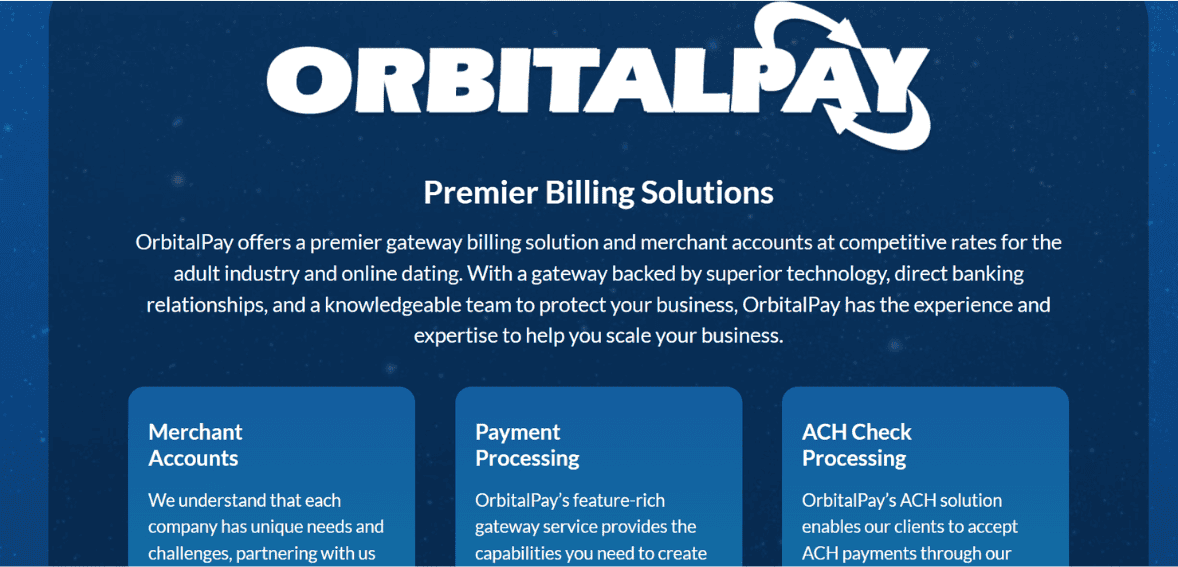
OrbitalPay is an independent payment processing company that has built its market identity around a specific and underserved commercial need: reliable, experienced payment processing for industries that mainstream processors routinely decline. The company has been described as a trusted payments partner for the adult industry and online dating for more than 25 years, placing its founding in the late 1990s at a time when internet-based adult content was first emerging as a commercial market and finding payment processing was already becoming a significant operational challenge for operators in that space. Lets read more about OrbitalPay Review.
Prior to continuing further, however, we must address an important naming issue affecting the research of this business entity. There are two separate entities using the Orbital brand name in the payments industry, and it is important not to confuse these businesses. OrbitalPay (orbitalpay.com) is the independent high-risk payment processor being reviewed in this study, while the Orbital Payment Gateway is a completely different product offered by Chase Paymentech; the payments processing division of JPMorgan Chase Bank.
These two companies are unrelated. It is very common for the search results and the review site lists of the two firms to be mixed up, so merchants conducting their due diligence should ensure they are looking at the right company before forming any conclusions based on any review found.
OrbitalPay’s focus on adult entertainment and online dating makes it unique from other generic high-risk processors reviewed in this series. As opposed to positioning itself as a high-risk processor offering services to a variety of markets, including adult among others, OrbitalPay builds its entire business and product offerings specifically around adult and online dating, gaining unique expertise in this field.
Company Background and Market Position | OrbitalPay Review
OrbitalPay has operated as a payment processing specialist for the adult industry for over 25 years, which places its founding in the late 1990s during the period when the commercial internet was first enabling widespread adult content distribution and when mainstream payment processors were already implementing their first restrictions on the category. Building sustained operations in this sector over that duration requires genuine and specific expertise in the compliance, banking relationships, and operational patterns of the adult industry rather than the general high-risk processing capability that many processors claim.
OrbitalPay has direct banking relationships in place to ensure the best possible rates for your business, and international banking relationships to help with offshore processing. The emphasis on direct banking relationships rather than ISO resale relationships reflects a positioning as a company with genuine acquiring infrastructure rather than one that routes transactions through a standard upstream processor. For adult industry merchants who have experienced the instability of processing arrangements that depend on a mainstream processor’s tolerance for their industry, direct banking relationships provide a more durable foundation for the payment processing relationship.
OrbitalPay has international banking connections for assistance in offshore processing because of the fact that the adult industry merchants do need international acquiring solutions in cases where their domestic banking connections are hard to maintain. The willingness of particular offshore banking regions to provide acquisition services of adult content has traditionally been higher compared to that of the US domestic banking region and an offshore processor can provide its merchants with opportunities that purely domestic processors cannot.
The adult entertainment and dating market served by OrbitalPay is one of the most challenging markets in terms of payment processing: high rates of chargebacks have always been a structural part of the business, rules of the card networks regarding the adult content are highly specific and should be carefully managed, the appetite of banks is lower than that for other industries, and there are legitimate merchants and fraudsters within the merchant base.
Core Payment Processing Capabilities
OrbitalPay accepts payments via multiple credit card types and ACH, with options to pay online, through a virtual terminal, and through recurring billing. The payment method coverage addresses the standard acceptance requirements of online adult and dating businesses, which primarily operate in digital environments where card-not-present and recurring billing transactions dominate the payment mix.
Credit and debit card processing covers the major card networks for card-not-present online transactions. Given the adult industry’s specific relationship with card network rules around content categorization, merchant category codes, and the disclosure requirements associated with adult content processing, the expertise of a specialist processor in managing these network-level requirements is a meaningful operational advantage over a generalist processor that treats adult processing as a standard card-not-present account with unusual content.
ACH processing provides the bank transfer payment option that some customers prefer to card payment, and that carries lower per-transaction costs than card interchange for merchants with sufficient ACH volume. The availability of ACH alongside card processing through a single provider relationship reduces the operational complexity of managing separate ACH and card processing arrangements.
OrbitalPay has an automated clearing house software and device that can process checks online and manually. It can deduct the amount directly from the customer’s account and credit it to the merchant’s account. Manual check processing capability, while less relevant for the primarily digital adult content market, extends the platform’s payment type coverage to the full range of customer payment preferences rather than being limited to card and ACH.
Recurring billing is specifically highlighted as a core capability, which reflects the subscription model that dominates the commercial adult content and online dating industries. Membership sites, subscription video platforms, and premium dating services all depend on automated recurring charge management that reliably processes monthly, weekly, or annual subscription fees without requiring customers to re-authorize each charge.
The OrbitalPay Gateway
The OrbitalPay Gateway enables billing through multiple accounts with just one gateway admin, which is a practically important feature for adult industry operators who may manage multiple merchant accounts across different content types, geographic markets, or brand identities from a single administrative interface rather than logging into separate systems for each account relationship.
OrbitalPay transactions are processed with no lag time, one to two seconds maximum, with real-time reporting and notifications. Transaction speed is a customer experience factor in online subscription checkout flows where a slow payment response creates perceptible friction at the moment of purchase decision, and one to two second authorization response times are consistent with competitive standards for eCommerce payment processing.
OrbitalPay has plug-ins compatible with the most commonly used shopping cart software and an API for incorporation into the shopping cart software. Compatibility with shopping carts is critical for merchants who create subscription and pay per view eCommerce systems within the existing eCommerce frameworks, rather than developing the entire payment system. Availability of plug-ins means that there will be no need to make extra efforts for technical integration of the platform.
A virtual terminal feature enables processing of payments via a web browser in the absence of specific payment equipment. It is necessary for businesses of the adult industry in case of customer service transactions, telephone transactions, or any transaction when the information from the client’s card is manually entered.
Recurring Billing and Subscription Management
Recurring billing is the commercial backbone of most adult content and online dating businesses, and OrbitalPay’s explicit emphasis on this capability reflects its deep understanding of the industry’s operational requirements. The subscription model, where customers pay a monthly or annual fee for ongoing access to content or platform features, creates a specific set of payment management needs that differ from transaction-by-transaction eCommerce.
Automated charge scheduling eliminates the manual effort of initiating each billing cycle, which at scale across thousands of active subscribers would be operationally impractical without automation. The system manages the charge schedule according to each subscriber’s specific billing date, handles pro-rated charges when subscription timing does not align with calendar month boundaries, and processes renewals automatically without requiring customer action.
Payment failure management is one of the most commercially relevant functions of subscription billing management. In the case of failed subscription payment due to expiring cards, lack of funds, and other issues, a subscription billing system is supposed to retry automatically, update card information in case of replacement cards using the Account Updater system, and notify merchants about repeated payment failures that need customer involvement. How much of this process is automated by OrbitalPay’s subscription billing system and how much requires manual merchant involvement is an important capability issue.
Chargeback management is especially important for recurring billing in the adult industry where the structural chargeback rate is higher compared to typical eCommerce and where account limits on chargebacks from the card networks may cause account termination. The integration of subscription billing management with chargeback prevention tools such as proper billing description policy, ease of cancellation options, and record keeping for possible disputes has a direct impact on the sustainability of merchant relationship with a processor.
Mobile Payment Solutions
OrbitalPay’s mobile solutions are perfect for plumbers, electricians, carpenters, landscape artists, delivery riders, builders, trade shows, and taxi service providers, among others. This mobile payment positioning, describing traditional field service industries, is somewhat incongruous with OrbitalPay’s primary adult industry focus, and likely reflects general payment processor language applied to mobile features rather than a significant actual market segment for OrbitalPay within these traditional field service categories.
More relevant to OrbitalPay’s actual client base is mobile payment processing for adult industry events, conventions, and in-person purchase scenarios that complement the primarily online business models of their merchant customers. The adult entertainment industry includes brick-and-mortar venues, conventions, and live event formats where in-person card acceptance is operationally necessary alongside the dominant online business.
The mobile solution extends card acceptance to these in-person scenarios through smartphone or tablet-based payment acceptance, allowing adult industry merchants to process card payments at their physical or event locations through the same processor relationship that handles their online subscription billing rather than requiring a separate merchant account for in-person transactions.
International Processing and Offshore Banking
OrbitalPay has international banking relationships to help with offshore processing, which is one of the most commercially significant capabilities for adult industry merchants facing domestic banking restrictions. US-based banking institutions have historically applied restrictive policies to adult content merchant accounts, driven by reputational considerations, regulatory scrutiny, and internal risk management frameworks that make domestic acquiring for adult merchants difficult to obtain and maintain.
International and offshore banking relationships provide adult industry merchants with acquiring options that are not subject to the same domestic banking restrictions, allowing them to process transactions through banking jurisdictions where the regulatory and reputational environment is more accommodating to the adult content category. The specific jurisdictions and banking relationships that OrbitalPay has in place are not disclosed publicly, which is standard practice for processors whose international banking arrangements represent proprietary business relationships rather than publicly verifiable claims.
Regarding international processing ability at OrbitalPay, the key questions would be about which specific currencies and countries are processed, which are the available settlement currency choices, and how international bank relations impact the authorization success rate of transactions in comparison to domestic US acquiring. The questions should be directly asked during the sales process and not assumed from generic information about the company’s international bank relations.
Multi-currency processing ability, which is a consequence of the international processing ability, becomes crucial for adult content and dating services as their clients are distributed all over the world. The system that works only for the US audience fails to provide an additional source of revenue by servicing European, Asian, and other international customers.
Fraud Prevention and Risk Management
Fraud prevention is an operational priority for adult industry payment processors that differs in character from standard eCommerce fraud management. The adult industry faces specific fraud patterns including card testing, where fraudsters use adult subscription sites to test stolen card validity before larger fraudulent purchases elsewhere, and friendly fraud, where customers make legitimate purchases and then dispute them on their bank statement to avoid charges they are embarrassed to acknowledge.
The customer profile management function described in reviews of the platform transforms credit card numbers into digital tokens, preventing raw card data from being stored in accessible systems. The tool that analyzes whether the customer is actually the person placing the order based on transaction history addresses account takeover fraud where stolen credentials are used to access subscription accounts. Geolocation shows where the customer is located, and risk scoring evaluates individual transaction risk based on multiple data signals simultaneously.
Address Verification Service and CVV matching provide standard card-not-present fraud prevention tools that catch basic fraud attempts where the fraudster does not have access to the full set of card credentials required to pass both checks. The combination of AVS, CVV, geolocation, transaction history analysis, and risk scoring creates a layered fraud prevention approach that addresses multiple fraud vector types rather than relying on any single check.
For adult industry merchants specifically, the ability to configure fraud rules that reflect the specific risk profile of their business model and customer base is more valuable than generic rule sets optimized for retail eCommerce. A fraud system that flags every international transaction as suspicious would generate excessive false positives for an adult content business with a globally distributed subscriber base, while a system calibrated for the actual risk patterns of that business would protect against genuine fraud without blocking legitimate international customers.
Pricing and Transparency
OrbitalPay does not publish its fees, rates, and pricing. There is no information about any additional transaction fees. There are no reports about any hidden charges. The absence of published pricing is standard for high-risk payment processors and reflects the genuine variability in processing costs based on industry category, chargeback history, processing volume, and the specific banking relationships involved in each merchant account.
For adult industry merchants, processing rates are structurally higher than standard low-risk merchant rates due to the elevated risk premium that acquiring banks charge for this category. The specific markup above interchange varies based on the individual merchant’s chargeback history, the content categories involved, the processing volume, and the specific acquiring bank relationship. Merchants with established track records of low chargebacks and high volume typically negotiate better rates than new entrants with no processing history.
Reserve requirements are standard for adult industry accounts, where processors retain a percentage of processed volume as security against chargeback liability. The specific reserve percentage, reserve cap, and release schedule are commercially significant parameters that affect the merchant’s effective working capital and should be clearly documented in the written merchant agreement before account activation.
Merchants evaluating OrbitalPay should request a complete written fee schedule covering transaction rates for each payment type, monthly platform fees, chargeback fees, reserve requirements, and any fees specific to the international processing capabilities they intend to use. Comparing the all-in effective cost against alternative high-risk processors for the adult industry, including CCBill and Segpay which are the most established specialist alternatives, provides the appropriate competitive context for evaluating OrbitalPay’s commercial terms.
Security and PCI Compliance
Orbital Payment Gateway is PCI Level 1 compliant. Note that this specific reference is to Chase Paymentech’s Orbital product rather than to OrbitalPay, the independent processor that is this review’s subject. For OrbitalPay specifically, PCI DSS compliance is a prerequisite for any processor handling cardholder data commercially, and the company’s description of its security infrastructure references tokenization of card numbers and standard security protocols.
For adult industry merchants, the security of stored cardholder data has specific sensitivity beyond the standard PCI compliance obligation. Adult content subscription databases contain information that customers have a particularly strong privacy interest in protecting, and a data breach that exposed the identity of adult content subscribers would have reputational consequences for affected individuals that differ in character from, for example, the exposure of a retail transaction record. The security infrastructure protecting cardholder data within OrbitalPay’s systems has the same formal PCI compliance requirements as any other processor, but the stakes of a security failure are heightened by the nature of the merchant category.
Merchants should ask specifically about the security measures protecting not only cardholder data but also the broader merchant account credentials and customer subscription records, since the full scope of data security relevant to an adult content subscriber relationship extends beyond the payment card data specifically.
Strengths, Limitations, and Who It Is Best For
OrbitalPay’s genuine strengths are concentrated in the specific area of its market focus. Over 25 years of operational experience in adult and online dating payment processing represents genuine expertise in the compliance requirements, chargeback patterns, banking relationships, and operational dynamics of these industries that a generalist processor beginning to serve the category cannot replicate. The direct banking relationships that underpin the processing capability, the international banking options for offshore processing, the subscription billing specialization that reflects how these businesses actually collect revenue, and the fraud prevention tools calibrated for adult industry risk patterns all reflect genuine investment in the operational reality of the merchant base OrbitalPay serves.
The limitations are primarily those inherent to any specialist high-risk processor. Pricing requires direct engagement and will reflect the elevated risk premium of the adult category. Reserve requirements lock up working capital. The absence of published pricing and terms requires careful contract review before signing. The platform’s depth outside its core adult and dating specialization is not established in the available independent review record.
The naming confusion with Chase Paymentech’s Orbital Payment Gateway is a practical nuisance for merchants conducting research rather than a substantive concern, but it underscores the importance of confirming specifically which entity is being evaluated before drawing conclusions from any review source.
OrbitalPay is best suited for adult content operators, online dating platforms, webcam and live streaming businesses, and similar digital entertainment businesses that need an experienced processing partner with genuine adult industry expertise, stable banking relationships, and subscription billing infrastructure optimized for the recurring revenue models that dominate these categories. Merchants in standard industries or high-risk categories outside the adult space would find more appropriate alternatives among the other processors reviewed in this series.
FAQs
Q1. Is OrbitalPay the same as Chase Paymentech’s Orbital Payment Gateway, and why do they appear together in search results?
These are two completely separate companies with no affiliation. OrbitalPay, accessible at orbitalpay.com, is an independent payment processor that has specialized in adult entertainment and online dating payment processing for over 25 years. Orbital Payment Gateway is a proprietary payment gateway product developed and operated by Chase Paymentech, the payment processing division of JPMorgan Chase Bank, and is available exclusively to merchants who have Chase Paymentech merchant accounts.
The similarity in name has caused the two entities to appear together in search engine results and on payment review aggregation sites, which creates genuine confusion for merchants researching either company. When conducting due diligence on either company, verify the corporate entity, the website domain, the ownership structure, and the target market described in any review before attributing the review’s content to the correct company. Chase’s Orbital gateway is a mainstream, large-institution product available to standard merchants. OrbitalPay is a specialist high-risk processor focused on adult and dating industries.
Q2. What makes OrbitalPay specifically suited to the adult industry compared to general high-risk processors?
Over 25 years of operation exclusively within the adult and online dating sectors has given OrbitalPay operational expertise in the specific payment challenges of these industries that general high-risk processors cannot match. This includes knowledge of the card network rules that specifically apply to adult content merchant category codes, banking relationships with acquiring institutions that have established appetite for adult industry accounts rather than tolerating them reluctantly, familiarity with the chargeback patterns that characterize adult subscriptions including the friendly fraud and embarrassment-driven dispute patterns that differ from standard eCommerce fraud, and subscription billing infrastructure specifically designed for the membership and recurring access model that most adult and dating platforms use.
General high-risk processors that serve dozens of restricted categories may be willing to open an adult merchant account but lack the deep institutional knowledge of how to manage that account type effectively over time, which can result in account instability, insufficient chargeback management support, and eventually account termination from processors whose risk models were not calibrated for the adult industry’s specific profile.
Q3. What should an adult content merchant ask OrbitalPay before signing a merchant agreement?
Before signing any merchant agreement with OrbitalPay or any other adult industry processor, merchants should request and review several specific items. First, the complete written merchant agreement including contract length, automatic renewal provisions, and early termination fee if any. Second, a complete and itemized fee schedule covering the transaction rate for each payment type, any monthly platform or service fees, chargeback fees, and reserve requirements including the reserve percentage, total reserve cap, and the specific timeline and conditions for reserve release. Third, the specific acquiring bank or banks that will process their transactions, since the stability of the banking relationship directly affects the stability of the merchant account.
Fourth, the international processing capabilities applicable to their specific account, including which currencies and countries are supported, what the settlement options are, and whether offshore banking is required for their content category. Fifth, the specific billing descriptor that will appear on their customers’ credit card statements, since adult content billing descriptors affect both customer recognition and chargeback rates. Sixth, the chargeback management support available from OrbitalPay including any tools for monitoring chargeback rates, assistance with chargeback representment, and notification processes when chargeback rates approach card network thresholds.

OpenEdge Review
By 10topmerchantservices August 4, 2026
OpenEdge is a payment processing platform designed to help businesses accept, manage, and secure electronic payments across multiple channels. Rather than functioning as a standalone point-of-sale system, it serves as a payment technology solution that integrates with business management software used in industries such as healthcare, dental care, veterinary practices, specialty retail, automotive services, education, and professional services. Lets read more about OpenEdge Review.
One of OpenEdge’s defining characteristics is its emphasis on integrated payments. Instead of requiring businesses to use separate systems for payment processing and day-to-day operations, the platform connects directly with compatible practice management, enterprise resource planning (ERP), and business management software. This approach allows payment information to flow automatically between systems, reducing manual data entry while helping maintain more accurate financial records.
The platform supports a wide range of payment methods, including credit cards, debit cards, contactless payments, and digital wallet transactions where supported. Businesses can also process recurring payments, card-on-file transactions, online payments, and in-person payments depending on their software integration and service package.
Security is another major focus of OpenEdge. Features such as tokenization, encryption, and PCI compliance tools are intended to help businesses protect customer payment information while reducing the burden of handling sensitive card data internally.
OpenEdge is primarily aimed at organizations that process payments regularly and want those transactions to become part of their broader operational workflow. Instead of simply acting as a payment gateway, the platform seeks to integrate payment acceptance with scheduling, billing, customer management, and financial reporting. For businesses already using compatible software solutions, this integrated approach may improve operational efficiency by minimizing duplicate work and simplifying payment management across different departments.
Key Features of OpenEdge | OpenEdge Review
OpenEdge offers a collection of payment processing tools that extend beyond basic card acceptance. Its primary strength lies in combining payment technology with software integrations that support everyday business operations.
One of the platform’s most important features is integrated payment processing. Rather than requiring employees to manually enter payment information into separate accounting or management systems, OpenEdge synchronizes payment data with compatible software. This can reduce administrative work while helping minimize errors caused by duplicate data entry.
The platform supports multiple payment channels, allowing businesses to accept in-person, online, mobile, and recurring payments depending on their implementation. Card-present and card-not-present transactions are both supported, giving organizations flexibility in how they serve customers.
OpenEdge also includes secure payment storage through tokenization. Instead of storing sensitive card numbers directly, payment information is replaced with secure tokens that can be used for future transactions such as recurring billing or stored payment methods. This can simplify repeat payments while improving overall security.
Reporting tools provide transaction histories, payment summaries, settlement information, and reconciliation support. These reports can help businesses monitor payment activity and identify discrepancies more efficiently.
Security features such as point-to-point encryption (P2PE), PCI compliance assistance, and fraud reduction tools are integrated into the platform. These capabilities are particularly valuable for organizations that process a high volume of transactions or operate in industries with strict regulatory requirements.
Depending on the business software being used, OpenEdge may also support electronic invoicing, payment links, customer payment portals, automated receipts, recurring billing schedules, and integrated financing options. However, not every feature is available with every software integration, so the overall experience may vary based on the specific business application connected to the platform.
Overall, OpenEdge’s feature set focuses less on offering numerous standalone tools and more on creating a payment ecosystem that works alongside existing business software.
Getting Started with OpenEdge
The onboarding experience with OpenEdge differs from many consumer-focused payment platforms because it is generally implemented through software vendors or authorized partners rather than being set up entirely through self-service registration.
Businesses typically begin by selecting OpenEdge through a compatible software provider or by working directly with an implementation specialist. During setup, payment processing is configured to work alongside the organization’s existing business management software, ensuring that payment information can be synchronized correctly.
Compared with simpler payment processors that can be activated within minutes, OpenEdge may require additional planning. Businesses often need to configure payment terminals, establish merchant accounts, verify banking information, and complete PCI compliance requirements before processing live transactions.
While this implementation process may take longer, it often results in a more customized setup that aligns with the organization’s operational workflow. Businesses with multiple locations, specialized billing procedures, or industry-specific software may benefit from the additional configuration options available during onboarding.
Training requirements also vary depending on the complexity of the business. Employees who primarily process customer payments generally face a relatively short learning curve, while administrators responsible for reporting, reconciliation, or payment management may require more detailed training.
One advantage of OpenEdge’s integrated approach is that staff members can often continue working within software they already know instead of switching between multiple independent systems throughout the day. This familiarity may reduce long-term training requirements even if the initial implementation takes longer.
Overall, getting started with OpenEdge involves more preparation than many entry-level payment processors. However, organizations seeking a tightly integrated payment environment may find that the additional setup effort contributes to smoother day-to-day operations once the system is fully configured.
User Interface and Overall Experience
The overall user experience of OpenEdge depends significantly on the business software it is integrated with. Since the platform functions primarily as an embedded payment solution, users often interact with payment features through their existing management software rather than through a separate OpenEdge application.
For many businesses, this integrated approach creates a more streamlined workflow. Employees can process payments while viewing customer records, appointments, invoices, or orders without switching between multiple systems. This can save time during busy periods and reduce opportunities for manual errors.
The payment interface itself is generally straightforward, with clear prompts for processing transactions, refunds, voids, and payment confirmations. Most routine payment tasks require only a few steps, making them relatively easy for front-office staff or customer service teams to learn.
Administrative functions such as settlement reports, payment history, transaction searches, and reconciliation tools may involve additional menus depending on the specific implementation. Organizations with higher transaction volumes may appreciate the ability to search historical payments and review detailed transaction records efficiently.
One potential limitation is that user experience is not entirely consistent across every software integration. Since OpenEdge works with numerous third-party business applications, interface design and workflow can differ depending on which software a business uses. Some integrations may offer deeper functionality and smoother navigation than others.
Overall, the platform prioritizes operational efficiency over visual design. Businesses looking for highly customizable dashboards or modern consumer-style interfaces may find certain areas relatively functional rather than visually polished. However, organizations focused on reliable payment workflows are likely to value the practical design and seamless integration more than appearance alone.
Payment Processing Performance
Reliable payment processing is one of the most important aspects of any payment platform, and OpenEdge is designed to provide consistent transaction handling across multiple payment environments.
The platform supports a variety of payment methods, including major credit cards, debit cards, EMV chip cards, contactless payments, and digital wallets where supported by compatible hardware and software. Businesses can also process recurring payments, card-on-file transactions, and online payments depending on their service configuration.
Transaction authorization generally occurs quickly under normal network conditions, allowing customers to complete purchases without significant delays. Integrated payment processing also enables transaction information to update customer accounts automatically, reducing the need for manual reconciliation after payments are completed.
Another advantage is payment consistency across different channels. Businesses that accept both in-person and remote payments can often manage those transactions within a unified payment environment rather than maintaining separate systems.
Settlement timelines vary according to merchant agreements, banking institutions, and processing schedules. Like most payment processors, OpenEdge follows standard settlement procedures rather than offering universal same-day funding for every business.
Refund processing, voids, partial payments, recurring billing, and stored payment methods are supported through compatible software integrations, giving businesses flexibility when managing customer accounts.
Performance ultimately depends on stable internet connectivity, compatible hardware, and proper software integration. Businesses using outdated systems or unsupported software may not experience the same level of efficiency as organizations with fully optimized implementations.
Overall, OpenEdge delivers dependable payment processing that emphasizes integration and workflow automation rather than simply acting as a standalone card processor.
Reporting and Business Insights
OpenEdge includes reporting and transaction management tools that help businesses monitor payment activity without relying entirely on separate accounting systems. Rather than offering advanced business intelligence software, the platform focuses on providing payment-related data that supports financial reconciliation and operational decision-making.
Users can typically access transaction histories, settlement reports, batch summaries, refunds, voids, and payment status information through their integrated software or OpenEdge reporting interface. Having this information centralized makes it easier to verify payments, investigate discrepancies, and reconcile daily transactions with bank deposits.
For businesses handling large transaction volumes, searchable payment records can save considerable administrative time. Staff can locate individual payments using customer names, transaction dates, invoice numbers, or payment amounts, depending on the software integration. This can be particularly useful when responding to customer inquiries or resolving payment disputes.
Another practical benefit is automated synchronization between payment data and compatible business management software. Since payment information is transferred directly into the system, organizations may spend less time manually updating invoices or financial records. This can improve reporting accuracy while reducing administrative overhead.
The depth of reporting, however, largely depends on the third-party software integrated with OpenEdge. Some business applications provide comprehensive financial dashboards and custom reporting, while others offer only standard payment summaries. Companies seeking highly advanced analytics, predictive insights, or visual business intelligence dashboards may still require dedicated reporting platforms alongside OpenEdge.
Overall, OpenEdge provides reliable payment reporting that supports day-to-day financial management. While it is not designed to replace enterprise analytics software, its reporting capabilities are generally sufficient for monitoring transactions, improving reconciliation, and maintaining accurate payment records within an integrated business environment.
Customer Support and Service Quality
Customer support plays an important role in any payment processing platform, particularly because payment issues can directly affect business operations and customer satisfaction. OpenEdge provides support through a combination of direct assistance, implementation partners, and software vendors, although the exact experience may vary depending on how a business purchases the service.
Many businesses first receive support from the software provider that integrates OpenEdge into their practice management or business system. Since these vendors understand both the software and the payment workflow, they are often well positioned to troubleshoot integration-related issues. More technical payment processing concerns may then be escalated to OpenEdge when necessary.
Support channels generally include phone assistance, online resources, documentation, and customer service representatives. Businesses may also have access to onboarding assistance during implementation, helping staff configure payment terminals, complete merchant setup, and understand system functionality.
Documentation and training materials can help users become familiar with payment processing features, security requirements, and transaction management. Organizations implementing OpenEdge across multiple locations may particularly benefit from structured onboarding resources.
One consideration is that support experiences can differ based on the reseller, software vendor, or implementation partner involved. While some businesses report responsive service, others may experience additional steps before reaching the appropriate technical team because multiple organizations are involved in the support process.
As with many enterprise-oriented platforms, OpenEdge’s support model is designed around long-term business relationships rather than quick self-service solutions. Businesses that value personalized implementation assistance may appreciate this approach, while organizations expecting immediate direct support for every issue should understand how responsibilities are shared between OpenEdge and their software provider before making a decision.

Pricing and Overall Value
OpenEdge does not publicly publish standardized pricing for all businesses, making it more difficult to compare costs directly with many modern payment processors that advertise flat-rate transaction fees online. Instead, pricing is generally customized based on factors such as business size, industry, transaction volume, payment methods, software integrations, and merchant requirements.
Businesses typically receive a tailored quote after discussing their processing needs with an authorized representative or software partner. This customized pricing model can benefit organizations with specialized requirements, although it also means potential customers may need to spend additional time evaluating proposals before making a decision.
Beyond transaction fees, businesses should consider other potential costs associated with payment processing. Depending on the agreement, expenses may include payment terminals, implementation services, merchant account setup, monthly service fees, PCI compliance programs, or hardware maintenance. Since these costs vary between merchants and software providers, reviewing the complete pricing structure before signing a contract is important.
The overall value of OpenEdge depends less on obtaining the lowest processing rate and more on the operational efficiencies created through software integration. Businesses that eliminate manual payment entry, reduce reconciliation work, and automate recurring billing may recover part of their investment through improved productivity rather than transaction savings alone.
For smaller businesses with simple payment requirements, lower-cost payment processors offering transparent flat-rate pricing may provide a more straightforward solution. Conversely, organizations with complex workflows, industry-specific software, or high transaction volumes may find greater value in OpenEdge’s integrated approach despite potentially higher implementation costs.
Ultimately, evaluating OpenEdge requires looking beyond processing fees alone. Considering workflow improvements, administrative savings, security features, and integration capabilities provides a more balanced picture of its overall return on investment.
Pros and Cons of OpenEdge
Like most payment processing platforms, OpenEdge offers several notable strengths while also presenting limitations that prospective users should consider before making a decision.
One of its biggest advantages is integrated payment processing. By connecting directly with compatible business management software, OpenEdge helps reduce duplicate data entry and allows payment information to flow automatically into customer accounts, invoices, and financial records. This integration can improve efficiency and reduce administrative errors for organizations that process payments frequently.
Security is another strong point. Features such as tokenization, point-to-point encryption, and PCI compliance support demonstrate a clear focus on protecting sensitive payment information. Businesses operating in regulated industries may particularly appreciate these capabilities.
The platform also supports multiple payment methods, recurring billing, stored payment credentials, and transaction reporting, allowing businesses to manage payments across different channels within a unified system.
However, OpenEdge is not without drawbacks. Pricing transparency is limited because businesses generally need to request customized quotes instead of reviewing publicly available rates. This can make comparisons with competing payment processors more challenging.
The implementation process may also require more time than simpler payment solutions, especially for organizations integrating multiple software systems or locations. Smaller businesses seeking quick setup and minimal configuration may find the onboarding process more involved than expected.
Additionally, the overall user experience depends heavily on the third-party software being used. Since OpenEdge functions primarily as an integrated payment platform, interface quality and available features can vary between software vendors.
Overall, OpenEdge is best viewed as a specialized integrated payment solution rather than a universal payment processor. Businesses that value automation and software integration are likely to benefit most, while those seeking basic standalone payment acceptance may find simpler alternatives better suited to their needs.
Who Should Use OpenEdge?
OpenEdge is designed primarily for businesses that want payment processing to become a seamless part of their existing operational workflow rather than functioning as an independent system. Organizations already using compatible business management software are generally the strongest candidates for the platform.
Healthcare providers, dental practices, veterinary clinics, specialty retailers, automotive service businesses, educational institutions, and professional service firms often process payments alongside appointments, invoices, customer records, or recurring billing. In these environments, integrated payment processing can reduce administrative work by automatically linking transactions with existing customer information.
Businesses handling recurring payments or storing customer payment credentials may also benefit from OpenEdge’s tokenization and security features. Automated payment workflows can improve convenience for both staff and customers while supporting stronger payment data protection.
Larger organizations or businesses operating multiple locations may find value in centralized payment reporting, standardized security practices, and integration with enterprise software. These capabilities can help maintain consistent payment processes across different offices or branches.
On the other hand, OpenEdge may not be the ideal choice for every business. Small merchants with straightforward payment needs, limited transaction volumes, or no requirement for software integration may find less expensive payment processors easier to implement and manage. Companies that primarily sell online may also prefer eCommerce-focused payment platforms offering built-in shopping cart tools and developer-friendly customization.
Ultimately, OpenEdge is best suited for organizations seeking long-term operational efficiency through integrated payments rather than businesses simply looking for a basic credit card processing solution. Evaluating existing software systems, payment workflows, and administrative requirements is essential when determining whether the platform is the right fit.
How OpenEdge Compares to Other Payment Processing Solutions
OpenEdge competes in a different segment of the payment processing market than many well-known providers such as Stripe, Square, or PayPal. While those platforms often emphasize quick account setup, online payment acceptance, and developer-friendly tools, OpenEdge focuses on deep integration with business management software used in industry-specific environments.
One of OpenEdge’s primary advantages is workflow integration. Businesses can process payments directly within their existing practice management or operational software, reducing the need to switch between multiple applications. This level of integration can significantly improve efficiency for organizations where payments are closely connected to appointments, invoices, or customer records.
In contrast, many standalone payment processors prioritize flexibility and rapid deployment. They often provide transparent pricing, online account creation, and extensive support for eCommerce businesses or small merchants that do not require complex software integrations.
From a security perspective, OpenEdge offers enterprise-grade features such as tokenization, point-to-point encryption, and PCI compliance support that compare well with many established payment providers. However, security capabilities across major payment processors have become increasingly sophisticated, making this less of a unique differentiator than workflow integration.
Pricing comparisons are more difficult because OpenEdge generally provides customized quotes rather than publicly listing standardized processing rates. Businesses considering multiple providers should evaluate total implementation costs, ongoing service fees, integration benefits, and operational savings instead of comparing transaction fees alone.
The right choice ultimately depends on business requirements. Organizations seeking integrated payment workflows within specialized business software may find OpenEdge more suitable, while businesses prioritizing simplicity, rapid deployment, or extensive online commerce features may be better served by alternative payment platforms.
Final Verdict
OpenEdge is best understood as an integrated payment technology platform rather than a conventional standalone payment processor. Its greatest strength lies in connecting payment acceptance with everyday business operations, allowing organizations to process transactions within the software they already use to manage customers, appointments, billing, and financial records.
Throughout this review, the platform demonstrates several clear advantages. Integrated workflows help reduce manual data entry, security features align with modern payment protection standards, and support for multiple payment methods gives businesses flexibility in how they accept customer payments. These capabilities can contribute to greater operational efficiency, particularly for organizations processing large numbers of transactions every day.
At the same time, OpenEdge is not the right fit for every business. The implementation process is generally more involved than that of many modern payment processors, pricing is not fully transparent without requesting a quote, and overall user experience depends significantly on the third-party software with which it is integrated. Businesses seeking a simple plug-and-play payment solution may find alternative providers easier to evaluate and deploy.
For organizations already using compatible business management software, however, OpenEdge offers a compelling value proposition. The operational benefits created through automation, integrated reporting, and streamlined payment workflows may outweigh the additional setup effort and customized pricing model.
Overall, OpenEdge earns positive marks as a specialized payment platform built for integrated business environments rather than for universal payment processing. Businesses considering the platform should evaluate how well it fits their existing software ecosystem, operational needs, and long-term growth plans before making a final decision.
Frequently Asked Questions
What types of businesses commonly use OpenEdge?
OpenEdge is widely used by businesses that rely on integrated payment processing, including healthcare providers, dental practices, veterinary clinics, specialty retailers, automotive service businesses, educational organizations, and professional service firms. It is particularly beneficial for businesses that want payment information to flow directly into their existing management software.
Does OpenEdge support recurring and stored payments?
Yes. Depending on the software integration and merchant setup, OpenEdge supports recurring billing, card-on-file transactions, and secure tokenization. These features allow businesses to process repeat payments while reducing the need to store sensitive card information directly.
Is OpenEdge suitable for small businesses?
It can be, but suitability depends on business needs. Small businesses that require integrated payment processing with compatible software may benefit from OpenEdge. However, merchants looking for simple payment acceptance with minimal setup and transparent flat-rate pricing may find other payment processors more appropriate.

OmniFund Review
By 10topmerchantservices July 31, 2026
OmniFund is a payment processing and accounts receivable automation platform that has served B2B and B2C businesses since 2005. Operating under GTB, which stands for GotoBilling, and headquartered in the United States, OmniFund has built its market identity around a specific operational problem: helping businesses of all sizes streamline their accounts receivable and accounts payable operations by combining payment acceptance, electronic invoicing, e-statements, and accounting software integration into a single platform. The company’s tagline, Payments as a Platform, reflects a positioning that goes beyond pure transaction processing toward comprehensive AR workflow automation. Lets read more about OmniFund Review.
Before proceeding with any substantive evaluation, it is necessary to clarify a naming confusion that affects online research for this company. There are two entirely separate businesses using the OmniFund name. The first, which is the subject of this review, is the B2B payment processing and AR automation platform operating under GTB and accessible at gotobilling.com and omnifund.com, serving businesses including clinics, nonprofits, retail shops, and professional services companies.
The second is a completely unrelated algorithmic trading and portfolio management platform that also uses the OmniFund name, with a tier-based subscription structure serving individual investors. These two companies have no relationship with each other. Any merchant conducting research should verify that the OmniFund they are evaluating is the payment processing platform rather than the investment technology service.
OmniFund the payment processor serves organizations ranging from small startups to Fortune 500 companies and explicitly targets mid-size businesses, small businesses, enterprise clients, freelancers, nonprofits, government entities, and startups. Specific sectors represented in its user base include healthcare practices, nonprofit organizations, retail businesses, and professional services firms.
Company Background and Market Position | OmniFund Review
OmniFund has operated under the GTB corporate umbrella since its founding in 2005, positioning itself as an industry leader in secure payment technology for businesses of any size. The company’s longevity, spanning two decades without the major ownership changes or acquisitions that have reshaped many competing processors, is itself a form of market credibility. Staying relevant and serving a growing client base across twenty years in the payment processing industry requires genuine product maintenance and customer satisfaction that one-time successes or marketing-driven acquisition cannot sustain.
The Payments as a Platform branding reflects OmniFund’s competitive differentiation from pure payment gateways that handle transaction processing without addressing the broader workflow context in which those transactions occur. For businesses where payment processing is one step in a larger AR management cycle that includes invoice generation, statement delivery, customer communication, and accounting reconciliation, a platform that handles all of these steps through a single integrated system reduces the number of vendor relationships, data transfers, and manual reconciliation steps required compared to managing each function through separate tools.
OmniFund serves clients in diverse sectors with notably different payment workflow requirements. Healthcare practices managing patient billing and recurring payments have different operational needs than nonprofit organizations managing fundraising and event ticket sales, which differ again from B2B professional services companies managing corporate accounts payable relationships. The fact that OmniFund’s review base includes all of these sectors suggests the platform has built sufficient flexibility to serve meaningfully different payment workflows rather than optimizing narrowly for a single industry.
The company’s support site at support.gotobilling.com and the GTB branding that appears in company responses to user reviews indicates that the GTB corporate entity is the operating structure behind the OmniFund brand, and businesses researching the company should be aware that GTB and OmniFund refer to the same organization.
Core Payment Processing Capabilities
OmniFund provides payment processing across credit cards, debit cards, ACH electronic checks, and eChecks, covering the primary payment types that B2B and B2C businesses typically need to accept from their customers. The platform processes all major credit card networks, giving merchants broad coverage for the card types their customers carry.
ACH processing is a particularly important capability for OmniFund’s target market. B2B payments, recurring subscription billing, and higher-value transactions where the lower per-transaction cost of ACH is commercially meaningful relative to card interchange fees all benefit from reliable ACH infrastructure. OmniFund’s explicit emphasis on ACH alongside card processing reflects an understanding of the payment mix that its target business customers actually use rather than treating ACH as a secondary afterthought to card acceptance.
Recurring payment automation is one of the platform’s most clearly marketed capabilities, designed for businesses managing regular billing cycles for subscriptions, memberships, installment plans, or any relationship where the same customer is charged on a schedule. Automated recurring payments reduce the manual effort involved in managing regular billing and decrease the late payment risk that manual collection creates, which are commercially meaningful benefits for businesses where predictable cash flow is a management priority.
The platform supports online bill payment through a customer-facing portal, allowing customers to view and pay their balances digitally rather than mailing checks or calling in card details. For businesses that still receive a significant portion of payments by check or phone, the customer portal provides a self-service digital alternative that reduces administrative processing costs while giving customers a more convenient payment experience.
Mobile payment capability extends the platform’s reach to in-person and field-based payment scenarios, and the text-to-pay feature allows businesses to send payment links directly to customers’ mobile phones, enabling payment completion from the customer’s own device without requiring them to navigate to a website or open a separate application.
Level II and Level III B2B Processing
Level II and Level III processing capability is one of OmniFund’s specific technical differentiators that is particularly relevant for its B2B client base. As covered in earlier reviews in this series, Level II and Level III processing capture enhanced transaction data for corporate and government purchasing card transactions, qualifying those transactions for lower interchange rates than standard Level I processing.
Level II processing adds customer codes, tax amounts, and tax identification data. Level III processing adds complete line-item detail including product codes, quantities, unit prices, and item descriptions. For B2B merchants whose customers regularly use purchasing cards to pay invoices, the interchange rate differential between Level I and Level III processing can exceed one percentage point, generating meaningful monthly savings at any significant B2B transaction volume.
OmniFund’s explicit marketing of Level II and Level III processing reflects an understanding of its B2B client base’s payment environment. Standard consumer-focused payment processors often do not support Level III processing or require additional configuration and cost to access it. Making Level III available as part of the standard platform for B2B clients who need it positions OmniFund favorably for this specific segment relative to more consumer-centric alternatives.
For healthcare practices and professional services firms that bill insurance companies, corporate entities, or government clients who pay through purchasing cards, the Level III capability can generate cost savings that materially offset the platform subscription cost. Businesses in these segments should specifically model their corporate and government card volume against the interchange rate differential available through Level III relative to their current processing costs.
Electronic Invoicing and Statement Delivery
The electronic invoicing and statement delivery capabilities are central to OmniFund’s AR automation positioning and represent one of the platform’s most consistently praised features in user reviews. The ability to generate and deliver invoices and statements electronically, with embedded payment links that allow customers to pay directly from the invoice or statement, addresses the specific inefficiency of the traditional invoice-mail-check cycle that many B2B businesses still manage.
Automated statement delivery with an embedded payment portal removes multiple manual steps from the standard accounts receivable process. Rather than printing statements, mailing them, waiting for customers to write and mail checks, and then manually recording and reconciling received payments, the automated workflow generates the statement, delivers it electronically, captures payment when the customer clicks through, and records the payment against the correct invoice automatically.
The reduction in manual reconciliation effort is the most quantifiable operational benefit, and it is specifically cited in independent reviews as a daily time saving for finance teams. When payment data flows automatically from OmniFund into the connected accounting software rather than requiring staff to re-enter payment information from bank deposits or checks, the time previously spent on data entry becomes available for higher-value financial management activities.
Customer self-service through the payment portal gives customers the ability to pay on their schedule, which often accelerates payment timing relative to the mailed statement process where customers must actively initiate payment through a different channel. When payment requires minimal effort from the customer, the number of customers who pay promptly tends to increase.
QuickBooks and Accounting Software Integration
QuickBooks integration is one of OmniFund’s most frequently mentioned features in user reviews and marketing materials, and it reflects the accounting software reality of its target market. QuickBooks, in its Desktop and Online versions, is the dominant accounting software platform for small and medium-sized businesses in the United States, and a payment processor that does not integrate with QuickBooks creates a manual data entry requirement for a large portion of its potential customer base.
OmniFund provides QuickBooks Plugins for QuickBooks Desktop Enterprise and Pro, covering the versions that many established businesses use for their accounting. The Sync to QuickBooks feature connects payment data to the accounting record automatically, so transactions processed through OmniFund appear in QuickBooks without requiring manual entry. The support for QuickBooks Desktop back to version 2004, noted in product listings, reflects a commitment to serving businesses that use older versions of the software rather than forcing upgrades as a condition of integration.
For businesses that run their accounting in QuickBooks and want payment processing that flows seamlessly into their existing records, this integration is often the primary selection criterion. A payment processor that requires manual data transfer between the payment system and QuickBooks creates daily reconciliation work that compounds in cost and error risk over time, and eliminating that manual step through a direct integration is a recurring operational benefit that justifies preference for integrated solutions over potentially cheaper standalone processors.
The ability to process credit cards natively within QuickBooks through the OmniFund integration, rather than processing in OmniFund and separately recording the transaction in QuickBooks, represents the tightest integration point that the platform offers for QuickBooks users.
EMV, Mobile, and In-Person Payment Capabilities
OmniFund extends beyond electronic billing and online payment acceptance to cover in-person card acceptance through EMV technology support, giving businesses with physical transaction environments the same integrated AR platform for their in-person sales as for their online and invoice-based billing.
EMV chip card acceptance provides the fraud liability protection associated with chip-authenticated transactions, which has been the standard expectation for in-person card acceptance since the October 2015 liability shift. The compatibility with EMV-enabled hardware allows merchants to process in-person transactions through the same OmniFund platform that handles their electronic invoicing and online payments, maintaining consistent transaction records and reporting across all payment channels.
Mobile payment capability allows merchants to process transactions through mobile devices, which is useful for field service businesses, healthcare providers collecting co-pays at the point of care, event-based businesses, and any operation where payment collection occurs outside a fixed office or retail environment. The combination of mobile acceptance with the electronic invoicing and QuickBooks sync capabilities means that a mobile transaction flows into the same AR system as an electronic invoice payment, maintaining reporting consistency across payment channels.
Text-to-pay functionality allows businesses to send payment links directly to customers via text message, providing a payment option that reaches customers where they are rather than requiring them to visit a website or check email. For businesses with customer bases that are more responsive to text than email, or for urgent payment collection scenarios, text-to-pay provides a direct and frictionless payment path.
Security and PCI Compliance
OmniFund positions security as a primary value proposition, describing itself as providing world class security for sensitive consumer data and noting that clients enjoy reduced data security liability. The platform is PCI compliant, meeting the Payment Card Industry Data Security Standards required for entities handling cardholder data, and the data security liability reduction for clients reflects the standard benefit of using a PCI-certified processor where cardholder data is handled within the processor’s certified environment rather than the merchant’s own systems.
Point-to-point encryption protects cardholder data from the moment of capture through processing, ensuring that card details are never transmitted in plain text across the communication chain. Tokenization replaces sensitive card data with non-sensitive tokens for storage and recurring transaction use, which is particularly important for OmniFund’s recurring billing use case where customer payment details are stored for automated future charges.
Fraud detection and prevention features are included in the platform at no additional charge, which the platform specifically highlights as a differentiator from processors that charge separately for fraud protection tools. The inclusion of baseline fraud prevention without extra fees is a meaningful commercial benefit for smaller businesses that might otherwise forego paid fraud tools to manage costs.
The direct connection to payment networks cited in OmniFund’s marketing materials refers to the acquiring relationships that allow the platform to process transactions without requiring an intermediate gateway, which can improve processing speed and reduce the number of entities that handle transaction data in transit.

Reporting, Analytics, and Dashboard Functionality
OmniFund provides transaction reporting and analytics through its merchant dashboard, covering the standard financial oversight needs of businesses managing AR operations. Transaction summaries, payment history by customer, and reporting across payment channels are accessible through the dashboard interface, which users consistently describe as clear and easy to navigate.
The dashboard design receives specific positive mentions in independent reviews for its clarity and the absence of repetitive data entry requirements, which reflects a user experience orientation appropriate for the finance staff and business owners who use it daily rather than a developer-focused interface that prioritizes technical capability over usability. When the dashboard delivers clear transaction summaries without requiring users to re-enter or reorganize data, the daily administrative burden of payment management is reduced.
Decline management reporting is specifically cited in independent reviews as a useful feature, with one reviewer noting that OmniFund provides useful information in instances where a payment is declined, allowing their system to respond appropriately by either representing the declined payment or informing the customer. For businesses managing recurring payments at scale, having clear visibility into declined transaction details is essential for maintaining collection rates without creating friction for customers whose cards have expired or been replaced.
The integration between OmniFund’s reporting and the QuickBooks accounting sync means that reports generated within OmniFund reflect the same data that appears in the accounting system rather than requiring reconciliation between two separate views of the same transaction history.
Customer Support and User Experience
Customer support at OmniFund receives consistently positive feedback across the independent review record, which is notably more uniform than the mixed support experiences documented for many of the larger processors reviewed in this series. Multiple reviewers specifically describe support as responsive and note that the team reacts to user feedback and implements solutions quickly, which reflects a service culture more typical of owner-operated or smaller businesses than of large enterprise software companies.
The ease of use assessment is the most consistent positive across all review sources. Users describe the platform as simple to navigate and fast to process transactions, requiring no user guide to get started. This ease-of-use assessment from actual users is a meaningful operational indicator, particularly for businesses where the staff processing payments are not dedicated payment technology specialists and need an interface that is straightforward enough to learn and use without extensive training.
The session timeout complaint, noted as the most consistent minor criticism in the review record, describes the platform logging users out after a relatively short period of inactivity, which creates minor friction in workflows where staff step away from the platform briefly during a billing session and must log back in to continue. This is a minor user experience issue rather than a functional limitation, but its consistency across reviews suggests it reflects a genuine friction point that users notice repeatedly.
The healthcare clinic reviews specifically describe integration with ChiroHD and other clinical management software, with users noting that the platform fits their clinical workflow for patient billing and that the customer experience with OmniFund’s support team is excellent. This sector-specific positive feedback confirms that the platform is genuinely functional for healthcare billing contexts rather than technically eligible but practically misaligned.
Nonprofit and Government Capabilities
OmniFund explicitly serves nonprofit organizations and government entities alongside commercial businesses, and the platform’s use cases in these sectors are specifically documented in independent reviews. A G2 reviewer notes using OmniFund for fundraising for a nonprofit organization, covering ticket purchases, auction bids, and donation collection.
For nonprofits managing event-based fundraising alongside regular donation collection and membership billing, the combination of online payment acceptance, recurring billing for regular donors and members, and electronic invoicing for event registrations covers the payment workflow needs of most nonprofit billing scenarios. The ease of use that characterizes user feedback is particularly relevant for nonprofits where staff are often generalists managing multiple functions rather than dedicated payment processing specialists.
Government and municipal clients are referenced in the platform’s marketing materials, with the description covering local municipalities as clients. Government payment collection involves specific compliance and audit documentation requirements that differ from standard commercial billing, and OmniFund’s explicit targeting of government clients suggests the platform has addressed these requirements rather than serving government entities through a standard commercial product that happens to be used by a government organization.
Strengths, Limitations, and Who It Is Best For
OmniFund is a well-positioned, operationally effective platform for its specific target market: businesses that need payment processing integrated with accounts receivable workflow automation, electronic invoicing, and accounting software reconciliation rather than pure transactional payment processing. The platform’s consistent positive feedback on ease of use, support responsiveness, and the time-saving impact of automated reconciliation through QuickBooks integration reflects genuine product-market fit for the small to mid-sized businesses it serves. Level II and Level III B2B processing capability, multi-channel payment acceptance across cards, ACH, and text-to-pay, included fraud prevention at no additional charge, and two decades of operational stability are all genuine strengths.
The limitations are primarily scope-based rather than quality-based. OmniFund is not designed for high-volume enterprise payment processing at global scale, for complex multi-currency or cross-border payment flows, for developer-first custom payment integrations requiring extensive API customization, or for businesses whose primary need is point-of-sale hardware rather than electronic billing and AR automation. The platform’s strength is in the B2B and service-based billing workflow rather than in retail card acceptance or sophisticated payment orchestration.
The session timeout issue, while minor in isolation, reflects the kind of user experience friction that a mature platform should be able to address through a settings preference, and its persistence across reviews suggests it has not been prioritized for resolution despite consistent user feedback.
OmniFund is best suited for small to mid-sized B2B businesses, professional services firms, healthcare practices, nonprofits, and service companies whose primary payment workflow involves electronic invoicing, recurring billing, and AR management connected to QuickBooks accounting. Businesses that process meaningful volumes of corporate and government purchasing card transactions will find the Level II and Level III capability particularly valuable. The platform is less appropriate for retail-first businesses whose primary need is POS hardware, for businesses requiring extensive international payment coverage, or for technical teams building custom payment experiences through flexible APIs.
FAQs
Q1. How is OmniFund the payment processor different from OmniFund the investment platform, and how can I verify which one I am researching?
These are two completely separate companies with no relationship to each other that happen to share the same name. OmniFund the payment processor operates under GTB, which stands for GotoBilling, and its primary web presence is at gotobilling.com, with the support site at support.gotobilling.com. It has been in the payment technology space since 2005 and serves businesses including healthcare practices, nonprofits, and B2B companies for billing and AR automation. OmniFund the investment platform is an algorithmic trading and portfolio management service with a tier-based subscription model starting at approximately ten dollars per month for individual investors.
When researching either company, verify the specific business activity described in reviews, the URL of the company website, and the nature of the products discussed. If a review mentions transaction processing, ACH, QuickBooks integration, electronic invoicing, or healthcare billing, it is describing the payment processor. If a review mentions trading strategies, portfolio management, or investment returns, it is describing the unrelated investment platform.
Q2. What makes OmniFund’s QuickBooks integration different from using QuickBooks Payments directly?
QuickBooks Payments is Intuit’s own payment processing service built natively into QuickBooks, which provides seamless data flow between transactions and accounting records. OmniFund’s QuickBooks integration provides a different set of trade-offs that may suit some businesses better than the native QuickBooks Payments product. OmniFund offers processing rates that some users describe as competitive compared to alternatives, Level II and Level III B2B processing capability that can reduce interchange costs on corporate and government card transactions, ACH processing alongside card processing in a single platform, and the broader AR automation workflow including electronic invoicing and e-statements that extends beyond pure payment processing.
QuickBooks Payments has the advantage of native integration and the Intuit brand, but it may not offer the same Level III processing depth, the same AR workflow automation features, or the same flexibility in connecting to payment types beyond standard cards and ACH. Businesses should evaluate both based on their specific card mix, whether they process significant B2B purchasing card volume, and whether the AR automation capabilities beyond pure transaction processing provide value relative to the cost difference if any.
Q3. Is OmniFund appropriate for healthcare practices, and does it handle specific healthcare billing requirements?
OmniFund is used by healthcare practices including chiropractic offices, as confirmed by multiple independent reviews that specifically mention integration with clinical management software including ChiroHD and other EMR systems. The platform handles recurring patient billing, co-pay collection, and the standard payment collection workflows of healthcare practices that bill patients directly for services.
The ease of use feedback from healthcare reviewers suggests the platform is accessible to clinical staff who manage billing alongside other responsibilities rather than dedicated billing specialists. However, OmniFund is a payment processing and AR automation platform rather than a dedicated healthcare billing system. It handles the payment collection aspect of healthcare billing but does not replace specialized medical billing software, insurance claims processing, or HIPAA-specific patient data management systems that some healthcare practices require.
Practices that need a platform specifically designed around healthcare billing workflows, including insurance claims, EOB processing, and patient balance management after insurance, should evaluate whether OmniFund’s general-purpose AR platform meets their full requirements or whether a healthcare-specific billing system is more appropriate for their operational context.

Nuvei Review
By 10topmerchantservices July 24, 2026
Nuvei is an international fintech firm based in Montreal whose success is characterized by the firm’s robust growth strategy and acquisitions and thus one of the important players in the world of fintech currently. Founded by Philip Fayer, who still serves as the Chairman and CEO of the company, in 2003, Nuvei started off building its reputation in payment processing in highly risky and complex verticals before making some major moves that have expanded its potential customer base substantially such as acquiring SafeCharge in 2019 at a price of 889 million dollars for its advanced European gateway and iGaming payment solutions capabilities; going public in the Toronto Stock Exchange in 2020 and the Nasdaq in 2021; and finally, most importantly, announcing its acquisition of Payoneer in June 2026 at a price of 2.75 billion dollars, resulting in a merged firm generating around 3 billion dollars annually in revenues and 500 billion dollars in annual payment volumes across 2.4 million clients. Lets read more about Nuvei Review.
The acquisition, if successful as discussed above, will mark the beginning of an unprecedented growth in the potential addressable market for Nuvei. Payoneer is the global leader in cross-border payments solutions provider for freelancers, small and medium businesses, and e-commerce merchants that require payment receipt and management from international marketplaces and clients. The integration of Payoneer’s mass market cross-border capabilities with Nuvei’s enterprise payment capabilities will provide a platform with the ability to provide payment services from enterprise-level gaming companies all the way down to the individual merchant collecting marketplace payouts.
The current state of Nuvei prior to the closing of the Payoneer acquisition is one that connects businesses to customers in over 200 countries, accepts 150 different currencies, and provides over 700 alternative payment methods with 50 countries providing local acquiring. The company is well positioned with its scalable technology for the iGaming, regulated sports betting, eCommerce, financial services, travel, and marketplace verticals among others.
Company Background and Market Position | Nuvei Review
Philip Fayer founded Nuvei in 2003 in Montreal, and the company’s early years were spent building payment infrastructure for demanding clients in categories that required sophisticated risk management, local payment method depth, and multi-jurisdictional compliance expertise. This heritage in complex, high-volume verticals shaped the platform’s architecture and the company’s approach to product development in ways that remain visible today.
The 2019 acquisition of SafeCharge for 889 million dollars was the defining strategic move of Nuvei’s growth into a global enterprise platform. SafeCharge had built a strong position in European card processing and iGaming payment technology, and its addition gave Nuvei direct acquiring infrastructure in Europe, a sophisticated gateway that handled complex payment routing, and a credible iGaming client roster that complemented Nuvei’s existing North American presence. The SafeCharge brand has since been fully absorbed into the Nuvei identity.
After going public on the TSX in September 2020, the company added a listing on the Nasdaq stock exchange in November 2021, which facilitated capital accessibility and public accountability that further fueled investment activities and acquisition. The following privatization in 2023, when Nuvei was acquired by Advent International in a deal worth 6.3 billion Canadian dollars, allowed the company to get rid of quarterly reporting pressure of being publicly traded while maintaining operational and strategic scope.
The 2026 acquisition of Payoneer worth 2.75 billion dollars in June 2026 is the biggest and strategically most important deal in the history of Nuvei. The merged company will offer merchants a one-stop shop to receive, store, and process payments across 190+ countries, including stablecoin payments. After the completion, the merged platform will have more than 2.4 million customers. The deal is subject to regulatory approval, and the completion of the deal is likely to significantly impact the relationship between Nuvei and its merchants.
Core Payment Processing Capabilities
Nuvei’s payment processing infrastructure handles credit and debit card transactions across all major card networks alongside a genuinely extensive range of alternative payment methods. The 700-plus alternative payment method coverage, which compares favorably to Worldpay’s approximately 300 methods and Paysafe’s approximately 260, reflects sustained investment in local method integrations across markets where domestic payment preferences differ significantly from international card network dominance.
The local acquiring capability in 50 markets provides direct relationships with domestic banking infrastructure in each market, which drives higher authorization rates and lower per-transaction costs compared to cross-border acquiring arrangements that route all transactions through a single external acquirer regardless of the cardholder’s home market. For businesses with significant transaction volume in specific geographic markets, local acquiring in those markets is a meaningful commercial advantage that reduces declines, reduces interchange costs, and improves the consistency of the settlement experience.
Real-time payments processing, multi-currency support across 150 currencies, and omnichannel payment solutions covering both online and in-person transaction environments give Nuvei the coverage needed to serve businesses whose payment operations span multiple channels and geographies through a single infrastructure relationship. Omnichannel consistency, where payment data from different channels flows into the same reporting and reconciliation environment, reduces the administrative complexity of managing multi-channel payment operations.
ACH payments and credit card processing on one platform is specifically noted in G2 reviews as a key benefit for US merchants who need both payment types handled through a single relationship rather than maintaining separate ACH and card processing arrangements. The inclusion of both within a single platform simplifies reconciliation, reduces vendor management overhead, and creates consistent reporting across payment types.
The SafeCharge Heritage and iGaming Specialization
The SafeCharge acquisition’s most enduring legacy is the depth of Nuvei’s iGaming payment infrastructure, which has made the platform what independent iGaming payment analysis describes as the enterprise iGaming PSP with the broadest capability set tracked, scoring the highest iGaming fit and security combination of any reviewed provider.
Nuvei serves Bet365, DraftKings, and FanDuel, the three largest operators at the very top of the iGaming volume pyramid. These client relationships are validation that no review metric can fully replicate: getting the highest-volume sports betting and online gaming operators globally to use a single payment platform validates not only the breadth of local payment method coverage but also the reliability, authorization optimization, and regulatory compliance capability that operating in licensed gambling jurisdictions requires.
There are six iGaming platform connectors available out of the box for SoftSwiss, EveryMatrix, Bragg, Altenar, BetConstruct, and Slotegrator, thus making the implementation task easier for gaming operators using such platforms and taking into account that they take a substantial part of the iGaming technology market share. There are four similar connectors provided by Paysafe. The fact that there are connectors for major iGaming platforms indicates real commitment to the workflow of iGaming companies, rather than just providing a payment gateway that operates technically and requires extensive customization efforts for each deployment.
The credential for legal sports betting in the United States that includes licensing according to the state-by-state regulatory regime is a very specific technical credential and one that not many payment service providers have bothered to acquire. The involvement of Nuvei in the US regulated sportsbooks demonstrates both the market size and the effort involved.
Authorization Optimization and AI Routing
Authorization optimization is one of Nuvei’s most commercially valuable and differentiated capabilities for high-volume merchants, and it addresses one of the most commercially significant problems in payment processing: declined transactions that represent lost revenue rather than genuine fraud or inability to pay.
Nuvei’s AI-driven routing system analyzes transaction characteristics in real time and directs each transaction through the acquiring path most likely to result in a successful authorization, based on machine learning models trained on the transaction patterns of Nuvei’s merchant portfolio across 200-plus markets. The routing decision considers card type, issuing bank behavior, transaction amount, currency, and geographic factors simultaneously, selecting the optimal acquiring path dynamically rather than sending every transaction through a fixed single acquirer.
The authorization optimization feature makes an immediate contribution to revenues for those merchants whose decline rates are sizable. For a business in the iGaming space processing 1 million dollars per month with 10% authorization rate optimization through AI-based routing, the contribution to revenues from the improvement will be 100,000 dollars per month in increased processing success rate. For the eCommerce merchants processing high volumes of payments in international markets where the differences in authorization rates of local acquiring and cross-border acquiring are substantial, the accumulated effect of routing optimization through millions of transactions can become a significant competitive cost advantage.
FX optimization is one of the currency management features reducing the cost of multi-currency operations. The point here is in ensuring that currency conversion takes place when optimal, not according to the rates set up by individual acquiring partnerships. An example of 0.5% to 1.5% FX markup mentioned above in the enterprise iGaming analysis is cited as the most narrow range of FX markup among enterprise PSPs.
Card Issuing and Embedded Finance
Nuvei’s card issuing capability allows businesses to issue customizable virtual and physical cards to their users, employees, or customers, with data-driven insights into spending behavior and spending controls configurable to specific use cases. Card issuing within the same platform as payment acceptance and payout disbursement creates a closed-loop financial infrastructure for platforms that want to manage the full money movement lifecycle from receipt through holding to spend.
The embedded finance services including digital banking, referenced in Nuvei’s platform description, extend the potential business model for platforms building on Nuvei infrastructure beyond pure payment processing into broader financial services embedding. This positioning aligns with the direction of the fintech industry broadly, where software platforms increasingly capture more financial services revenue per customer by embedding banking, lending, and payment capabilities alongside their core software product.
The Payoneer acquisition, pending close, will substantially extend this embedded finance positioning. Payoneer’s mass-market multi-currency accounts, local collection capabilities, and marketplace payout infrastructure give Nuvei the consumer-accessible financial services layer that its enterprise payment platform lacks, and the combined entity will be positioned to serve both the large enterprise merchant and the individual seller receiving marketplace payouts through the same infrastructure umbrella.
Agentic Commerce Infrastructure
One of the more forward-looking product developments Nuvei has announced is its agentic commerce infrastructure, targeting initial availability in the second half of 2026. The platform is building protocol compatibility, a KYA registry, agent risk scoring, network certifications, and a developer sandbox to support AI-agent-initiated transactions, all on the Level 1 PCI-certified infrastructure and risk and fraud tooling Nuvei already operates at scale.
Agentic commerce, where AI agents initiate purchases, manage recurring services, or execute financial transactions on behalf of human users, represents an emerging category of payment flow that existing payment infrastructure was not designed to accommodate. The specific challenges include carrying a verifiable mandate confirming that the agent is authorized to act on behalf of the human, managing the risk profile of agent-initiated transactions which differs from standard human-initiated flows, and clearing transactions across appropriate rails for agent-generated purchases.
Whether agentic commerce develops as rapidly and at the scale that Nuvei and others are anticipating is genuinely uncertain. However, the investment in infrastructure for this category, rather than treating it as a feature addition to an existing product, reflects a serious technological bet from a well-resourced company that serves clients at the frontier of payment volume and complexity.
Pricing Structure and the Billing Complaint Pattern
Nuvei does not publish standard pricing, and the pricing structure varies by market, payment method, transaction volume, and the specific contract negotiated for each merchant relationship. For enterprise and high-volume clients, pricing is custom and negotiated, with the economics reflecting the specific capabilities engaged and the volume committed.
A realistic total cost of ownership for an enterprise iGaming operator processing one million dollars monthly across European cards, LATAM local methods, and US sportsbook is estimated at 20,000 to 40,000 dollars monthly before the reserve capital impact, based on publicly available iGaming payment analysis from February 2026.
The rolling reserve of 5% to 10% held for six months, which locks up 50,000 to 100,000 dollars of capital per one million dollars of monthly volume, is a structurally significant cash flow consideration for operators at any scale. The reserve terms are described as lighter than Worldpay’s 8% to 15% for six months or Paysafe’s 7% to 12% for six months, which provides comparative context for the iGaming operator evaluating reserve requirements across providers.
For small and medium-sized merchants, the billing complaint pattern documented in Software Advice reviews is a materially serious concern. A documented complaint describes fees for specialized reports being added without request and then reappearing after reversal, a 35-dollar base monthly fee appearing despite a contract specifying zero dollars, the loyalty team asserting they have the right to change the contract to add fees whenever they want as long as it is noted on the statement, and a 300-dollar early termination fee charged to a merchant who attempted to close an account within the window specified in the statement for penalty-free cancellation.
Another reviewer describes being charged 45 dollars monthly for PCI non-compliance rather than the stated 35 dollars, discovering this only when downloading a statement, and having the company initially refuse a refund before agreeing to refund only 18 months of overcharges rather than the full amount charged, which the reviewer characterized as admitted theft with partial remediation. These documented billing practices reflect a pattern that small and medium-sized merchants should weigh seriously, understanding that the contract terms, fee change provisions, and early termination practices documented in these complaints apply to the same merchant agreement framework that governs all Nuvei accounts regardless of size.
Security and Compliance
Nuvei holds Level 1 PCI DSS certification, the highest tier available for payment service providers, covering its processing infrastructure and data handling practices. Point-to-point encryption, tokenization, and advanced fraud prevention tools are standard components of the platform’s security architecture, providing the layered data protection expected from a processor of Nuvei’s scale and the regulated sectors it serves.
The fraud prevention and risk management capabilities are described as sophisticated across multiple independent assessments, with AI-driven fraud detection that analyzes transaction patterns across Nuvei’s global merchant portfolio providing a threat intelligence advantage proportional to the breadth and diversity of the transaction data being analyzed. For iGaming and financial services clients where fraud exposure is structurally elevated, the quality of fraud management tooling is a meaningful selection criterion that Nuvei’s review record generally supports positively.
Compliance coverage across multiple regulated markets, including regulated gambling jurisdictions and financial services markets with specific payment institution licensing requirements, is a specific and documented investment area that distinguishes Nuvei from payment providers that operate primarily in less regulated commercial contexts. The US state-by-state sports betting licensing framework, the EU payment institution licences, and the Australian financial services licences that support Nuvei’s global operations represent regulatory infrastructure that took years and significant investment to assemble and that cannot be replicated quickly by new market entrants.
Customer Support
Customer support at Nuvei presents a divided picture that mirrors many of the enterprise payment platforms reviewed in this series. Enterprise and high-volume clients with dedicated account management relationships describe responsive, knowledgeable support that proactively addresses issues and provides expertise on payment optimization. The account manager described in one G2 review as having incredible knowledge and guidance, with the integration described as seamless, reflects the high-touch account management experience that enterprise-tier Nuvei relationships are designed to deliver.
The support experience for smaller merchants is documented as meaningfully worse. Setup complexity for smaller businesses is noted as a concern, and customer support response times during peak periods as slower. The billing dispute complaints documented on Software Advice describe support teams asserting rights to add fees mid-contract, initially refusing refunds for documented overcharges, and applying early termination fees during cancellation windows that were specifically communicated as penalty-free. These documented experiences with support during billing disputes represent a specific and serious service quality failure that differs from the general response time and availability concerns that characterize most processor support complaints.
The Syspro ERP partnership announced in May 2026, which embeds Nuvei payment processing directly into Syspro’s ERP platform for manufacturers and distributors, reflects the B2B commercial integration strategy that Nuvei is pursuing alongside its consumer-facing payment acceptance capabilities. Whether partners like Syspro mediate the support relationship for their mutual clients in ways that improve the experience compared to direct Nuvei support is a practical question for businesses considering Nuvei through an ISV or platform partnership channel.
Strengths, Limitations, and Who It Is Best For
Nuvei delivers at enterprise scale what no comparable competitor offers through a single integration: 700-plus payment methods, local acquiring in 50 markets, AI-driven authorization optimization, six pre-built iGaming platform connectors, and US state sports betting licensing. The iGaming client roster of Bet365, DraftKings, and FanDuel validates this capability at the very top of the volume pyramid. The pending Payoneer acquisition will add mass-market cross-border infrastructure that makes the combined entity relevant across a far broader commercial spectrum than Nuvei serves today. The security infrastructure, PCI Level 1 certification, and compliance coverage in regulated markets are genuine competitive assets built over years of investment.
The limitations are real and must be weighed honestly against those strengths. The billing complaint pattern for smaller merchants, covering mid-contract fee additions, overcharge disputes with partial remediation, and early termination fee application during communicated penalty-free windows, represents documented systemic concerns rather than isolated incidents. Pricing is enterprise-grade, requires sales engagement, and includes reserve requirements that lock up material capital for high-volume merchants. Setup complexity is a documented friction point for smaller businesses. Customization flexibility is limited relative to more developer-centric alternatives.
The businesses best positioned for Nuvei are large iGaming operators and regulated sports betting platforms processing high volumes across multiple markets where local method breadth, authorization optimization, and regulatory licensing are non-negotiable requirements; enterprise eCommerce and marketplace businesses for whom a single integration covering 700-plus payment methods in 200-plus markets justifies the premium pricing; financial services and insurtech companies that need sophisticated payment infrastructure with compliance coverage in regulated jurisdictions; and, pending the Payoneer close, the combined entity will extend genuine value to cross-border commerce businesses of all sizes through Payoneer’s mass-market infrastructure.
FAQs
Q1. What does the Nuvei acquisition of Payoneer mean for businesses that currently use either platform?
Nuvei announced the acquisition of Payoneer for 2.75 billion dollars in June 2026, with the combined company expected to generate approximately three billion dollars in annual revenue and process more than 500 billion dollars in annual payment volume for more than 2.4 million customers across 190-plus countries. The transaction was announced with regulatory approval as a condition to close, meaning the combination is not yet final as of the time of this review’s research. For current Nuvei enterprise clients, the addition of Payoneer’s cross-border SMB infrastructure expands the combined platform’s total addressable market without materially changing the enterprise payment capabilities that current Nuvei clients use.
For current Payoneer users, the combination with Nuvei’s enterprise payment technology, local acquiring in 50 markets, and 700-plus alternative payment method coverage could meaningfully expand what is available to them through a single platform relationship. Businesses currently using either platform should monitor communications from their respective account teams about integration timelines, any planned product or pricing changes, and the specific implications for their account type as the transaction progresses toward close.
Q2. How does Nuvei’s pricing compare for a mid-sized eCommerce merchant versus a large iGaming operator?
The pricing experience at Nuvei differs significantly between enterprise-tier clients and smaller merchants, and this difference appears in both the rate structure and the billing practices documented in independent reviews. For enterprise iGaming operators processing one million dollars or more monthly across multiple markets, published analysis from February 2026 suggests a realistic total cost of 20,000 to 40,000 dollars monthly plus reserve capital of 50,000 to 100,000 dollars on one million dollars of monthly volume, with FX markup of 0.5% to 1.5% described as the tightest range among enterprise PSPs in the iGaming sector.
For smaller eCommerce merchants, the pricing structure and billing practices are less favorably characterized in the documented complaint record, with mid-contract fee additions, base monthly fees appearing despite zero-dollar contract terms, and resistance to refunding overcharges all documented in Software Advice reviews. Mid-sized merchants who do not have the negotiating leverage of high-volume enterprise accounts should specifically request written confirmation of all fees applicable to their account, ask about fee change provisions in the contract, and verify the specific early termination terms before signing any agreement with Nuvei.
Q3. Is Nuvei appropriate for a small business, or is it primarily designed for enterprise-scale merchants?
Nuvei’s platform capabilities are designed and priced for enterprise and mid-market businesses rather than small businesses with simple payment needs. The setup complexity is documented as a friction point for smaller businesses, and the billing complaint pattern from smaller accounts suggests a commercial model whose terms and practices create material risk for businesses that cannot actively monitor their statements and dispute unexpected charges. The 700-plus payment methods, local acquiring in 50 markets, AI authorization optimization, and iGaming platform integrations represent capabilities whose value is most fully realized by high-volume merchants operating across multiple markets and payment methods simultaneously.
A small domestic eCommerce business that primarily accepts standard credit cards from a single country does not benefit from most of what distinguishes Nuvei from simpler, more straightforwardly priced alternatives, and the billing pattern documented for smaller Nuvei accounts represents unnecessary commercial risk for businesses that would be better served by providers with more transparent pricing and less complex contractual fee change provisions. The pending Payoneer acquisition may eventually create a more accessible product tier for smaller businesses through Payoneer’s existing SMB infrastructure, but that combination has not yet closed.

NCR Corporation Review
By 10topmerchantservices July 20, 2026
Since the establishment of the National Cash Register Company in 1884, the NCR Corporation has emerged as one of the oldest technology firms around the globe. While the company initially focused on manufacturing cash registers which revolutionized the transaction process in businesses, it has adapted to the ever-evolving technological trends throughout the last century. Lets read more about NCR Corporation Review.
With advancements in the field of computing and digital technologies, NCR has gone far ahead in manufacturing to provide integrated technology solutions. Currently, the company offers software solutions, payment technologies, cloud platforms, and enterprise solutions to many different industries. As opposed to the company’s past success stories with cash registers and ATMs, its current offerings revolve around assisting enterprises to leverage the power of technology ecosystems in order to enhance their operations.
The NCR Corporation achieved worldwide fame for providing groundbreaking ATM technology that facilitated banking transactions for millions of customers around the globe. The company’s product line-up has extended from ATMs to digital banking platforms, retail technologies, hospitality solutions, and payments processing. Business restructurings have helped NCR focus on its core products which include banking, retail, and hospitality.
Core Business Segments | NCR Corporation Review
NCR’s business is targeted mainly at three key industries: finance, retail, and hospitality. Rather than providing separate products, it offers integrated solutions including hardware, software, payment solutions, and support services in one technology platform. This allows companies to handle several business processes from one source.
The finance sector includes solutions for ATMs, interactive tellers, and digital banking software. In retail, NCR offers solutions for POS systems, self-checkout, inventory management, and store operations software. In the hospitality segment, it provides solutions for POS systems in restaurants, drive-thru technologies, ordering and back office solutions. The operation in different industries allows increasing sources of revenue while, on the other hand, necessitates consistent investment in technology development.
Banking Solutions and ATM Technology
A great deal of NCR’s reputation has been built on its ATM technology. Banks across the globe utilize NCR’s machines for such purposes as cash withdrawal, deposits, account management, and other types of self-service banking operations. Along with changing customers’ needs, NCR has made these systems interactive through video assisted banking and additional services.
In addition to its hardware products, it is engaged in developing software for ATM network management, performance monitoring, security and transaction analysis services. Numerous banks use NCR for implementation and maintenance of their ATMs.
While ATM technology continues being one of NCR’s key products, customer banking behavior changed greatly and became more digital/mobile oriented. Acknowledging the change in customers’ behavior, NCR has increased its commitment to development of digital banking software while still supporting a huge amount of ATMs in use.
Retail Technology and POS Systems
In the area of retail, NCR offers enterprise-grade POS solutions that are meant for use in supermarkets, convenience stores, department stores, and other retail chains.
The retail technologies offered by NCR have been designed to be scalable, making them highly applicable to businesses that have several business locations. With such features as real-time reporting and centralized payment processing, retailers can increase efficiency in operations as well as consistency across the network.
Integrating these solutions may prove to be somewhat complicated compared to lightweight cloud-based POS systems, especially when an organization is upgrading from old technologies. Therefore, when assessing NCR, businesses look at its long-term reliability and capabilities as opposed to initial costs only.
Restaurant and Hospitality Solutions
Moreover, it offers technologies that aim at easing out operations for restaurants and hospitality business establishments. This includes POS, payment processing, kitchen communication, order processing, and performance reporting functionalities that make it relevant for use in quick-service restaurants, full-service restaurants, and multi-restaurant operations.
With current solutions including mobile payment options and drive-thru optimization, the company also seeks to satisfy changing requirements of customers as well as increase efficiency through integration of various systems within the restaurant environment.
In addition, the technology landscape for restaurants is highly competitive, with plenty of cloud-born companies providing subscription services that attract small companies. Nonetheless, NCR continues to hold its relevance among larger restaurant chains with complex integration needs and management systems.
Digital Banking and Software Platforms
In recent years, NCR has increasingly emphasized software-driven banking solutions alongside its traditional hardware business. Its digital banking platforms enable financial institutions to offer online banking, mobile applications, bill payment services, account management, and personalized customer engagement features.
This transition reflects a broader shift within the financial services industry toward SaaS and cloud-based platforms. Rather than relying solely on physical banking infrastructure, financial institutions now expect technology providers to support customers across digital channels as well.
NCR has invested significantly in expanding these capabilities, positioning itself as a partner in digital transformation rather than simply an ATM manufacturer. While the company has made meaningful progress, it continues to compete with fintech firms that were built specifically around cloud-native architectures and often release new features at a faster pace.
Hardware Quality and Reliability
One of NCR’s biggest advantages is the experience it has gained through decades of designing enterprise hardware. Its ATMs, self-checkout terminals, and POS systems are built to operate reliably in high-volume environments where downtime can have a direct impact on business operations. Banks, retailers, and hospitality businesses often depend on these systems to handle thousands of transactions every day, making durability a critical consideration.
The company also benefits from an established service infrastructure that supports equipment maintenance, replacement parts, and technical assistance across many regions. For organizations investing in NCR hardware, long-term reliability is often just as important as the initial purchase. However, maintaining enterprise hardware requires ongoing planning, and many businesses choose comprehensive service agreements to help minimise operational disruptions throughout the equipment lifecycle.
Software Capabilities and Integration
Beyond hardware, NCR has developed a software ecosystem that supports transaction management, analytics, reporting, device monitoring, and business operations. These platforms are designed to integrate with payment processors, accounting software, customer relationship management systems, and other enterprise applications that businesses rely on every day.
As cloud technology has become increasingly important, NCR has expanded its API capabilities and cloud deployment options, making it easier for enterprises to connect existing infrastructure with newer digital platforms. For organisations operating complex technology environments, this integration capability can be a major advantage. Smaller businesses, however, may find implementation more demanding than simpler cloud-based solutions that are designed for quick deployment with minimal configuration.
Payment Processing and Fintech Capabilities
Payment processing has become an essential component of NCR’s technology portfolio. Its banking and retail platforms allow businesses to process debit cards, credit cards, contactless payments, mobile wallets, and other electronic payment methods through integrated systems rather than relying on multiple vendors.
As consumer payment preferences continue to evolve, businesses increasingly expect secure, fast, and unified payment experiences. NCR’s payment capabilities are designed to simplify transaction management while supporting compliance with industry security standards. Although the company is not a fintech startup in the traditional sense, its payment technologies play an important role in helping organisations manage commerce across physical and digital channels through a single technology ecosystem.
Pricing Structure and Cost Considerations
The cost of implementing NCR solutions varies considerably depending on the industry, deployment size, hardware requirements, software subscriptions, payment processing services, and support agreements. Unlike many smaller software providers that offer standard pricing packages, NCR typically delivers customised enterprise solutions tailored to individual business requirements.
This pricing structure generally makes NCR more attractive to medium-sized and large organisations than to small businesses or startups. Initial implementation costs may be higher because projects often include hardware purchases, installation, software licensing, integration services, and ongoing maintenance contracts. For organisations requiring advanced functionality, international support, and enterprise-level scalability, these investments may be justified by the breadth of services provided.
Customer Support and Service Network
A major strength of NCR is its extensive global support network. Large financial institutions, retail chains, and hospitality businesses often require technical assistance around the clock, and it provides installation services, remote monitoring, maintenance programmes, and field support across numerous regions.
Its international presence enables multinational organisations to receive consistent service across multiple locations, an important consideration for businesses operating on a global scale. As with any large service provider, customer experiences can differ depending on geographic location, contract terms, and the complexity of individual deployments. Nevertheless, the company’s ability to provide worldwide support remains one of its strongest competitive advantages.
Strengths of NCR Corporation
NCR has built its reputation on more than a century of experience serving enterprise customers. Long-standing relationships with financial institutions, retailers, and hospitality brands demonstrate the company’s ability to deliver technology solutions that support mission-critical business operations.
Its integrated approach is another significant advantage. Instead of purchasing hardware, software, payment processing, and support services from multiple vendors, businesses can work with a single provider capable of delivering a comprehensive technology ecosystem. This simplifies vendor management while helping ensure compatibility between systems.
The company also possesses extensive knowledge of transaction security, regulatory compliance, and enterprise infrastructure. These capabilities are particularly valuable for industries where reliability, data protection, and operational continuity are essential.
Limitations and Potential Drawbacks
Despite its many strengths, NCR faces increasing competition from newer technology companies that focus exclusively on cloud-based software solutions. These competitors often introduce new features more rapidly and provide subscription models that appeal to smaller businesses seeking lower upfront costs.
Enterprise implementations can also be more complex than lightweight software alternatives. Organisations may need additional technical expertise, longer deployment timelines, and higher initial investment before fully benefiting from NCR’s capabilities. While the company continues modernising its product portfolio, some businesses may still associate it more closely with traditional hardware than with newer cloud-first technologies.
Is NCR Corporation the Right Choice for Your Business?
The suitability of NCR largely depends on an organisation’s size, operational complexity, and long-term technology strategy. Large banks, supermarket chains, hospitality groups, and multi-location retailers often benefit from the company’s enterprise-grade infrastructure, broad service capabilities, and integrated technology platforms.
Smaller businesses with straightforward operational needs may find cloud-native POS providers or specialised software vendors more affordable and easier to implement. These alternatives often require less customisation while offering subscription-based pricing that reduces upfront investment.
Ultimately, NCR is best suited for organisations that prioritise scalability, reliability, comprehensive integrations, and long-term technology partnerships over rapid deployment and minimal initial costs.
Competitive Position in the Financial and Retail Technology Market
NCR operates in highly competitive markets where customer expectations and technology continue to evolve rapidly. Within banking, the company competes with global ATM manufacturers, digital banking software providers, and fintech companies focused on mobile-first financial services. In retail and hospitality, it faces growing competition from cloud-based POS vendors that emphasise simplicity, flexibility, and subscription pricing.
What continues to distinguish NCR is its deep enterprise experience and ability to support large-scale operations. Many organisations choose the company because of its proven reliability, regulatory expertise, global service network, and capacity to manage high transaction volumes across multiple locations. At the same time, NCR must continue investing in software innovation to maintain its competitive position as the industry shifts further toward cloud-based and digital-first technologies.
Innovation Strategy and Product Development
NCR has steadily shifted its innovation strategy from being primarily hardware-focused to developing software-driven solutions that support digital transformation. While the company continues to manufacture ATMs, POS systems, and self-service terminals, much of its recent investment has been directed toward cloud platforms, analytics, automation, and customer-facing applications.
This transition reflects the changing needs of modern businesses. Organisations increasingly want connected ecosystems where hardware, software, payment processing, and cloud management work together seamlessly. NCR has responded by expanding its software portfolio and strengthening its recurring revenue through subscription-based services.
At the same time, the company faces the challenge of balancing innovation with the needs of its existing customer base. Large enterprises often rely on long-established infrastructure that cannot be replaced overnight, requiring NCR to modernise its offerings while continuing to support legacy systems. This gradual approach allows customers to adopt new technologies without disrupting critical business operations.
Global Reach and Geographic Presence
NCR operates across numerous countries, serving financial institutions, retailers, and hospitality businesses in both developed and emerging markets. Its international footprint includes manufacturing capabilities, technical support teams, service centres, and implementation specialists, enabling the company to deliver enterprise solutions on a global scale.
This worldwide presence is particularly valuable for multinational organisations that require consistent technology standards across multiple regions. Banks and retail chains with international operations often benefit from working with a provider capable of supporting equipment, software, and maintenance under a unified global framework.
Operating internationally also brings additional challenges. NCR must navigate varying regulatory requirements, evolving payment standards, cybersecurity expectations, and currency fluctuations across different markets. Despite these complexities, its broad geographic presence remains one of the company’s strongest competitive advantages and continues to support long-term customer relationships around the world.
Long-Term Outlook and Strategic Direction
NCR’s long-term success will largely depend on how effectively it continues transitioning from a business centred on hardware sales to one driven by recurring software and service revenue. Digital banking platforms, payment technologies, cloud services, and subscription-based software represent significant growth opportunities as organisations continue investing in digital transformation.
At the same time, NCR benefits from a substantial installed base of ATMs, self-checkout systems, and retail terminals already deployed worldwide. These systems generate ongoing revenue through maintenance, upgrades, software enhancements, and support services, providing a stable foundation while newer digital offerings continue to expand.
The broader technology landscape also aligns with many of NCR’s strategic priorities. Contactless payments, self-service technologies, mobile commerce, automation, and cloud-based management platforms continue to reshape banking, retail, and hospitality industries. Having successfully adapted through several major technological shifts during its long history, NCR has demonstrated an ability to evolve alongside changing market demands. Its future competitiveness, however, will depend on maintaining a pace of innovation that matches increasingly agile fintech and software-first competitors.
Conclusion
NCR Corporation has transformed significantly since its beginnings as the National Cash Register Company more than a century ago. What started as a manufacturer of mechanical cash registers has grown into a global provider of enterprise technology solutions spanning banking, retail, hospitality, payment processing, and digital services.
Its greatest strengths lie in enterprise-scale reliability, deep industry experience, integrated technology platforms, and an extensive global support network. These qualities continue to make NCR an attractive choice for organisations managing complex operations across multiple locations.
While competition from cloud-native software providers and fintech companies continues to intensify, NCR has made meaningful progress in expanding its software capabilities and digital banking solutions. Businesses evaluating the company should consider not only its long-standing reputation but also how its integrated ecosystem aligns with their operational requirements, growth plans, and technology strategy.
For large enterprises seeking dependable infrastructure, comprehensive integration, and long-term technology partnerships, NCR remains a well-established player in the financial and retail technology market.
Frequently Asked Questions
- What industries does NCR Corporation primarily serve?
It mainly serves the banking, retail, and hospitality sectors. Its portfolio includes ATMs, POS systems, digital banking platforms, payment technologies, self-service solutions, and enterprise software designed to support large organisations.
- Is NCR Corporation better suited for enterprise businesses or small businesses?
NCR’s products and services are generally designed for medium-sized and enterprise organisations that require scalable technology, advanced integrations, and long-term support. Smaller businesses with simpler operational needs may find cloud-based alternatives more suitable.
- Does NCR Corporation offer both hardware and software solutions?
Yes. it provides integrated technology solutions that combine hardware such as ATMs, self-checkout systems, and POS terminals with software platforms, cloud services, payment processing, analytics, and ongoing maintenance.
- Does NCR provide payment processing services?
Yes. it offers integrated payment processing capabilities that support card payments, contactless transactions, digital wallets, and other electronic payment methods within its banking and commerce platforms.
- What are NCR’s biggest competitive strengths?
Some of NCR’s key strengths include its long industry history, global service network, enterprise-grade infrastructure, integrated technology ecosystem, regulatory expertise, and strong relationships with financial institutions, retailers, and hospitality businesses.

National Merchants Association Review
By 10topmerchantservices July 15, 2026
National Merchants Association, commonly abbreviated as NMA, is a payment processing company and self-described merchant advocacy organization founded in 2004 by Heather Altepeter and headquartered in Las Vegas, Nevada. The company serves both standard and high-risk businesses, with particular emphasis on industries that mainstream processors routinely decline, including nutraceuticals, CBD, travel, debt collection, and subscription billing. Public business databases list NMA’s annual revenue at roughly 81 million dollars as of 2025 with approximately 45 employees, positioning it as a mid-sized specialist in the high-risk processing segment rather than a large national acquirer. Lets read more about National Merchants Association Review.
The name and marketing positioning of NMA require honest scrutiny before any substantive review. The National Merchants Association is fairly deceptive with its advertising and sales processes. The company’s name and marketing materials sometimes make it sound as though it is a non-profit business. That is not the case. NMA is a for-profit company whose purpose is to make money. This observation from an independent reviewer is the appropriate starting point for any merchant evaluating NMA: the advocacy and membership language that characterizes the company’s branding reflects a marketing choice rather than a structural distinction from other for-profit payment processors.
That said, NMA does provide genuinely useful payment processing services to businesses in high-risk categories that have limited alternatives, and the advocacy positioning, however commercially motivated, includes some real member benefits including account optimization services and educational resources.
Company Background and Market Position | National Merchants Association Review
NMA was founded in 2004 in Las Vegas, Nevada by Heather Altepeter, and operates as a merchant services and advocacy organization marketing itself to both standard and high-risk businesses. The organization positions itself as an advocate for merchants to reduce processing fees, and this advocacy framing extends into its membership model, educational resources, and the language used throughout its marketing materials.
NMA also positions itself as an advocate group for its merchant members, lobbying on payment-industry issues and offering members educational resources alongside processing accounts. The Public advocacy dimension, including trade show participation and industry lobbying, adds a layer of organizational activity that distinguishes NMA from purely transactional ISOs, though it does not change the fundamental nature of the commercial relationship between NMA and its merchant customers.
The company operates as a payments acquirer rather than a pure ISO reselling another processor’s infrastructure, which gives it somewhat more direct control over underwriting decisions and account management than a standard ISO that depends entirely on the upstream processor’s decisions. NMA is also eyeing expansion of omnichannel sales distribution, looking for new agents in different verticals with different risk profiles, and working with existing agents to incentivize portfolio diversification. This stated strategy of diversifying across risk profiles reflects a commercial acknowledgment that concentration in high-risk categories creates portfolio vulnerability when card network rules shift or specific industry categories face regulatory pressure.
The company employs around 45 people, which means the organizational capacity for the merchant support functions it markets, including account optimizers who evaluate and maintain merchant accounts, is necessarily limited. Merchants should factor this scale into their expectations for dedicated ongoing account management.
Core Payment Processing Services
NMA processes major debit and credit cards for a variety of businesses, including high-risk sectors. Their services include EMV card readers, POS solutions, EBT, NFC processing, e-check processing, eCommerce solutions, fraud protection, access to payment gateways, QuickBooks integration, and recurring billing.
Payment service offerings cover the traditional payment acceptance capabilities for most merchants. Traditional payment acceptance for both physical and online businesses through POS systems, virtual terminals, and payment gateways involves the acceptance of EMV chip, magnetic stripe, and NFC contactless payments such as Apple Pay and others. The mobile/wireless payments service offering helps merchants accepting card payments in their field-based environment.
Payment service offerings such as ACH/eCheck processing in addition to card acceptance are useful for high-risk merchants in areas such as debt collection and B2B services where some customers prefer bank transfer payments or merchants fall in categories that restrict card acceptance making ACH payments the main option for collecting payment from customers.
Recurring billing service offering is targeted towards subscription-based businesses as an indication of how NMA targets high-risk segments of the subscription commerce that has high levels of chargebacks. Gateway and QuickBooks integration are part of the payment processing capability to integrate with eCommerce platforms/shopping carts and accounting software respectively.
The ATRI Technology and CertifyPCI
NMA offers proprietary tools including the Advanced Transaction Routing Interface, branded as ATRI, and CertifyPCI as part of its technology differentiation from pure-play ISOs that resell standard gateway infrastructure without proprietary enhancements.
The Advanced Transaction Routing Interface is described as providing advanced processing capabilities for merchants, though the specific mechanics of how the routing optimization works, which processing paths it routes between and on what criteria, are not extensively detailed in publicly available documentation. The concept of intelligent routing, directing transactions through the acquiring path most likely to result in authorization, is a genuine and valuable capability for high-risk merchants whose decline rates at any single processor can be material. Whether NMA’s ATRI delivers meaningful authorization rate improvement relative to standard single-path processing is something merchants should ask specifically about, with requests for documented authorization rate improvement data before treating it as a differentiating factor.
CertifyPCI addresses the PCI DSS compliance management challenge that small and medium-sized businesses without dedicated IT resources often find difficult to navigate independently. The tool is positioned as helping merchants maintain compliance without requiring specialized expertise, which addresses a genuine operational need, particularly for high-risk merchants whose compliance obligations are the same as standard merchants despite the additional processing complexity they navigate.
NMA is currently working on three other technology developments to offer merchants greater performance, throughput, and enhanced security, though specific details of these developments are not publicly disclosed beyond this general statement.
The Membership Model and Member Benefits
To utilize NMA’s services, merchants first have to pay a monthly membership fee. This can range between 19.95 and 69.95 dollars based on the services selected. This membership fee structure distinguishes NMA from standard payment processors where monthly account fees cover operational costs directly rather than being framed as membership dues with associated benefits.
As the holder of a merchant account from NMA, the merchant will become a member of their organization. Apart from the payment processing services offered by NMA, members of this organization will benefit from savings opportunities, educational services, industry advocacy, among others. The exact value of the benefits that are derived from membership cannot be quantified independently since it depends on how actively a merchant member utilizes them. Education and industry advocacy are valuable aspects for a merchant that actively participates in them, but they do not impact the business model of the processing relationship in any way.
The account optimizer service offered by NMA, which involves the evaluation of merchant accounts by the NMA representatives with the goal of offering the best solutions and best rates possible, will be a valuable offering if delivered continuously. Monthly optimization of merchant accounts with the goal of making sure that merchants pay the lowest rates possible can be viewed as a valuable cost management offering rather than just maintenance of accounts. It remains to be seen whether this process of optimization takes place for most of the merchant accounts, or if it serves only a marketing purpose.
High-Risk Industry Coverage
NMA claims to be a leader in high-risk credit card processing, and the industries it explicitly serves span a broad range of restricted and higher-risk categories. According to the company, high-risk merchants are judged by their credit, product, method, ticket size, or volume.
High-risk industries mentioned in the marketing of NMA’s payment processing services include nutraceuticals and dietary supplements, CBD and hemp-based products, travel and vacation businesses, debt collectors, subscription billing companies, credit repair services, adult entertainment, online gambling and gaming-related business operations, and many more eCommerce industries viewed suspiciously by card processors and normal banking institutions.
Merchants from such categories who cannot secure processing services from established providers or are skeptical about the stability of accounts with processors such as PayPal and Stripe find a valid solution in NMA’s acceptance to provide payment processing services to these industries. The problem, however, as seen throughout this review, is that the commercial conditions of obtaining these services, which involve pricing, length of contract period, and cancellation fee, among other factors, have created a significant number of merchant complaints.
Merchants of high-risk industries will be required to pay slightly more for their processing than usual. Such an assertion is correct and expected, considering the higher cost of processing and reserves associated with higher-risk merchant industries.
Pricing Structure and Transparency Problems
National Merchants Association does not publish its processing rates on its public website. The company describes its pricing model as interchange-plus, meaning a merchant pays the card networks’ interchange fees plus a markup negotiated with NMA, and states that member accounts are reviewed each month with the stated goal of keeping merchants at the lowest available effective rate. Specific per-transaction percentages and per-item fees are presented to applicants on a quote-by-quote basis after an underwriting review, and NMA does not commit to a published rate card.
According to user reviews and expert analysis, standard-risk merchants typically see interchange-plus pricing with a small basis-point markup, while high-risk accounts can see materially higher effective rates that vary by vertical and processing volume. NMA does not publicly disclose monthly account fees, statement fees, PCI compliance fees, equipment costs, early termination provisions, or reserve requirements.
We suspect that National Merchants Association may be engaging in billing practices that contain hidden fees or inconsistencies. This specific concern from an independent payment industry analyst reflects the pattern documented across merchant reviews: the gap between the pricing presented during sales conversations and the actual fees that appear on monthly statements has been a recurring source of merchant complaint.
High-risk applicants are commonly required to fund a rolling reserve as a condition of approval. Rolling reserves, where a percentage of processed volume is held back for a defined period as security against chargebacks, are a standard and legitimate feature of high-risk merchant accounts. The concern is not the existence of reserves but the degree to which the specific reserve percentage, reserve cap, and release timeline are clearly disclosed and documented in writing before the merchant agrees to the account terms.
Contract Terms: The Advertised versus Actual Discrepancy
The contract terms at NMA contain one of the most clearly and consistently documented discrepancies between advertised terms and actual practice in any processor reviewed in this series.
The National Merchants Association advertises one-year contracts with a 99 dollar early termination fee. But in practice, they tend to utilize three-year contracts with an early termination fee of 395 dollars or even more. This discrepancy between the advertised one-year contract with a 99 dollar ETF and the actual three-year contract with a 395 dollar ETF is documented across multiple independent review sources and represents a specific and material misrepresentation that has generated a significant share of the merchant complaints associated with NMA.
There have been several online complaints about NMA promising one-year contracts while actually signing merchants up for three-year contracts with a hefty cancellation fee. The mechanism by which this discrepancy occurs, whether through deliberate misrepresentation by independent sales agents, unclear contract documentation, or other means, does not change its practical impact on merchants who discover after signing that their actual contract terms differ from what they were told.
All of the company’s contracts include a monthly membership fee. These range between 19.95 and 69.95 dollars per month on top of transaction fees, representing a fixed monthly cost that accumulates over the contract term regardless of transaction volume.
The independent sales agent distribution model that NMA uses to sell its products is directly connected to the contract term discrepancy complaints. Merchants who encountered misleading terms during the sales process describe interactions with independent agents rather than NMA employees, and the agent relationship creates accountability ambiguity about which party is responsible for misrepresentations. Merchants evaluating NMA should request the complete written contract before signing and verify that the specific terms documented in writing match what they have been verbally promised, including the contract length, the early termination fee, and all monthly fees.
Legal History and Active Litigation
NMA’s legal history is more extensive than most payment processors reviewed in this series, and it reflects both the company’s active pursuit of its own legal claims and its status as a defendant in merchant complaints.
NMA filed a seven-count civil suit against Commercial Bank of California in Los Angeles County Superior Court on December 8, 2021, alleging breach of written contract, breach of the covenant of good faith and fair dealing, unjust enrichment, and unfair business practices over the bank’s handling of merchant reserve funds and confidential merchant information. NMA pursued roughly 280 million dollars in damages. The original action was dismissed without prejudice, and NMA refiled the matter in February 2023 in Los Angeles County Superior Court. The scale of the claimed damages, 280 million dollars, is notable and reflects significant commercial stakes in the dispute with the bank partner.
Merchant X LLC filed a federal complaint against NMA and additional defendants in the US District Court for the Central District of California in 2022, alleging breach of contract and related claims arising out of the parties’ processing relationship. NMA also filed a federal civil action naming Priority Payment Systems, LLC as defendant in the US District Court for the Northern District of Georgia in 2024, indicating active commercial litigation on multiple fronts simultaneously.
One documented merchant complaint from an independent review forum describes an NMA sales agent in Bakersfield who left no paperwork, resulting in a merchant’s cousin being enrolled in a lease for wireless and countertop terminals without their awareness. The reviewer noted that this agent had done this to numerous merchants and that affected parties were seeking a class action suit and contacting legal groups that had previously pursued leasing company cases.

Security and PCI Compliance
NMA offers fraud protection and PCI compliance tools as part of its service offering, with the CertifyPCI proprietary tool specifically designed to help merchants manage their PCI compliance obligations. For small and medium-sized businesses without dedicated IT security staff, compliance management tools that reduce the complexity of annual self-assessment questionnaires and technical requirements are a practical benefit.
Standard fraud prevention capabilities including transaction monitoring and chargeback management tools are offered, which are essential for high-risk merchants whose chargeback rates are structurally elevated and whose continued payment processing access depends on keeping chargebacks within card network thresholds.
NMA’s status as a payments acquirer rather than a pure ISO means that its relationship with the underlying banking and processing infrastructure gives it some degree of direct control over risk management decisions, which can benefit high-risk merchants who need a processor capable of making nuanced underwriting judgments rather than applying rigid automated rules.
Customer Support and Complaint Patterns
Many of these complaints reference the deceptive sales tactics that NMA uses to lure merchants into contracts with terms they didn’t realize they were accepting. Some merchants have also complained about NMA’s poor customer service, hidden fees, and the difficulty of canceling service with the company.
The common concerns identified across NMA’s complaint record include unexpected or high cancellation fees, undisclosed transaction or monthly fees, automatic contract renewals, unfulfilled promises of refunds or rebates, and challenges in resolving issues through customer service. Rates can differ greatly between merchants, and difficult cancellation processes have been consistently noted.
The 24/7 customer support that NMA markets sits against this documented pattern of customer service complaints, suggesting the support availability does not translate consistently into effective resolution of complex account issues. For merchants with straightforward operational questions, the support infrastructure may be adequate. For merchants navigating billing disputes, cancellation requests, or reserve fund concerns, the documented experience suggests a more frustrating process.
Strengths, Limitations, and Who It Is Best For
National Merchants Association offers genuine payment processing access for high-risk industries that have limited alternatives. For businesses in nutraceuticals, CBD, travel, subscription billing, debt collection, and similar categories, having a processor willing to serve them at all is a meaningful commercial necessity rather than a preference.
The interchange-plus pricing model, when actually delivered and clearly documented, is more favorable than tiered pricing. The account optimizer service and monthly review commitment, if substantively conducted, represent a more active account management approach than the passive relationship most ISOs maintain. The zero setup fee is a genuine commercial benefit at the point of account opening.
The limitations are substantial and consistently documented across multiple independent sources. The advertised one-year contract with a 99 dollar ETF versus the actual three-year contract with a 395-plus dollar ETF discrepancy is the most serious documented concern and represents a specific and material gap between marketing and practice. Pricing opacity across transaction fees, monthly membership fees, reserve requirements, and PCI compliance charges requires active and detailed upfront negotiation rather than passive acceptance.
The independent sales agent model creates accountability gaps between what is promised during sales and what is documented in contracts. The legal history, including the 280 million dollar claim against a bank partner and merchant complaints naming NMA as a defendant, reflects a more contentious operating history than most processors of comparable size. Customer service quality in complex dispute resolution has generated consistent complaints.
The merchants best positioned to consider NMA are those in high-risk categories who have been declined elsewhere and whose processing options are genuinely limited, who conduct thorough contract review before signing and negotiate all terms explicitly in writing, who actively monitor their monthly statements against documented fee disclosures, and who establish written cancellation procedures and calendar their contract renewal dates at the point of signing. Merchants with standard risk profiles, those who prioritize pricing transparency and contract flexibility, and those who cannot commit to active ongoing account monitoring are better served by processors with more favorable standard terms.
FAQs
Q1. Is National Merchants Association a non-profit advocacy organization or a for-profit payment processor?
National Merchants Association is a for-profit payment processing company, not a non-profit organization. The company’s name, its membership language, and its positioning as a merchant advocacy group can create the impression of a non-profit or industry association structure, but NMA is a commercial business whose primary purpose is generating revenue from payment processing services.
The advocacy activities, including trade show participation and industry lobbying, are genuine components of the organization’s activities, but they exist alongside and in support of the commercial payment processing business rather than as the primary organizational mission of a non-profit advocacy group.
Merchants evaluating NMA should approach the relationship as they would any for-profit payment processor, conducting the same due diligence around contract terms, pricing transparency, and complaint history rather than extending additional trust based on the advocacy and membership framing.
Q2. What is the actual contract length and early termination fee at NMA, and why do these differ from what is advertised?
NMA’s marketing materials have advertised one-year contracts with a 99 dollar early termination fee, but multiple independent review sources and documented merchant complaints consistently indicate that actual contracts are three years in length with an early termination fee of 395 dollars or more. This discrepancy is one of the most documented and consistent complaints associated with NMA.
The mechanism appears to involve independent sales agents who communicate the more favorable advertised terms verbally during the sales conversation, while the written contract that the merchant signs contains the longer term and higher ETF.
Merchants evaluating NMA should request the complete written contract before signing and verify specifically that the contract length is the one they were verbally quoted, that the early termination fee matches the amount communicated during sales, and that all monthly fees including membership dues and any potential liquidated damages provisions are clearly identified. Any term that differs between verbal representation and written documentation should be resolved in the written contract before signing rather than after.
Q3. What should a high-risk merchant know about reserve requirements when applying to NMA?
Rolling reserves are a standard and expected feature of high-risk merchant accounts, and merchants applying to NMA for high-risk processing should anticipate that a reserve requirement will be part of their account approval conditions. A rolling reserve involves the processor holding back a percentage of each transaction’s proceeds for a defined period, typically 90 to 180 days, as security against potential chargebacks and refunds.
The specific reserve percentage, the total cap on reserves held, and the timeline for reserve release are the three parameters that most directly affect a merchant’s cash flow, and all three should be explicitly documented in the written agreement before signing. NMA does not publicly disclose reserve requirements, and the specific terms for any merchant account are determined through the underwriting process.
Merchants should ask specifically about the reserve percentage that will apply to their account, the maximum total amount that can be held in reserve at any time, and the specific conditions under which reserves are released, requesting these terms in writing as part of the account agreement rather than accepting verbal assurances that may not be honored if the processing relationship becomes contentious.

Merchant Warrior Review
By 10topmerchantservices July 2, 2026
Merchant Warrior is a privately owned Australian fintech company that has built one of the more distinctive positions in the domestic payment gateway market: a Brisbane-based, independently owned, Australian-operated payment infrastructure provider that has deliberately remained outside foreign corporate ownership at a time when most of its competitors have been acquired by international payment conglomerates. Founded in 2009, the company operates from Brisbane, Queensland, and describes its mission as enabling customers to process online credit card payments directly with their bank in seconds while providing first class service for website payments. Lets read more about Merchant Warrior Review.
Merchant Warrior is one of the few remaining payment processor companies that is Australian owned and operates out of Australia. It is not by coincidence that this is how the company markets itself. There has been a major consolidation and buyout of payment gateway providers over the years in Australia, such as with the IP Payment being bought by Bambora, Ingenico, and finally Worldline, as well as several other companies being acquired by overseas corporations. Merchant Warrior’s continued independence makes it an important choice for Australian businesses that want to ensure that they have an Australian operator of their payment infrastructure provider.
Merchant Warrior provides a wide array of payment services, which includes credit and debit card processing, Direct Debit payments using banks, PayID direct bank payments, PayTo near direct bank debits, BPAY billing payments, batch payments, and a Payouts service for real-time payments. These services make Merchant Warrior a true full-service payment gateway in Australia, as opposed to just being a card payment gateway with additional payment services added on top of it.
Company Background and Market Position | Merchant Warrior Review
Founded in 2009, Merchant Warrior is a privately owned fintech company located in Brisbane, Australia. The organisation prides itself in establishing and maintaining a healthy relationship with each of its clients, working in synergy with clients to gain insight into their individual requirements and by providing them with a solution that caters wholly to those requirements.
The private ownership structure is a meaningful characteristic in the context of the Australian payment gateway market. Where many gateway competitors are ultimately accountable to international corporate parents whose strategic priorities may not align with Australian merchant needs, Merchant Warrior operates as a locally owned business where the people making product and service decisions are based in Brisbane and directly invested in the outcomes of Australian merchants.
Merchant Warrior presents itself as a business functioning in the convergence of payment gateway technology and merchant account facilitation, thus giving Australian merchants choice regarding how the payment acceptance arrangement is structured. It is possible for the merchant either to hire Merchant Warrior to provide the all-inclusive solution consisting of both the merchant account on the internet and the payment gateway service; or use the existing merchant account provided by the bank and combine it with the services offered by Merchant Warrior as a payment gateway provider. Such choice accounts for both new merchants and those with existing bank relationship but desiring to obtain advanced payment gateway services.
Merchant Warrior is a local Australian Payment Gateway helping merchants acquire a merchant account and providing either merchant accounts of various Australian banks or all-inclusive packages including a merchant account and a payment gateway service at reasonable prices. The capability to negotiate on merchant account options available at various Australian banks on the client’s behalf, instead of pointing out one specific banking institution for every merchant, proves the independence of Merchant Warrior as an adviser.
Core Payment Gateway Capabilities
Merchant Warrior’s payment gateway infrastructure handles credit card and debit card transaction processing, enabling Australian merchants to accept payments online through their websites, eCommerce platforms, and billing software. The gateway supports real-time transaction processing, returning authorization responses immediately so that merchants and their customers receive payment confirmation without delays that might cause checkout abandonment.
The All-in-One solution bundles the internet merchant account with the payment gateway, allowing merchants to establish their entire online payment infrastructure through a single relationship without requiring a separate bank merchant account application. The bring-your-own merchant account option allows merchants with existing bank relationships to connect those accounts to Merchant Warrior’s gateway, taking advantage of the gateway’s technology capabilities while retaining the banking relationship they have already established.
All major credit card networks are supported, covering Visa and Mastercard as the primary networks across both consumer and commercial card types. The gateway’s multi-currency support allows merchants to accept payments from international customers across a range of currencies, which is relevant for Australian businesses with significant offshore customer bases or those selling to international markets through digital channels.
The Least Cost Routing capability, available through Merchant Warrior, directs debit card transactions through the most cost-effective network path available, typically routing domestic debit transactions through the eftpos network rather than through the Visa or Mastercard networks when this results in a lower merchant service fee. EFTPOS Least Cost Routing is available through Merchant Warrior, reflecting the company’s engagement with the evolving Australian payment infrastructure and the regulatory focus on enabling merchants to benefit from competitive routing options for debit card transactions.
Australian-Specific Payment Methods
The range of Australian-specific payment methods supported by Merchant Warrior is one of the most practically significant aspects of its product offering for domestic merchants, and it reflects genuine investment in the local payment landscape rather than a card-centric approach that treats Australian payment methods as secondary.
PayID enables merchants to generate unique payment identifiers for all customers and invoices. Customers are able to make bank transfers using unique payment identifiers and merchants can receive the funds in real-time 24 hours a day, seven days a week including public holidays. This real-time payment capability, operating through Australia’s New Payments Platform infrastructure, gives merchants an alternative to card payments that settles immediately without the overnight settlement delay that batch-processed transactions involve. For businesses where same-day cash flow is operationally important, the real-time nature of PayID receipts is a meaningful advantage.
PayTo provides near real-time debit capability, allowing merchants to initiate debits from customer bank accounts through a pre-authorized mandate framework. PayTo represents a modernization of the traditional direct debit process, maintaining the automated collection convenience of direct debit while enabling faster settlement and a more transparent authorization framework for customers who want to understand and manage their payment mandates directly through their banking app.
BPAY gives a billing solution for the Australian merchants such that their customers can pay through their internet or mobile banking services, with facilities for scheduling payments and making sure no wrong payments are made through a referencing system. BPAY has become an integral part of the payment culture in Australia, especially for those merchants who provide bill payment, utilities, and subscription billing in which the customers make payments through the banking websites. In the case of such billing solutions, BPAY acceptance becomes a necessity.
The Direct Debit service allows merchants to collect the payments regularly through debiting of the customer’s bank account, which is the right method for collecting payments from subscription services, memberships, installment billing, and other recurring billing situations.
Integration Options: Direct API, Payframe, and Hosted Pages
Merchant Warrior supports multiple integration approaches that accommodate different merchant technical capabilities and checkout design requirements, covering the spectrum from fully custom developer-built implementations to ready-to-deploy hosted options.
The Direct API Integration enables merchants to process credit card, bank account, and check transactions in real time directly through any eCommerce solution such as shopping carts, web pages, and other billing software. Merchants are given the ability to maintain their own branding while utilizing the Merchant Warrior Payment Gateway to process online transactions. The Direct API solution can be extensively customized for a seamless integration that ensures that the merchant’s customers remain under the impression that the merchant processes all transactions themselves.
This Direct API approach gives technically capable merchants complete control over the payment experience within their own application environment, with card data entering Merchant Warrior’s processing infrastructure via API without requiring any page redirect to a Merchant Warrior-hosted environment. Merchants using this approach need to ensure that their own systems meet appropriate security standards for handling card data at the collection point, though tokenization and encryption capabilities within the API reduce the raw card data exposure within merchant systems.
Payframe Integration offers a solution that combines customization flexibility and minimal PCI compliance scope. Instead of accepting cards by having a form written completely from scratch in the merchant’s own codebase, Payframe will host a payment form provided by Merchant Warrior on the merchant’s page through an iframe. While the form will look according to the merchant’s style guide, it will still operate on Merchant Warrior’s server where the raw card details will not end up in the merchant’s codebase.
Hosted Payment Pages offer the easiest integration approach as it consists of sending the user from the merchant’s page to the Merchant Warrior-hosted checkout page where card details can be entered. There is no front-end integration required other than providing a link for redirection and this approach is considered the most powerful one regarding PCI compliance as card details are fully hosted on Merchant Warrior’s side and do not touch merchant’s system at all.
Batch Payments and High-Volume Processing
Merchant Warrior Batch Payments is the ideal payment solution for businesses that harbour a significant amount of offline transactions. The Batch Payments solution has the ability to efficiently process an extremely large number of transactions per batch file via the Merchant Warrior Payment Gateway. Merchants are able to manually upload or automatically transfer a formatted file with credit card and bank account payment information to the Merchant Warrior Payment Gateway and receive an instant notification upon processing completion. This solution is best suited for businesses that deal with memberships such as magazine subscriptions, health clubs, charitable donations, and similar recurring payment scenarios.
The batch processing capability addresses a specific and genuine operational need for businesses that collect payments at scale outside a real-time online checkout environment. Rather than processing each transaction individually through an API call, batch processing allows thousands of transactions to be submitted simultaneously from a single formatted file, with the gateway processing the entire batch and returning completion notification. This is operationally efficient for subscription businesses, membership organizations, and any company with large volumes of scheduled recurring charges that are better handled as a coordinated batch than as individual real-time authorizations.
The ability to automate batch file transfer rather than requiring manual upload reflects an understanding that high-volume merchants need their payment workflows integrated into automated business processes rather than dependent on staff intervention at each billing cycle. The instant notification upon batch completion provides the operational confirmation that finance teams need before proceeding with downstream processes dependent on payment completion.
Payouts: Real-Time Fund Disbursement
The MW Payouts product enables businesses to push funds from their bank accounts in real-time via APIs. Merchants can push funds to business accounts or consumer accounts in real-time with fallback support. By powering the product with the latest industry technology, merchants are not required to hold a float of funds with Merchant Warrior and can simply push funds directly from their nominated bank account.
The Payouts product not only provides the solution on the transactional payment side but also on the disbursement aspect where businesses will be able to disburse their payments to customers, suppliers, or employees in real-time through the same platform infrastructure used by businesses to collect payment from customers in real-time. It is one of the commercially valuable attributes of the product because businesses are not required to pre-fund the balance with Merchant Warrior prior to the disbursements; instead, it allows businesses to withdraw funds from their bank accounts.
The ability of the Payouts product to facilitate real-time fund disbursement will prove to be beneficial to various types of organizations like marketplace platforms where payments need to be made to the sellers, insurance organizations where claim payments need to be made, financial services businesses that require distribution of funds, and organizations that routinely distribute payments to their dispersed recipients. In-built fallback facility will help the disbursements to find another way if the initially selected way fails to work in case of the real-time payments being attempted.
Fraud Prevention and Security
Merchant Warrior is a Tier 1 PCI DSS compliant provider, holding the highest level of Payment Card Industry Data Security Standard certification available for payment service providers. This certification requires rigorous independent audit and verification of security controls across the organization’s payment infrastructure, and maintaining it reflects a sustained operational commitment to security management rather than a one-time certification exercise.
An Advanced Fraud Platform is included as a component of the Merchant Warrior payment infrastructure, providing fraud detection and prevention tools that merchants can leverage alongside their card acceptance capability. The specifics of the fraud rule sets, the customization available to merchants for their specific risk profiles, and the reporting and monitoring capabilities of the fraud platform are detailed in the company’s documentation rather than summarized in public marketing materials, and merchants with elevated fraud exposure should discuss the specific capabilities available during their evaluation.
3DS 2.0 authentication support provides the modern strong customer authentication framework applicable in payment environments where this authentication protocol is relevant, including for transactions with European cardholders under PSD2 requirements and for domestic transactions where issuer-side 3DS challenge is initiated. 3DS 2.0’s improved authentication flow compared to the original 3DS standard reduces the friction of the authentication experience while maintaining the fraud liability shift associated with successfully authenticated transactions.
The scheme tokenization capability allows Merchant Warrior to replace stored card PANs with network-issued tokens from Visa and Mastercard, which are maintained and updated by the card networks when underlying cards are replaced. This eliminates the stored card data staleness problem that generates failed recurring charges when customers receive new cards, improving authorization rates on recurring billing while simultaneously reducing the sensitivity of any stored card reference data.
Pricing Structure and Transparency
Merchant Warrior’s pricing is competitive and free rate reviews are provided. Merchant Service Fee ranges from 0.5% to 1.5% depending on volume. Annual fees start from 400 dollars with zero dollar options also available. Transaction fees range from 0.04 to 0.30 dollars.
This published pricing information, available through independent Australian payment gateway comparison resources, is notably more transparent than many competing payment processors reviewed in this series. The Merchant Service Fee range of 0.5% to 1.5% reflects volume-based pricing where higher-volume merchants qualify for lower rates, which is a standard and merchant-favorable pricing structure that rewards growth rather than penalizing it.
The pricing page on Merchant Warrior’s website uses a transaction volume selector to match merchants with their appropriate pricing profile, covering Standard and Premier pricing tiers based on monthly transaction counts. This tiered structure acknowledges that the right pricing model for a small merchant processing a few hundred transactions per month differs from that appropriate for a larger operator processing thousands monthly.
The all-in-one bundled pricing for merchants who take both the merchant account and gateway through Merchant Warrior simplifies the cost structure by eliminating the need to separately manage bank merchant account fees alongside gateway fees. For merchants who bring their own bank merchant account, the gateway fee is charged separately, with the total cost reflecting both the gateway fee and the merchant account fee from their bank.
The option for zero annual fee arrangements alongside the standard 400 dollar annual fee reflects flexibility in how the cost structure is packaged, and merchants should ask specifically about which arrangement is applicable to their situation and what, if any, trade-offs exist between the fee structures in terms of included services or rate levels.
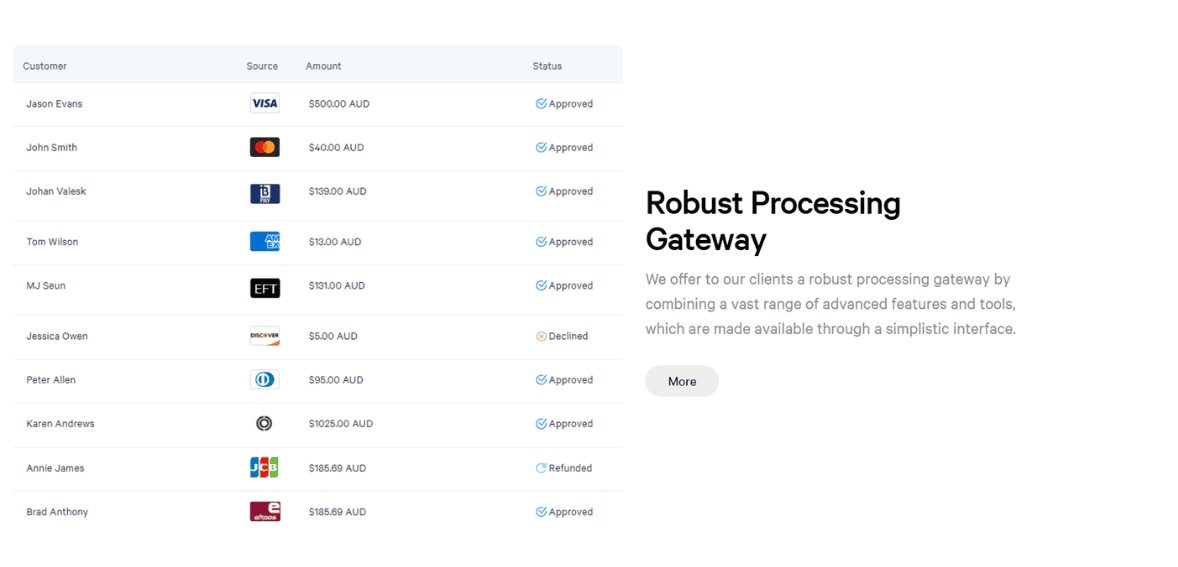
Shopping Cart and Platform Integrations
Merchant Warrior’s integration ecosystem covers a range of eCommerce platforms and shopping cart solutions commonly used by Australian merchants, reducing the development effort of connecting an existing online store to the gateway. Integration support spans both major international platforms with Australian merchant bases and Australian-specific eCommerce solutions.
WooCommerce integration makes the gateway accessible to the large number of Australian merchants running WordPress-based eCommerce stores, which represent a significant share of the small and medium-sized online retail market. Magento 2 integration, available through third-party extension providers including the documented Meetanshi extension, provides access for merchants running the more enterprise-oriented Magento commerce platform. VirtueMart integration covers Joomla-based eCommerce deployments, and Spiffy Stores integration connects with the Australian-built all-in-one eCommerce platform for merchants who want to keep their entire online store infrastructure with Australian providers.
The referral program for web developers and integrators, offering 10% commission for integrating or referring customers to the Merchant Warrior gateway, reflects a deliberate strategy of building the integration ecosystem through the development community rather than relying solely on direct merchant acquisition. Developers who work with multiple merchant clients and can recommend a gateway across their client base represent a cost-effective distribution channel that simultaneously deepens the integration ecosystem by creating developer expertise in the Merchant Warrior API.
Customer Support and the Local Service Advantage
The customer support model at Merchant Warrior benefits from the same local, independently owned operational context that characterizes the company overall. With a Brisbane-based team and a business model built on direct client relationships rather than mass-market commoditized processing, the support experience is characterized by the accessibility of people who are directly invested in the outcome of merchant issues.
Independent reviewers have noted that third-party payment gateways like Merchant Warrior offer a support team that will actually answer phone calls and help diagnose issues, bundled with solutions to help maintain PCI compliance and integrate seamlessly with applications, contrasted with Australian bank payment gateways that can offer limited support. This characterization positions Merchant Warrior as meaningfully more responsive and more technically engaged than bank-provided gateway alternatives, which are often documented as difficult to reach for complex technical issues.
The free rate review service, where merchants with questions about their current pricing can contact Merchant Warrior for an independent assessment, is an unusual service offering that reflects confidence in the competitive positioning of the company’s own rates. Offering to review a merchant’s current pricing from any provider rather than requiring them to commit to switching first removes a barrier from the evaluation process and positions Merchant Warrior as a consultative partner rather than a purely transactional vendor.
Phone contact is available through the published number of 07 3166 5489, providing a direct channel for merchants who prefer phone-based support over ticket or email systems. The availability of a published phone number is worth noting specifically because it is a commitment to accessibility that some larger, more corporate payment providers do not maintain as consistently.
Strengths, Limitations, and Who It Is Best For
Merchant Warrior is a genuinely strong option for Australian merchants who want a domestically owned and operated payment infrastructure partner with competitive pricing, comprehensive Australian payment method support, and genuine local accountability. The Tier 1 PCI DSS certification, the breadth of integration options from full API to hosted pages, the Australian-native payment methods including PayID, PayTo, BPAY, and Direct Debit, the Payouts disbursement product, and the batch processing capability for high-volume recurring billing collectively represent a product portfolio that is well-matched to the operational needs of Australian eCommerce businesses across a wide range of sectors.
The transparent pricing with a published rate range and a free rate review service distinguishes Merchant Warrior from processors that require merchants to engage in a sales conversation to obtain even approximate cost information. The local ownership and Brisbane-based team provide accountability and responsiveness that is structurally harder to deliver from a subsidiary of a foreign corporate parent.
The limitations are primarily geographic and scale-based. Merchant Warrior is an Australian-focused provider and is not the appropriate choice for merchants who need global payment infrastructure, multi-country acquiring relationships, or payment methods beyond the Australian and some international markets. Merchants who require the developer ecosystem breadth, global alternative payment method support, or enterprise-scale orchestration capabilities of providers like Stripe or Adyen will find Merchant Warrior’s scope more limited, though for the domestic Australian merchant who does not need global infrastructure, these limitations are irrelevant trade-offs rather than meaningful gaps.
The merchants best positioned to benefit from Merchant Warrior are Australian eCommerce businesses of all sizes that want a domestically owned gateway with competitive pricing and comprehensive local payment method support, membership organizations and subscription businesses that need batch Direct Debit and recurring billing infrastructure alongside card acceptance, marketplace and platform businesses that need both payment collection and Payouts disbursement through a single integrated provider, and businesses that value the advisory relationship of a locally accessible team over the self-service model of larger international providers.
FAQs
Q1. Is Merchant Warrior suitable for merchants outside Australia, and can it accept payments in currencies other than Australian dollars?
Merchant Warrior is primarily designed and optimized for Australian merchants, and the majority of its distinctive product features, including PayID, PayTo, BPAY, Direct Debit, and Least Cost Routing, are specific to the Australian payment infrastructure. The company describes itself as a worldwide payment solutions provider and supports multi-currency card acceptance, allowing merchants to accept payments from international customers across a range of currencies. However, the company’s acquiring relationships, regulatory framework, and operational infrastructure are Australian-based, which means it is not the appropriate primary provider for merchants who need significant payment processing outside Australia.
Merchants with predominantly Australian customer bases who also want to accept some international card payments will find Merchant Warrior’s multi-currency card support sufficient for that secondary requirement. Merchants whose primary market is outside Australia or who need multi-country payment infrastructure with local acquiring in multiple markets should evaluate international-focused providers alongside Merchant Warrior to determine the most appropriate configuration for their geographic needs.
Q2. What is the difference between using Merchant Warrior’s all-in-one solution versus bringing your own bank merchant account?
The all-in-one solution bundles the internet merchant account with Merchant Warrior’s payment gateway into a single relationship, meaning merchants apply through Merchant Warrior, receive a single account for both the merchant facility and the gateway, and pay a bundled fee that covers both components. This is the simpler option for merchants who do not already have a bank-issued merchant account and want to establish their online payment infrastructure through a single application and provider relationship.
The bring-your-own merchant account option allows merchants who already have an internet merchant account with an Australian bank to connect that existing account to Merchant Warrior’s gateway technology, taking advantage of the gateway’s advanced features, integration options, fraud platform, and payment method range while retaining the merchant account relationship they have already established with their bank.
This can be appropriate when a merchant’s existing bank offers competitive merchant service fees that are difficult to match elsewhere, or when an existing banking relationship makes it operationally simpler to keep the merchant account with the bank. In either case, Merchant Warrior offers free rate reviews to help merchants evaluate whether their current arrangement is competitive and which option is likely to be most cost-effective for their specific volume and transaction profile.
Q3. How does Merchant Warrior’s PayID and PayTo capability work, and which types of businesses benefit most from these features?
PayID allows merchants to generate unique payment identifiers for customers or invoices, which customers then use to send bank transfers directly from their internet or mobile banking app. Because PayID operates through Australia’s New Payments Platform infrastructure, payments are received in real-time around the clock including weekends and public holidays, and automatic reconciliation is possible by matching incoming payments to the unique identifiers. This eliminates the manual reconciliation effort associated with traditional bank transfers where matching payments to invoices requires manual review.
PayTo is a newer payment method that allows merchants to initiate direct debits from customer bank accounts through a pre-authorized mandate, with the debit processing in near real-time rather than the overnight processing associated with traditional direct debit. The businesses that benefit most from PayID are those that invoice customers for significant amounts and want to offer bank transfer as a payment option without the reconciliation burden of traditional EFT, including professional services firms, B2B suppliers, and businesses where card payment fees on large transaction values are material.
PayTo is most beneficial for subscription businesses, membership organizations, and any operation that manages recurring billing relationships and wants the real-time settlement and modern mandate management of PayTo relative to the older direct debit infrastructure.

TransFirst Review
By 10topmerchantservices June 29, 2026
TransFirst is a long-established payment processor founded in 1995 in Colorado, having operated through its early years from Hauppauge, New York before relocating its headquarters to Broomfield, Colorado. The company built one of the larger independent merchant services operations in the United States, eventually serving more than 235,000 small and mid-sized businesses and processing over 30 to 37 billion dollars annually before its sale to TSYS in 2016. TransFirst’s growth came substantially through acquisition and merger, with the company absorbing portfolios that included Bank of America Merchant Services and Fifth Third Bank Processing Solutions, meaning many merchants have processed payments through TransFirst’s infrastructure without ever directly recognizing the brand name. Lets read more about TransFirst Review.
The history of TransFirst since 2016 is actually quite complex and is something every merchant must know. In a deal that went through on April 1, 2016, TransFirst was acquired by TSYS for roughly 2.4 billion dollars, forming what was then the sixth-largest merchant acquirer in the US with over 645,000 merchants and 117 billion dollars of annual sales. The TSYS company would later merge with Global Payments in a 21.5 billion dollar all-stock deal in 2019. Global Payments would acquire Worldpay and would divest their Issuer Solutions business to FIS in January 2026 in an effort to form a pure-play merchant solutions provider with over six million customers and approximately 94 billion transactions annually in over 175 countries.
TransFirst’s legacy merchant portfolio and brand are now part of this newly formed Global Payments organization. In this review, we cover what TransFirst created while being an independent company, their product and services offerings, their very well-known complaint patterns, and what every merchant who works with the TransFirst brand needs to know about the corporate structure behind it.
Company Background and Market Position | TransFirst Review
TransFirst was founded in 1995 in Colorado and grew into the ninth-largest payment processor in the United States by client base, eventually serving approximately 200,000 to 235,000 merchants and processing between 30 and 37 billion dollars in annual transaction volume. The company’s growth strategy relied heavily on acquiring and absorbing other processors’ merchant portfolios, including notable acquisitions of Bank of America Merchant Services and Fifth Third Bank Processing Solutions’ third party and agent bank merchant division, which is why TransFirst’s reach into the merchant base extended well beyond businesses that had directly signed up with the TransFirst brand.
The company’s distribution model relied substantially on referral partnerships with professional associations, software vendors, banks, and healthcare providers, rather than a purely direct sales approach. This partnership-driven distribution strategy meant that many merchants encountered TransFirst’s processing services through an intermediary relationship, such as a software vendor recommending TransFirst as their payment processing partner, rather than through a direct TransFirst sales engagement. This distribution structure has direct relevance to understanding the variability in merchant experience, since the terms and quality of service a merchant receives often depend significantly on which referral partner or reseller facilitated the relationship.
Vista Equity Partners owned TransFirst prior to 2016, having structured the company through private equity ownership before executing the sale to TSYS for approximately 2.4 billion dollars. The acquisition extended what had already been a fifteen-year business partnership between TSYS and TransFirst, suggesting the two companies had a substantial pre-existing working relationship before the formal acquisition was completed.
Following the TSYS acquisition, TransFirst’s then-CEO assumed the role of Senior Executive Vice President and President of TSYS’s Merchant Services segment, continuing to lead the TransFirst team within the larger TSYS organization. The merged entity became the sixth-largest US merchant acquirer, serving more than 645,000 merchants with over 117 billion dollars in annual sales, reflecting the scale TransFirst’s portfolio added to TSYS’s existing merchant business.
Core Payment Processing Capabilities
TransFirst’s payment processing infrastructure covers the full range of standard transaction types that businesses across retail, eCommerce, mobile, and B2B environments require. The company supported acceptance of all major credit cards including Visa, Mastercard, Discover, American Express, Diners Club, and JCB, providing comprehensive card network coverage for merchants with diverse customer payment preferences.
POS processing covered in-person card-present transactions through dedicated terminal hardware, while internet-capable card acceptance addressed the needs of eCommerce businesses operating online storefronts. Mobile payment processing extended card acceptance to smartphone and tablet-based environments for merchants operating away from fixed locations. Electronic check processing, gift and loyalty card programs, and prepaid card capabilities rounded out a comprehensive product suite that positioned TransFirst as a full-service provider rather than a narrow specialist.
The PC Charge Pro software product allowed merchants to process credit card transactions directly from their computer, with the optional addition of a USB Magtek card swiper eliminating the need to manually key in card details for card-present transactions. Beyond basic transaction processing, PC Charge Pro included recurring billing capability, file import and export functionality, and a customer database, positioning it as a more complete payment management tool than a simple virtual terminal.
The Transaction Express payment gateway provided the infrastructure for online and card-not-present transaction processing, with built-in security tools including Address Verification Service and CVV2 identification matching. AVS verification confirmed that the billing address provided by the purchaser matched the address on file with the card issuer, while CVV2 matching confirmed that the person making the purchase had physical access to the card itself, both serving as standard fraud prevention measures for card-not-present transaction environments.
EMV and Security Infrastructure
TransFirst maintained meaningful technical investment in EMV chip card processing infrastructure and broader payment security capabilities, reflected in the certification work documented through its technology development partnerships. EMV certification through UL Labs using the Collis Brand Test Tool, achieving Level of Assurance 1 and 2 certification, covered card reader interface solutions across major hardware brands including Verifone VX and MX series, Ingenico iPP, iCT, and iSC series, Magtek Mobile, DynaPro series, and IDTech Mobile card readers.
This wide array of compatible terminals indicated that TransFirst was not tied to any specific terminal manufacturer, giving merchants the freedom to choose their physical acceptance equipment while still being able to be compatible with EMV requirements. The ability to use the UniPay series with USB, serial, and Bluetooth connectivity options added even more options regarding the hardware component for users.
ISO 8583 EMV integration with payment gateways and processors indicated that TransFirst conformed to the international standard for financial transaction card originated messages. Magnetic stripe, EMV chip-and-pin and chip-and-sign, and contactless transactions which were compatible with ISO7816 and ISO14443 standards covered all physical card transaction types that became standards in the United States after the EMV liability shift.
Support for end-to-end and point-to-point encryption along with the ability to use the TransArmor encryption solution by First Data provided data security infrastructure that protected cardholder data at each step of the transaction process. Compliance documentation explicitly mentioned the requirement for compliance with PCI DSS, Sarbanes-Oxley, Dodd-Frank, Check-21, and Securities Act of 1933 standards.
eCommerce and B2B Reporting Capabilities
TransFirst positioned itself as capable of serving the full range of business sizes and complexity, from startup businesses needing basic secure payment solutions to eCommerce retailers looking to streamline checkout experiences to B2B clients requiring detailed customized reporting. This breadth of positioning reflected the company’s strategy of serving diverse merchant segments through its scale rather than specializing narrowly in any single vertical or business size.
For B2B clients specifically, TransFirst marketed detailed customized reporting as a distinguishing capability, addressing the more sophisticated financial reporting and reconciliation needs that B2B merchants typically have relative to standard consumer retail transactions. The specific depth of this B2B reporting capability relative to specialized B2B payment processors is not extensively documented in available materials, and merchants with significant B2B processing needs should request specific demonstration of the reporting capabilities relevant to their use case.
The eCommerce solutions offered through TransFirst’s gateway infrastructure supported online checkout integration designed to streamline the customer purchase experience, reducing the friction that can lead to cart abandonment in online retail environments. Custom integration capability with eCommerce sites and shopping carts, documented through TransFirst’s technology development partnerships, suggests that the platform supported a meaningful range of online store environments beyond a fixed set of pre-built integrations.
Reseller-Dependent Pricing and Terms
One of the most operationally important and consistently documented aspects of the TransFirst merchant experience is the degree to which pricing, contract terms, and overall service quality depend on the specific reseller or referral partner through which a merchant’s account was established, rather than being uniform across the TransFirst brand.
Independent reviewers have specifically noted that a significant factor determining the rates a merchant receives is the reseller, and that a merchant’s agreement with TransFirst is mainly based on the reseller’s discretion. This structural characteristic means that two merchants of similar size and risk profile, both processing through TransFirst’s infrastructure, could receive meaningfully different rates, terms, and service quality depending entirely on which reseller, referral partner, or sales channel facilitated their account setup.
The use of the reseller dependent pricing strategy creates a large burden on the merchant to research and negotiate, because the particular sales representative that is working for TransFirst to manage a particular account is not necessarily motivated to try and give the most advantageous terms available. Independent reviewers have specifically cautioned that one cannot expect the sales representative to work hard to get a good deal for you, but rather to research your own options prior to even discussing any sales with TransFirst.
The two major recommendations made by independent analysts when assessing TransFirst is to ask for interchange plus pricing and to avoid paying early termination fees. This creates an additional factor of variability based on reseller dependence, which indicates that the particular experiences had by other merchants may not be relevant to what an individual merchant can expect.
Documented Complaint Patterns
TransFirst has accumulated a substantial volume of documented complaints over the years, and the consistency of these complaints across multiple independent review sources and time periods is significant context for any merchant evaluating the company. The Better Business Bureau profile has recorded 111 complaints over a three-year period, with allegations covering unauthorized bank debits, deceptive or fabricated contracts, unhelpful customer service, and dishonest sales practices.
Independent payment industry review sites have documented roughly 150 negative reviews across merchant forums, with complainants citing unexpected fees, long-term equipment leases, poor customer service, and nondisclosure of fees by sales agents as the most common themes. The observation that these complaints have been posted at a fairly regular pace over an extended period, rather than clustering around a single event or period, suggests that the underlying issues reflect longstanding operational protocols rather than isolated incidents or a temporary service quality lapse.
The BBB’s resolution of the complaints against TransFirst showed that most of the complaints were either resolved or that the firm had made a good faith effort to resolve the complaint, a more favorable resolution trend compared to other firms processed in this report; however, the friction that led to these complaints has remained even after the resolution of the complaints themselves.
The consistency of such complaints across the TSYS acquisition in 2016 and the later Global Payments merger in 2019 shows that the causes of the merchant complaints were not unique to the standalone operation of TransFirst but continued in spite of the ownership change. Outside observers have pointed out that there is hardly any instance of a merchant service firm where there was a sudden improvement in the quality of service following acquisition by a bigger firm, and this seems to be the case with TransFirst.

Customer Support
TransFirst’s customer support infrastructure includes phone support and email support available to all merchants, with the company’s marketing materials emphasizing principles of honesty, integrity, and outstanding service as core operational values. Inbound sales representatives operated from the Broomfield, Colorado headquarters following the company’s relocation from its original Hauppauge, New York location.
The gap between the company’s stated service values and the documented complaint record around customer service responsiveness is a recurring theme across independent reviews. Complaints specifically describing customer service as unhelpful, alongside the broader pattern of nondisclosure of fees by sales agents, suggest that the support experience for merchants navigating disputes or seeking clarification on billing has not consistently matched the company’s stated service philosophy.
The reseller-dependent distribution model that affects pricing and contract terms also has implications for the support experience, since a merchant’s primary point of contact and ongoing relationship management may run through their specific reseller rather than directly through TransFirst’s corporate support infrastructure. This can create ambiguity about which entity is responsible for resolving a given issue, particularly in disputes that involve disagreements about what was promised or disclosed during the original sales process.
Following the TSYS and subsequent Global Payments integration, the support infrastructure that TransFirst merchants access today reflects the broader corporate support organization of Global Payments rather than a standalone TransFirst support team. Given Global Payments’ significant scale following the January 2026 completion of its Worldpay acquisition, with more than six million customers across more than 175 countries, the TransFirst legacy merchant base represents a relatively small portion of the overall organization’s support obligations.
Equipment and Contract Terms
Long-term equipment leases are specifically and repeatedly cited as a source of merchant complaints in independent review aggregation, reflecting a pattern common across the broader merchant services industry where equipment financing arrangements can create financial obligations that persist independently of the underlying processing relationship. Merchants who lease equipment through a TransFirst reseller should request the complete lease terms, including the total cost over the full lease period compared to the outright purchase price of equivalent hardware, before committing to a leasing arrangement.
Contract terms more broadly, including the length of the merchant agreement and the conditions under which it renews, are determined at the time of the original agreement and are subject to the same reseller-dependent variability that affects pricing. Independent analysts have specifically noted that it is up to the merchant to negotiate favorable terms, including interchange-plus pricing and the exclusion of early termination fees, rather than expecting these terms to be offered proactively.
The pattern of deceptive or fabricated contract complaints documented in the BBB record is a serious allegation that merchants should weigh carefully. While the BBB’s resolution data suggests that many of these complaints were addressed to some degree of satisfaction, the underlying frequency of such allegations across an extended period suggests that contract documentation practices at the POS have been a recurring vulnerability for merchants engaging with TransFirst through certain reseller channels.
The Global Payments Corporate Context Today
Understanding the corporate entity that now stands behind the TransFirst brand requires tracing through several major transactions that have reshaped the organization since TransFirst’s original sale to TSYS in 2016. TSYS merged with Global Payments in 2019 in a 21.5 billion dollar all-stock transaction, with TSYS investors owning 48% of the combined company and Global Payments shareholders owning 52%.
Most significantly for the current context, Global Payments completed its acquisition of Worldpay and the divestiture of its Issuer Solutions business to FIS in January 2026. The Worldpay acquisition involved a net purchase price of 22.7 billion dollars, while the Issuer Solutions divestiture to FIS was valued at 13.5 billion dollars. This transaction repositioned Global Payments as what the company describes as a pure-play merchant solutions provider, with the combined entity serving more than six million customers and enabling approximately 94 billion transactions and 3.7 trillion dollars in payment volume across more than 175 countries.
Global Payments also launched its next-generation Genius POS platform during 2025, which the company has highlighted as a flagship innovation receiving strong market reception, with monthly sales increasing significantly in the months following launch. This platform investment reflects where Global Payments is directing its current product development resources, and it is reasonable to expect that legacy brand portfolios like TransFirst will increasingly be integrated with or migrated toward this newer platform infrastructure over time.
For merchants with existing TransFirst accounts, the practical implication of this corporate history is that the entity ultimately responsible for their processing relationship has changed multiple times since their original agreement was signed, and the current parent organization, Global Payments following the Worldpay acquisition, is in an active period of significant integration and platform consolidation. Merchants should anticipate that further changes to systems, support structures, and potentially branding are likely as this integration proceeds.
Strengths, Limitations, and Who It Is Best For
TransFirst, evaluated on the basis of its independent operational history and the infrastructure it built, was a genuinely large-scale and technically capable payment processor with broad card network support, meaningful EMV and hardware compatibility certification, comprehensive product coverage across POS, mobile, eCommerce, and B2B processing, and the operational scale that comes from serving hundreds of thousands of merchants across diverse industries. The company’s technology integration work and security certification documentation reflect genuine investment in maintaining current and compliant payment infrastructure.
The limitations are substantial and well-documented across an extended period and multiple ownership structures. The reseller-dependent pricing and terms model creates meaningful variability in the merchant experience that places a significant due diligence burden on individual merchants. The consistent and long-running pattern of complaints regarding deceptive contract practices, unauthorized debits, equipment lease disputes, and unhelpful customer service represents a systemic concern rather than isolated incidents, and this pattern has persisted across the company’s acquisition by TSYS and the subsequent integration into Global Payments. Independent industry analysts characterize TransFirst as, at best, an average payment processor, with the most significant concerns centered on responsiveness to customer feedback and the consistency of fair dealing during the sales and contracting process.
Merchants who are evaluating TransFirst, whether through a direct relationship or through a software vendor, professional association, or bank referral partnership that uses TransFirst as its processing backend, should approach the engagement with the same rigorous due diligence recommended throughout this review series: request the complete written contract, insist on interchange-plus pricing rather than accepting whatever structure is initially offered, explicitly negotiate or exclude early termination fees, scrutinize any equipment leasing terms carefully, and obtain written confirmation of all fees before activating service. Given the reseller-dependent variability in the TransFirst experience, the specific representative and channel through which a merchant engages may matter as much as the underlying TransFirst brand itself.
FAQs
Q1. Who actually owns TransFirst today, and how many times has the company changed hands?
TransFirst has changed ownership multiple times since its founding in 1995. The company was privately held, most recently under Vista Equity Partners, before being sold to TSYS for approximately 2.4 billion dollars in a transaction that became final on April 1, 2016. TSYS then merged with Global Payments in 2019 in a 21.5 billion dollar all-stock transaction, bringing TransFirst’s legacy merchant portfolio into the combined Global Payments organization. Most recently, in January 2026, Global Payments completed its acquisition of Worldpay for a net purchase price of 22.7 billion dollars while simultaneously divesting its Issuer Solutions business to FIS for 13.5 billion dollars, repositioning the company as a pure-play merchant solutions provider.
The entity ultimately responsible for TransFirst’s legacy operations today is this restructured Global Payments organization, which now serves more than six million customers across more than 175 countries following the Worldpay integration. Merchants with active TransFirst accounts should understand that their processing relationship sits within a large, actively restructuring organization, and they should anticipate continued platform and branding changes as Global Payments integrates its various acquired businesses, including its newly launched Genius POS platform, into a more unified offering.
Q2. Why do TransFirst merchants report such different experiences with pricing and contract terms?
The variability in TransFirst merchant experiences stems significantly from the company’s reseller-dependent distribution model. TransFirst has historically relied heavily on referral partnerships with professional associations, software vendors, banks, and healthcare providers, rather than exclusively direct sales, and a merchant’s specific pricing, contract terms, and account setup are largely determined by the discretion of the particular reseller or sales channel that facilitated their account. This means two merchants with similar business profiles and processing volumes, both ultimately processing through TransFirst’s underlying infrastructure, can receive meaningfully different rates, contract terms, and overall service experiences depending entirely on which reseller or referral partner handled their signup.
Independent analysts specifically caution that TransFirst sales representatives are not necessarily incentivized to proactively offer the best available terms, making it the merchant’s responsibility to research pricing benchmarks, request interchange-plus pricing specifically, and negotiate the exclusion of early termination fees before signing rather than accepting the initial terms presented. This structural characteristic explains why online reviews of TransFirst can range from satisfied long-term customers to merchants alleging deceptive contract practices, since these experiences may reflect genuinely different resellers operating under the same brand umbrella.
Q3. What specific steps should a merchant take before signing with TransFirst given its documented complaint history?
Given the documented pattern of complaints around deceptive contracts, unauthorized debits, equipment lease disputes, and fee nondisclosure, merchants considering TransFirst should take several specific precautions before signing.
First, request the complete written merchant agreement in full, not a summary, and read every section personally rather than relying solely on a verbal explanation from the sales representative.
Second, explicitly request interchange-plus pricing rather than accepting a tiered pricing structure, and ask for a side-by-side written comparison of what each pricing model would have cost based on a sample of your recent processing statements if you have an existing processor.
Third, identify and negotiate the early termination fee specifically, asking whether it can be reduced, capped, or eliminated, and get any agreed changes in writing within the contract itself rather than as a verbal side agreement.
Fourth, if equipment is being leased rather than purchased, calculate the total cost of the lease over its full term and compare that to the outright purchase price of equivalent hardware before agreeing to the lease.
Fifth, identify in writing who your primary point of contact will be for both routine account management and dispute resolution, and confirm whether that contact is a TransFirst employee or an independent reseller representative, since this affects the appropriate escalation path if issues arise. Sixth, monitor your first three to six months of statements closely against the written fee disclosure you received, and raise any discrepancies in writing immediately rather than allowing them to continue unaddressed.

Merchant e-Solutions Review
By 10topmerchantservices June 23, 2026
Merchant e-Solutions, now operating as MerchantE, is an Atlanta, Georgia-based merchant account provider and payment gateway that has served businesses across retail, eCommerce, hospitality, and B2B sectors since its founding in early 2000. The company was established by a team largely composed of former executives from Bank of America Merchant Services, and that institutional pedigree shaped its early product development and its relationships within the acquiring banking ecosystem. Lets read more about Merchant e-Solutions Review.
The platform has undergone significant ownership changes since its founding. It was acquired by Cielo S.A., the dominant Brazilian payment processor, which used it as the vehicle for US market entry before divesting non-core international assets as part of a strategic refocus on its domestic Brazilian operations in the early 2020s. According to PitchBook data, MerchantE was subsequently acquired by Omise in November 2022. As of 2020, the company began phasing out the Merchant e-Solutions name in favor of the MerchantE brand, and the original website domain now redirects to merchante.com.
The company processes over 17 billion dollars in annual transactions and supports payment acceptance in more than 150 global currencies, positioning itself as a full-service payment processing provider for businesses that need both domestic and international transaction capabilities.
Company Background and Market Position | Merchant e-Solutions Review
Merchant e-Solutions was founded in early 2000 in San Francisco, California, by a founding team that included former Bank of America Merchant Services executives whose institutional knowledge of payment acquiring, risk management, and banking relationships gave the company a credible infrastructure foundation from its earliest days. The company grew through a combination of direct merchant relationships and partnerships with software companies, eCommerce platforms, and financial institutions that resold its payment processing capabilities to their own customer bases.
The acquisition by Cielo S.A., Brazil’s largest payment processor and acquirer, brought significant capital and international payment expertise into the Merchant e-Solutions infrastructure. Cielo processes hundreds of billions of reais in annual transaction volume in Brazil and holds market-leading positions in Brazilian card acquiring, making it one of the most consequential payments organizations in Latin America. The strategic intent of the Merchant e-Solutions acquisition was to give Cielo a vehicle for expanding its payment technology capabilities into the United States market.
However, Cielo’s US strategy did not develop as intended. The company subsequently sold its Merchant e-Solutions stake as part of a broader strategic refocus on its core Brazilian domestic operations, reflecting the competitive and regulatory dynamics of the Brazilian market that demanded management attention and capital investment. The divestiture confirmed that Merchant e-Solutions’ US operations were not central to Cielo’s long-term strategic direction.
The subsequent acquisition by Omise, a Southeast Asian payment technology company known for its Omise Payment Gateway and the OmiseGO blockchain project, added another ownership layer. For merchants evaluating MerchantE today, this ownership history is a relevant context for understanding the company’s strategic direction, the stability of its platform investment, and the accountability structure that governs how merchant complaints and contractual disputes are managed.
Core Payment Processing Capabilities
MerchantE provides credit and debit card processing across all major card networks including Visa, Mastercard, American Express, and Discover. The platform handles both card-present and card-not-present transaction environments, making it suitable for businesses operating across in-store, online, and mobile payment contexts without requiring separate provider relationships for each channel.
The international payment capability supporting over 150 global currencies is one of the platform’s most frequently cited features and a genuine differentiator for businesses with international customer bases. Currency acceptance at the transaction level, where customers can pay in their local currency rather than being required to transact in US dollars, reduces checkout friction for international buyers and can improve conversion rates for eCommerce merchants selling across geographic markets.
The support for ACH and electronic check processing expands the list of payment types from cards to bank payments, which have a lower per-transaction charge than card payments and are more suitable for particular B2B payment situations and high-value transactions. The integration of ACH payment processing with card payment processing under one provider provides greater ease in managing payment processing for businesses, which use both payment types.
Level II and Level III processing are offered, and this feature is especially important for B2B businesses, which sell their products to large companies and governments using purchasing cards. Level II processing is performed with an increased transactional data set including customer codes and taxes, while Level III processing provides more details about each item included in a purchase, thus allowing merchants to qualify for reduced interchange rates when processing B2B card transactions. For businesses that have substantial B2B card transaction volumes, Level II and Level III processing can bring significant savings compared to basic Level I processing, which only qualifies for standard interchange rates.
Payment Gateway and eCommerce Integration
MerchantE’s payment gateway serves as the technical infrastructure connecting merchants’ eCommerce environments to the payment processing network, and it represents a substantial portion of the company’s product investment relative to pure terminal-based processing.
The proprietary gateway API is available for developers who want to build custom payment integrations within their own applications or websites. Documentation on the developer site includes sample code in multiple programming languages, reducing the development time required to connect a custom application to the MerchantE processing infrastructure. The availability of sample code in a range of languages rather than a single supported language reflects a genuine developer accessibility orientation rather than a documentation-only approach.
The hosted payment solution is a convenient out-of-the-box solution for those who do not want to integrate APIs into their system. This way allows the customer to have a secured checkout page where a Pay Now button can be embedded without developing any code for payment processing functionality. In addition, the use of the hosted page solution significantly decreases the compliance requirements from the merchant’s side since card holder information will be collected in MerchantE’s certified environment.
The integration of the solution into the Adobe Commerce marketplace, which allows Level III processing and hosted checkout in the environment of this popular eCommerce platform, is a kind of technological investment in one of the most popular eCommerce platforms. For merchants who use Adobe Commerce as their online store platform and process significant volumes of business transactions via card payments, these solutions are very complementary. The support of alternative payment types such as PayPal and Bill Me Later is an option to provide different checkout options for online buyers.
POS and In-Person Payment Solutions
For merchants operating physical retail or service environments, MerchantE provides POS solutions covering standard countertop terminals, wireless terminal configurations, and the full range of card acceptance methods that modern consumer payment expectations require.
EMV chip card acceptance handles the fraud liability regime that was created by the liability shift in October 2015, shielding merchants against chargebacks of fraudulent counterfeits in card transactions authenticated using the EMV chip. Contactless NFC payment acceptance ensures coverage of all forms of tap-and-go payments involving both contactless credit cards as well as mobile wallets like Apple Pay and Google Pay.
Wireless terminal capabilities enable payment acceptance in cases where a physical countertop space is not feasible, which would include situations such as tableside restaurant services, curb side retailing and service establishments where the payments take place at locations other than the fixed check out point. The mobility of wireless terminals is especially useful in hospitality and service businesses, where transaction locations can change daily.
The POS systems offered are not proprietary to MerchantE and the system uses hardware provided by well-established terminal manufacturers, rather than forcing merchants to buy terminals with MerchantE’s brand.
Mobile Payment Solutions
MerchantE’s mobile payment application works across iPhone, iPad, and Android devices, extending card acceptance to smartphones and tablets that merchants already own or can acquire at consumer electronics prices rather than specialized payment hardware costs.
The mobile application supports both swiped and keyed transaction entry, with card swipe requiring the optional card reader hardware accessory. For merchants who regularly process mobile transactions, the card reader accessory reduces the fraud risk associated with manually keyed card-not-present transactions and may qualify those transactions for lower interchange rates than equivalent keyed entries.
Ordering via mail and telephone orders via the mobile virtual terminal allows extending the functionality of the platform to the merchants who accept payment information by phone. The transaction of this kind represents a typical necessity for service providers, professional services companies, and organizations that collect payment information in an unusual checkout environment and its implementation within the mobile application instead of using a dedicated virtual terminal makes the process easier for the merchant.
The solution is targeted at specific categories of the businesses working outside the premises – landscapers, movers, artists, and exhibitors at the tradeshow have been listed as examples of such businesses. This target selection is based on a good understanding of the payment situation for businesses working in a variable location environment rather than trying to make mobile payments a feature for the fixed location businesses.
Virtual Terminal and Invoicing
MerchantE’s virtual terminal functionality allows merchants to process card payments through any internet-connected computer without dedicated POS hardware, making payment acceptance possible in office environments, remote work settings, and any location where a phone order needs to be processed without a physical terminal present.
The MerchantE Invoice electronic invoicing platform streamlines billing and payment collection by allowing merchants to generate and send invoices with embedded payment links, enabling customers to pay invoices online through a secure payment portal rather than mailing checks or providing card details over the phone. For service businesses, B2B vendors, and professional services firms where invoicing is the primary billing mechanism, an integrated electronic invoicing tool that connects directly to the payment processing platform reduces the administrative effort of managing separate billing and payment systems.
Invoice tracking within the platform allows merchants to monitor which invoices have been paid, which are outstanding, and which are overdue, providing the accounts receivable visibility that service businesses need to manage their cash flow without maintaining separate spreadsheet-based tracking alongside the invoicing tool.
The combination of virtual terminal and electronic invoicing creates a practical payment workflow for businesses that primarily collect payment through phone orders and invoiced billing rather than through attended in-person checkout. For these business types, the virtual terminal and invoicing tools may be more operationally central than any physical terminal configuration.
Employee Payment Services and Cash Flow Management
Beyond merchant payment acceptance, MerchantE has historically offered employee payment services that extend the platform’s utility to the employer side of the financial relationship. These services covered payroll payment distribution including direct deposit capability, enabling employers to use the same platform for both collecting payments from customers and distributing payments to employees.
The Payouts Network partnership announced in April 2020 was positioned as a strategic expansion of this employee and disbursement payment capability. The specific details of how that partnership developed and what product capabilities it produced are not extensively documented in publicly available materials, reflecting the opacity around Merchant e-Solutions’ strategic direction during the period of ownership transition and rebranding.
Cash flow management tools and working capital services have been referenced in some MerchantE marketing materials, though specific product details around merchant financing, cash advances, or credit facilities are not as clearly documented as the core payment processing capabilities. Merchants interested in these adjacent financial services should request specific product documentation from MerchantE rather than assuming capability based on general marketing language.
Level II and Level III B2B Processing
Level II and Level III processing capability is one of MerchantE’s more specific and commercially valuable technical differentiators, particularly for merchants with substantial B2B card volume where the interchange rate implications of processing level are financially meaningful.
Standard Level I processing passes basic transaction data including card number, expiration date, and transaction amount. Level II processing adds customer code, tax amount, and tax identification data that enables corporate and government purchasing card transactions to qualify for lower interchange rates than would apply to the same transaction processed at Level I. Level III processing adds full line-item detail including product codes, quantities, unit prices, and extended descriptions that qualifies for the lowest available interchange rates on B2B card transactions.
The practical financial impact of Level II and Level III processing for a B2B merchant with significant purchasing card volume can be substantial. The interchange rate differential between Level I and Level III for corporate purchasing card transactions can exceed one percentage point, meaning that a merchant processing 500,000 dollars per month in B2B card volume who qualifies for Level III rates saves more than 5,000 dollars monthly compared to processing those same transactions at Level I rates.
The hosted checkout integration with Adobe Commerce specifically features Level III transaction capability, reflecting an understanding that Adobe Commerce is frequently used by B2B and mid-market merchants for whom this specific feature is commercially relevant rather than incidental.
Pricing Structure and the Complaint Record
Pricing transparency at MerchantE follows the standard pattern for the merchant services industry: rates are customized per merchant based on business type, industry, transaction volume, and the specific product configuration required, rather than published as a public rate schedule. This requires direct engagement with the sales team to obtain a quote, which is a consistent friction point for merchants who want to benchmark costs independently before entering a sales conversation.
The complaint record around pricing provides important context beyond the absence of published rates. Independent complaint aggregators and review platforms have documented several recurring patterns that merchants should understand before signing. Automatic contract renewal provisions that extend the merchant agreement beyond the initial term without requiring affirmative merchant action have been cited in multiple complaints.
Early termination fees described as substantial have been reported, with one documented complaint citing a 500 dollar penalty for closing an account that the merchant believed was on a one-year term with no cancellation fee. Processing rate escalation to levels cited as 5 to 7 percent in one documented case, significantly above the rates disclosed at signup, has been reported. Unexpected charges related to American Express transactions have been documented, suggesting that Amex pricing is not always clearly communicated relative to Visa and Mastercard rates. Fund holds without adequate advance notice or explanation have also appeared in complaint patterns.
The range of issues documented across multiple independent sources reflects systemic patterns rather than isolated incidents, and merchants should treat the contract review process as particularly important before signing with MerchantE. Requesting written confirmation of all fees, including the specific Amex rate structure, monthly minimums, PCI compliance fees, and the early termination fee applicable to their account, should be completed before activation.
Customer Support and Service Quality
MerchantE maintains a 24/7 customer support operation staffed by Atlanta-based customer care specialists, which is a meaningful operational commitment for merchants whose payment processing issues do not respect business hours. The geographic consistency of US-based support is noted in marketing materials as a specific differentiator from processors whose support functions are outsourced internationally.
The documented support experience in merchant feedback tells a more complicated story than the 24/7 availability commitment suggests. Specific complaints describe waiting seven days for a return call after four outbound attempts, with the experience characterized as representatives playing interference with every phone call and being unwilling to connect the merchant with the right person. Characterizations of rudeness alongside claims of minimal action being taken on reported issues appear in the complaint record with enough consistency to reflect a pattern rather than isolated incidents.
The contrast between the institutional commitment to support, reflected in the 24/7 availability and the Atlanta-based team, and the documented individual merchant experiences suggests that either the support quality varies significantly across different account types and representative assignments, or that the commitment to 24/7 availability does not translate into effective resolution of complex account issues.
Merchants evaluating MerchantE should establish a direct escalation path and confirm the name of their specific account manager before activating service, rather than relying on the general customer service queue for post-signup issue resolution.
Security and Compliance
MerchantE maintains PCI DSS compliance for its processing infrastructure, meeting the data security standards required for any organization handling cardholder data at commercial scale. The hosted payment solution specifically enables merchants to accept card payments without handling raw cardholder data in their own systems, reducing the merchant’s PCI compliance scope and the associated certification requirements.
Encryption protects transaction data in transit through the payment processing chain, ensuring that card details are not transmitted in plain text at any point between customer entry and processing completion. For eCommerce merchants whose primary concern is the security of online card data submission, the combination of PCI-compliant infrastructure and encryption provides the baseline protection that card network rules and regulatory expectations require.
The fraud management tools available through the gateway include address verification, CVV matching, and velocity controls that can be configured to flag or block suspicious transaction patterns. These standard fraud prevention mechanisms provide baseline protection for card-not-present transaction environments where fraud risk is elevated relative to in-person chip card transactions.
For B2B merchants processing Level II and Level III transactions, the data capture requirements of these processing levels involve additional transaction information that must be handled securely alongside the standard card data, and MerchantE’s certified infrastructure accommodates this expanded data capture within its PCI compliance framework.
Strengths, Limitations, and Who It Is Best For
MerchantE is a broadly capable merchant account provider with genuine strengths in international payment processing, B2B Level II and Level III transaction support, and the range of payment channel coverage that businesses with multi-environment sales operations require. The founding team’s Bank of America Merchant Services background gave the company a credible institutional foundation, and the 17 billion dollars in annual processing volume reflects a real-scale operation rather than a marginal player.
The limitations are significant and well-documented. The ownership complexity, moving from founding team through Cielo through the MerchantE rebrand and into the Omise ownership structure, raises questions about strategic continuity and long-term investment direction that merchants entering multi-year agreements should take seriously. The complaint record around automatic renewals, early termination fees, rate escalation, unexpected Amex charges, and fund holds reflects patterns that require careful contract diligence before signing. The pricing opacity and the documented gap between sales-quoted rates and actual billing create financial risk for merchants who do not monitor their statements actively.
The merchants best positioned to benefit from MerchantE are B2B businesses with significant purchasing card volume that can meaningfully benefit from Level II and Level III processing cost reductions, mid-market eCommerce merchants with substantial international customer bases who need multi-currency payment acceptance across a broad range of currencies, professional services and service businesses that use electronic invoicing and virtual terminal as their primary payment collection methods, and businesses using Adobe Commerce as their eCommerce platform who want a gateway with a validated Level III integration in that environment.
FAQs
Q1. What is the relationship between Merchant e-Solutions, MerchantE, and Cielo, and who owns the company today?
Merchant e-Solutions was founded in 2000 and subsequently acquired by Cielo S.A., the Brazilian payment processing giant, as the vehicle for its US market entry. Cielo later divested the business as part of a strategic refocus on its core Brazilian operations. As of 2020, the company began rebranding from Merchant e-Solutions to MerchantE, with the original website redirecting to merchante.com. According to PitchBook, MerchantE was acquired by Omise in November 2022, adding another ownership layer to the company’s history.
Omise is a Southeast Asian payment technology company known for its payment gateway operations and its blockchain-related ventures. The company’s current operational status under Omise ownership is not extensively documented in publicly available materials. Merchants engaging with MerchantE today should request confirmation of the current corporate structure and the entity with which they will be contracting before signing any merchant agreement, ensuring that the accountability for contractual obligations is clearly understood.
Q2. What are Level II and Level III processing, and when does the cost saving justify choosing MerchantE for these capabilities?
Level II and Level III processing refer to tiers of transaction data capture that qualify B2B card transactions for lower interchange rates than standard Level I processing. Level I passes basic card and transaction data. Level II adds customer code, tax amount, and tax identification, qualifying corporate purchasing card transactions for a lower interchange rate. Level III adds complete line-item data including product codes, quantities, unit prices, and descriptions, qualifying transactions for the lowest available B2B interchange rates.
The interchange rate differential between Level I and Level III for corporate purchasing card transactions can exceed one percentage point, which means a business processing 100,000 dollars per month in eligible B2B card volume saves approximately 1,000 dollars or more per month by processing at Level III rather than Level I.
For businesses with significant monthly B2B card volume, this saving can substantially offset or exceed the cost of any platform fees associated with a provider that supports Level III processing. For businesses with primarily consumer card volume where Level III does not apply, the capability is irrelevant to the cost-benefit analysis. Merchants should calculate their specific B2B card volume and verify with MerchantE what interchange rate differential they can realistically expect before treating Level III capability as a primary selection criterion.
Q3. How should merchants protect themselves from the fee and contract issues documented in MerchantE complaints?
The complaint patterns documented across MerchantE’s review record, covering automatic renewals, early termination fees, rate escalation, and unexpected Amex charges, are preventable through thorough upfront diligence rather than requiring merchants to discover them after signing. Before activating service, merchants should take the following specific steps.
First, request the complete written merchant agreement and read every provision, specifically identifying the contract term, the automatic renewal notice requirement, the early termination fee amount, the notice period required for cancellation, and any provisions allowing the processor to change rates mid-contract.
Second, request written disclosure of all fees that will appear on monthly statements, including the Visa, Mastercard, and American Express rate structures separately, monthly service fees, statement fees, PCI compliance fees, batch fees, and any monthly minimums.
Third, confirm the specific cancellation process in writing, including the required notice period, the form in which notice must be submitted, and who must receive it. Fourth, monitor monthly statements from the first billing cycle, comparing every line item against the written fee disclosure before filing it. Fifth, establish the name and direct contact information of an account manager who can escalate billing disputes, rather than relying on the general customer service queue for complex account issues.

T1 Payments Review
By 10topmerchantservices June 18, 2026
T1 Payments is a Las Vegas, Nevada-based merchant account provider that positioned itself as a specialist in high-risk payment processing for eCommerce businesses operating globally. Founded around 2010 to 2012, the company built its market identity around serving merchant categories that mainstream processors routinely decline, including CBD and hemp products, nutraceuticals, adult content, firearms and ammunition, online gaming, travel, and subscription-based businesses. The platform offered international payment processing across more than 160 currencies, integration with over 175 shopping carts, and a stated 99.9% approval rate for applicants with no credit check required. Lets read more about T1 Payments Review.
This review cannot be written without being direct about what the research record shows. T1 Payments became the subject of a significant volume of lawsuits in 2021, including an eight-count complaint filed by Diamond CBD alleging fraud, conversion, theft, breach of contract, and wrongful retention of 649,311 dollars in reserve funds.
Multiple other merchants filed similar claims alleging the company withheld millions of dollars owed to them. In July 2021, T1 Payments’ listed phone number was disconnected, its office was vacated, its website was taken down, and its CEO Donald Kasdon stopped responding to press and client inquiries. Independent payment industry analysts who reviewed the company described it at that point as having shut down or operating in the shadows.
Despite this history, the company appears to have resumed some form of online presence and operation under its original brand. Any merchant evaluating T1 Payments today needs to understand the full documented history before proceeding. This review provides that context.
Company Background and Market Position | T1 Payments Review
T1 Payments, LLC was registered as a Nevada limited liability company and operated from an office in the Summerlin neighborhood of Las Vegas. The company maintained two addresses at various points: one in Las Vegas and one in London, England at 138 Holborn EC1N 2SW, a commercial address used by many offshore or internationally structured businesses. The company operated under multiple names, including 7 Processing, which is significant context for merchants attempting to conduct due diligence on the company’s structure and history.
The founding year has been inconsistently reported across the company’s own platforms, with the Facebook page listing 2012 and the LinkedIn profile claiming 2010. Donald Kasdon was listed as the founder, president, and CEO in most public documentation and in the lawsuits filed against the company. The BBB at one point listed Debra K. King as the current manager and principal, which introduced questions about the structure of the company’s leadership and accountability.
As for T1 Payments, they claimed that they have built valuable partnerships in the industry of high-risk payment processing and differentiated themselves with personalized merchant processing. Among their key selling points was working with businesses that other processors were not interested in, worldwide bank connections, and internal customer support system. All of the above-listed characteristics are certainly true and attractive for many restricted category merchants, and I should point out that the company indeed serviced many customers effectively prior to 2021.
One interesting thing about the due diligence for a merchant processor that needs to be discussed is the following: an independent researcher mentioned that there is some connection between Brandon Chapnick and T1 Payments. The matter is that he was sued by the FTC in 2016 because of making false claims concerning his health supplements and that the same address in Europe where T1 Payments operated was associated with Brandon Chapnick. This is definitely some interesting due diligence information although it should not necessarily be seen as fact.
Core Payment Processing Capabilities
During its period of active operation, T1 Payments offered a range of payment processing services designed specifically for the needs of high-risk eCommerce merchants. The platform processed all major credit and debit cards including Visa, Mastercard, American Express, and Discover, with the card-not-present transaction processing infrastructure that online merchants require.
Multi-currency processing across more than 160 currencies was a central feature of the international payment offering, allowing merchants with global customer bases to price and accept transactions in local currencies rather than requiring customers to transact exclusively in US dollars. This capability was genuinely valuable for high-risk merchants who had been denied by domestic processors and needed international acquiring relationships to continue operating.
The payment gateway was compatible with more than 175 shopping carts and eCommerce platforms that would encompass the different eCommerce environments used by the high-risk merchants T1 worked with. Shopify integration was emphasized since this platform was favored by direct-to-consumer eCommerce companies operating in different industries. Besides offering traditional card processing options, there was support for ACH and eChecks processing that would be particularly useful for high-risk merchants where customers preferred making payments without using their credit card or for subscriptions where bank transfer was cheaper than credit card billing. The solution offered recurring billing features.
For merchants dealing in mobile commerce, the mobile payment options offered supported smartphones and the various eCommerce processes involved in making payments using them. Payments links allow users to collect funds from customers through secure links sent via email that customers click on when paying a bill for services rendered.
Industries Served and High-Risk Acceptance
T1 Payments explicitly marketed itself to a broad range of high-risk and restricted industry categories, and its willingness to serve these sectors was its primary competitive differentiator. The platform described itself as working with nearly every high-risk industry, which is a significant claim that reflects both the commercial opportunity in this market and the operational risk management demands it creates.
The CBD and hemp industry was one of the sectors most prominently associated with T1 Payments, and it was CBD merchants who were most vocally affected by the events of 2021. CBD payment processing is a genuinely difficult category because the regulatory status of hemp-derived CBD products shifted significantly with the 2018 Farm Bill but remained complex for payment processors navigating card network rules and bank appetite for the category. T1 Payments served major CBD brands including Diamond CBD, which became one of the plaintiffs in the 2021 lawsuits.
Additional industries served included nutraceuticals and dietary supplements, online gaming and gambling-adjacent businesses, adult entertainment, firearms and ammunition dealers, travel and vacation services, credit repair businesses, multilevel marketing companies, and subscription box businesses. The nutraceutical and supplement category is another sector where high chargeback rates create structural processing challenges, and the MLM category introduces its own risk profile related to business model scrutiny and dispute frequency.
For merchants in these categories who are evaluating any high-risk processor, the fundamental dilemma is real: mainstream processors will not serve them, the market of willing providers is smaller and includes companies with widely varying levels of reliability and integrity, and the consequences of choosing a bad processor are severe because fund withholding and account termination directly threaten business viability.
Fraud Prevention and Risk Management Tools
T1 Payments marketed a suite of fraud prevention and risk management tools as part of its merchant offering, which is particularly important for high-risk merchants whose transaction profiles generate elevated fraud exposure. The company described these tools as a full suite of chargeback and credit card fraud mitigation tools designed to protect merchants from both fraudulent chargebacks and the growing problem of friendly fraud, where customers dispute legitimate transactions.
Chargeback management support is one of the most operationally important services a high-risk payment processor can offer, because chargeback rates in high-risk categories are structurally elevated above the levels that mainstream processors tolerate, and the consequences of exceeding card network chargeback thresholds include account termination and placement on the MATCH list, which can make obtaining payment processing extremely difficult in the future.
Integrated risk management tools within the gateway allowed merchants to configure fraud rules, velocity limits, and transaction screening parameters to identify suspicious activity before it results in chargebacks. The ability to customize these rules to the specific transaction profile of a high-risk business is more useful than applying generic retail fraud rules to a business whose transaction patterns look different from standard retail by design.
Reserve accounts are a standard feature of high-risk merchant processing arrangements, where the processor retains a percentage of processed volume as a security deposit against potential chargebacks and refunds. The reserve mechanism is legitimate and appropriate for high-risk accounts, but the management of reserves became one of the central issues in the 2021 lawsuits, where multiple merchants alleged that T1 Payments retained reserve funds beyond the contractual terms and failed to return them when the processing relationship ended.
The 2021 Collapse: What Happened
The events of 2021 represent the most important information any merchant evaluating T1 Payments needs to understand, and they deserve detailed documentation rather than a brief mention. In the first half of 2021, T1 Payments began accumulating legal actions from multiple merchants simultaneously. Diamond CBD, a major hemp CBD brand operated by First Capital Venture Co., filed an eight-count complaint in Clark County, Nevada on May 14, 2021, naming T1 Payments and Donald Kasdon personally as defendants.
The complaint alleged fraud, conversion, theft, breach of contract, breach of implied covenant of good faith and fair dealing, unjust enrichment, and sought declaratory relief. Prior to filing, Diamond CBD had sent a written demand for the return of 649,311.73 dollars in reserve funds that the company alleged T1 had wrongfully retained. The defendants admitted to holding the funds but failed to return them.
The MLM-style firm Vida Divina filed another suit against T1 concerning the sum of 233,424 dollars in connection with termination fees. In total, there were additional suits filed by many merchants in Nevada and Florida, which altogether amounted to the description of the withholding of money in tens and hundreds of millions of dollars among all the merchants.
At some point in or around July 2021, the 800-number for T1 Payments ceased working. The Summerlin office was abandoned by the company, along with its website. Donald Kasdon stopped responding to any media contacts as well as to its clients. The firm itself was described as a business that either shut down or went into hiding, leaving cannabis businesses with their processing relationships frozen and money withheld.
According to one of the reports, which appeared in connection with the suits filed, the firm might be a part of the network of shell companies stretching over to the foreign land, as indicated by the company’s use of the London address.

Post-2021 Status and Current Operation Questions
Following the apparent shutdown in mid-2021, the situation around T1 Payments became less clear and more concerning from a due diligence perspective. The company’s website, t1payments.com, reappeared at some point after the initial disappearance. The current listing on the site includes two addresses: the original Las Vegas address at 10161 W Park Run Dr Suite 150 and the London address at 138 Holborn EC1N 2SW.
Analysts from the independent payment industry who examined the company in their reports as recently as March 2026 characterized T1 Payments as either being shut down or continuing its operations in secret and emphasized that merchants must exercise extreme caution when dealing with the company. Given the nature of the recommendations issued in the latest report, it appears that the concerns that arose following the events of 2021 have not been effectively addressed by the company.
The complaint history of T1 Payments is evident from the BBB listing for the organization. The earlier mentioned A-plus BBB rating that was given to T1 before 2021, and which is cited in some of the older reviews, no longer holds true following the complaints of 2021.
In the absence of up-to-date information on the outcome of the 2021 lawsuits, the status of T1 Payments’ operations, its new management, and the measures taken by the organization to address its past issues, there is an obvious lack of due diligence that can only be addressed by more information than what is available to merchants today.
Pricing Structure and Contract Terms
T1 Payments described its pricing model as flat rate billing, which is positioned as providing transparency without unpleasant surprises. The company did not publish specific rates on its website, instead requiring merchants to go through the onboarding process to receive a quote. This lack of published pricing is standard in the high-risk processing industry where rates are customized based on industry category, chargeback history, processing volume, and the specific risk profile of the merchant.
Independent reviews noted that T1 Payments uses flat rate pricing rather than interchange-plus pricing. For high-risk merchants, the choice between flat rate and interchange-plus is less determinative of overall cost than in standard merchant processing, because the risk premium charged on top of the card network interchange cost is the dominant cost driver rather than the specific markup structure applied to the interchange itself.
Reserve requirements are a standard and expected component of high-risk merchant account agreements, and the reserves that became the subject of litigation in 2021 were initially established within contractual terms that merchants had agreed to. The dispute was not about the existence of reserves but about the failure to return them when the processing relationship ended and the contractual release conditions were met.
Contract terms, including the length of the agreement, the cancellation notice requirements, and the early termination fee structure, were not disclosed publicly on the T1 Payments website. The Vida Divina lawsuit specifically involved 233,424 dollars in termination fees, which suggests that the exit cost provisions in T1’s standard agreements were material rather than nominal. Merchants considering any high-risk processor should request complete written contract documentation and have it reviewed carefully before signing, paying particular attention to reserve requirements, release conditions, and early termination fee provisions.
Security and Compliance Infrastructure
T1 Payments described its security infrastructure as PCI compliant and incorporated end-to-end encryption for transaction data protection. For a gateway processing card-not-present eCommerce transactions, PCI DSS compliance is the baseline expectation, and the representation that T1 maintained this standard is consistent with operating a legitimate payment processing business.
The fraud prevention tools marketed by T1 Payments, including velocity checks, AVS verification, CVV matching, and configurable transaction screening rules, represent standard high-risk gateway security features rather than proprietary capabilities. The emphasis on proactive fraud prevention in the company’s marketing was genuine in the sense that chargeback management is existentially important for high-risk processors, whose business viability depends on keeping merchant chargeback rates within card network thresholds.
The international processing infrastructure described by T1 Payments required relationships with acquiring banks across multiple jurisdictions, each with their own compliance requirements. The claim of processing in over 160 currencies implies bank relationships across multiple regions, which in the high-risk processing space often involves offshore or non-US acquiring banks with different regulatory frameworks than US-domiciled processors. The nature and stability of these banking relationships is a relevant context for any merchant evaluating the reliability of the processing infrastructure, but is not information that T1 Payments disclosed publicly.
Customer Support Model
T1 Payments marketed in-house customer support as a differentiator from processors that outsource support functions, and some user reviews noted responsive and personalized support as a positive aspect of the relationship. The personalized approach to merchant processing cited in the company’s marketing reflects the account-relationship model common in high-risk processing, where merchants in specialized categories often have questions and issues that require knowledgeable, category-specific support rather than generic service desk responses.
The documented complaint pattern, however, tells a more complicated story. Independent analysis identified complaints describing poor customer service that was characterized as rude in some cases, difficulty resolving billing disputes, and the failure to return funds after account termination that became the basis for the 2021 lawsuits. The disconnect between the marketed personalized support model and the experiences described in complaints suggests that support quality was inconsistent and may have deteriorated as the company’s financial and operational difficulties escalated.
The complete disappearance of customer support channels in mid-2021, when the phone line was disconnected and the website was taken down, represents the most severe possible failure of customer support and directly contributed to the harm experienced by merchants who had unresolved fund disputes at that point.
Strengths, Limitations, and Who It Is Best For
Presenting a balanced strengths-and-limitations assessment of T1 Payments in 2026 requires honesty about what the documented record shows. The strengths that T1 Payments offered during its operational period, including international multi-currency processing, high-risk industry acceptance, rapid account approval without credit checks, shopping cart integration breadth, and an in-house support model, addressed real and specific needs of merchants who had limited processing options.
The limitations, as documented across court filings, investigative reporting, and independent payment industry analysis, are severe and go beyond the standard friction points that characterize most payment processor reviews in this series. The pattern of fund withholding across multiple merchants, the filing of lawsuits alleging fraud and conversion, the apparent operational shutdown in 2021, the subsequent reappearance under unclear ownership and leadership, the connection to other entities with concerning regulatory histories, and the continued caution expressed by independent analysts as recently as 2026 combine to create a risk profile that most merchants should treat as disqualifying rather than manageable.
Any merchant considering T1 Payments in 2026 should treat the due diligence requirements as substantially higher than for any other processor reviewed in this series. Independent legal verification of the company’s current ownership, corporate structure, and status of the 2021 litigation is the minimum appropriate precaution before any commercial engagement.
FAQs
Q1. What happened to T1 Payments in 2021, and is the company still operating?
In 2021, T1 Payments became the subject of multiple lawsuits filed by merchants alleging fraud, conversion, theft, and wrongful retention of reserve funds. Diamond CBD filed an eight-count complaint seeking the return of 649,311 dollars in allegedly withheld reserves. Vida Divina filed a separate lawsuit over 233,424 dollars in termination fees.
Multiple other merchants filed similar actions in Nevada and Florida courts. Around July 2021, T1 Payments’ phone line was disconnected, its Summerlin office was vacated, its website was taken down, and CEO Donald Kasdon stopped responding to communications. Investigative reporting described the company as having disappeared, with CBD operators specifically left in limbo with frozen accounts and withheld funds.
Subsequently, T1 Payments’ website reappeared, and the company appears to have resumed some form of online presence. Whether the company is fully operational, under current legitimate management, and whether the 2021 litigation has been resolved are questions that cannot be definitively answered from publicly available information as of early 2026. Independent payment industry analysts reviewing the company as recently as March 2026 continue to advise extreme caution.
Q2. Is T1 Payments the same as 7 Processing, and why does the company use multiple names?
T1 Payments has been reported to operate under the name 7 Processing as an alternate brand. The use of multiple operating names in the payment processing industry is not inherently unusual, as companies sometimes operate different brands for different market segments or geographies. However, in the context of T1 Payments’ documented history, the multiple operating names and addresses are factors that make due diligence more complex rather than less.
The London address shared between T1 Payments and other entities concerning regulatory histories, combined with the alternate 7 Processing brand, means that merchants should independently verify the full corporate structure, registration details, and beneficial ownership of any entity they are considering contracting with before providing banking information or entering a merchant agreement. Researching both T1 Payments and 7 Processing separately through court records, BBB filings, and payment industry complaint databases will provide a more complete picture than researching either name alone.
Q3. What should a high-risk merchant who genuinely needs specialized processing consider instead of T1 Payments?
High-risk merchants who need payment processing for categories like CBD, nutraceuticals, subscription businesses, or other restricted industries have legitimate payment processing needs that deserve to be met by reliable providers. The documented history of T1 Payments does not mean that specialist high-risk processing is unavailable from credible sources. When evaluating alternative high-risk processors, merchants should prioritize several due diligence criteria.
First, verify the processor’s banking relationships, specifically asking which acquiring banks are involved and whether those banks are US-regulated institutions with documented compliance programs. Second, request complete contract documentation before signing, with particular attention to reserve requirements, release conditions, and early termination fee provisions.
Third, search court records, BBB complaints, and independent payment industry review sites for the specific processor name and any alternate names it operates under. Fourth, ask specifically about the processor’s chargeback management tools and what support is available when chargeback rates approach card network thresholds. Fifth, establish clear written protocols for fund settlement timing and reserve release at contract end, confirming these in the signed agreement rather than relying on verbal assurances. Reputable high-risk processors with documented positive track records include companies like PaymentCloud, Host Merchant Services, and Durango Merchant Services, which are regularly cited by independent payment industry analysts as credible options for merchants who have been declined by mainstream processors.