
Nuvei Review
24
Jul 2026

No Comments
Nuvei Review
Nuvei is an international fintech firm based in Montreal whose success is characterized by the firm’s robust growth strategy and acquisitions and thus one of the important players in the world of fintech currently. Founded by Philip Fayer, who still serves as the Chairman and CEO of the company, in 2003, Nuvei started off building its reputation in payment processing in highly risky and complex verticals before making some major moves that have expanded its potential customer base substantially such as acquiring SafeCharge in 2019 at a price of 889 million dollars for its advanced European gateway and iGaming payment solutions capabilities; going public in the Toronto Stock Exchange in 2020 and the Nasdaq in 2021; and finally, most importantly, announcing its acquisition of Payoneer in June 2026 at a price of 2.75 billion dollars, resulting in a merged firm generating around 3 billion dollars annually in revenues and 500 billion dollars in annual payment volumes across 2.4 million clients. Lets read more about Nuvei Review.
The acquisition, if successful as discussed above, will mark the beginning of an unprecedented growth in the potential addressable market for Nuvei. Payoneer is the global leader in cross-border payments solutions provider for freelancers, small and medium businesses, and e-commerce merchants that require payment receipt and management from international marketplaces and clients. The integration of Payoneer’s mass market cross-border capabilities with Nuvei’s enterprise payment capabilities will provide a platform with the ability to provide payment services from enterprise-level gaming companies all the way down to the individual merchant collecting marketplace payouts.
The current state of Nuvei prior to the closing of the Payoneer acquisition is one that connects businesses to customers in over 200 countries, accepts 150 different currencies, and provides over 700 alternative payment methods with 50 countries providing local acquiring. The company is well positioned with its scalable technology for the iGaming, regulated sports betting, eCommerce, financial services, travel, and marketplace verticals among others.
Company Background and Market Position | Nuvei Review
Philip Fayer founded Nuvei in 2003 in Montreal, and the company’s early years were spent building payment infrastructure for demanding clients in categories that required sophisticated risk management, local payment method depth, and multi-jurisdictional compliance expertise. This heritage in complex, high-volume verticals shaped the platform’s architecture and the company’s approach to product development in ways that remain visible today.
The 2019 acquisition of SafeCharge for 889 million dollars was the defining strategic move of Nuvei’s growth into a global enterprise platform. SafeCharge had built a strong position in European card processing and iGaming payment technology, and its addition gave Nuvei direct acquiring infrastructure in Europe, a sophisticated gateway that handled complex payment routing, and a credible iGaming client roster that complemented Nuvei’s existing North American presence. The SafeCharge brand has since been fully absorbed into the Nuvei identity.
After going public on the TSX in September 2020, the company added a listing on the Nasdaq stock exchange in November 2021, which facilitated capital accessibility and public accountability that further fueled investment activities and acquisition. The following privatization in 2023, when Nuvei was acquired by Advent International in a deal worth 6.3 billion Canadian dollars, allowed the company to get rid of quarterly reporting pressure of being publicly traded while maintaining operational and strategic scope.
The 2026 acquisition of Payoneer worth 2.75 billion dollars in June 2026 is the biggest and strategically most important deal in the history of Nuvei. The merged company will offer merchants a one-stop shop to receive, store, and process payments across 190+ countries, including stablecoin payments. After the completion, the merged platform will have more than 2.4 million customers. The deal is subject to regulatory approval, and the completion of the deal is likely to significantly impact the relationship between Nuvei and its merchants.
Core Payment Processing Capabilities
Nuvei’s payment processing infrastructure handles credit and debit card transactions across all major card networks alongside a genuinely extensive range of alternative payment methods. The 700-plus alternative payment method coverage, which compares favorably to Worldpay’s approximately 300 methods and Paysafe’s approximately 260, reflects sustained investment in local method integrations across markets where domestic payment preferences differ significantly from international card network dominance.
The local acquiring capability in 50 markets provides direct relationships with domestic banking infrastructure in each market, which drives higher authorization rates and lower per-transaction costs compared to cross-border acquiring arrangements that route all transactions through a single external acquirer regardless of the cardholder’s home market. For businesses with significant transaction volume in specific geographic markets, local acquiring in those markets is a meaningful commercial advantage that reduces declines, reduces interchange costs, and improves the consistency of the settlement experience.
Real-time payments processing, multi-currency support across 150 currencies, and omnichannel payment solutions covering both online and in-person transaction environments give Nuvei the coverage needed to serve businesses whose payment operations span multiple channels and geographies through a single infrastructure relationship. Omnichannel consistency, where payment data from different channels flows into the same reporting and reconciliation environment, reduces the administrative complexity of managing multi-channel payment operations.
ACH payments and credit card processing on one platform is specifically noted in G2 reviews as a key benefit for US merchants who need both payment types handled through a single relationship rather than maintaining separate ACH and card processing arrangements. The inclusion of both within a single platform simplifies reconciliation, reduces vendor management overhead, and creates consistent reporting across payment types.
The SafeCharge Heritage and iGaming Specialization
The SafeCharge acquisition’s most enduring legacy is the depth of Nuvei’s iGaming payment infrastructure, which has made the platform what independent iGaming payment analysis describes as the enterprise iGaming PSP with the broadest capability set tracked, scoring the highest iGaming fit and security combination of any reviewed provider.
Nuvei serves Bet365, DraftKings, and FanDuel, the three largest operators at the very top of the iGaming volume pyramid. These client relationships are validation that no review metric can fully replicate: getting the highest-volume sports betting and online gaming operators globally to use a single payment platform validates not only the breadth of local payment method coverage but also the reliability, authorization optimization, and regulatory compliance capability that operating in licensed gambling jurisdictions requires.
There are six iGaming platform connectors available out of the box for SoftSwiss, EveryMatrix, Bragg, Altenar, BetConstruct, and Slotegrator, thus making the implementation task easier for gaming operators using such platforms and taking into account that they take a substantial part of the iGaming technology market share. There are four similar connectors provided by Paysafe. The fact that there are connectors for major iGaming platforms indicates real commitment to the workflow of iGaming companies, rather than just providing a payment gateway that operates technically and requires extensive customization efforts for each deployment.
The credential for legal sports betting in the United States that includes licensing according to the state-by-state regulatory regime is a very specific technical credential and one that not many payment service providers have bothered to acquire. The involvement of Nuvei in the US regulated sportsbooks demonstrates both the market size and the effort involved.
Authorization Optimization and AI Routing
Authorization optimization is one of Nuvei’s most commercially valuable and differentiated capabilities for high-volume merchants, and it addresses one of the most commercially significant problems in payment processing: declined transactions that represent lost revenue rather than genuine fraud or inability to pay.
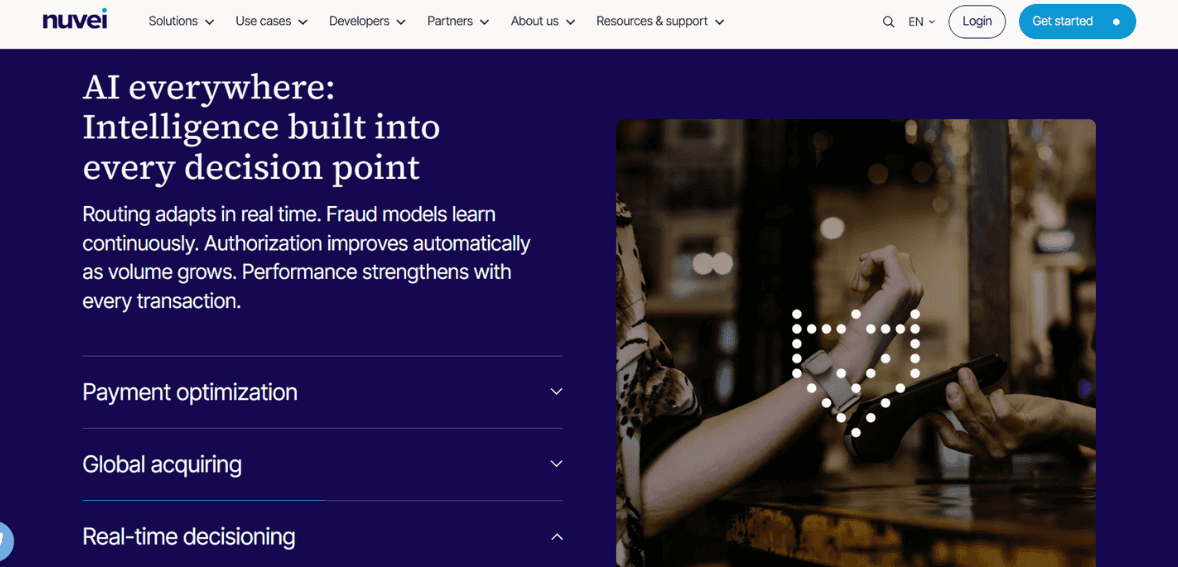
Nuvei’s AI-driven routing system analyzes transaction characteristics in real time and directs each transaction through the acquiring path most likely to result in a successful authorization, based on machine learning models trained on the transaction patterns of Nuvei’s merchant portfolio across 200-plus markets. The routing decision considers card type, issuing bank behavior, transaction amount, currency, and geographic factors simultaneously, selecting the optimal acquiring path dynamically rather than sending every transaction through a fixed single acquirer.
The authorization optimization feature makes an immediate contribution to revenues for those merchants whose decline rates are sizable. For a business in the iGaming space processing 1 million dollars per month with 10% authorization rate optimization through AI-based routing, the contribution to revenues from the improvement will be 100,000 dollars per month in increased processing success rate. For the eCommerce merchants processing high volumes of payments in international markets where the differences in authorization rates of local acquiring and cross-border acquiring are substantial, the accumulated effect of routing optimization through millions of transactions can become a significant competitive cost advantage.
FX optimization is one of the currency management features reducing the cost of multi-currency operations. The point here is in ensuring that currency conversion takes place when optimal, not according to the rates set up by individual acquiring partnerships. An example of 0.5% to 1.5% FX markup mentioned above in the enterprise iGaming analysis is cited as the most narrow range of FX markup among enterprise PSPs.
Card Issuing and Embedded Finance
Nuvei’s card issuing capability allows businesses to issue customizable virtual and physical cards to their users, employees, or customers, with data-driven insights into spending behavior and spending controls configurable to specific use cases. Card issuing within the same platform as payment acceptance and payout disbursement creates a closed-loop financial infrastructure for platforms that want to manage the full money movement lifecycle from receipt through holding to spend.
The embedded finance services including digital banking, referenced in Nuvei’s platform description, extend the potential business model for platforms building on Nuvei infrastructure beyond pure payment processing into broader financial services embedding. This positioning aligns with the direction of the fintech industry broadly, where software platforms increasingly capture more financial services revenue per customer by embedding banking, lending, and payment capabilities alongside their core software product.
The Payoneer acquisition, pending close, will substantially extend this embedded finance positioning. Payoneer’s mass-market multi-currency accounts, local collection capabilities, and marketplace payout infrastructure give Nuvei the consumer-accessible financial services layer that its enterprise payment platform lacks, and the combined entity will be positioned to serve both the large enterprise merchant and the individual seller receiving marketplace payouts through the same infrastructure umbrella.
Agentic Commerce Infrastructure
One of the more forward-looking product developments Nuvei has announced is its agentic commerce infrastructure, targeting initial availability in the second half of 2026. The platform is building protocol compatibility, a KYA registry, agent risk scoring, network certifications, and a developer sandbox to support AI-agent-initiated transactions, all on the Level 1 PCI-certified infrastructure and risk and fraud tooling Nuvei already operates at scale.
Agentic commerce, where AI agents initiate purchases, manage recurring services, or execute financial transactions on behalf of human users, represents an emerging category of payment flow that existing payment infrastructure was not designed to accommodate. The specific challenges include carrying a verifiable mandate confirming that the agent is authorized to act on behalf of the human, managing the risk profile of agent-initiated transactions which differs from standard human-initiated flows, and clearing transactions across appropriate rails for agent-generated purchases.
Whether agentic commerce develops as rapidly and at the scale that Nuvei and others are anticipating is genuinely uncertain. However, the investment in infrastructure for this category, rather than treating it as a feature addition to an existing product, reflects a serious technological bet from a well-resourced company that serves clients at the frontier of payment volume and complexity.
Pricing Structure and the Billing Complaint Pattern
Nuvei does not publish standard pricing, and the pricing structure varies by market, payment method, transaction volume, and the specific contract negotiated for each merchant relationship. For enterprise and high-volume clients, pricing is custom and negotiated, with the economics reflecting the specific capabilities engaged and the volume committed.
A realistic total cost of ownership for an enterprise iGaming operator processing one million dollars monthly across European cards, LATAM local methods, and US sportsbook is estimated at 20,000 to 40,000 dollars monthly before the reserve capital impact, based on publicly available iGaming payment analysis from February 2026.
The rolling reserve of 5% to 10% held for six months, which locks up 50,000 to 100,000 dollars of capital per one million dollars of monthly volume, is a structurally significant cash flow consideration for operators at any scale. The reserve terms are described as lighter than Worldpay’s 8% to 15% for six months or Paysafe’s 7% to 12% for six months, which provides comparative context for the iGaming operator evaluating reserve requirements across providers.
For small and medium-sized merchants, the billing complaint pattern documented in Software Advice reviews is a materially serious concern. A documented complaint describes fees for specialized reports being added without request and then reappearing after reversal, a 35-dollar base monthly fee appearing despite a contract specifying zero dollars, the loyalty team asserting they have the right to change the contract to add fees whenever they want as long as it is noted on the statement, and a 300-dollar early termination fee charged to a merchant who attempted to close an account within the window specified in the statement for penalty-free cancellation.
Another reviewer describes being charged 45 dollars monthly for PCI non-compliance rather than the stated 35 dollars, discovering this only when downloading a statement, and having the company initially refuse a refund before agreeing to refund only 18 months of overcharges rather than the full amount charged, which the reviewer characterized as admitted theft with partial remediation. These documented billing practices reflect a pattern that small and medium-sized merchants should weigh seriously, understanding that the contract terms, fee change provisions, and early termination practices documented in these complaints apply to the same merchant agreement framework that governs all Nuvei accounts regardless of size.
Security and Compliance
Nuvei holds Level 1 PCI DSS certification, the highest tier available for payment service providers, covering its processing infrastructure and data handling practices. Point-to-point encryption, tokenization, and advanced fraud prevention tools are standard components of the platform’s security architecture, providing the layered data protection expected from a processor of Nuvei’s scale and the regulated sectors it serves.
The fraud prevention and risk management capabilities are described as sophisticated across multiple independent assessments, with AI-driven fraud detection that analyzes transaction patterns across Nuvei’s global merchant portfolio providing a threat intelligence advantage proportional to the breadth and diversity of the transaction data being analyzed. For iGaming and financial services clients where fraud exposure is structurally elevated, the quality of fraud management tooling is a meaningful selection criterion that Nuvei’s review record generally supports positively.
Compliance coverage across multiple regulated markets, including regulated gambling jurisdictions and financial services markets with specific payment institution licensing requirements, is a specific and documented investment area that distinguishes Nuvei from payment providers that operate primarily in less regulated commercial contexts. The US state-by-state sports betting licensing framework, the EU payment institution licences, and the Australian financial services licences that support Nuvei’s global operations represent regulatory infrastructure that took years and significant investment to assemble and that cannot be replicated quickly by new market entrants.
Customer Support
Customer support at Nuvei presents a divided picture that mirrors many of the enterprise payment platforms reviewed in this series. Enterprise and high-volume clients with dedicated account management relationships describe responsive, knowledgeable support that proactively addresses issues and provides expertise on payment optimization. The account manager described in one G2 review as having incredible knowledge and guidance, with the integration described as seamless, reflects the high-touch account management experience that enterprise-tier Nuvei relationships are designed to deliver.
The support experience for smaller merchants is documented as meaningfully worse. Setup complexity for smaller businesses is noted as a concern, and customer support response times during peak periods as slower. The billing dispute complaints documented on Software Advice describe support teams asserting rights to add fees mid-contract, initially refusing refunds for documented overcharges, and applying early termination fees during cancellation windows that were specifically communicated as penalty-free. These documented experiences with support during billing disputes represent a specific and serious service quality failure that differs from the general response time and availability concerns that characterize most processor support complaints.
The Syspro ERP partnership announced in May 2026, which embeds Nuvei payment processing directly into Syspro’s ERP platform for manufacturers and distributors, reflects the B2B commercial integration strategy that Nuvei is pursuing alongside its consumer-facing payment acceptance capabilities. Whether partners like Syspro mediate the support relationship for their mutual clients in ways that improve the experience compared to direct Nuvei support is a practical question for businesses considering Nuvei through an ISV or platform partnership channel.
Strengths, Limitations, and Who It Is Best For
Nuvei delivers at enterprise scale what no comparable competitor offers through a single integration: 700-plus payment methods, local acquiring in 50 markets, AI-driven authorization optimization, six pre-built iGaming platform connectors, and US state sports betting licensing. The iGaming client roster of Bet365, DraftKings, and FanDuel validates this capability at the very top of the volume pyramid. The pending Payoneer acquisition will add mass-market cross-border infrastructure that makes the combined entity relevant across a far broader commercial spectrum than Nuvei serves today. The security infrastructure, PCI Level 1 certification, and compliance coverage in regulated markets are genuine competitive assets built over years of investment.
The limitations are real and must be weighed honestly against those strengths. The billing complaint pattern for smaller merchants, covering mid-contract fee additions, overcharge disputes with partial remediation, and early termination fee application during communicated penalty-free windows, represents documented systemic concerns rather than isolated incidents. Pricing is enterprise-grade, requires sales engagement, and includes reserve requirements that lock up material capital for high-volume merchants. Setup complexity is a documented friction point for smaller businesses. Customization flexibility is limited relative to more developer-centric alternatives.
The businesses best positioned for Nuvei are large iGaming operators and regulated sports betting platforms processing high volumes across multiple markets where local method breadth, authorization optimization, and regulatory licensing are non-negotiable requirements; enterprise eCommerce and marketplace businesses for whom a single integration covering 700-plus payment methods in 200-plus markets justifies the premium pricing; financial services and insurtech companies that need sophisticated payment infrastructure with compliance coverage in regulated jurisdictions; and, pending the Payoneer close, the combined entity will extend genuine value to cross-border commerce businesses of all sizes through Payoneer’s mass-market infrastructure.
FAQs
Q1. What does the Nuvei acquisition of Payoneer mean for businesses that currently use either platform?
Nuvei announced the acquisition of Payoneer for 2.75 billion dollars in June 2026, with the combined company expected to generate approximately three billion dollars in annual revenue and process more than 500 billion dollars in annual payment volume for more than 2.4 million customers across 190-plus countries. The transaction was announced with regulatory approval as a condition to close, meaning the combination is not yet final as of the time of this review’s research. For current Nuvei enterprise clients, the addition of Payoneer’s cross-border SMB infrastructure expands the combined platform’s total addressable market without materially changing the enterprise payment capabilities that current Nuvei clients use.
For current Payoneer users, the combination with Nuvei’s enterprise payment technology, local acquiring in 50 markets, and 700-plus alternative payment method coverage could meaningfully expand what is available to them through a single platform relationship. Businesses currently using either platform should monitor communications from their respective account teams about integration timelines, any planned product or pricing changes, and the specific implications for their account type as the transaction progresses toward close.
Q2. How does Nuvei’s pricing compare for a mid-sized eCommerce merchant versus a large iGaming operator?
The pricing experience at Nuvei differs significantly between enterprise-tier clients and smaller merchants, and this difference appears in both the rate structure and the billing practices documented in independent reviews. For enterprise iGaming operators processing one million dollars or more monthly across multiple markets, published analysis from February 2026 suggests a realistic total cost of 20,000 to 40,000 dollars monthly plus reserve capital of 50,000 to 100,000 dollars on one million dollars of monthly volume, with FX markup of 0.5% to 1.5% described as the tightest range among enterprise PSPs in the iGaming sector.
For smaller eCommerce merchants, the pricing structure and billing practices are less favorably characterized in the documented complaint record, with mid-contract fee additions, base monthly fees appearing despite zero-dollar contract terms, and resistance to refunding overcharges all documented in Software Advice reviews. Mid-sized merchants who do not have the negotiating leverage of high-volume enterprise accounts should specifically request written confirmation of all fees applicable to their account, ask about fee change provisions in the contract, and verify the specific early termination terms before signing any agreement with Nuvei.
Q3. Is Nuvei appropriate for a small business, or is it primarily designed for enterprise-scale merchants?
Nuvei’s platform capabilities are designed and priced for enterprise and mid-market businesses rather than small businesses with simple payment needs. The setup complexity is documented as a friction point for smaller businesses, and the billing complaint pattern from smaller accounts suggests a commercial model whose terms and practices create material risk for businesses that cannot actively monitor their statements and dispute unexpected charges. The 700-plus payment methods, local acquiring in 50 markets, AI authorization optimization, and iGaming platform integrations represent capabilities whose value is most fully realized by high-volume merchants operating across multiple markets and payment methods simultaneously.
A small domestic eCommerce business that primarily accepts standard credit cards from a single country does not benefit from most of what distinguishes Nuvei from simpler, more straightforwardly priced alternatives, and the billing pattern documented for smaller Nuvei accounts represents unnecessary commercial risk for businesses that would be better served by providers with more transparent pricing and less complex contractual fee change provisions. The pending Payoneer acquisition may eventually create a more accessible product tier for smaller businesses through Payoneer’s existing SMB infrastructure, but that combination has not yet closed.
Best Product & Services
Recent Posts