
Lightspeed Payments Review
10
Jun 2026

No Comments
Lightspeed Payments Review
Lightspeed Payments is the integrated payment processing service embedded within Lightspeed Commerce’s cloud-based POS ecosystem. Rather than a standalone payment processor competing for merchants independently, Lightspeed Payments is designed to work as the payment layer within Lightspeed’s retail, restaurant, and golf POS platforms, creating a unified commerce experience where the POS software and payment processing share the same data environment, reporting infrastructure, and hardware configuration. Lets read more about Lightspeed Payments Review.
Lightspeed Commerce, Inc. is a Canadian technology company listed on the Toronto Stock Exchange and the New York Stock Exchange under the ticker LSPD, founded in Montreal in 2005 by Dax Dasilva. The company has grown through an aggressive acquisition strategy that brought in Kounta for Australian hospitality market access, Vend for New Zealand retail, ShopKeep for US SMB retail, Ecwid for eCommerce capabilities, and Upserve for restaurant analytics, among others. Lightspeed Payments was introduced as a proprietary payment service to complement and monetize this POS footprint, positioning the company to capture payment revenue from its existing software customer base rather than routing that revenue to third-party processors.
Company Background and Market Position | Lightspeed Payments Review
Lightspeed Commerce began as a retail POS software company and spent its first decade focused on building commerce management tools for small and medium-sized businesses across retail and hospitality. The company’s growth model was built on acquiring complementary software businesses, expanding geographic coverage, and deepening vertical specialization in retail, restaurant, and golf management.
The decision to launch Lightspeed Payments represented a strategic shift: rather than remaining a software business that partnered with payment processors, Lightspeed moved to capture the payment processing revenue generated by its own merchant base. This integrated payments model, where the POS and payments come from the same vendor, follows the pattern established by Square and Toast and reflects the recognition that payment processing margins can substantially increase the revenue per merchant for a POS software company.
Lightspeed Payments launched in the United States and Canada first, with the Australia rollout following through the Kounta subsidiary, which had been acquired in October 2019. The Australian expansion of Lightspeed Payments became legally contentious when Tyro Payments, the fintech whose EFTPOS terminals were used by Kounta merchants, filed proceedings against Kounta in the Supreme Court of New South Wales in September 2023 alleging breach of contract. The court found in Tyro’s favor in November 2023, and a 10 million dollar settlement followed in February 2024.
Today Lightspeed Commerce describes itself as a platform powering businesses in approximately 100 countries, with significant merchant concentrations in the United States, Canada, Australia, New Zealand, the United Kingdom, and continental Europe. Lightspeed Payments is available in the US and Canada, with payment capabilities in other markets delivered through partnerships with local payment providers rather than through the proprietary Lightspeed Payments product directly.
Core Payment Processing Capabilities
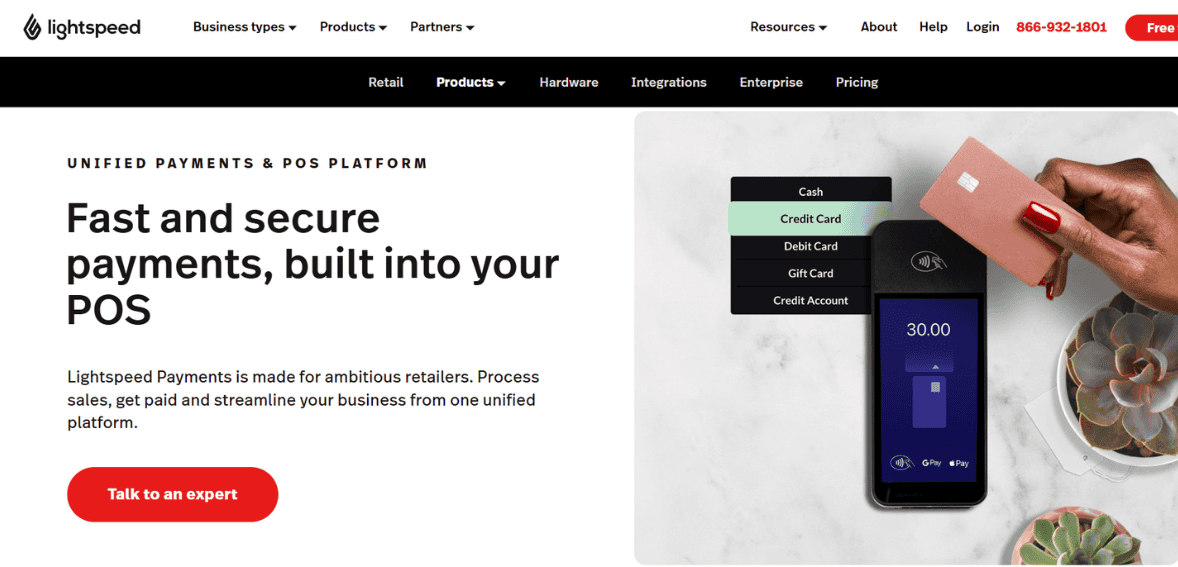
Lightspeed Payments processes credit and debit card transactions across all major card networks including Visa, Mastercard, American Express, and Discover. The service supports all major transaction types: in-person card-present transactions through Lightspeed’s integrated hardware, online transactions through eCommerce integrations, and card-not-present transactions through the virtual terminal functionality.
Methods for accepting payments include the use of the EMV chip card, the magnetic stripe, and contactless NFC payments that cover both the use of contactless cards as well as mobile wallets like Apple Pay and Google Pay. A full range of current consumer payment methods is covered, providing up-to-date support in line with standard customer behavior within the retail and hospitality industry sectors.
The system used for processing payments by Lightspeed Payments is operated by Lightspeed itself and is not licensed from a single third-party provider. This provides the Lightspeed company with increased control over their own process and an opportunity to create a tight integration between payment information and POS system data. The above factor is the only technical benefit associated with having a proprietary payment system as compared to using another vendor’s payment technology.
Lightspeed supports offline payment processing, with transactions being stored until a network is available and processed later when the connection is established again. This feature allows a seamless transaction flow in cases where network reliability is not guaranteed, eliminating the need for additional hardware or manual record-keeping.
Integrated POS and Payments Architecture
The core value proposition of Lightspeed Payments is its integration with Lightspeed’s POS software, and understanding this integration is essential to evaluating whether the payment service is worth its cost relative to alternatives. When payment processing and POS software come from the same vendor, the data generated by each function flows into the same environment without requiring export, import, or reconciliation steps between separate systems.
In practice this means that a sale processed through Lightspeed Payments is simultaneously a transaction record in the payment system and an inventory movement in the POS system, a data entry in the customer’s purchase history, an input to the real-time analytics dashboard, and a revenue figure in the business performance reports. Each of these connections exists automatically rather than requiring manual linking or a custom integration, and the elimination of that manual work is the primary operational benefit of the integrated approach.
For retail businesses, the inventory management integration is particularly valuable. Lightspeed Retail POS includes one of the more sophisticated inventory management systems available in the SMB POS market, covering product variants, bundles, serialized items, purchase ordering, and preloaded product catalogs with more than eight million items through NuORDER integration. When payment processing flows through the same system, inventory adjustments triggered by sales are immediate and automatic rather than dependent on a data sync between separate systems.
For restaurant businesses, the SkyTab-competing Lightspeed Restaurant platform connects table management, order routing, kitchen display communication, and split payment handling through the same integrated environment. Payment splits, tip handling, and course management that require real-time coordination between the POS and the payment system are handled within a single coherent application rather than across two vendor relationships that need to communicate reliably.
Pricing: Transaction Rates and Monthly Fees
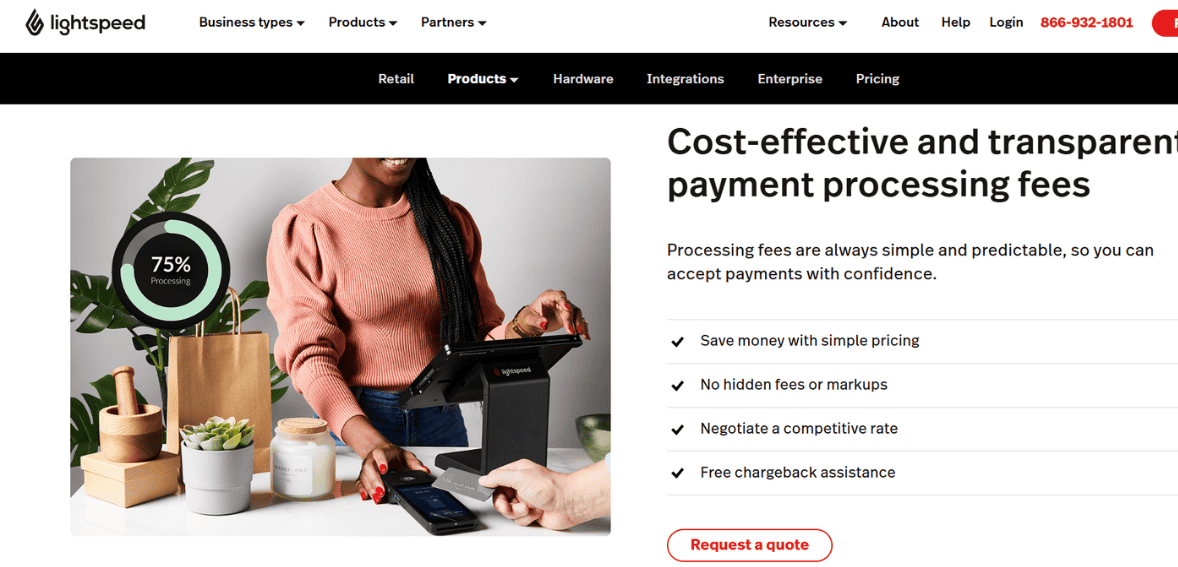
Lightspeed Payments charges a flat rate of 2.6% plus 10 cents per in-person transaction and 2.9% plus 30 cents for online transactions. These rates are straightforward and competitive relative to the market for integrated POS payment processing, sitting in the same range as Square’s flat-rate structure and below the effective rates many merchants pay under tiered pricing arrangements with traditional processors.
The monthly subscription fees for the Lightspeed POS software are separate from the payment processing rates. Lightspeed Retail POS plans start at 109 dollars per month for the Basic plan, 179 dollars for the Core plan, and 339 dollars for the Plus plan, with annual billing offering approximately 20% savings. Restaurant and golf plans are priced separately. These subscription fees are for the POS software and apply regardless of which payment processor is used.
The significant pricing dynamic that merchants need to understand is the third-party processor surcharge. Merchants who choose to use a payment processor other than Lightspeed Payments are charged a substantially higher subscription rate for the POS software, with independent reviewers noting that Lightspeed charges additional monthly fees of up to 400 dollars for using external processors. This structure creates a financial incentive, or depending on perspective a financial penalty, for using a third-party processor rather than Lightspeed Payments, even if the merchant has an existing processor relationship or can negotiate better rates elsewhere.
This third-party processor surcharge is one of the most consistently noted concerns in independent evaluations of Lightspeed. Merchants with high processing volumes who could potentially negotiate better interchange-plus rates with a third-party processor need to model whether the processing fee savings exceed the additional monthly POS software cost before making that decision. For high-volume merchants, the math may favor the third-party processor despite the surcharge. For lower-volume merchants, the flat-rate structure of Lightspeed Payments is likely competitive, and the convenience of the integrated system may justify accepting the flat rate rather than negotiating separately.
Hardware and Terminal Ecosystem
Lightspeed Payments operates through Lightspeed’s integrated hardware ecosystem, which includes iPad-based POS configurations and a range of accessories designed to work within the Lightspeed POS environment. Hardware is ordered through Lightspeed’s online store, with individual product pricing publicly available.
The Mobile Tap V2 card reader, priced at 79 dollars, provides contactless, chip, and swipe card acceptance through a compact device compatible with smartphone and tablet configurations. The Universal Tablet Stand at 89 dollars provides a customer-facing display configuration with a swivel base for transaction review and contactless payment at the counter. Full iPad and desktop hardware kit pricing is quote-based rather than published, reflecting the variable nature of multi-component POS setup costs.
The hardware system is specially designed for Lightspeed systems as opposed to hardware-agnostic. This implies that the merchants will only be able to use the Lightspeed card readers and not any other card readers in conducting transactions through Lightspeed Payments. This restriction in the hardware is a compromise since it ensures that the software and hardware function compatible but at the cost of some restrictions in merchants’ choice of hardware.
There is a provision of the functionality of a customer-facing display that allows for customers to see their transaction details and make payments based on those details as opposed to blindly paying for amounts presented to them. This feature is especially crucial in the hospitality industry since customers might not have had an opportunity to see their bills prior to payment.
Omnichannel and eCommerce Integration
Lightspeed Payments connects in-store and online payment processing within Lightspeed’s unified commerce platform, allowing merchants to manage payments across physical and digital channels through a single integrated environment. The eCommerce capabilities, significantly strengthened through the Ecwid acquisition, allow merchants to sell online with payment processing through Lightspeed Payments, maintaining consistent data flow between in-store and online transactions in the reporting and inventory management systems.
The online transaction processing feature of Lightspeed Payments is applicable to merchants who use Lightspeed eCommerce software, and the 2.9% plus 30 cents online rate applies to card transactions conducted via the eCommerce channel. The relationship between the two inventories online and in-store implies that an item purchased online impacts the inventory record in the same way an item bought at the store does, preventing duplication or inventory mismatch due to lack of synchronization between the two channels.
When it comes to multi-locations, cloud technology adopted by Lightspeed allows for centralizing payment processing and sales activities across various locations through a unified reporting interface. Centralized access to this type of information can provide retailers and restaurant chains with a tangible benefit when analyzing the performance of different stores and managing inventory levels as well as promotions centrally.
Lightspeed Payments, being integrated with the loyalty program capability within the POS, helps to unify the customer experience during purchasing by providing an opportunity for tracking their spending behavior and earning rewards and then redeeming them through the same system used for payment processing, thus avoiding additional scanning of loyalty cards and account lookup procedures at checkout.
Geographic Availability and International Limitations
Lightspeed Payments is available in the United States and Canada only as of 2026. This is a meaningful geographic limitation for merchants operating internationally or evaluating Lightspeed for locations outside North America.
In Australia and New Zealand, Lightspeed’s hospitality merchants use the platform that was formerly Kounta, now branded as Lightspeed Restaurant in those markets. Payment processing in these markets is handled through integrations with local payment providers rather than through the proprietary Lightspeed Payments product, and the specific payment terms, rates, and hardware available differ from the North American offering.
In European markets, Lightspeed serves merchants through its retail and restaurant POS platforms with payment processing handled through regional partnerships. Merchants evaluating Lightspeed for European deployments should ask specifically about the payment options and terms applicable to their country, as they will not be the same as the Lightspeed Payments product available in North America.
For multinational merchants considering Lightspeed for a presence across the US, Canada, and other markets simultaneously, the geographic inconsistency of the payment offering means that the integrated payments experience available in North America may not be replicated in non-North American locations. This is a practical consideration for any business planning international operations within a single POS ecosystem rather than a concern for merchants operating exclusively in North America.
The Tyro Dispute and Australian Market Context
The legal dispute between Tyro Payments and Kounta, Lightspeed’s Australian subsidiary, is relevant context for understanding how Lightspeed Payments was introduced in Australia and what that introduction cost in financial and reputational terms.
Tyro Payments, a major provider of EFTPOS terminals for Australian hospitality businesses, had a contractual agency relationship with Kounta under which Kounta directed its merchants toward Tyro terminals for payment processing. Following the Lightspeed acquisition of Kounta in 2019, Lightspeed developed its own payment processing product and began marketing it to merchants in Australia, including to merchants who were already Tyro customers through their Kounta POS relationship.
Tyro filed proceedings in the Supreme Court of New South Wales in September 2023, alleging that Kounta had breached its contractual non-solicitation obligations to Tyro by marketing the competing Lightspeed Payments service to Tyro’s merchant base. Tyro further alleged that Kounta imposed additional fees on merchants who used the Lightspeed POS software but chose to retain their Tyro payment terminals rather than switching to Lightspeed Payments, effectively creating a financial incentive for merchants to switch payment processors in a direction that benefited Lightspeed at Tyro’s expense.
The Supreme Court of NSW found in Tyro’s favor in November 2023, issuing a restraint preventing Kounta from soliciting Tyro merchants to switch to Lightspeed Payments. Kounta filed an appeal, but in February 2024 the parties settled, with Kounta paying Tyro 10 million dollars in damages, dropping the appeal, and agreeing to a continuing restriction on merchant solicitation until September 2024 applying to Kounta, Lightspeed Commerce, Inc., and Vend Limited.
The outcome of this dispute is directly relevant to Australian merchants evaluating Lightspeed’s payment products. The court finding and settlement confirm that the manner in which Lightspeed Payments was introduced to Australian merchants through the Kounta channel involved conduct that breached contractual obligations and was found by a court to be inappropriate. Merchants should factor this context into their evaluation of how Lightspeed manages its commercial interests in payment processing relationships.
Reporting and Analytics
One of the most genuine strengths of the Lightspeed Payments integration is the unified reporting environment it enables. When payment processing and POS software data share the same infrastructure, the reporting available to merchants reflects their complete business picture rather than requiring separate reports from separate systems to be manually combined.
Real-time analytics across multiple locations and sales channels are accessible through Lightspeed’s dashboard from any internet-connected device. Sales performance by product, category, time period, employee, and location can be viewed alongside payment method breakdown, refund activity, and transaction counts without any additional data integration steps. For multi-location retailers and restaurant groups, this consolidated view supports the operational decision-making that benefits from timely, complete data.
The advanced reporting functionality offered by higher-tier levels of the plan features customer behavior tracking, product performance analysis, as well as periodical comparisons that can help businesses track their seasonal trends and see how certain changes impacted their results. In terms of the link between inventory tracking and sales reporting, users benefit from having visibility into both processes and can make better-informed decisions when it comes to buying stock.
The reporting functionality is often noted in the best reviews because it is considered an extremely useful feature that helps merchants see the true benefits of working with the cloud-based solution, such as convenient access from anywhere using different devices, multi-location management capabilities, and detailed reports that go down to product level. Merchants that worked in the hospitality or retail industry but used different systems for POS and payments before would especially appreciate how streamlined the process became.
Customer Support
Lightspeed offers 24/7 chat support as a standard feature, with phone support and dedicated account management available at higher plan tiers. The breadth of self-service support resources including documentation, onboarding guides, video tutorials, and webinars is consistently noted positively in user reviews, with one independent reviewer describing Lightspeed as a platform where you are certainly not going to feel lost at any point given the volume and quality of available guidance.
The support model reflects Lightspeed’s positioning as a platform for more established small and medium-sized businesses rather than casual or first-time operators. The depth of documentation assumes that users are building a real commerce operation and need substantive guidance on advanced features, not just basic setup instructions. For merchants who value comprehensive self-service resources alongside responsive live support, the Lightspeed support model compares favorably to competitors who provide thinner documentation and rely primarily on phone support.
Where the support experience becomes more complicated is in multi-product deployments that span acquired platforms. Merchants using Lightspeed in markets where the underlying technology came from an acquired company, such as Australia and New Zealand where the Kounta heritage is still present, may encounter some fragmentation in support quality depending on which aspects of their deployment are handled by legacy infrastructure versus the consolidated Lightspeed platform. This is a transitional issue that should diminish as the platform consolidation progresses, but it is worth asking about specifically during the evaluation process.
The back-office setup complexity noted in multiple independent reviews is a fair counterbalance to the positive support feedback. Lightspeed’s feature depth means that initial configuration involves more decisions and steps than simpler POS systems, and merchants who underestimate the setup effort may find the learning curve steeper than expected even with good support resources available.
Strengths, Limitations, and Who It Is Best For
Lightspeed Payments is genuinely strong when evaluated as what it is designed to be: the payment layer within a comprehensive, cloud-based, omnichannel commerce platform for retail and hospitality businesses that have grown beyond the needs of basic POS systems. The flat-rate pricing at 2.6% plus 10 cents in-person and 2.9% plus 30 cents online is competitive for the integrated POS market segment.
The unified data architecture that connects payment processing, inventory management, customer profiles, loyalty, and analytics through a single platform is a real operational advantage that reduces manual reconciliation, improves data quality, and supports better business decisions. The 24/7 support, comprehensive documentation, multi-location management, and omnichannel capabilities are genuine strengths relative to simpler alternatives.
The limitations are equally real and documented. Geographic availability of Lightspeed Payments is limited to the United States and Canada, which constrains its value for merchants with international operations. The third-party processor surcharge of up to 400 dollars per month creates a financially coercive dynamic that reduces merchant flexibility and has been noted critically by independent evaluators. Pricing increases quickly with additional registers, locations, and add-ons, making the total cost of ownership for complex multi-location deployments materially higher than the base plan rates suggest.
The Tyro dispute and its 10 million dollar settlement raises questions about how Lightspeed manages its payment processing commercial interests in markets where existing partnership obligations exist. And for smaller, simpler businesses, the platform’s depth may be more than is needed at a cost that does not match the operational complexity being managed.
The merchants best positioned to benefit from Lightspeed Payments are established small and medium-sized retailers in the US and Canada operating one or more locations with meaningful inventory complexity, hospitality businesses that need a restaurant POS platform with integrated payment processing across table service and counter service environments, multi-location businesses that want consolidated reporting across all sites in a single cloud-based environment, and merchants who value the operational simplicity of a single vendor relationship for POS software and payment processing over the maximum possible pricing flexibility.
FAQs
Q1. Can Lightspeed merchants use a third-party payment processor instead of Lightspeed Payments, and what does that cost?
Yes, Lightspeed merchants can use third-party payment processors with Lightspeed’s POS software, but the financial penalty for doing so is significant. Merchants who choose a processor other than Lightspeed Payments are charged a substantially higher monthly subscription rate for the POS software, with independent reviewers noting additional fees of up to 400 dollars per month compared to the rate available to merchants using Lightspeed Payments.
This surcharge structure means that a merchant considering a third-party processor needs to calculate whether the savings from better negotiated processing rates exceed the additional monthly software cost before making that choice. For high-volume merchants who process significant monthly transaction values, the better rates potentially available through an interchange-plus arrangement with a third-party processor may justify the surcharge.
For lower-volume merchants, the all-in economics typically favor Lightspeed Payments despite the flat rate being potentially above what high-volume merchants could negotiate. Any merchant evaluating this trade-off should model both scenarios at their actual processing volume before deciding.
Q2. Is Lightspeed Payments available in Australia, and what happened with the Tyro Payments legal dispute?
Lightspeed Payments as a proprietary product is available in the United States and Canada only. In Australia and New Zealand, Lightspeed serves merchants through its Lightspeed Restaurant and Lightspeed Retail platforms, which were originally built on the Kounta and Vend technology acquired in 2019, with payment processing handled through local payment provider integrations rather than the proprietary Lightspeed Payments product.
The Tyro Payments legal dispute arose from Lightspeed’s attempt to introduce its own payment service in Australia through the Kounta subsidiary. Tyro, whose EFTPOS terminals were used by Kounta’s merchant base, filed proceedings alleging that Kounta had breached contractual obligations by marketing Lightspeed Payments to Tyro merchants and imposing additional fees on merchants who retained Tyro terminals rather than switching to Lightspeed.
The Supreme Court of NSW found in Tyro’s favor in November 2023, and in February 2024 Kounta settled, paying Tyro 10 million dollars in damages and dropping its appeal. Australian merchants using Lightspeed’s POS platform should ask specifically about the current payment processing options available to them and the terms applicable to each option, understanding that the payment offering in Australia has been shaped by this legal context.
Q3. How does Lightspeed Payments compare to Square for a small retail business choosing between the two?
The comparison between Lightspeed Payments and Square for a small retailer depends heavily on the complexity of the business and the stage of its growth. Square’s key advantages are pricing simplicity, zero monthly software fees for its base plan, broad hardware compatibility, and an onboarding experience designed for businesses at the very beginning of their retail journey.
Lightspeed Payments’ advantages are deeper inventory management, stronger multi-location support, more advanced reporting and analytics, better integration with wholesale ordering platforms like NuORDER, and a platform that scales more naturally to the operational complexity of an established multi-location retailer. For a business just starting out with simple inventory and a single location, Square’s lower total cost and simpler setup make it the more practical starting point.
For a business with meaningful inventory complexity, multiple locations, or the operational sophistication to benefit from Lightspeed’s advanced features, the additional monthly cost of the Lightspeed platform may be justified by the operational efficiency and data quality improvements it enables. The flat processing rates of both platforms are broadly similar, with Lightspeed at 2.6% plus 10 cents in-person and Square at 2.6% plus 10 cents in-person matching almost exactly, meaning the processing cost comparison is not a differentiating factor and the decision is driven by the software capabilities and total monthly cost at the merchant’s specific volume and location count.
Best Product & Services
Recent Posts