

National Bankcard Review
By 10topmerchantservices October 8, 2025
National Bankcard is a well-established name in the U.S. payments industry, known for providing merchant services to small businesses, e-commerce sellers, and larger enterprises seeking secure payment processing. With so many providers competing for attention, merchants often find it difficult to distinguish one from another. National Bankcard has carved out a space for itself by offering a broad portfolio of services that aim to simplify transactions and give businesses the infrastructure needed to accept payments quickly and securely. Lets read more about National Bankcard Review.
This review takes a deeper look at what National Bankcard brings to the table. Instead of focusing on marketing claims, it examines the company’s history, services, pricing, hardware, integrations, and customer support. By weighing strengths and weaknesses, businesses can better understand how National Bankcard compares to other providers and whether its features justify the cost. Transparency, reliability, and flexibility often matter just as much as competitive rates, and this review explores where National Bankcard succeeds and where it leaves room for caution.
Company Overview and Background | National Bankcard Review
National Bankcard has been in the merchant services industry for many years, offering businesses an entry point into the complex world of payment acceptance. The company positions itself as a one-stop provider, helping merchants navigate banking networks and technology without relying on multiple vendors. Its client base includes traditional storefront retailers, restaurants, service-based businesses, and e-commerce companies, demonstrating flexibility across multiple industries.
The payments landscape has changed rapidly over the last decade. Consumers now expect digital wallets, mobile payments, and online checkout options alongside traditional cards. National Bankcard has adapted by expanding beyond countertop terminals into e-commerce gateways and mobile readers. This evolution allows businesses of varying sizes to find a suitable solution, whether they need a reliable terminal for in-store use, a shopping cart integration for online sales, or a mobile reader for payments on the go.
One of the company’s strengths lies in its attempt to bridge traditional reliability with modern demands. While some providers target either startups or large enterprises exclusively, National Bankcard markets itself to a broad spectrum. That wide positioning can be beneficial for businesses seeking flexibility, but it may also mean that highly specialized industries will not find the same level of tailored support as they might with niche providers. Understanding this broad market focus helps frame the evaluation of their specific offerings.
Core Services Offered
At the center of National Bankcard’s business is credit and debit card processing, covering Visa, Mastercard, American Express, and Discover. Alongside this core function, the company provides merchants with check processing, gift card programs, and loyalty solutions. These additional tools are designed to expand revenue streams and improve customer retention.
For physical retailers and restaurants, National Bankcard supplies POS systems and countertop terminals that support high-volume, fast-paced environments. E-commerce businesses gain access to an online gateway with fraud detection, recurring billing, and integrations with popular shopping cart platforms. Meanwhile, mobile service providers and event-based sellers can use portable readers connected to smartphones or tablets.
The company also emphasizes reporting and analytics, offering merchants the ability to track transactions, monitor chargebacks, and identify sales patterns. This breadth of service demonstrates an effort to cover multiple channels rather than specialize in one. While this flexibility is valuable, it can also mean that some tools are functional but not as advanced as those from specialized providers.
Payment Gateway and Online Solutions
E-commerce continues to dominate retail growth, and National Bankcard provides a gateway that connects online merchants to secure processing networks. Features include recurring billing, tokenization for securely storing customer data, and compatibility with major shopping carts. For businesses selling subscriptions, these functions reduce the need for manual invoicing and ensure consistent revenue collection.
Fraud detection measures are also bundled into the gateway. Suspicious transactions can be flagged before final approval, helping merchants minimize chargebacks and losses. Although these tools are standard across the industry, their inclusion ensures that National Bankcard meets basic merchant expectations.
Compatibility with popular platforms such as Shopify, WooCommerce, and Magento is another advantage. While integration may require technical setup or developer assistance in some cases, businesses without in-house IT support may find the process manageable with external help.
The gateway provides solid functionality but does not stand out as a groundbreaking innovation. For businesses with moderate e-commerce needs, it is sufficient. However, enterprises that rely heavily on advanced fraud prevention or specialized subscription tools may find greater value in dedicated e-commerce processors.
POS Systems and Hardware Options
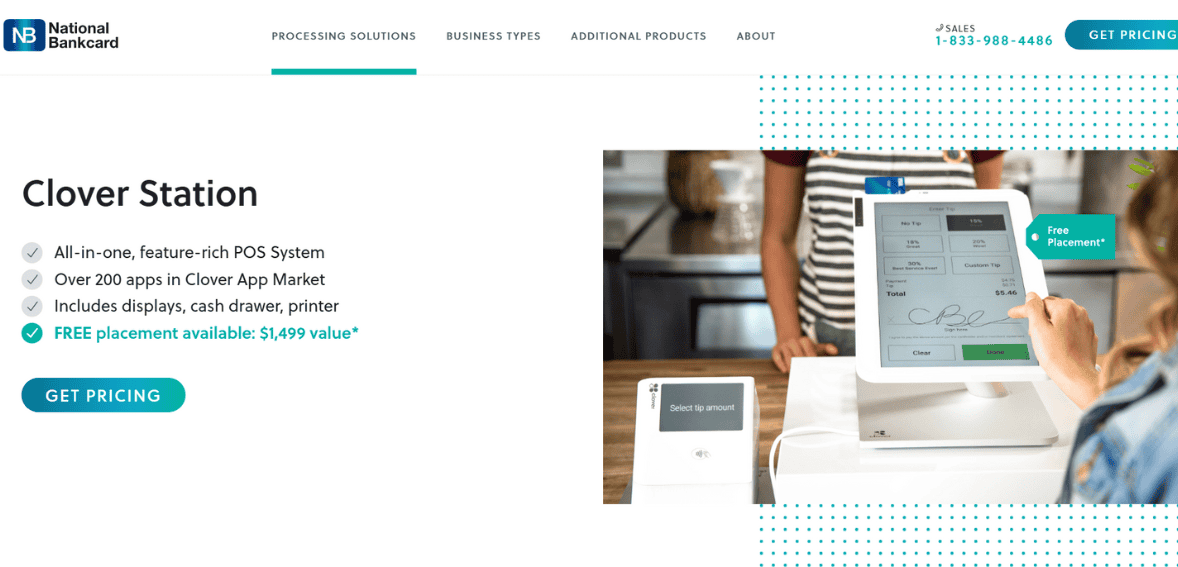
Point-of-sale systems remain critical for brick-and-mortar businesses, and National Bankcard offers a range of hardware options. Countertop terminals that support magnetic swipe, chip, and contactless payments provide familiar reliability. For more advanced needs, integrated POS systems include inventory management, employee tracking, and sales reporting.
Restaurants can access POS systems designed for order management, table tracking, and tip adjustment. Retailers may prefer systems with barcode scanning and receipt printing. For mobile businesses, wireless terminals and portable readers allow payments to be processed outside of fixed locations.
Hardware reliability is crucial since downtime directly affects revenue. National Bankcard partners with well-known manufacturers, reducing the risk of equipment failure. Still, merchants should clarify warranty policies, replacement terms, and any fees tied to leasing or renting equipment.
While the equipment catalog is comprehensive, competitors increasingly highlight touchscreen smart terminals with advanced features. National Bankcard leans toward proven reliability over innovation, appealing to businesses that prioritize stability over experimentation.
Mobile and Contactless Payments
The rise of mobile wallets and touch-free transactions has changed consumer behavior. National Bankcard provides card readers compatible with smartphones and tablets that accept EMV chips and NFC-based payments such as Apple Pay and Google Pay. These tools are particularly useful for delivery services, repair providers, and vendors at temporary locations.
Merchants also gain access to an app that connects mobile devices to the processing network. Through the app, users can process payments, view basic reports, and issue refunds. While the functionality does not rival advanced mobile POS systems, it covers the essentials for small businesses.
The emphasis on contactless payments reflects shifting consumer expectations. Many customers prefer touch-free checkout for speed and safety, and businesses without NFC capability risk falling behind. National Bankcard’s support in this area ensures merchants can remain competitive, even if the mobile ecosystem does not yet rival the advanced offerings of fintech-driven platforms.
Pricing and Fees Structure
Pricing remains one of the most important and contentious aspects of any payment processor. National Bankcard, like many traditional providers, does not list standardized rates publicly. Instead, fees often depend on business type, volume, and perceived risk. Merchants may encounter tiered pricing or, in some cases, interchange-plus models depending on negotiations.
Common charges include transaction fees, monthly account fees, PCI compliance costs, and gateway fees for online processing. Some merchants have reported contracts with early termination penalties, a factor that can complicate switching providers if dissatisfaction arises. This lack of transparency can frustrate smaller merchants who prefer predictable costs.
On the positive side, larger businesses that process higher volumes may be able to negotiate significantly lower transaction rates. Equipment placement programs sometimes reduce upfront hardware costs, though they may involve recurring leasing expenses.
The main takeaway is that pricing is highly variable. Merchants should request detailed contract terms, confirm whether interchange-plus pricing is available, and clarify early termination policies before signing. Evaluating total costs over the length of a contract is essential to avoid unexpected expenses.
Security and Compliance
Protecting customer data is a non-negotiable requirement in payment processing. National Bankcard aligns with PCI DSS standards, ensuring merchants follow the rules established by the Payment Card Industry Security Standards Council. Encryption and tokenization tools secure sensitive data and reduce risks of breaches.
Fraud prevention measures include filters, alerts, and chargeback management tools that allow businesses to dispute transactions effectively. For online sellers, support for AVS (address verification) and CVV checks adds another safeguard against unauthorized card use.
While these features meet industry expectations, they do not necessarily distinguish National Bankcard from competitors. Still, the company provides the baseline protections merchants should expect, ensuring compliance and risk reduction. Businesses with higher risk profiles may still need specialized fraud solutions layered on top of what National Bankcard offers.
Integrations and API Support
Smooth integrations are crucial for businesses that rely on multiple software systems. National Bankcard provides APIs for connecting payment processing to third-party platforms such as shopping carts, accounting software, and CRM systems. Automating these data flows reduces manual bookkeeping, improves accuracy, and enhances customer management.
For example, linking sales data directly into accounting software eliminates time-consuming reconciliations. Integration with CRM systems allows customer loyalty and purchase history to be tracked seamlessly. National Bankcard’s plug-and-play compatibility with Shopify and WooCommerce is useful for e-commerce merchants who want straightforward setups.
However, businesses with highly technical needs or custom workflows may find the available integrations limited. While the documentation supports flexibility, developer assistance may be required for advanced implementations. For most small-to-medium-sized merchants, the integration support is adequate, but it may not satisfy enterprise-level requirements.
Customer Support and Reliability
Customer support quality often determines whether a payment processor becomes a long-term partner or a short-term experiment. National Bankcard provides phone, email, and in some cases live chat support. Availability is marketed as round-the-clock, though merchant experiences vary. Some report quick, helpful responses, while others describe delays in issue resolution, particularly around billing disputes.
Larger clients often benefit from dedicated account representatives, giving them faster access to assistance. Smaller businesses may rely on general support lines, which can create inconsistent experiences depending on account size.
Reliability of the processing network itself is generally solid, with minimal downtime reported. Since the company leverages established banking infrastructure, most merchants experience steady service. However, as with any provider, occasional outages are possible, and businesses should evaluate whether backup plans are in place.
Pros of Using National Bankcard
National Bankcard’s advantages stem from its breadth of service. Businesses can manage in-store, online, and mobile transactions under one provider. The availability of POS systems, mobile readers, and online gateways provides flexibility for diverse models. Security compliance is strong, ensuring basic protections for sensitive data.
Merchants processing high volumes can negotiate competitive rates, making the service cost-effective in certain scenarios. Integration with common platforms also reduces administrative burdens. Finally, the company’s longevity in the industry gives it credibility, offering reassurance to merchants who prefer working with established providers.
Cons and Limitations
The biggest drawback reported by many merchants is pricing transparency. Without standardized interchange-plus offerings advertised upfront, contracts may involve tiered pricing and hidden fees. Long-term contracts with early termination penalties can also lock businesses into arrangements that are difficult to exit.
Customer support quality is inconsistent, particularly for smaller businesses. While larger accounts may receive dedicated attention, smaller merchants may struggle to get quick resolution. Equipment leasing programs may reduce upfront costs but can accumulate into long-term expenses that outweigh ownership.
Innovation is another area where the company lags. While it provides the basics across mobile and online payments, competitors in the fintech sector often deliver more advanced tools with clearer pricing models. Businesses seeking cutting-edge solutions may find National Bankcard more conservative than expected.
Ideal Business Types for National Bankcard
National Bankcard is versatile, serving retailers, restaurants, service providers, and e-commerce merchants. Restaurants benefit from tipping and order management functions, while retailers value inventory tracking and barcode support. Mobile businesses gain from portable readers that allow payments at client sites or events.
E-commerce sellers find recurring billing and fraud detection useful, particularly for subscription models. Professional service providers may appreciate reporting features that simplify billing and chargeback management.
The company is best suited for small to mid-sized businesses that need a balance of in-store and online acceptance without deep customization. Larger enterprises with complex technical needs may require more specialized providers.
Competitor Comparison
Against competitors, National Bankcard’s strengths lie in its longevity and service breadth. Unlike newer fintech entrants that focus heavily on one channel, National Bankcard provides a multi-channel solution. However, transparency and innovation are areas where rivals often hold an edge.
Flat-rate processors like Square or Stripe appeal to merchants who prefer simplicity, while other traditional providers may offer more advanced POS ecosystems. Businesses must decide whether stability and experience outweigh the appeal of transparent rates and modernized platforms.
Final Verdict
National Bankcard delivers a comprehensive suite of merchant services covering card processing, POS systems, mobile acceptance, and online gateways. It performs reliably, meets compliance requirements, and integrates with common platforms. Larger merchants can benefit from negotiated rates, while smaller merchants gain flexible hardware and multi-channel options.
However, the company’s lack of pricing transparency, potential for restrictive contracts, and mixed support quality are significant considerations. It may not be the most innovative provider, but it remains a credible choice for businesses seeking established reliability. Merchants considering National Bankcard should review contracts closely, clarify fees, and evaluate support responsiveness before committing.
FAQs
Q1. Is National Bankcard suitable for small businesses just starting out?
Yes, National Bankcard offers entry-level tools that help small businesses accept payments. However, new merchants should carefully review contracts and confirm pricing terms to avoid hidden fees.
Q2. Does National Bankcard support e-commerce integrations with popular platforms?
Yes, National Bankcard’s gateway integrates with Shopify, WooCommerce, Magento, and other platforms. These integrations make it easier for online sellers to process transactions.
Q3. Are there cancellation fees with National Bankcard?
Yes, depending on the contract, early termination fees may apply. Merchants are advised to confirm cancellation policies in writing before signing an agreement.

Merchant One Review
By 10topmerchantservices October 3, 2025
Merchant One is a well-established credit card processing company that provides businesses with a range of tools to manage transactions efficiently. Over the years, it has positioned itself as a payment solutions provider catering primarily to small and medium-sized enterprises, though it also works with larger organizations. Its value proposition lies in making electronic payments more accessible, whether through point-of-sale systems, ecommerce gateways, or mobile readers. Lets read more about Merchant One Review.
The payments industry has undergone tremendous change in the last two decades, with consumer preferences shifting from cash to card, and more recently, toward digital wallets. Companies like Merchant One have grown alongside this shift, offering technology and service bundles that simplify complex aspects of accepting payments. Instead of focusing exclusively on hardware or software, Merchant One combines both, creating an ecosystem that supports modern businesses.
While the company highlights flexibility and customer service as its strengths, it also operates in a crowded market where transparency and reliability are key decision-making factors for merchants.
Company Background and History | Merchant One Review
Founded in 2002, Merchant One is headquartered in Miami, Florida, and has grown steadily to become a recognizable name in the payment processing industry. The company started with a goal to simplify how small businesses accept card payments at a time when setting up merchant accounts was often complicated and expensive. Over time, its client base expanded to include retailers, restaurants, service providers, and ecommerce businesses.
One of the reasons Merchant One has been able to maintain a presence in a highly competitive sector is its ability to adapt to new technologies and industry standards. From the introduction of EMV chip cards to the rise of mobile payments and contactless transactions, the company has consistently updated its offerings. By doing so, it has aligned itself with the expectations of both merchants and their customers.
Today, Merchant One claims to serve more than 350,000 businesses across different industries. This reach demonstrates not just longevity but also the ability to scale its operations. For many merchants, particularly those without large budgets, the appeal of a provider that understands the needs of smaller enterprises has been central to Merchant One’s growth. Its continued investment in partnerships and technology reinforces its role as a stable, mid-tier player in the U.S. payment ecosystem.
Partnership with Fiserv and Clover Systems
One of Merchant One’s biggest strengths is its partnership with Fiserv, a global leader in financial services technology. Fiserv provides the backbone infrastructure that enables secure and reliable transactions. For merchants, this partnership translates into confidence that their provider is backed by one of the most established names in the industry.
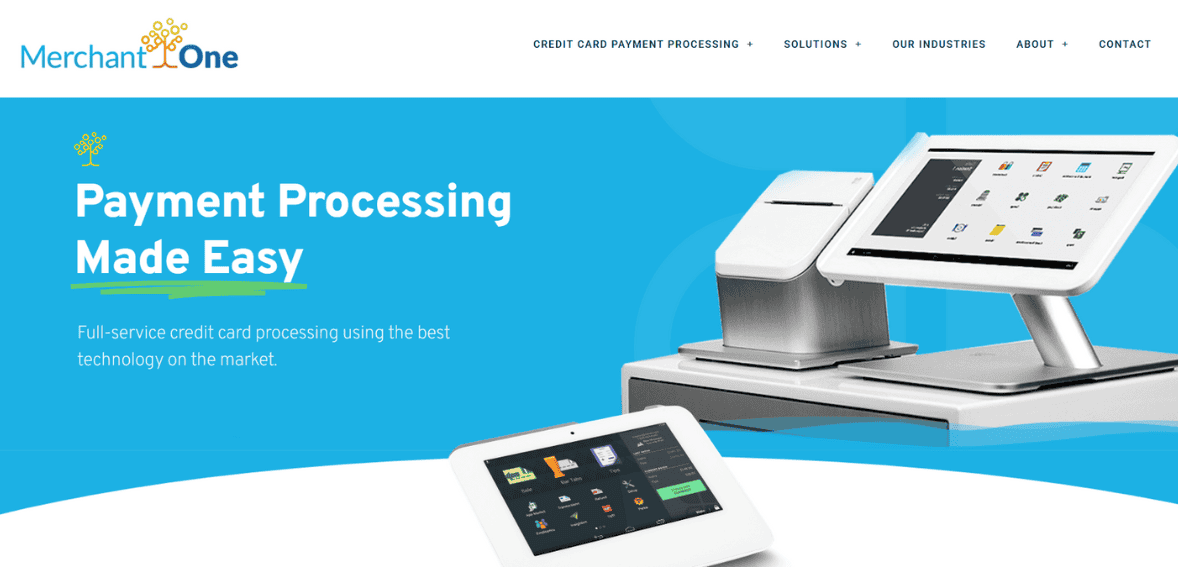
Through this relationship, Merchant One is able to offer Clover POS systems, which are among the most popular in the U.S. Clover hardware includes countertop terminals, mobile devices, and full POS stations that support everything from payment acceptance to inventory management. The availability of these systems gives Merchant One a competitive edge because it can provide tools that scale with a business’s growth.
Having access to Fiserv’s technology also ensures compliance with security regulations and the ability to handle large transaction volumes. This makes Merchant One suitable not just for small shops but also for mid-sized businesses with higher processing demands. While many independent sales organizations (ISOs) in the payment space struggle with credibility, Merchant One benefits from being tied to a trusted global processor. This affiliation reinforces reliability and helps mitigate concerns about operational risks.
Products and Services Overview
Merchant One’s portfolio covers a broad spectrum of payment solutions designed to serve different business models. At the core, it offers merchant accounts that allow businesses to accept credit and debit card payments. Beyond that, its services include:
Point-of-Sale Systems: A range of Clover terminals and stations for in-store payments.
Mobile Payment Tools: Card readers and mobile apps for accepting payments on the go.
Ecommerce Solutions: Secure payment gateways and virtual terminals for online businesses.
Recurring Billing: Options for subscription-based businesses to automate payments.
Gift Cards and Loyalty Programs: Tools that help merchants engage and retain customers.
The diversity of services shows that Merchant One is not restricted to traditional brick-and-mortar retail. It has made efforts to ensure ecommerce merchants and mobile service providers have access to the same infrastructure as physical stores. This breadth of offerings is a selling point for businesses that may evolve over time — for instance, a retailer adding an online store can expand within Merchant One’s ecosystem instead of switching providers.
Merchant One Pricing Structure
Pricing in the payment processing industry is often one of the most challenging areas for businesses to evaluate, and Merchant One is no exception. The company advertises competitive rates, though exact fees depend on business type, volume, and risk profile. Typical charges include interchange fees, per-transaction fees, and monthly service costs.
Merchant One has been noted for offering customized quotes, which means pricing is not always transparent upfront. For some businesses, this flexibility can be an advantage, as rates may be tailored to their specific processing needs. For others, the lack of standard pricing may feel opaque compared to flat-rate processors. Additionally, there have been reports of early termination fees and equipment lease agreements, which are important to clarify before signing a contract.
While Merchant One positions itself as an affordable option for small and medium-sized businesses, it is essential for merchants to read contracts carefully. Understanding monthly minimums, PCI compliance fees, and potential cancellation penalties is crucial. Like many traditional merchant service providers, its pricing model is more complex than newer fintech competitors, but it can be cost-effective for businesses processing significant volumes.
Hardware and Technology Options
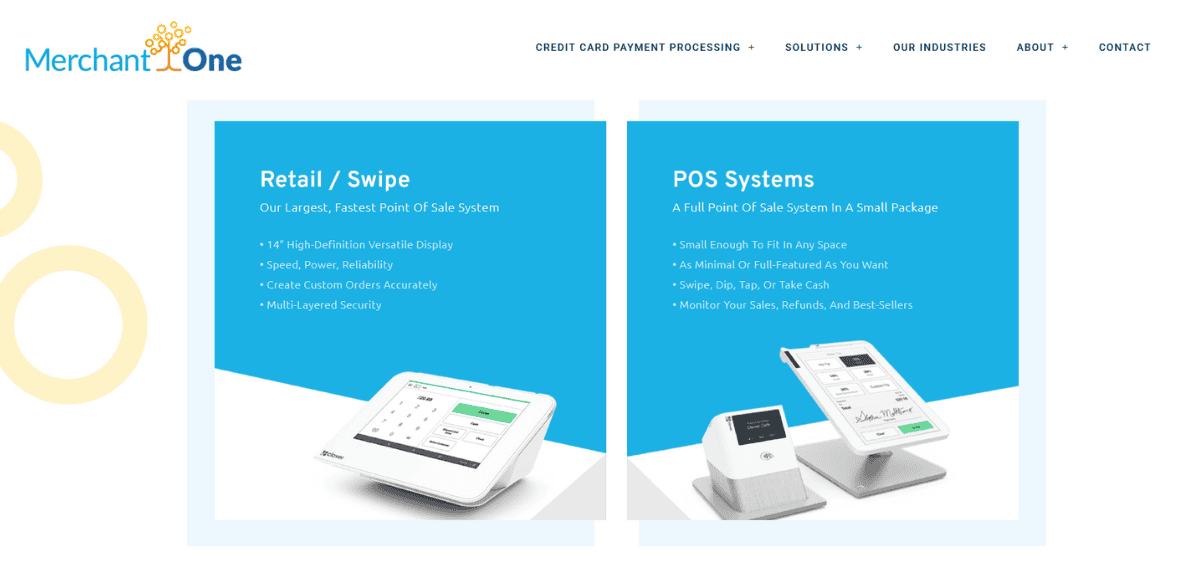
A significant component of Merchant One’s value comes from its hardware offerings. By reselling Clover devices, it provides merchants with access to one of the most widely used POS ecosystems. Clover devices are known for their sleek design, reliability, and ability to integrate business management tools beyond payment acceptance.
Options include handheld readers like Clover Flex, countertop solutions like Clover Station, and simple mobile readers for businesses on the move. These devices are designed to handle a variety of payment types, including chip cards, contactless payments, and mobile wallets like Apple Pay and Google Pay.
The integration of technology extends to reporting and analytics. Many Clover devices come with built-in apps that help track sales, manage employees, and oversee inventory. This means that for businesses looking for more than just payment acceptance, Merchant One offers solutions that contribute to operational efficiency. While the hardware is an attractive feature, merchants should evaluate costs carefully, as device leases can add to long-term expenses.
Security and Compliance Standards
Security is a non-negotiable factor in payment processing, and Merchant One emphasizes compliance with industry standards. The company ensures that all accounts meet PCI DSS (Payment Card Industry Data Security Standard) requirements, which are designed to protect cardholder data.
Fraud prevention tools are also part of its services, offering merchants safeguards against chargebacks and suspicious transactions. Through its partnership with Fiserv, Merchant One can rely on advanced encryption and tokenization technologies that minimize risks during payment transmission.
However, compliance does come with associated costs. Merchants should confirm whether PCI compliance fees are part of their monthly charges. Failure to maintain compliance can result in penalties, so it is important that businesses understand their responsibilities. Overall, Merchant One delivers the level of security expected from a reputable provider, but merchants must stay proactive in ensuring ongoing compliance to avoid unexpected fees.
Onboarding and Application Process
Merchant One’s onboarding process is designed to be straightforward, though as with most merchant service providers, approval depends on business type and risk level. The application requires basic information such as business details, estimated transaction volumes, and processing history.
One of the company’s selling points is fast approvals. In many cases, accounts can be set up within 24 hours, allowing businesses to begin accepting payments quickly. This is particularly beneficial for new merchants who need to start operations without delays.
That said, some merchants have reported that the contract terms can be confusing at the outset. Clarity around pricing, equipment leases, and cancellation fees is essential before finalizing the application. Businesses should also be prepared for underwriting checks, which may take longer if the business falls into a higher-risk category. Overall, the process is competitive compared to other traditional providers but requires attention to detail from applicants.
User Experience and Ease of Use
Day-to-day usability is where Merchant One delivers tangible value for merchants. The systems provided, especially Clover POS, are known for intuitive interfaces that simplify training for employees. Features such as touchscreen navigation, integrated reporting, and digital receipts contribute to a smoother checkout process for customers.
For ecommerce merchants, the virtual terminal and gateway solutions are also designed with ease of use in mind. Businesses can process transactions online securely and manage them through centralized dashboards. Having consolidated reporting tools helps businesses monitor sales trends and customer behaviors, aiding better decision-making.
That said, some of the more advanced features may require additional apps or software, which can add to costs. While the base experience is user-friendly, merchants should evaluate whether they need premium add-ons or integrations. Overall, Merchant One provides a balance between functionality and simplicity, making it suitable for businesses without extensive technical expertise.
Customer Support and Service Quality
Customer support is a critical factor when choosing a payment processor, and Merchant One emphasizes its 24/7 availability. Merchants can access support via phone, email, and live chat, ensuring that technical issues or service interruptions are addressed quickly.
Many customers appreciate the responsiveness of Merchant One’s support team, especially during onboarding. However, reviews are mixed, with some merchants reporting difficulties in resolving billing disputes or contract-related concerns. This suggests that while the company has invested in accessible support channels, the quality of resolutions may vary depending on the issue.
For businesses that rely on uninterrupted payment processing, the assurance of around-the-clock support is a positive. Still, prospective merchants should research user experiences to understand potential challenges in areas like contract cancellations or fee disputes.
Reputation and Market Presence
Merchant One has built a sizable presence, serving over 350,000 businesses nationwide. Its affiliation with Fiserv adds credibility, while its longevity in the market signals stability. On platforms such as the Better Business Bureau (BBB), Merchant One holds accreditation, though ratings reflect a mix of positive and critical feedback.
Satisfied customers often highlight the reliability of payment systems and responsive onboarding support. On the other hand, complaints commonly revolve around contract terms, unexpected fees, or challenges with cancellation. These are not uncommon in the payment industry but are important considerations for merchants making a choice.
Market presence alone indicates that Merchant One is a trusted provider for many businesses. However, prospective clients should balance this reputation with a clear understanding of contractual obligations. Transparency remains a recurring theme when assessing the company’s overall image.
Advantages of Using Merchant One
Merchant One offers several benefits that appeal to a wide range of merchants. Its partnership with Fiserv provides access to secure, scalable infrastructure, while Clover POS systems offer modern hardware and business management tools. The ability to serve both in-store and online merchants makes it versatile.
Another advantage is the speed of account setup, which can be completed in as little as 24 hours. This is attractive for businesses needing to launch quickly. The company also provides 24/7 support, which is reassuring for merchants who cannot afford downtime.
Flexibility in services, such as recurring billing and loyalty programs, further enhances its appeal. For businesses that want more than basic payment acceptance, these add-ons provide opportunities to improve customer engagement. Ultimately, Merchant One’s strengths lie in its adaptability, industry credibility, and ability to provide a comprehensive package of solutions.
Limitations and Criticisms
Like many traditional payment processors, Merchant One has its drawbacks. One of the most common criticisms is the lack of transparent pricing. Customized quotes can make it difficult for businesses to compare rates upfront, and unexpected fees have been reported by some merchants.
Contract terms are another area of concern. Early termination fees and equipment lease agreements can lock businesses into longer commitments than anticipated. This may be challenging for newer businesses that need flexibility.
Customer service, while accessible, has received mixed reviews. Some merchants report excellent experiences, while others note difficulties in resolving disputes. The inconsistency highlights the need for businesses to carefully evaluate support quality.
Overall, Merchant One provides strong services but requires merchants to exercise diligence. Reading contracts thoroughly and asking detailed questions before signing can help mitigate many of the common complaints.
Who Should Consider Merchant One?
Merchant One is best suited for small to medium-sized businesses that need flexible payment options and reliable hardware. Retailers, restaurants, and service providers that value Clover POS systems may find Merchant One an attractive choice. Ecommerce businesses can also benefit from its secure gateways and virtual terminals.
However, businesses that prioritize flat-rate pricing and complete transparency may find newer fintech providers more appealing. Merchant One’s model is more traditional, which works well for merchants processing higher volumes but may feel restrictive for startups or businesses with uncertain cash flow.
In summary, Merchant One is a strong option for businesses seeking a balance between established infrastructure and versatile services. Those willing to navigate its contracts and pricing structures may find it to be a long-term partner in payment processing.
Conclusion and Final Thoughts
Merchant One has established itself as a reputable provider in the competitive payment processing market. Its partnership with Fiserv and use of Clover POS systems ensure that merchants receive reliable, modern tools. The breadth of services, from in-store payments to ecommerce and mobile processing, highlights its versatility.
At the same time, the company’s limitations in transparency and contract flexibility are important considerations. Businesses must weigh the benefits of secure, scalable infrastructure against the potential challenges of fees and long-term agreements.
For many merchants, Merchant One provides a dependable way to accept payments and manage business operations. With careful evaluation of terms, it can serve as a valuable partner in navigating today’s complex payment landscape.
FAQs
Q1. Does Merchant One require a long-term contract?
Yes, Merchant One typically requires a contract that may include early termination fees. While some merchants report flexibility, it is essential to review terms carefully to understand the commitment involved.
Q2. What types of businesses benefit most from Merchant One?
Merchant One is well suited for retailers, restaurants, service providers, and ecommerce businesses. It is particularly useful for small to medium-sized companies that need a mix of in-store and online payment tools.
Q3. How does Merchant One compare with newer fintech providers?
Compared to fintech companies offering flat-rate pricing, Merchant One provides more traditional, customized pricing. This can be cost-effective for higher-volume businesses but may lack transparency for smaller merchants. Its advantage lies in its established infrastructure and partnership with Fiserv.

Electronic Payment Systems Review
By 10topmerchantservices September 29, 2025
Electronic Payment Systems is a merchant services provider that allows businesses to accept payments across multiple channels. In an era where electronic transactions are the norm, businesses can no longer view payments as a back office process. Customers expect seamless, secure and instant checkouts whether they are paying in person, through mobile wallets or online. EPS positions itself as a partner for businesses that want to meet this expectation by offering a range of services from traditional point of sale terminals to online payment gateways. Lets read more about Electronic Payment Systems Review.
The payments landscape is changing fast with contactless technology, digital wallets and recurring subscription billing. Merchants have to comply with industry standards, manage transaction costs and integrate flexible systems into their existing operations. It tries to balance reliability and flexibility by providing stable infrastructure, security support and scalable solutions. Like any provider, its effectiveness depends on the specific needs and priorities of the business using it.
This review looks at EPS across multiple areas including company background, core solutions, hardware support, e-commerce functionality, security, pricing, customer support and overall market relevance.
Company Background and Industry Position | Electronic Payment Systems Review
EPS has been in the payments industry for decades, building a reputation mainly among small to mid-sized businesses. Unlike newer fintech companies that operate on a flat rate, app based model, it is a traditional merchant account structure. This means formal underwriting, merchant agreements and service contracts which has been the norm in payment processing. Its longevity has helped it build industry relationships and a stable base of merchants that value predictability over innovation.
The payments industry is crowded and competitive. It competes with global giants like Fiserv, Elavon and Global Payments as well as disruptive fintech platforms like Square, PayPal and Stripe. While the big names get more attention with their technology driven tools, EPS appeals to businesses that value established processes, infrastructure and hands on support. For merchants that view payment acceptance as a critical function rather than a playground for experimentation, EPS provides a solid foundation.
The flip side of this is visibility. Compared to newer, more marketed platforms, EPS doesn’t have brand recognition among startups and digital native companies. In fast paced industries where recognition and innovation matters this can be a problem. But for industries like healthcare, hospitality and traditional retail that value compliance, regulatory stability and consistent service, EPS has credibility that only comes with being in the market for decades. Its challenge today is to stay relevant in a world that demands both traditional reliability and modern flexibility.
Core Payment Processing Solutions
At its core EPS allows merchants to accept payments through all major card networks including Visa, Mastercard, American Express and Discover. It also supports ACH processing for direct bank transfers so merchants can accept a variety of payment types in-store and online. The backbone of its processing infrastructure is stability which is critical for businesses that can’t afford downtime or transactional inconsistencies.
For physical store environments EPS offers countertop terminals, mobile readers and support for contactless payments like Apple Pay and Google Pay. These options cater to changing consumer expectations around speed and convenience. For digital businesses it provides an online gateway with features like recurring billing, tokenization and hosted payment pages. Together these tools cover the basics of modern payment acceptance.
Where EPS falls short is on value added features. Competitors like Stripe or Square highlight analytics dashboards, customer insights and advanced integrations that help businesses go beyond accepting payments to using transaction data for growth strategies. EPS delivers on core processing but stops short of positioning payments as a business intelligence tool. For many merchants this isn’t a problem as reliability trumps the bells and whistles. But for digitally ambitious businesses EPS may feel limited in scope.
Merchant Account Setup and Onboarding
Setting up an account with EPS follows the traditional underwriting model. Merchants must go through a credit review, provide financial history and submit documentation for risk assessment. This can take several days to weeks depending on the complexity of the business and whether it’s a high risk industry. For startups or unconventional industries the process can feel demanding compared to the instant approvals offered by fintech platforms.
The advantage of EPS’s model is long term stability. Businesses that pass underwriting are far less likely to encounter account holds or unexpected closures which are common complaints with instant approval processors. It ensures risk is managed upfront so there’s less chance of downstream disruption. For businesses that value consistency this structured approach is reassuring.
However the onboarding process doesn’t suit every merchant. Businesses that need to start processing within 24 hours often find EPS’s process too slow. While the onboarding team helps with paperwork and compliance the perception of slowness compared to fast moving competitors can deter time sensitive merchants. This is the ongoing trade off between thorough vetting and immediate convenience.
POS Systems and Hardware Support
EPS supports a range of point-of-sale solutions designed for various business settings. From traditional countertop terminals to mobile readers, it ensures compatibility with EMV chip cards, magnetic stripes, and contactless payments. For merchants operating in brick-and-mortar locations, this provides flexibility to meet customer expectations across payment formats.
EPS also offers integrated POS systems that connect payments with sales management and inventory tracking. These full-featured systems help retailers and restaurants manage transactions holistically, although their design leans more toward reliability than innovation. Equipment can be leased or purchased outright, depending on business preference and budget.
While EPS provides a strong foundation for physical payments, its systems appear conservative compared to modern cloud-based POS solutions. Businesses looking for built-in loyalty programs, customer engagement tools, or seamless integration with third-party apps may find EPS lacking. For merchants that only need stable, compliant, and efficient hardware, EPS’s offering works well. Those seeking advanced, all-in-one business ecosystems may prefer newer POS innovators.
Online Payment Gateway and E-Commerce Features
As digital commerce continues to grow, EPS’s online gateway provides essential support for businesses selling products and services online. Its gateway integrates with shopping carts, enables hosted payment pages, and supports recurring billing for subscription models. Tokenization features ensure sensitive cardholder data is protected during online transactions.
It offers a degree of customization, allowing merchants to embed its gateway into existing websites or rely on hosted solutions for easier deployment. This flexibility appeals to both small businesses looking for simplicity and larger companies with unique system requirements. Security is a core strength here, as merchants can process online payments with confidence in compliance standards.
That said, EPS faces stiff competition in the e-commerce space. Providers like Shopify Payments or Stripe are deeply integrated into the digital economy, offering developer-friendly APIs and plug-ins that streamline the process for online merchants. EPS provides the necessary infrastructure but lacks the developer-first approach that digitally native companies often demand. For traditional businesses expanding into e-commerce, EPS’s solutions are adequate. For tech-forward businesses, however, it can feel limiting.
Security, Compliance, and Fraud Protection
Security is non-negotiable in payment processing, and EPS maintains compliance with PCI DSS standards. The company employs encryption and tokenization to safeguard customer data during transactions. These measures ensure sensitive information is protected against interception and unauthorized use.
Fraud protection tools are available, including velocity checks, filters, and monitoring systems that flag suspicious transactions. While effective, these tools are not as sophisticated as the AI-driven fraud systems offered by some fintech competitors. They provide a reliable baseline but may not cover the most complex fraud patterns seen in high-risk industries.
One of EPS’s advantages is its support for PCI compliance guidance. Many businesses struggle with the complexity of meeting industry requirements, and EPS provides resources to assist merchants in maintaining compliance. While feedback on support quality varies, the overall framework ensures businesses can operate securely within established guidelines. EPS’s emphasis on compliance reflects its traditional model of prioritizing trust and stability over experimental innovation.
Pricing Structure and Fees
Pricing is often the deciding factor when selecting a merchant services provider. EPS employs traditional pricing models such as interchange-plus or tiered rates depending on merchant type and volume. This means fees vary depending on the card type, transaction method, and risk profile of the business. In addition to per-transaction fees, EPS merchants may encounter monthly account charges, statement fees, PCI compliance fees, and gateway costs.
Compared to flat-rate providers like Square, this structure can feel more complex. However, for larger merchants processing significant volumes, interchange-plus pricing can result in lower effective rates. The challenge lies in transparency. Some merchants report unexpected fees or confusing contract terms, while others praise EPS for delivering competitive costs once terms are clearly understood.
Contracts typically involve multi-year commitments with early termination penalties, which may discourage businesses seeking flexibility. For small businesses or startups, these agreements may feel restrictive, particularly when compared to the month-to-month structures offered by newer players. Overall, EPS’s pricing can be advantageous for established merchants with consistent volume but less appealing to businesses prioritizing simplicity and flexibility.
Customer Support and Service Quality
Customer support is one of the most crucial elements of a payment processing relationship. It offers support via phone, email, and online resources. Its model emphasizes direct communication with representatives rather than relying entirely on automated channels. This appeals to merchants who value the reassurance of speaking to knowledgeable staff when issues arise.
Feedback on service quality, however, is mixed. Some merchants highlight the responsiveness of EPS’s support team and appreciate the personalized assistance. Others report frustration with long wait times or inconsistent problem resolution. Documentation and training resources exist but are less extensive compared to the robust self-service knowledge bases offered by larger competitors.
For businesses that prioritize personal relationships and one-on-one support, EPS provides value. For those that prefer fast, self-service solutions, its resources may feel limited. This reflects the company’s broader identity as a traditional provider focused on human support rather than automated efficiency.
Integrations and Compatibility
Modern businesses often require their payment systems to integrate with accounting software, ERP platforms, and e-commerce tools. It supports a range of integrations that help streamline financial management and reduce manual reconciliation. Its solutions are designed to be compatible with many legacy systems, which is beneficial for businesses that rely on established infrastructure.
However, EPS does not offer the same level of developer-friendly APIs and plug-and-play integrations found in fintech platforms like Stripe. This makes it less appealing to companies that prioritize automation, customization, and technology-driven workflows. For businesses that prefer stability and compatibility with older systems, EPS is more than sufficient. For digital-first businesses seeking advanced integrations, it may fall short.
Strengths of EPS
EPS’s strengths lie in its reliability, long-standing industry experience, and broad range of payment solutions. Its infrastructure emphasizes stability, ensuring merchants experience consistent uptime and secure transaction handling. The structured underwriting process reduces the likelihood of account freezes, providing reassurance to merchants that prioritize consistency.
EPS also serves a wide range of industries including retail, hospitality, healthcare, and e-commerce. Its flexibility across physical and digital environments adds to its appeal. Personalized customer support remains a distinguishing feature, especially for merchants that prefer human interaction over automated systems. Overall, it succeeds in offering solid, dependable service for businesses that value traditional reliability.
Limitations and Potential Drawbacks
EPS also presents several limitations. Its pricing structure, while potentially cost-effective for large merchants, can be confusing for smaller businesses. The presence of multiple fees, combined with multi-year contracts, reduces flexibility and may discourage businesses that want straightforward arrangements.
Technology is another challenge. EPS’s tools do not always match the innovation and advanced features offered by fintech competitors. Merchants seeking detailed analytics, advanced mobile capabilities, or developer-friendly environments may find EPS restrictive. While it meets core processing needs, it does not position itself as a technology leader in the payments space.
These drawbacks do not make EPS unsuitable, but they highlight its best-fit scenarios. It works well for businesses that value compliance, stability, and structured support. It is less appealing to businesses seeking cutting-edge innovation or contract flexibility.
EPS for Different Business Sizes
EPS’s suitability varies depending on business scale. For small businesses, onboarding and contract requirements may feel burdensome compared to instant-approval fintech alternatives. However, once approved, small merchants benefit from EPS’s stability and reliable hardware support.
Mid-sized businesses often find EPS most advantageous. They have the volume to justify interchange-plus pricing and the operational need for integration with accounting and ERP systems. For these merchants, EPS strikes a balance between traditional reliability and manageable costs.
Large enterprises may use EPS as part of a broader payment strategy but often prefer providers with more advanced global capabilities. EPS’s offerings are best suited as supplementary support rather than primary solutions for global corporations. Overall, EPS fits best with businesses that prioritize consistency and compliance rather than innovation.
Final Verdict on EPS
Electronic Payment Systems represents a traditional yet dependable option in the crowded merchant services market. It offers reliable processing infrastructure, wide hardware support, compliance guidance, and personalized customer service. Its long-standing presence in the industry highlights stability and trustworthiness, appealing to merchants that value consistency.
At the same time, EPS faces competition from fintech firms that emphasize transparency, quick onboarding, and advanced technology. While EPS may not always provide the most innovative or cost-effective solution, it excels in delivering payment fundamentals. For businesses that prioritize compliance, structured support, and proven reliability over cutting-edge features, it remains a strong and dependable choice.
FAQs
Q1. What types of businesses benefit most from EPS?
It caters to industries such as retail, hospitality, healthcare, and e-commerce. It works best for businesses that value stability, structured onboarding, and traditional merchant account models rather than instant-approval fintech systems.
Q2. Does EPS provide PCI compliance support for merchants?
Yes, it assists merchants in maintaining PCI DSS compliance. It uses features like encryption and tokenization to protect customer data and offers resources to help businesses navigate compliance requirements.
Q3. How does EPS compare with newer payment processors in terms of pricing?
It employs traditional interchange-plus and tiered pricing models. For high-volume businesses, this can result in competitive rates. However, for smaller businesses, the complexity and additional fees may feel less predictable compared to the flat-rate pricing favored by newer fintech providers.
Charge.com Review
By 10topmerchantservices September 26, 2025
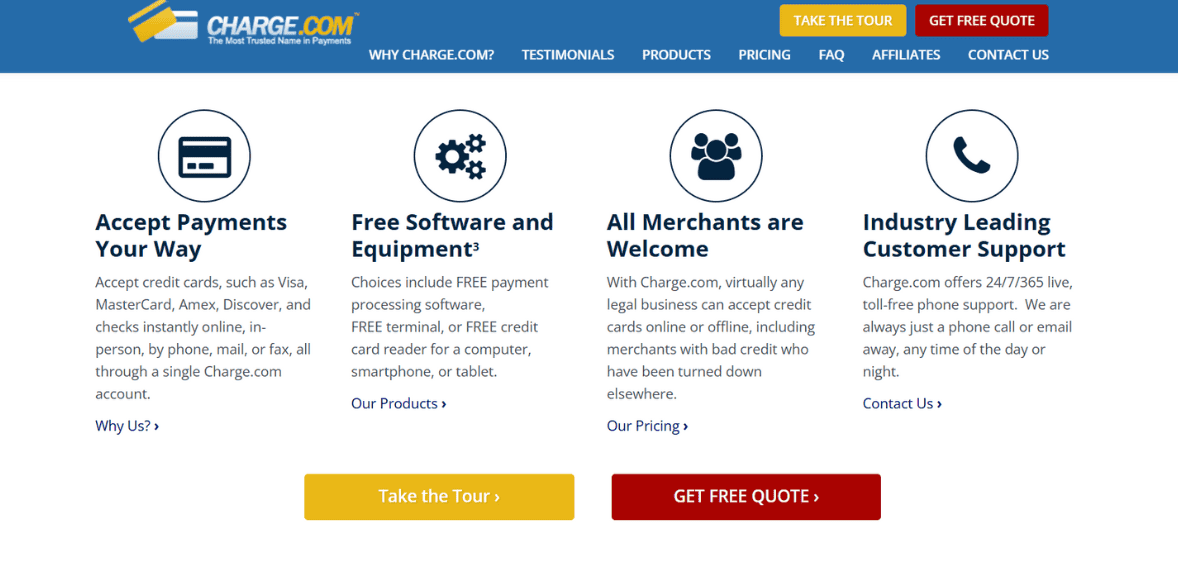
Charge.com has been a merchant services provider for nearly three decades. Founded in 1995, the company bills itself as a simple and affordable payment solution for businesses of all sizes. It offers in-person, online and mobile transactions to give merchants cost effective tools without big upfront investments. Over the years Charge.com has gotten attention for its low advertised rates and easy setup but has also gotten flak for hidden fees, outdated systems and mixed customer support. Lets read more about Charge.com Review.
Company Background | Charge.com Review
Charge.com entered the payment processing industry in the mid 1990s when small businesses were struggling to get affordable merchant accounts. The company’s initial strategy was to fill that gap by offering simple and inexpensive solutions that would allow entrepreneurs to accept credit cards without going through banks’ restrictive and expensive merchant programs. This gave Charge.com an early advantage especially among small businesses that needed low barriers to entry.
Through mergers and acquisitions Charge.com’s corporate structure has changed several times. It was acquired by Pipeline Data, then merged with Cynergy Data and eventually absorbed into Priority Payment Systems. These changes have given the company access to stronger financial backing and corporate oversight but also raises questions about consistency of service. Some merchants see the corporate backing as a stabilizing force while others worry about the complexity that comes with multiple ownership changes.
Despite being around for nearly thirty years, Charge.com’s online presence has not kept up with modern competitors. Its branding, website and user portal looks outdated which may give prospective merchants the impression that the company is behind the times. But for many cost conscious businesses branding is less important than reliability and affordability. Charge.com’s ability to stay relevant for almost thirty years is a testament to its ability to adapt as the payment industry gets more competitive and innovative.
Services Offered
Charge.com markets itself as a provider of versatile merchant services capable of serving both small operations and growing enterprises. Its offerings span key areas of payment acceptance and security.
Merchant Accounts and Processing Solutions
The cornerstone of Charge.com’s services lies in its ability to process credit and debit card payments. Merchants can accept transactions from Visa, Mastercard, American Express, and Discover, ensuring compatibility with the most widely used card brands. Additionally, the company supports electronic checks, which broadens its utility for businesses that serve customers who prefer direct bank payments. The ability to process high transaction volumes efficiently makes Charge.com a fit for both small and medium-sized merchants with steady sales activity.
Online Payment Gateways
Charge.com provides a secure payment gateway for businesses running e-commerce operations. This gateway allows website owners to embed checkout functionality directly into their sites through hosted forms or shopping cart integrations. While these features may seem basic compared to modern gateways with advanced customization, they remain useful for businesses that want a dependable way to handle online sales. Charge.com also emphasizes customization, giving merchants the flexibility to align the checkout page with their brand identity, which is essential for maintaining consumer trust.
Mobile Payment Options
Mobile solutions have become increasingly vital in an economy that favors flexibility. Charge.com offers mobile payment processing through smartphones and tablets, allowing merchants to accept payments on the go. This feature is particularly relevant for food trucks, trade show vendors, service professionals, and temporary pop-up shops. The mobile app includes features such as issuing digital receipts and tracking inventory, making it more than just a card-swiping tool. By providing this service, Charge.com positions itself as a partner for entrepreneurs who operate outside traditional storefronts.
Virtual Terminals and Recurring Billing
The virtual terminal is another useful feature, enabling merchants to process payments manually by entering customer card details through a secure online portal. For businesses that accept orders over the phone or by mail, this functionality is particularly valuable. Charge.com also supports recurring billing, an increasingly important feature for subscription-based businesses such as gyms, online services, and membership organizations. Its recurring billing tools allow merchants to automatically charge customers at set intervals, reducing administrative effort and improving cash flow reliability.
POS Solutions
For brick-and-mortar businesses, Charge.com provides POS systems. These include card readers and compatible software that allow retailers to process payments in physical stores. The POS systems integrate with basic inventory management, though they are not as advanced as systems offered by specialized providers. For businesses that need comprehensive retail management tools with analytics and hardware variety, Charge.com’s solutions may feel limited. However, for merchants who only require essential POS functionality, these systems remain useful and budget-friendly.
Payment Security Features
Charge.com emphasizes security across its services. Fraud-prevention tools include tokenization, encryption, AVS, and CVV checks. These measures protect sensitive data and reduce the risk of fraudulent transactions. By maintaining compliance with industry standards, Charge.com ensures that businesses meet the requirements necessary to handle cardholder information responsibly.
Industry-Specific Solutions
The company adapts its services for various industries, including retail, hospitality, and e-commerce. For example, high-volume retailers benefit from its scalable processing systems, while subscription-based businesses gain from recurring billing options. This tailored approach helps Charge.com remain competitive by demonstrating that its solutions are not one-size-fits-all but adaptable to sector-specific needs.
Pricing and Fees
Charge.com advertises itself as a low-cost option, but a closer look reveals complexities that businesses should evaluate carefully.
Breakdown of Costs
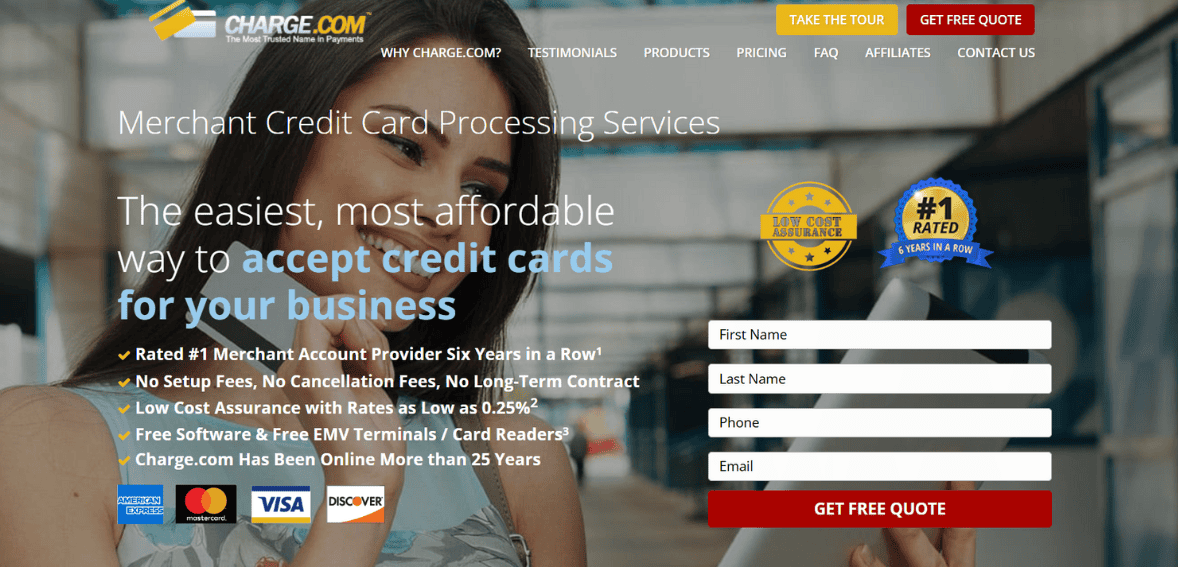
The company promotes transaction rates as low as 0.25%. However, this rate usually applies only to qualified transactions that meet certain requirements, such as being swiped in person with a standard consumer credit card. Non-qualified transactions; such as those keyed in manually, made with rewards cards, or processed online; may incur higher fees. Additional costs, such as monthly statement fees, gateway access charges, and PCI compliance fees, can increase the overall expense for merchants.
Hidden Fees and Transparency Issues
Some merchants have reported surprise fees, including setup costs, early termination penalties, or additional surcharges for specific transaction types. While Charge.com emphasizes transparency, these reports suggest that the clarity of its contracts may not always meet expectations. Businesses should carefully review terms and ask direct questions during the sales process to avoid unexpected expenses.
Comparison with Competitors
Against competitors like Square and PayPal, Charge.com’s model can be more attractive for high-volume merchants who benefit from low per-transaction rates. However, small businesses with inconsistent or seasonal sales may find the monthly charges disadvantageous. In such cases, providers that charge only per transaction without monthly fees may present a better deal. The choice largely depends on a business’s sales volume and transaction patterns.
Integration and Compatibility
Charge.com has integrations with various platforms and systems so it’s pretty flexible for different business models. It’s compatible with major e-commerce platforms like Shopify, WooCommerce and Magento so online retailers can embed payment solutions into their stores without much hassle. Charge.com also has APIs that developers can use to create custom integrations. While the APIs work, the documentation is not as comprehensive as the bigger competitors. Improving their developer resources could help them attract more tech-savvy businesses.
On the hardware side, Charge.com supports standard card readers and traditional terminals. This means businesses don’t have to upgrade their hardware. But it also means they don’t have advanced or specialized hardware options for merchants who want modern POS features like contactless payments, integrated loyalty programs or advanced analytics.
User Experience
User experience is important for payment processing platforms and Charge.com’s is a mixed bag. The account setup process is straightforward, application and approval process is quick and sales reps often provide direct onboarding support so merchants can start accepting payments right away. But businesses that want a self-service onboarding process might find Charge.com less efficient than competitors that offer fully digital signups.
The website and merchant portal is functional but outdated. Many modern payment processors emphasize sleek dashboards, intuitive navigation and visually appealing designs. Charge.com’s older design might deter businesses that value a nice user experience.
Customer support is 24/7 via phone and email. While the 24/7 availability is a big plus, feedback is inconsistent. Some users say responsive and knowledgeable support while others report delays or limited help. Adding live chat and comprehensive online resources could make a big difference in the support experience.
Pros and Cons
Charge.com’s appeal lies in its affordability and versatility, but merchants must also weigh its drawbacks.
Pros include:
Attractive rates for high-volume merchants
Support for multiple payment methods, including e-checks
Range of options across online, mobile, and in-store payments
24/7 customer support availability
Cons include:
Hidden or unclear fees in certain cases
Outdated design and branding
Limited advanced hardware options
Mixed reviews about support responsiveness
Security and Compliance
Charge.com takes payment security seriously, offering features that safeguard customer data and maintain compliance. The company adheres to PCI DSS standards, ensuring sensitive information is encrypted and securely transmitted. Fraud prevention measures include AVS checks, CVV verification, and chargeback support. Although effective, these tools are basic compared to more advanced systems offered by specialized fraud-prevention providers. Encryption is applied end-to-end, reducing the risk of interception during transactions. This focus on data security gives merchants confidence that their customers’ information is being handled responsibly.
Customer Feedback
Customer reviews of Charge.com reflect a blend of satisfaction and criticism. On the positive side, merchants appreciate the affordability and flexibility of its payment options. Many cite the ability to accept diverse payment methods, including e-checks, as a major advantage.
On the negative side, merchants often complain about hidden fees, outdated user interfaces, and inconsistent customer support. These recurring themes indicate areas where Charge.com could significantly improve its reputation. Transparency and investment in modern technology would go a long way in addressing these concerns.
Contract Terms and Policies
Charge.com typically requires merchants to commit to contracts lasting one to three years. These contracts often include automatic renewal clauses, which can catch businesses off guard if they are not aware of the terms. Early termination fees are a common frustration, sometimes running into hundreds of dollars. Businesses that attempt to switch providers before the contract ends may find themselves facing steep penalties. This highlights the need for merchants to carefully review all contract details, including cancellation policies, before signing an agreement.
Scalability for Growing Businesses
Charge.com has the infrastructure to support businesses that scale, offering high-volume transaction processing and integration with enterprise-level tools. This makes it a potentially viable option for companies planning to expand operations.
However, its limited reporting and analytics tools may hinder growing businesses that rely on data-driven decision-making. While basic reports provide visibility into sales and transactions, the lack of advanced analytics means businesses may need to invest in third-party solutions to gain deeper insights. Expanding its reporting capabilities would make Charge.com more competitive for scaling enterprises.
Reporting and Analytics
Reporting is a critical component for businesses monitoring financial performance. Charge.com provides fundamental tools that allow merchants to view sales summaries, transaction histories, and account activity. These reports are functional but not advanced.
For example, merchants looking for customer behavior insights, predictive analytics, or customizable dashboards may find Charge.com lacking. Competitors increasingly provide such features as standard, which highlights an area where Charge.com could enhance its value proposition. While the existing tools suffice for basic tracking, data-driven companies will likely need to supplement them with external analytics software.
Chargeback Management
Chargebacks can be costly and disruptive, so businesses need robust management tools. Charge.com offers fraud prevention measures, automated alerts for disputes, and support for responding to chargeback claims. These tools help merchants build a defense against chargebacks but are not as comprehensive as the solutions provided by specialized providers.
Merchants handling high volumes of transactions, especially in industries prone to disputes, may find Charge.com’s chargeback management insufficient for their needs. While it provides a basic framework, businesses that require detailed chargeback analytics or dedicated prevention programs may need to look elsewhere.
Customer Support Accessibility
Charge.com emphasizes accessibility by providing 24/7 support via phone and email. This is a major benefit for businesses that operate outside standard business hours or encounter urgent issues. However, the absence of live chat and a limited online knowledge base reduces convenience for users who prefer immediate, self-service solutions. Competitors are increasingly adopting these support channels to improve resolution times and empower customers. Expanding support resources could greatly improve the overall customer experience.
Final Verdict
Charge.com has remained a reliable presence in the merchant services industry for nearly three decades, largely due to its affordability and comprehensive basic services. It is a strong option for businesses seeking straightforward payment processing without unnecessary extras. However, its drawbacks; including outdated branding, inconsistent support, and hidden fees; make it less attractive for merchants who prioritize transparency and advanced technology. For small businesses focused primarily on low-cost solutions, Charge.com remains a viable option. But for enterprises or tech-driven companies, newer competitors may offer more sophisticated features and a better overall experience.
FAQs
Is Charge.com suitable for small businesses?
Yes. Its affordable pricing and variety of payment options make it a good choice for small businesses, though contract terms should be reviewed carefully to avoid surprises.
Does Charge.com require long-term contracts?
Yes. Most agreements span one to three years and may include early termination penalties. Merchants are advised to clarify terms before committing.
What industries does Charge.com serve?
Charge.com supports a wide range of industries, including retail, hospitality, e-commerce, and service-based businesses, tailoring its solutions to sector-specific requirements.

BluePay Review
By 10topmerchantservices September 23, 2025
BluePay is a long established payment processing company that has served businesses of all sizes across North America. Known for its secure and flexible transaction solutions, the company built a reputation for balancing innovation with reliability. Before being acquired by First Data and then integrated into Fiserv, BluePay was an independent provider that offered robust services to both brick-and-mortar merchants and online businesses. Its focus on compliance, security and multi-channel payment support made it a player in a crowded market. Lets read more about BluePay Review.
The appeal of BluePay was that it was more than just a processor. It bundled gateway services, ACH transactions, recurring billing and fraud protection, so businesses had one stop shop for payments. For e-commerce businesses the flexibility of the platform was a big plus, for traditional retailers the POS compatibility was a bonus. BluePay also emphasized security features like tokenization and PCI DSS compliance which reassured merchants worried about fraud and compliance risks.
But some users complained about pricing transparency and contract terms. Like many traditional processors BluePay required merchants to sign agreements that sometimes had early termination fees or unclear cost structures.
Company Background and History | BluePay Review
BluePay was founded in 2003 to deliver flexible, secure and comprehensive payment processing solutions to U.S. and Canadian businesses. From the start the company focused on helping merchants streamline transactions across multiple channels, whether through traditional POS terminals, online stores or recurring billing systems. Based in Naperville, Illinois BluePay quickly expanded its reach and became a reputable player in the payment industry.
Its growth was driven by the increasing demand for secure and efficient payment solutions in the mid 2000s. It became known for serving small and medium sized businesses as well as larger businesses with more complex processing needs. Over time the company added features like API integrations, hosted payment pages and tokenization as e-commerce and mobile commerce became more important.
In 2017 BluePay was acquired by First Data, one of the largest payment processors in the world. This allowed BluePay to leverage First Data’s infrastructure and resources while continuing to offer its services under its own brand for a period.
After First Data merged with Fiserv, BluePay’s operations were further integrated into Fiserv’s ecosystem so it could support merchants at scale.BluePay is no longer a standalone brand but still has an impact as part of Fiserv’s payment portfolio. Its heritage is in its focus on secure transactions and ability to deliver custom solutions to merchants as they evolved. Knowing this history helps you understand BluePay today.
Core Services and Solutions Offered
It has always been a full service payment processor with solutions for businesses across industries. At the heart of their offerings are credit and debit card processing services that allow merchants to accept payments online, in person and mobile. These are backed by robust security so they are PCI DSS compliant.
Beyond standard card acceptance BluePay offered ACH and eCheck processing which was great for businesses that do high volume or recurring payments. Nonprofits and subscription based businesses loved this feature as it was cheaper than card transactions. Another key part of BluePay’s service offering was recurring billing which allowed businesses to automate subscription payments and cash flow.
The payment gateway was the foundation of their e-commerce support, real time processing, fraud tools and customizable integration. Merchants could link BluePay’s gateway to popular shopping carts and business software so transactions would flow smoothly. They also offered virtual terminals, hosted payment forms and tokenization services to make it more user friendly and secure.
Omnichannel was also a big selling point. BluePay supported transactions in physical stores, websites and mobile apps so merchants could unify their payment operations. This was great for businesses with multiple payment environments. Overall BluePay’s services were comprehensive but you had to read the fine print on the contract and pricing. Businesses looking for end to end solutions loved their offerings especially those looking for scalability and flexibility in their payment operations.

Payment Gateway Capabilities
It’s payment gateway was a centerpiece of its offerings, designed to facilitate secure, real-time online transactions. The gateway enabled merchants to accept payments directly through their websites, mobile apps, or custom platforms. One of its strongest features was flexibility; it supported major credit and debit cards, ACH payments, and even recurring transactions, making it suitable for subscription-based businesses.
Integration was another key advantage. BluePay’s gateway was compatible with popular e-commerce platforms and shopping carts, reducing the technical barriers for businesses setting up online stores. For companies with custom requirements, BluePay provided APIs that developers could use to build tailored solutions. This adaptability appealed to merchants who needed more than a one-size-fits-all payment gateway.
Security was embedded into the gateway’s design. With tokenization, card data was replaced with secure identifiers, minimizing the risk of sensitive information being compromised. Coupled with encryption and PCI DSS compliance, this gave merchants confidence in handling online payments. The gateway also included fraud detection tools, such as address verification and CVV validation, to reduce chargebacks and fraudulent activity.
Merchants also benefited from reporting tools integrated into the gateway. These provided insights into transactions, settlements, and trends, helping businesses make informed decisions. However, some users noted that the interface could feel less intuitive compared to newer, tech-driven competitors like Stripe. In summary, BluePay’s gateway capabilities were strong and reliable, particularly for businesses that valued integration and security. While not always the most user-friendly option, it delivered robust functionality for merchants prioritizing safety and adaptability.
Security and Compliance Standards
Security has always been a cornerstone of BluePay’s services. The company emphasized compliance with the PCI DSS, which sets the benchmark for secure handling of cardholder data. By adhering to these standards, It helped merchants reduce liability and meet industry requirements without having to manage the complexities alone.
Tokenization was one of the standout security measures. Instead of storing sensitive card details, BluePay replaced them with secure tokens that could not be used outside the system. This drastically minimized the risk of data breaches and reassured merchants about their customers’ safety. In addition, end-to-end encryption ensured that transaction data remained secure from the point of entry to authorization.
Fraud prevention tools added another layer of protection. BluePay’s system supported AVS, CVV checks, and velocity filters to flag unusual transaction patterns. These measures reduced the likelihood of fraudulent charges and chargebacks. For industries with higher risks, BluePay offered advanced fraud detection tools to further safeguard payments.
Compliance extended beyond PCI DSS. BluePay also worked to meet industry-specific requirements, making it a trusted option for sectors like healthcare, which demand strict adherence to data protection laws. By offering features tailored to regulatory environments, the company positioned itself as a partner for businesses with sensitive customer data.
Although merchants appreciated these protections, some criticized the added costs or complexity associated with implementing advanced features. Overall, BluePay’s focus on security and compliance was a defining characteristic that helped it remain competitive in a payment landscape increasingly concerned with data safety.
Integrations and Compatibility
One of BluePay’s notable strengths was its wide range of integrations with third-party platforms. For e-commerce businesses, the ability to connect seamlessly with shopping carts like Magento, WooCommerce, and Shopify simplified the payment setup process. This eliminated the need for costly development work and allowed merchants to start accepting payments more quickly.
Beyond e-commerce, BluePay integrated with accounting software such as QuickBooks and enterprise resource planning systems. These integrations helped businesses unify their payment data with financial records, improving accuracy and reducing manual reconciliation. For organizations with custom needs, BluePay’s APIs offered flexibility to build tailored solutions, making it appealing to developers and IT teams.
POS compatibility was another valuable aspect. It supported integration with major POS hardware and software providers, enabling retailers to unify their online and in-store payment systems. This omnichannel approach was especially useful for businesses expanding across physical and digital channels. Nonprofits and service providers benefited from BluePay’s support for hosted payment forms, which could be easily embedded into websites for donations or invoice payments. These forms were customizable, secure, and easy to deploy.
Despite these strengths, some users reported that integrations could feel more complex than with newer, developer-friendly processors. Competing platforms like Stripe or Square offered more plug-and-play options, while BluePay sometimes required additional technical expertise. Nevertheless, for businesses seeking comprehensive integration with both mainstream and specialized systems, BluePay delivered solid compatibility. Its flexibility made it a practical choice for organizations with diverse payment and reporting needs.
Pricing Structure and Fees
Pricing transparency has been one of the more debated aspects of BluePay’s services. Unlike flat-rate providers such as Square, BluePay typically operated on interchange-plus or tiered pricing models. Interchange-plus pricing is generally considered more transparent, as it separates the card network fees from the processor’s markup. However, not all merchants were offered this model, and some reported confusion over fee structures.
Common fees associated with BluePay included monthly account fees, payment gateway fees, PCI compliance fees, and potential early termination fees tied to contracts. While these charges are not uncommon in the payment industry, merchants often emphasized the importance of carefully reviewing agreements before signing. Some small businesses found the costs prohibitive compared to newer fintech options with simpler structures.
On the positive side, BluePay’s pricing was competitive for mid-sized and large businesses with high processing volumes. Interchange-plus pricing could result in savings for merchants who processed significant amounts of credit card transactions. Additionally, BluePay’s ACH and eCheck processing typically cost less than card transactions, providing further cost efficiency.
Hidden fees were a point of contention. Some merchants reported surprise charges for compliance or customer support services. While these were outlined in contracts, they were not always made clear during the sales process. In summary, BluePay’s pricing was neither the most expensive nor the most transparent in the industry. It worked best for businesses willing to negotiate contracts and carefully manage their fee structures, but it was less appealing to small merchants seeking straightforward, predictable pricing.
Usability and Merchant Experience
BluePay’s usability was a mixed experience for merchants. On one hand, its platform offered a wide range of features, including virtual terminals, reporting tools, and integration options. These capabilities allowed businesses to manage payments efficiently and gain insights into their transaction data. The availability of hosted payment forms and mobile support also made it easier for merchants to reach customers across multiple channels.
On the other hand, some merchants found the interface less intuitive compared to competitors like Square or Stripe, which emphasize user-friendly dashboards. BluePay’s system occasionally required more training or technical support, particularly when configuring integrations or managing advanced reporting features. For businesses with dedicated IT teams, this was manageable, but smaller merchants sometimes struggled.
The onboarding process varied depending on the merchant’s size and processing needs. Larger businesses appreciated the ability to customize solutions, while smaller companies sometimes encountered longer approval times or stricter underwriting requirements. This is common among traditional processors but can feel cumbersome compared to instant-approval models offered by fintech providers.
Once set up, merchants generally reported stable performance and reliable processing. The ability to automate recurring payments and access detailed transaction reports added to the platform’s overall value. Customer feedback suggested that while usability could improve, BluePay offered robust functionality for those willing to navigate a steeper learning curve. Ultimately, BluePay’s merchant experience was shaped by its focus on security and versatility. It was not always the easiest platform to use, but it provided the tools needed for businesses that required more than just basic processing.

Customer Support and Service Quality
Customer support is a crucial factor in payment processing, and BluePay received mixed reviews in this area. The company provided multiple support channels, including phone, email, and online resources. For merchants needing immediate assistance, phone support was the most effective option, particularly for technical issues or transaction disputes.
BluePay also maintained an online knowledge base with FAQs, documentation, and troubleshooting guides. This resource was helpful for merchants who preferred self-service or needed quick answers outside of business hours. Some users noted that the content was thorough but could be overwhelming, especially for those unfamiliar with technical payment terminology.
In terms of responsiveness, experiences varied. Many merchants praised the professionalism and helpfulness of BluePay’s representatives, particularly when resolving integration or compliance issues. However, others reported slower response times or difficulty reaching knowledgeable staff during peak periods. This inconsistency was a common critique, suggesting that support quality depended on timing and the complexity of the issue.
Larger businesses tended to receive more dedicated support, reflecting BluePay’s focus on high-volume clients. Smaller merchants sometimes felt overlooked, especially when compared to fintech competitors offering 24/7 chat support. Overall, BluePay’s support services were functional and often effective, but not exceptional. For businesses requiring hands-on assistance, it was advisable to confirm the level of support available in their contracts. While the company provided the necessary resources to address most issues, the experience was not always as seamless or proactive as some modern processors.
Strengths and Advantages of BluePay
BluePay had several notable strengths that contributed to its appeal among merchants. Chief among these was its emphasis on security. By prioritizing PCI DSS compliance, tokenization, and encryption, BluePay reassured businesses handling sensitive customer data. This strong focus on fraud prevention and data protection made it particularly attractive for industries like healthcare and nonprofits.
Another advantage was its versatility. BluePay offered a comprehensive suite of payment solutions, including credit card processing, ACH, eCheck, recurring billing, and omnichannel support. This range of services allowed businesses to consolidate their payment operations under one provider, reducing complexity. Its compatibility with major e-commerce platforms, accounting software, and POS systems further enhanced its value.
Scalability was also a key strength. BluePay catered to both small businesses and larger enterprises, providing tools that could grow with a merchant’s needs. Its recurring billing and ACH processing features made it a strong choice for subscription-based models and organizations with repeat customers.
Finally, its integration into First Data and later Fiserv added stability and expanded infrastructure, ensuring long-term reliability. Merchants could feel confident that the processor was backed by one of the largest payment companies in the world. While BluePay had areas for improvement, these strengths reinforced its position as a competitive payment provider. Businesses that valued security, integration flexibility, and scalability often found BluePay to be a capable partner despite some drawbacks.
Limitations and Common Complaints
Like most payment processors, BluePay was not without its drawbacks. One of the most frequent complaints involved pricing transparency. While the company offered interchange-plus pricing to some merchants, others encountered tiered models that were harder to interpret. Hidden fees, such as PCI compliance or early termination charges, were also a concern for some users.
Another limitation was the complexity of its platform. While robust in features, BluePay’s system could feel overwhelming, particularly for small businesses with limited technical expertise. Merchants sometimes reported difficulty navigating the interface or configuring integrations without professional assistance.
Customer support, while functional, received mixed feedback. Some merchants praised the responsiveness of BluePay’s staff, but others experienced delays or inconsistent service quality. Smaller businesses, in particular, felt they did not always receive the same level of support as larger, high-volume clients. Contract terms were another point of frustration. BluePay, like many traditional processors, often required multi-year agreements with cancellation penalties. This inflexibility contrasted with the month-to-month contracts offered by fintech competitors, which appealed more to startups and small merchants.
In summary, BluePay’s limitations centered on pricing clarity, ease of use, and contract structures. While these issues did not outweigh its strengths for many businesses, they highlight the importance of reviewing agreements carefully and ensuring the platform aligns with specific business needs before committing.
Ideal Business Types for BluePay
BluePay’s versatility made it suitable for a broad range of industries, but certain business types benefited more from its services than others. Subscription-based companies, for example, found its recurring billing and ACH processing features particularly useful. These tools streamlined collections, reduced administrative workload, and supported predictable cash flow.
E-commerce businesses also gained value from BluePay’s gateway integrations and fraud prevention measures. The ability to connect seamlessly with major shopping carts and implement security protocols like tokenization gave online retailers confidence in managing transactions securely. Similarly, nonprofits appreciated BluePay’s hosted donation forms and ACH capabilities, which allowed them to accept contributions efficiently while minimizing costs.
Healthcare providers were another key segment. With strict regulatory requirements, these organizations valued BluePay’s emphasis on compliance and data protection. Tokenization and encryption reassured them that patient and payment information would remain secure.
Larger enterprises benefited from BluePay’s scalability and support for omnichannel payments. By consolidating in-store, online, and mobile payments under one provider, they achieved greater efficiency. Meanwhile, small businesses could still use BluePay effectively, but often faced challenges with onboarding, costs, or support compared to competitors designed specifically for their segment.
In short, BluePay was best suited for medium-to-large organizations in sectors where compliance, recurring payments, or omnichannel needs were paramount. Smaller merchants could find value but needed to weigh the potential complexities and costs before choosing it as their provider.
Comparison with Competitors
It competed in a crowded field, with rivals like Stripe, Square, PayPal, and Elavon offering alternatives. Compared to newer fintech providers such as Stripe, BluePay’s strength lay in security, compliance, and scalability. Stripe often appealed to developers and startups with its user-friendly APIs and transparent pricing, while BluePay attracted businesses that valued compliance and industry-specific support.
Square, by contrast, excelled at simplicity and accessibility. Its flat-rate pricing and plug-and-play hardware made it ideal for small businesses and entrepreneurs. BluePay, with its contracts and variable fees, was less attractive to this segment but better suited for mid-sized organizations.
PayPal offered global recognition and ease of use, especially for e-commerce. However, BluePay’s recurring billing and ACH features provided more advanced options for subscription-based models. Elavon, another traditional processor, was closer in profile to BluePay, with both emphasizing security and scalability for larger enterprises.
Ultimately, BluePay’s differentiators were its focus on compliance, advanced security, and comprehensive service portfolio. It was not the most user-friendly or cost-transparent option but remained competitive for businesses with specific needs around recurring payments, ACH, or regulatory compliance.
Final Verdict
BluePay built a reputation as a secure, flexible payment processor offering comprehensive services and scalability across industries like e-commerce, healthcare, and nonprofits. Its strengths included strong security, wide integration options, and compliance focus, making it attractive to larger organizations with complex needs. However, concerns around pricing transparency, contract terms, and usability limited its appeal for smaller businesses, who often preferred simpler solutions like Square or Stripe. Now part of Fiserv, it benefits from enhanced infrastructure and long-term stability. It remains a strong option for businesses prioritizing security and recurring payments, though simpler, more transparent alternatives may better suit others.
FAQs
Q1: Is BluePay a good option for small businesses?
It can work for small businesses, but its contracts and pricing may feel restrictive compared to fintech providers offering flat-rate or month-to-month models.
Q2: Does BluePay offer transparent interchange-plus pricing?
Yes, interchange-plus pricing is available, but not guaranteed for all merchants. Businesses should confirm terms upfront to avoid surprises.
Q3: What industries benefit most from BluePay’s services?
Industries like e-commerce, healthcare, nonprofits, and subscription-based businesses often gain the most value due to BluePay’s compliance, recurring billing, and integration features.

Zoho Books Review
By 10topmerchantservices September 18, 2025
Zoho Books is a cloud based accounting solution for small and medium sized businesses looking for an affordable all in one solution to manage their finances. Part of the Zoho ecosystem (which includes CRM, HR and productivity apps) it’s perfect for businesses already using Zoho tools but also works as a standalone product. With automation, invoicing and compliance features it competes with bigger names at a lower price point. Lets read more about Zoho Books Review.
Where Zoho Books stands out is in its usability and integration. It covers the expected essentials (expense tracking, bank reconciliation, reporting) and adds extras like project billing and tax compliance. It’s a versatile option across industries but especially useful for freelancers, startups and growing companies that want streamlined financial processes without the complexity of enterprise systems. It may not have the name recognition of QuickBooks or Xero but Zoho Books has earned credibility as a reliable and affordable alternative.
User Interface and Ease of Use | Zoho Books Review
Zoho Books is designed to be simple but not simplistic. On login the dashboard shows income, expenses, invoices and cash flow and the sidebar has banking, reports and invoicing. This helps non-accountants get started quickly. Setup is easy with guided steps for importing data, linking bank accounts and configuring taxes. Tutorials and sample transactions make onboarding a breeze. Unlike older accounting tools that feel rigid, Zoho Books has a modern interface that makes managing money less scary.
For advanced users it offers flexibility through workflow automation, customizable invoice templates and multi user permissions. Some users say the many features can feel overwhelming at first but most find it intuitive after a while. The balance between beginner friendliness and customization is one of Zoho Books’ greatest strengths.
Invoicing Capabilities
Zoho Books makes invoicing professional and easy. Templates can be branded with logos and colors and fields for client details, taxes and payment terms make creation a breeze. Recurring invoices save time for subscription based businesses. Automatic payment reminders reduce late payments and integration with multiple gateways lets clients pay directly from invoice links. Multi currency support automatically manages exchange rates so you don’t have to in international transactions.
While capable it may not be suitable for larger firms that require highly specialized billing workflows or deep contract based billing features. For most small to mid sized businesses though the invoicing is more than enough; automation, professionalism and speed.
Expense Tracking and Management
Zoho Books makes expense tracking easy. Businesses can categorize expenses, assign to projects or mark as billable to clients. Mobile receipt scanning saves time by auto uploading and categorizing expenses. Bank statement imports and transaction matching simplifies reconciliation and reports can be filtered by vendor, category or timeframe for more insights. Approval workflows add an extra layer of control.
Though more complex procurement processes may find it basic, it covers what most small and medium businesses need. Real time tracking and integration with billing ensures expenses aren’t missed, improves financial reporting accuracy.
Banking and Reconciliation Tools
Bank integration allows auto import of transactions, reduces manual entry. Zoho Books suggests matches between imported bank activity and recorded entries, simplifies reconciliation. Custom rules and categorization options reduce repetitive work.
While good for small businesses, businesses with multiple accounts or very high transaction volumes may find it less robust than specialized reconciliation software. Some regional banks may also require manual imports. Despite these limitations, Zoho Books’ reconciliation features reduce errors, improves accuracy and saves time, making financial oversight easy for business owners and accountants.
Project and Time Tracking
Zoho Books ties financial management to project work by allowing task assignments, time logging and billable hour tracking. Service based businesses; like agencies or consultancies; can link tracked time to invoices. Budgets can be set, progress monitored and actual hours compared to planned hours. Team members can log work through the mobile app, making it convenient for remote teams. Though not as advanced as dedicated project management tools, it’s a way to combine billing and time tracking without needing multiple tools.
Tax Management and Compliance
Zoho Books simplifies tax handling by supporting systems like GST, VAT, and sales tax. Regional compliance settings, such as GST in India, are built in. Multiple tax rates can be applied to transactions, and reports help prepare for filing deadlines. Its limitations mainly involve global coverage; some regions still lack localized features, requiring manual adjustments. Still, for most small to mid-sized firms, Zoho Books reduces the complexity of compliance and lowers the risk of errors.
Multi-Currency and Global Support
For businesses working internationally, Zoho Books includes multi-currency invoicing, expense tracking, and reporting. Exchange rates update automatically, reducing manual effort. Clients benefit from being billed in their own currency, which speeds up payments. Integration with international gateways further supports global operations. While it lacks advanced features like currency risk management, it simplifies cross-border accounting for small and medium enterprises.
Automation and Workflow Customization
Automation is a highlight of Zoho Books. Workflows can be set for recurring invoices, payment reminders, or expense approvals. Custom rules let businesses tailor processes based on conditions like invoice size or client type. Though complex workflows may require a learning curve, the automation tools save time, reduce errors, and standardize operations. For most businesses, this balance of flexibility and usability is a major advantage.
Integrations and Ecosystem Compatibility
Zoho Books integrates smoothly with other Zoho apps, creating a unified platform for sales, operations, and finance. Third-party integrations with Stripe, PayPal, G Suite, and Office 365 extend its utility. APIs allow custom connections for unique business setups. While its marketplace is smaller than QuickBooks or Xero’s, it provides enough options for most use cases, especially for businesses already using the Zoho ecosystem.
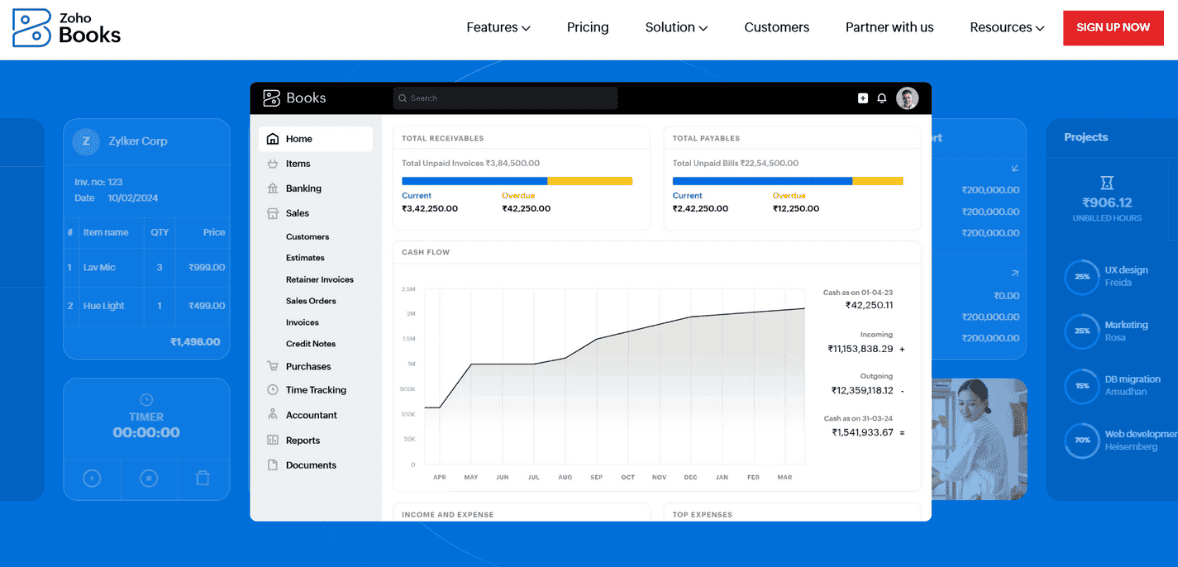
Mobile App and Accessibility
The mobile app for iOS and Android brings key features to handheld devices: invoicing, expense tracking, receipt scanning, time logging, and reporting. Offline functionality ensures data syncs later, making it practical for mobile teams. Though some advanced desktop features aren’t mirrored, the mobile app provides strong flexibility and convenience for users who manage finances on the move.
Reporting and Analytics
Zoho Books offers standard financial reports; profit and loss, balance sheets, cash flow; along with detailed insights like tax liabilities, project profitability, and expense categories. Custom filters and scheduling make it easy to distribute insights to stakeholders. The visual dashboard with charts highlights trends at a glance. While larger enterprises may require deeper analytics, Zoho Books provides more than enough for small to mid-sized companies to make data-driven decisions.
Pricing and Value
Zoho Books is known for affordability. Plans range from budget-friendly tiers with essentials to higher tiers with advanced features and more users. Discounts are available on annual subscriptions, and a free trial helps new users test it out. User limits on plans may add costs for larger teams, but overall, Zoho Books delivers excellent value when compared with larger competitors.
Customer Support and Resources
Support is offered via email, chat, and phone (in select regions). Self-service resources; knowledge base articles, guides, and video tutorials; are comprehensive. Zoho also maintains a helpful community forum and offers webinars and training resources. While some users feel personalized support could improve, especially for complex queries, the mix of official support, peer forums, and learning tools gives most businesses ample guidance.
Pros and Cons
Pros:
Affordable compared to competitors
Strong invoicing, expense, and tax tools
Automation and integrations with Zoho apps
Mobile-friendly with multi-currency support
Cons:
Limited global tax coverage in some regions
Smaller integration marketplace compared to QuickBooks/Xero
User caps on plans may limit larger teams
Some accountants are less familiar with Zoho
Final Verdict
Zoho Books is a practical, cost-effective accounting tool for freelancers, startups, and small to mid-sized businesses. It combines usability, automation, and strong integration into one platform. While not as entrenched globally as QuickBooks or Xero, its feature set and affordability make it a strong alternative. Large enterprises with highly complex needs may need more advanced systems, but for growing businesses, Zoho Books offers a powerful balance of simplicity and functionality.
FAQs
Q1. Is Zoho Books suitable for freelancers as well as larger businesses?
Yes. Freelancers benefit from simple invoicing and expense tracking, while larger firms can use its automation, multi-user access, and integrations.
Q2. How does Zoho Books compare with QuickBooks or Xero?
Zoho Books is typically more affordable and integrates tightly with Zoho apps. QuickBooks and Xero offer wider accountant familiarity and marketplaces, but Zoho holds its own in value and ease of use.
Q3. Can Zoho Books handle compliance for international businesses?
Yes. It supports multiple currencies and tax systems like GST and VAT. However, some features vary by country, so certain regions may require manual adjustments or external support.

Worldpay Review
By 10topmerchantservices September 16, 2025
Worldpay is one of the most well known payment processors, serving millions of merchants worldwide. Born as a card payments pioneer, the company has evolved into a global leader over decades of innovation. Today Worldpay operates across multiple regions, allowing businesses to accept payments in-store, online and through mobile channels and support multiple currencies and payment methods. From small shops to multi-nationals, businesses rely on its infrastructure for secure and efficient transactions. Lets read more about Worldpay Review.
The company’s scale and reliability makes it attractive to large enterprises. However, like most big processors, Worldpay isn’t without its downsides. Some merchants like its global reach, others don’t like its pricing complexity, long term contracts and inconsistent service.
Company History and Evolution | Worldpay Review
Worldpay’s history goes back to the 1980s when it was founded in the UK to help businesses accept card payments in a market just starting to adopt electronic transactions. Over time it expanded internationally and became one of the biggest brands in payment processing, driven by technology, a strong customer base and growing demand for secure solutions.
A turning point came in 2019 when Fidelity National Information Services acquired Worldpay for over $40 billion, creating one of the largest fintech companies in the world. The acquisition gave Worldpay access to FIS’s resources and scale. In 2023 FIS announced it would spin off Worldpay, reaffirming its position as a standalone payment processor.
These corporate changes show Worldpay’s ability to adapt in a fast changing industry. With the rise of digital wallets, mobile payments and fintech challengers, Worldpay has consistently updated its offerings to stay relevant. However, changes in ownership and structure leave some merchants uncertain about its long term stability and pricing models.
Core Payment Processing Services
At its core Worldpay allows businesses to accept payments in multiple ways, from card-present transactions at the point of sale to online and mobile wallet payments. The company processes billions of transactions every year, that’s how big and robust its infrastructure is.
Brick and mortar merchants benefit from its in-store solutions for chip, swipe and contactless payments. Online sellers get a robust payment gateway, recurring billing tools and international acceptance through multi-currency processing. Mobile capabilities also extend Worldpay’s reach to retail and delivery services.Fraud screening and security is built into its processing, merchants are protected from chargebacks and unauthorized transactions. Smaller businesses may find it more complex than newer competitors but Worldpay has depth, customization and scale.
Merchant Account Features
Worldpay uses the traditional merchant account model, so businesses get a dedicated account for payment processing. This is better for high volume merchants. Detailed reporting is a big plus. Merchants can analyze transaction data, track sales trends and reconcile settlements with precision; useful for complex businesses. Analytics also shows peak sales periods and preferred payment methods.
Settlement times are quick, funds are in a few days, some merchants report occasional delays. Chargeback tools are available but vary by industry and volume. Contract requirements are key. Many Worldpay accounts have long term agreements with early termination fees; not good for merchants who want flexibility. While the account features are robust, businesses need to weigh those against the contract commitments.
Pricing and Fees
Pricing is one of Worldpay’s biggest controversies. Unlike newer providers who advertise flat fees, Worldpay uses interchange-plus or tiered pricing. Interchange-plus is considered transparent but can be overwhelming for merchants who don’t speak processing jargon.
In addition to per-transaction fees, merchants may have monthly, annual or gateway fees. PCI compliance or non-compliance fees may also apply; some businesses are surprised by these. Multi-year contracts with auto-renewal clauses add to the complexity with penalties for early termination. For big volume businesses, negotiated rates and economies of scale can make pricing competitive. Smaller businesses struggle with the lack of transparency and potential hidden fees. Careful contract review and a full fee breakdown is essential before committing.
Hardware and POS Systems
Worldpay has a wide range of payment hardware and POS systems for different industries. For retailers, countertop terminals support chip, swipe and contactless. For mobile merchants, portable and wireless terminals connect via Wi-Fi or cellular. Smartphone compatible readers are low cost and flexible. Their POS software goes beyond payments to include inventory management, customer tracking and reporting; useful for retail and hospitality. Worldpay hardware also integrates with many 3rd party apps; more flexibility for businesses.
The downside is cost. Hardware costs can be high and some merchants are locked into long term leases. But the overall range of POS solutions is competitive and suitable for businesses from small shops to national chains.
Online and E-commerce Capabilities
For online businesses, Worldpay’s e-commerce tools are a strong selling point. Its payment gateway supports multiple currencies and methods, integrates with platforms like Shopify, WooCommerce, and Magento, and accepts digital wallets such as Apple Pay, Google Pay, and PayPal. Recurring billing is another strength, making it an excellent fit for subscription-based models. Fraud prevention measures add an additional layer of protection for both merchants and customers.
Still, smaller businesses may find the system harder to configure without technical expertise, and fees for online payments can be higher compared to flat-rate competitors. Nevertheless, for global reach and recurring billing needs, Worldpay’s online capabilities are robust.
Security and Compliance Standards
Worldpay maintains strong security standards, including PCI DSS compliance, tokenization, and encryption. These measures protect sensitive cardholder data during storage and transmission. Real-time fraud monitoring powered by machine learning helps detect unusual activity, though configuration may require technical support.
Merchants must stay compliant to avoid additional fees, which can be a burden for small businesses lacking IT resources. Still, Worldpay’s security practices are aligned with industry best practices, giving merchants confidence in the safety of their transactions.
Integrations and API Flexibility
Worldpay’s APIs and integration tools allow businesses to connect payment processing with third-party platforms, custom applications, ERP systems, and accounting tools. This flexibility benefits enterprises needing complex or tailored solutions.
Advanced functions such as tokenized payments, subscription billing, and multi-currency processing make global expansion easier. However, the integration process can be more technical than with newer, developer-focused platforms, creating challenges for smaller merchants without in-house expertise.
Customer Support and Service Quality
Merchant feedback on Worldpay’s customer support is mixed. Large businesses often benefit from dedicated account managers, while smaller merchants sometimes report long wait times or difficulty resolving issues.
The company provides multiple support channels, along with tutorials and compliance guides, though these may not always substitute for timely human assistance. Onboarding can be smooth for some merchants but lengthy for others, depending on business size and complexity.
Pros of Using Worldpay
Global reach with multi-currency support.
Comprehensive services covering in-store, online, and mobile payments.
Strong security and fraud prevention.
Advanced features such as recurring billing, analytics, and API integrations.
Cons and Limitations
Complex and sometimes opaque pricing.
Long-term contracts with early termination fees.
Inconsistent customer support experiences.
Significant hardware and leasing costs.
Ideal Business Types for Worldpay
Worldpay is best suited to mid-sized and large businesses that process high transaction volumes or operate internationally. Enterprises benefit from negotiated rates, global reach, and advanced tools such as recurring billing. Small businesses or startups may find the complex pricing, contracts, and equipment costs prohibitive. For them, simpler, flat-rate providers may be a better fit.
Final Verdict
Worldpay stands out as a global payment processor with decades of experience, advanced security, and a comprehensive suite of tools. It is particularly attractive to enterprises and international businesses that prioritize scale, global reach, and sophisticated features. At the same time, its complexity, long-term commitments, and inconsistent support can make it less appealing for small merchants seeking straightforward, flexible solutions. Ultimately, Worldpay remains a reliable partner for businesses that value infrastructure and global capabilities, but it is not the best fit for everyone.
FAQs
Q1. Is Worldpay suitable for small businesses?
Yes, but many small businesses find the pricing complexity and contracts challenging compared to flat-rate providers. Careful cost evaluation is recommended.
Q2. Does Worldpay support international payments?
Absolutely. It supports multiple currencies and operates in numerous countries, making it ideal for global businesses.
Q3. What are Worldpay’s biggest drawbacks?
Complex pricing, long-term contracts, and variable customer support are the most common concerns, particularly for smaller merchants.

WePay Review
By 10topmerchantservices September 14, 2025
WePay, founded in 2008 by Rich Aberman and Bill Clerico, is a US based payment service provider that offers integrated and customizable payment solutions. Built around its API driven approach WePay primarily serves platform businesses, marketplaces, crowdfunding sites and small business software providers. In 2017 the company was acquired by JPMorgan Chase expanding its reach and solidifying its position in the financial services space. Lets read more about WePay Review.
In today’s digital economy processors like WePay are essential in supporting smooth electronic transactions between businesses and their customers. They handle all types of payments; credit cards, debit cards and digital wallets; ensuring secure and efficient fund transfers. Beyond payments they also play a critical role in customer trust by providing reliable authorization, authentication and settlement processes.
Processors also offer strong security measures like encryption and fraud detection to protect sensitive financial data and help businesses comply with industry standards. They support multiple currencies and payment methods so businesses can go global and serve diverse customer bases.
Company Background: WePay History and Growth
The idea for WePay came from a personal challenge. When Aberman couldn’t collect money from friends for his brother’s bachelor party he realized there needed to be a better way to collect money from multiple people. Partnering with Clerico the two created WePay to make collecting money from multiple people easier.
In its early days WePay focused on group payments and event ticketing. Over time the company shifted to serving platform based businesses with integrated payment solutions. This allowed WePay to work with marketplaces, crowdfunding platforms and SaaS providers and offer tailored services through its APIs.
JPMorgan Chase acquired WePay in October 2017 for over $220 million. The acquisition aimed to give small businesses access to Chase’s resources through software partners while preserving WePay’s innovative Silicon Valley culture. As part of JPMorgan Chase WePay is a payments innovation hub giving partners and merchants access to Chase’s large small business client base.
Today it continues to serve platforms with customizable API based payment solutions. Clients like GoFundMe, Meetup and FreshBooks rely on WePay’s ability to provide seamless branded payment experiences that match their operational needs.
Key Features: Enhancing Payment Solutions with WePay | WePay Review
WePay is designed with platform-based businesses in mind, offering features that streamline transactions while prioritizing security and flexibility.
Integrated Payment Processing: Payments can be embedded directly within a platform’s service, avoiding external redirects and simplifying user experience.
Customizable User Experience: Through APIs, businesses can design branded checkout pages, emails, and communications, ensuring consistency across all interactions.
Fraud Detection and Risk Management: With machine learning and data analysis, it actively monitors for suspicious activity, providing merchants with a secure environment.
Instant Merchant Onboarding: Automated verifications and compliance checks help businesses begin processing payments quickly.
Flexible Payout Options: Same-day deposits and adaptable schedules support healthy cash flow management.
Mobile and Wallet Support: Compatibility with Apple Pay, Google Pay, and mobile transactions meets the growing demand for digital-first payments.
These tools allow WePay to deliver flexible and secure solutions that meet the diverse needs of modern, platform-driven businesses.
Pricing Structure: Understanding WePay’s Cost Framework
WePay structures its offerings under three tiers; Link, Clear, and Core; each catering to different business requirements.
WePay Link: An entry-level option, Link allows merchants to accept payments through Chase Integrated Payments. It carries standard fees of 2.9% plus $0.25 per transaction and requires minimal integration work.
WePay Clear: A step up from Link, Clear allows for deeper integration into platforms, offering customization and risk management features. Pricing is set on a case-by-case basis.
WePay Core: Targeted at larger facilitators, Core delivers full control over user experience and lifecycle management, with fees negotiated individually.
Platforms also have the option to set their own merchant pricing by applying markups to WePay’s rates, creating an additional revenue stream. However, Clear and Core lack publicly available pricing details, which has led to concerns about transparency.
Integration and Compatibility: Seamless Payment Solutions
It emphasizes easy integration and wide compatibility, making it attractive to developers and platforms alike.
Its developer-focused APIs, with documentation in multiple programming languages, allow customization for different applications. This flexibility ensures smooth payment experiences across mobile and desktop platforms. Additionally, it supports mPOS systems for in-person transactions, broadening its usability.
Digital wallet compatibility with Apple Pay and Google Pay further enhances convenience, aligning with customer expectations for modern payment methods. This adaptability makes it suitable for platforms spanning marketplaces, crowdfunding, and SaaS.
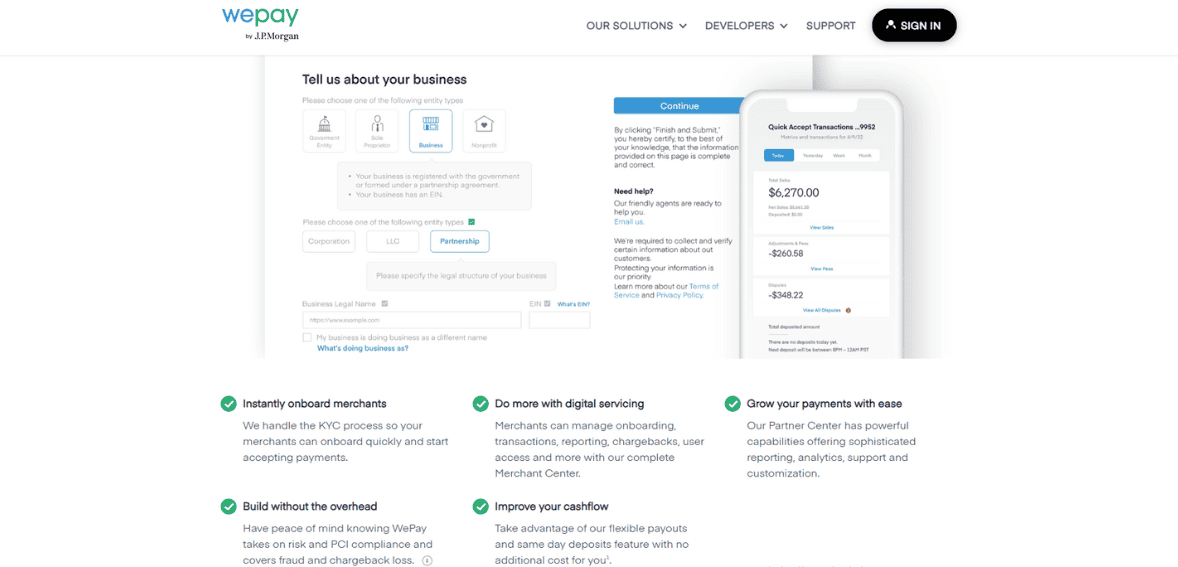
Security and Compliance: Safeguarding Transactions
Security is at the core of WePay’s operations.
Fraud Prevention: The platform uses machine learning to detect irregular patterns, blocking unauthorized activity.
PCI DSS Compliance: As a Level 1 PCI DSS-certified provider, it undergoes regular independent audits to maintain strict security standards.
Encryption: Data in transit is secured with RSA 2048-bit keys and SHA-256 certificates, while stored data uses AES 256-bit encryption with unique keys.
By combining regulatory compliance with advanced fraud detection, It provides a secure and reliable environment for both merchants and customers.
Customer Support and User Experience
It offers support primarily through email and its online Help Center, which provides articles and guides on key topics. The “Customer Delight” team operates Monday through Friday, from 6 am to 6 pm PST. Feedback on support is mixed. Some users appreciate the available documentation, while others find the reliance on email; without phone support; slows down response times. Concerns about resolution speed and communication options are recurring themes.
From an experience standpoint, It is designed for simplicity. Merchants benefit from a smooth onboarding process, while end-users enjoy straightforward checkouts without redirection to external sites. This ease of use supports both customer satisfaction and business efficiency.
Pros and Cons
Pros
Developer-friendly APIs for seamless integration.
Customizable, branded payment experiences.
No setup or monthly fees.
Cons
Limited direct access for small businesses (only available through partner platforms).
Lack of transparent pricing for advanced tiers.
Limited support channels, with reliance on email.
Alternatives to WePay
Businesses comparing WePay should also consider Stripe, PayPal Payments Pro, and Braintree:
Stripe: Known for its robust APIs and wide range of supported payment methods, Stripe offers transparent pricing (2.9% + $0.30 per transaction) with no monthly fees. Its global reach and subscription billing features make it ideal for tech-savvy businesses.
PayPal Payments Pro: Offers customizable checkout options and broad brand recognition, but requires a $30 monthly fee plus transaction fees. Its global presence makes it appealing to businesses targeting international customers.
Braintree: A PayPal-owned service supporting multiple payment methods, including Venmo and Bitcoin, Braintree charges 2.9% + $0.30 per transaction with no monthly fees. Its flexibility makes it attractive to businesses seeking a wide range of payment options.
Compared with these competitors, It stands out for its tight integration with JPMorgan Chase and platform-first strategy, though its limited transparency and support may deter some users.
Conclusion
It is best suited for platform-based businesses seeking integrated, customizable, and secure payment solutions. Its API-driven approach and Chase affiliation give it strong credibility, while its features support smooth transactions and fraud prevention. However, potential clients should weigh concerns about pricing transparency and customer support against its strengths. For marketplaces, crowdfunding platforms, and SaaS providers, it remains a compelling option in the competitive payment processing landscape.
FAQs
Can individual small businesses use WePay directly?
No. Small businesses typically access WePay through partner platforms or ISVs rather than engaging with WePay directly.
What types of platforms work best with WePay?
It integrates most effectively with crowdfunding platforms, marketplaces, and SaaS providers, where embedded payment functionality is crucial.
Does WePay support international payments?
It’s international support is limited to merchants in the U.S. and Canada. While it accepts payments from most global cards, availability depends on the platform partner.

VisaNet Review
By 10topmerchantservices September 11, 2025
VisaNet is the global transaction engine behind almost every Visa payment made worldwide. It’s the central hub that connects issuing banks, acquiring banks, merchants and cardholders, so transactions clear in seconds. Whether a customer swipes a card in-store, pays online or taps contactless, VisaNet routes, validates and completes the request. Its reputation for speed and reliability has made it one of the most trusted payment infrastructures. Lets read more about VisaNet Review.
Beyond moving money, VisaNet does multiple critical things in real time. It verifies cardholder credentials, applies fraud detection rules and enforces security compliance. It also handles complex cross-border functions like currency conversion and regional regulations. These capabilities make VisaNet not just a payment processor but a fundamental enabler of global commerce.
Despite being efficient, VisaNet is not without controversy. Merchants pay transaction fees and some argue that relying on one of the world’s largest private payment systems creates concentration risks. But VisaNet has become synonymous with reliability, balancing innovation with scale to process billions of transactions daily. By being the invisible bridge between merchants and consumers, VisaNet influences how money moves across industries and economies, how billions interact with payments every day.
History and Evolution of VisaNet | VisaNet Review
VisaNet’s history is tied to the rise of modern electronic payments. Its foundations were laid in the late 1970s when Visa started digitizing manual, paper-based processes. As card usage grew, Visa realised the need for a unified system to manage authorisations, settlements and clearing on a global scale. In 1977, VisaNet was launched, one of the first large-scale networks to deliver electronic transaction processing.
The system has evolved continuously. In the 1990s, the growth of cross-border commerce required broader currency and regulatory support. In the early 2000s, e-commerce brought new challenges, so VisaNet built solutions for card-not-present transactions. With mobile and contactless payments emerging in the 2010s, the network expanded to handle higher volumes with minimal latency.
Today, VisaNet is one of the largest and most advanced payment networks, processing tens of thousands of transactions per second. It uses AI, machine learning and advanced analytics to enhance fraud detection and efficiency. But its layered infrastructure needs to be updated constantly to keep up with the fast-paced fintech landscape. Its ability to adapt over decades shows its resilience and long-term relevance.
Global Reach and Transaction Volume
VisaNet’s strength is its sheer scale. Operating in over 200 countries and territories and supporting more than 160 currencies, it lets consumers and businesses transact almost anywhere in the world. It processes billions of transactions every year across retail, e-commerce, travel and services, that’s trillions of dollars in payment volume.
That scale is a reflection of Visa’s dominance and the trust of banks, merchants and consumers. VisaNet’s ability to handle peak surges – holiday seasons or global shopping events – without disruption is critical to global commerce. But with that dominance comes scrutiny. Critics argue that Visa’s market share concentrates too much power in one network, limiting competition and diversity in payments. Even so, VisaNet is essential to commerce, offers unparalleled reach and reliability and is the gatekeeper of the financial system.
Core Infrastructure and Technology Backbone
VisaNet is engineered for speed, scalability and resilience. Multiple globally distributed data centers ensure redundancy and near 100% uptime, so authorizations and settlements happen in real time. Consumers get seamless transactions, merchants and banks get uninterrupted payment flows.
Security is embedded at every level. VisaNet uses encryption, tokenization and secure protocols to protect sensitive data. AI and machine learning are used to analyze transaction flows, detect anomalies and flag fraud in real time. Scalability is a core focus, with Visa investing in cloud and software defined networking to handle the growing global demand.
Running such a complex infrastructure requires massive resources and investment in hardware, cybersecurity and compliance. Some say this complexity makes Visa slower to adapt compared to leaner fintech startups. But its technology backbone is one of the most robust in financial services.
Payment Processing Capabilities
VisaNet’s main job is to process payments reliably and securely across physical and digital channels. Whether a transaction is card-present in a store or card-not-present online, the system authorizes, clears and settles payments. It’s flexible beyond traditional retail, supporting recurring billing cycles, subscription based business models and mobile wallet transactions that mirror today’s consumer behaviour.
Card-present was where VisaNet built its reputation, with rapid authorisation and checkout experiences that reduced friction for merchants and customers. As commerce went online, the platform adapted by adding 3D Secure and real-time fraud screening. These features help strengthen online payment security for merchants and cardholders against cyber threats. VisaNet’s multi-currency functionality also allows businesses to accept payments from international customers with ease, global commerce and seamless experiences for travellers and cross-border shoppers.
But merchants complain about cost. Transaction fees, network charges and interchange rates are big for small businesses with tight margins. For many, these costs are a barrier to using VisaNet even though the infrastructure is reliable, global and has advanced risk management. Balancing cost with innovation is the challenge. While VisaNet evolves to meet market demands, making sure smaller merchants can use it without being burdened by fees is key to wider adoption and long term growth in the digital economy.
Security and Compliance Features
VisaNet’s security is one of its biggest and most trusted assets. At its heart is a multi-layered defence system that protects sensitive payment data at every stage of a transaction. Encryption protects information as it moves across networks, tokenization replaces card details with unique identifiers to reduce data exposure and real-time fraud detection uses machine learning and behavioural analytics to catch suspicious activity before it gets out of hand. For online and mobile transactions, biometric verification and multifactor authentication add extra security and consumer confidence.
Equally important, it meets global regulatory standards including the PCI DSS. By following these frameworks and continuously updating its security protocols, the network stays compliant and ahead of the threats. For banks and merchants, this means a trusted foundation for regulatory confidence and consumer trust.
But with size and fame comes being a bigger target for cybercriminals. As threats get more sophisticated, continuous investment in advanced defences is essential to stay resilient. Fintechs can roll out new security innovations quickly but VisaNet has been processing billions of transactions for years and is proven to be reliable. The combination of established trust, global compliance and ongoing innovation means VisaNet is the cornerstone of secure digital commerce in a complex cyber world.
Integration with Financial Institutions and Merchants
It integrates seamlessly with a vast ecosystem of banks, processors, and merchants. Issuing banks rely on it for authorizations, acquiring banks use it for settlement, and merchants benefit from its universal acceptance. Integration typically occurs via payment gateways and POS systems, minimizing technical barriers for adoption.
Specialized services, such as recurring billing and detailed reporting, add value for merchants seeking predictable cash flow and insights into consumer activity. For global corporations, VisaNet’s reach is indispensable. Yet costs and technical requirements can be obstacles for smaller businesses. Fees and integration expenses often weigh heavily on those operating with limited margins, restricting access despite the network’s advantages.
Real-Time Processing and Speed
VisaNet is renowned for its processing speed, typically authorizing payments within seconds; even during peak shopping periods. Its global data centers and optimized routing protocols allow the system to process thousands of transactions per second with minimal latency. For merchants, this means steady cash flow and reliable settlement. For consumers, it delivers seamless checkout experiences. Although rare, outages reveal the risks of concentrating so much infrastructure in one system. Still, VisaNet’s performance record sets a benchmark few competitors can match.
Support for Emerging Payment Methods
It has consistently adapted to evolving payment trends. Contactless transactions, digital wallets, and QR code-based systems are all supported, making the network compatible with a wide array of consumer preferences. Post-pandemic, contactless and wallet-based transactions have grown significantly, with VisaNet scaling to meet demand.
In developing regions, support for QR payments reflects VisaNet’s inclusive approach. However, competition from local platforms like UPI in India or UnionPay in China highlights the challenges of maintaining global dominance where regional systems thrive. Still, its ability to integrate emerging methods while preserving security is a strategic advantage.
Analytics, Reporting, and Insights
VisaNet extends beyond transaction processing by offering robust analytics and reporting tools. Banks and merchants use these insights to identify consumer trends, monitor performance, and manage fraud risks. For businesses, these tools help tailor marketing strategies, refine operations, and track settlements.
Yet accessibility varies. Larger organizations are best positioned to leverage advanced analytics, while smaller merchants often lack resources to maximize these capabilities. Despite this limitation, VisaNet’s role as both processor and intelligence provider reinforces its centrality to financial ecosystems.
Reliability, Uptime, and Performance
VisaNet is widely respected for its reliability, consistently maintaining uptime above industry averages. Its global redundancy and disaster recovery measures ensure transactions flow smoothly even during regional disruptions. For businesses, reliability translates to trust and stable revenue. While outages occasionally occur, their rarity underscores VisaNet’s resilience. Its long-standing performance record remains one of its most reassuring qualities for stakeholders worldwide.
Comparison with Competitors
VisaNet competes with Mastercard, American Express, and Discover. Mastercard is its closest rival, offering comparable speed and security, though Visa often holds larger market share. American Express integrates issuing and network roles, giving it tighter control but limiting acceptance. Discover, while functional, operates at a smaller scale.
Where competitors may excel in niche innovation, VisaNet’s unmatched scale and global reach keep it ahead. The competition forces VisaNet to continue evolving while maintaining its position as the payments benchmark.
Challenges and Limitations
Despite its dominance, VisaNet faces challenges. High transaction costs remain a barrier for small businesses, who often pass fees to consumers. Its centralized structure, while controlled, increases systemic risk during outages. Growing competition from fintech startups and regional systems also pressures VisaNet to innovate faster.
Regulatory scrutiny is intensifying, with governments demanding transparency around fees and operations. It must balance compliance, affordability, and innovation to sustain its role in the global economy.
Future Outlook
VisaNet’s future will be shaped by technology adoption and consumer behavior. Areas like real-time payments, blockchain integration, and biometric security present opportunities for innovation. Cross-border e-commerce growth further enhances VisaNet’s importance, though competition from regional systems will intensify.
Sustainability initiatives, such as energy-efficient data centers, are likely to feature in its long-term strategy. The challenge will be maintaining global reliability while adapting at the speed of fintech disruptors. Its ability to balance scale with agility will define its relevance in the next decade.
Conclusion
VisaNet is one of the most significant achievements in modern financial infrastructure. From its launch in 1977 to its role as the backbone of global payments today, it has consistently evolved with technology and consumer needs. Its speed, scale, and security have made it indispensable, though high fees and regulatory challenges highlight its limitations. For consumers, it means seamless transactions. For businesses, it offers global reach with associated costs. For regulators, it remains an entity under close watch. Despite imperfections, VisaNet continues to be the foundation for digital commerce worldwide, shaping how money moves across industries and economies.
FAQs
Q1: What makes VisaNet different from other payment networks?
It stands out for its massive scale, global acceptance, and ability to process thousands of transactions per second. While Mastercard and Amex offer similar services, VisaNet’s universal reach gives it an edge.
Q2: Is VisaNet secure for handling sensitive payment data?
Yes. it relies on encryption, tokenization, fraud detection, and compliance with PCI DSS to secure sensitive information, making it one of the most trusted networks.
Q3: Who benefits most from VisaNet?
Multiple stakeholders benefit: consumers enjoy convenience, merchants gain global access, and banks rely on its secure infrastructure. However, smaller merchants often struggle with costs, even as they benefit from its reliability.

Verifone Review
By 10topmerchantservices September 8, 2025
Verifone has long been a prominent name in the payments industry, with decades of experience bridging merchants and consumers. Established in the 1980s, the company began by producing innovative card-processing hardware and gradually expanded into both physical and digital payment solutions. Today, it operates in more than 150 countries, serving businesses of all sizes; from small merchants to multinational corporations. Its focus has consistently been on simplifying transactions and ensuring payments remain secure, fast, and accessible. Much of Verifone’s brand strength comes from its reputation for reliability and its ability to adapt to a constantly changing industry. Lets read more about Verifone Review.
As consumer preferences shift toward digital wallets, contactless cards, and mobile-first experiences, Verifone has expanded its portfolio to include more than just POS terminals. With cloud-based platforms, omni-commerce tools, and integrated payment systems, the company has sought to remain relevant in an environment where fintech startups and tech giants alike are raising the bar.
Verifone’s Role in the Payment Ecosystem | Verifone Review
At its heart Verifone powers secure, compliant and fast payment connections between customers’ chosen methods and merchants’ banks. Whether countertop POS, mobile or e-commerce gateways the company enables transactions across industries.
Retail, quick-service restaurants, hospitality, fuel stations and transportation are the key sectors where Verifone solutions are used. In retail Verifone supports EMV chip cards, magnetic stripe, contactless wallets and QR payments. In restaurants and service industries Verifone helps improve customer experience by integrating payments with ordering platforms, loyalty programs and back-office tools.
Verifone is the bridge between traditional financial institutions and modern digital commerce. By offering both hardware and cloud services the company allows businesses to operate in hybrid environments where physical and online transactions coexist. For example its terminals manage in-store payments and its e-commerce tools manage online checkouts all under one roof.
In emerging markets where mobile-first payments are dominant Verifone provides lightweight and portable devices that don’t require complex infrastructure. This flexibility has made it the go-to partner in regions with diverse acceptance needs and consistent consumer experience and simplified merchant operations.
Hardware Solutions: POS Devices and Terminals
One of Verifone’s biggest strengths is its POS hardware. From small handheld devices to big countertop units, its devices are tough, reliable and user friendly. Businesses choose Verifone terminals for their ruggedness, ease of setup and long life. Countertop options like the VX and Engage series support multiple payment methods – chip and pin, swipe and contactless – and are fast processing and easy to use. Mobile devices like the e285 and Carbon series are for restaurants, delivery services and pop up stores where portability is key.
The company also offers integrated solutions that bundle hardware with software so you can customize apps for loyalty, inventory and employee management. While these devices are very functional they are more expensive than low cost competitors. You may also experience downtime during software updates. But the security and durability of Verifone hardware makes it a long term investment for many businesses.
Software Solutions and Payment Platforms
Beyond the hardware Verifone has invested in software and cloud based services. Their platforms include gateways, APIs and omni-commerce solutions to manage payments across physical and digital channels. A big plus is the ability to unify in-store and online transactions so customers have a consistent experience across touchpoints. Features like tokenization, recurring billing and multi-currency support make global commerce easy. Developers have APIs to build custom apps and merchants have integrations with accounting systems, CRM tools and loyalty programs.
The trade off is complexity. Some users say Verifone’s software is less intuitive than newer fintech competitors. Training and onboarding may be required which can slow adoption for smaller businesses. But for enterprises that need scalability and depth Verifone’s software ecosystem has capabilities beyond what lighter weight providers offer.
Security and Compliance Features
Security is at the heart of Verifone’s offering. Their devices and platforms are PCI DSS compliant and have end-to-end encryption and tokenization to protect cardholder data. End-to-end encryption means information is protected from the terminal to the acquirer, tokenization replaces card details with a unique token to reduce the risk of breach. These are especially important in industries with high compliance requirements like healthcare and retail. Real-time monitoring tools also help detect suspicious activity so you can prevent fraud.
But compliance can be resource intensive especially for smaller merchants. System updates are also required to stay ahead of evolving threats which adds complexity. But Verifone’s long history of security gives merchants peace of mind that their transactions are compliant and secure.
Integration and Customization Capabilities
Verifone’s integrations are a big plus. Their developer tools and APIs let you connect payment terminals to accounting, CRM, inventory and other business systems. Industry specific customizations make it even more attractive. Hospitality providers can integrate with property management systems, fuel stations can connect terminals directly to pump controls. Value added applications like loyalty programs or tipping features can be deployed on compatible devices.
However integrating with legacy or niche systems can require technical expertise so implementation is more resource heavy than plug and play fintech competitors. For big enterprises with complex infrastructures Verifone’s flexibility and scalability is valuable.
User Experience and Interface Design
Verifone’s POS devices are designed for both merchants and consumers. Terminals have backlit keypads, clear navigation and fast processing speeds to reduce checkout times. From the consumer perspective familiarity with Verifone devices builds trust.
Merchants have access to reporting dashboards and analytics to see transaction volumes, settlement and consumer trends. While these tools are powerful they are more complex than fintech dashboards and require training to use fully. Not always the most user friendly option, It balances functionality with reliability. Global recognition among consumers also builds confidence at the point of sale.
Global Reach and Market Presence
Verifone is a leading player in the global payments industry, operating in more than 150 countries and maintaining one of the broadest international footprints in the sector. This extensive presence allows the company to support multi-currency transactions and ensure compliance with diverse regional regulations, making it a trusted partner for businesses with cross-border operations. Verifone’s solutions are particularly well established in the retail and fuel station industries, where its devices are widely recognized and frequently used. For multinational enterprises, this global reach provides a sense of consistency and reliability.
However, service quality is not always uniform, and customers in certain regions may experience differences in support or implementation. Additionally, delays in rolling out new products and technologies across markets can pose challenges for businesses eager to adopt innovations. Even so, Verifone’s strong reputation and longstanding presence in the payments ecosystem offer stability and credibility that many newer providers cannot match.
Pricing Structure and Costs
Pricing is often a critical factor for merchants when considering Verifone’s solutions. Compared to low-cost competitors, Verifone’s hardware generally comes at a higher price point, reflecting its durability and advanced capabilities. However, this premium can be a barrier for smaller businesses with limited budgets. In addition to hardware costs, merchants may face recurring service or licensing fees for accessing Verifone’s software platforms, which further increases the total cost of ownership.
Transaction fees add another layer of complexity, as they are determined by the acquiring bank or processor rather than being standardized. This makes overall expenses less predictable compared to flat-rate providers like Square. Larger enterprises often view these costs as worthwhile, since it offers scalability, reliability, and compliance across multiple markets. Smaller merchants, on the other hand, may find the upfront investment, ongoing fees, and maintenance or support expenses challenging to manage, leading them to seek more affordable alternatives.
Customer Support and Service Quality
Verifone offers a variety of support channels to help merchants manage their payment systems effectively. These include phone-based assistance, comprehensive online resources, and detailed product documentation. The company also provides training guides, compliance materials, and troubleshooting articles, which are particularly useful for merchants navigating complex payment environments. For multinational enterprises, it delivers localized support tailored to different regions, although the quality and responsiveness of that support can vary.
Some merchants have noted delays in response times or inconsistent service experiences, especially when assistance is handled through third-party resellers rather than Verifone directly. Compared to newer fintech competitors that emphasize fast, highly personalized customer support, It can sometimes feel less agile and responsive. Nonetheless, its extensive global presence and long-standing reputation ensure that businesses generally have access to the resources they need, either through Verifone’s own support network or via reliable third-party partners, maintaining a level of operational continuity.
Pros of Using Verifone
Durable, reliable hardware with a long lifespan
Advanced encryption and tokenization for security
Extensive global reach and compliance support
Strong integration and customization capabilities
Omni-commerce solutions supporting both physical and digital payments
Cons and Common Criticisms
Higher hardware and service costs
Software interfaces can be complex for new users
Support quality varies across regions
Slower to innovate compared to agile fintech startups
Ideal Business Types for Verifone
Verifone is best positioned to serve medium to large enterprises that require scalable and customizable payment solutions tailored to their complex needs. Its offerings are particularly valuable in industries such as retail, hospitality, transportation, and fuel, where transaction volumes are high and reliability is critical. Verifone’s ability to support multi-currency payments, comply with diverse regulations, and integrate with enterprise-level systems makes it a strong choice for organizations with multi-location or international operations.
These businesses often prioritize security, compliance, and long-term reliability, areas where Verifone has built a strong reputation. While smaller businesses can certainly adopt Verifone’s solutions, the higher upfront costs, ongoing service fees, and technical complexity may outweigh the benefits compared to lighter, more cost-effective fintech alternatives. For enterprises that demand consistent performance, advanced features, and strict regulatory compliance, however, it delivers significant value and remains a trusted partner in managing complex global payment infrastructures.
Comparison with Competitors
When compared with competitors such as Ingenico, Square, and Clover, Verifone demonstrates a mix of notable strengths and some limitations. Ingenico, often regarded as its closest rival, matches Verifone in terms of durable hardware and expansive global reach, making both strong choices for multinational enterprises. On the other hand, Square and Clover focus heavily on simplicity, ease of setup, and affordability, which makes them particularly appealing to small and medium-sized businesses that value speed and cost-efficiency.
It differentiates itself with enterprise-grade scalability, deep system integration, and strong compliance capabilities, which are critical for organizations operating across multiple regions or in highly regulated industries. These advantages make Verifone a preferred partner for businesses prioritizing reliability and security. However, the trade-off comes in the form of higher costs, complex implementation, and potentially less agile support. As a result, smaller merchants may gravitate toward lighter, more user-friendly fintech alternatives.
Conclusion: Is Verifone Worth It?
It remains a cornerstone of the payments industry, delivering secure, reliable hardware and software solutions with unmatched global reach. It is a strong choice for enterprises prioritizing long-term stability, scalability, and compliance. For small businesses, however, Verifone’s higher costs and complexity may outweigh the benefits, with fintech alternatives often providing simpler and more affordable setups. Ultimately, it’s value depends on the size, industry, and goals of the business. For large-scale operations, it continues to be one of the most trusted providers in the space.
FAQs
Q1. Is Verifone suitable for small businesses?
It can serve small businesses, but its systems are generally more aligned with medium and large enterprises. Smaller merchants may prefer more affordable, plug-and-play alternatives.
Q2. How secure are Verifone systems?
It offers advanced security through PCI DSS compliance, end-to-end encryption, and tokenization, ensuring sensitive data is protected throughout the payment process.
Q3. Does Verifone support contactless and mobile wallets?
Yes. Verifone’s modern devices support NFC-enabled cards and digital wallets such as Apple Pay, Google Pay, and Samsung Pay, aligning with current consumer preferences.