

Worldline Review
By 10topmerchantservices November 12, 2025
Worldline is a big player in the payments universe. This review will give a balanced view of the company: who they are, how they work, what are their strengths and weaknesses, what’s to come. Not to promote the company but to dissect their model, performance, strategy and risks so you can make your own judgement. In an age of digital payments, e-commerce and financial infrastructure, companies like Worldline are at the crossroads of technology, regulation and commerce; so their story is relevant. This review will cover the company’s history and evolution, business model, market position, financials, technology and innovation, geographical presence, regulatory environment, reputation and controversies, SWOT analysis, strategic outlook, stakeholder impact and conclusion. Lets read more about Worldline Review.
Company Background & Evolution | Worldline Review
Worldline has its roots in the early 1970s and has gone through several phases of growth, consolidation and strategic repositioning. Founded in 1972 as part of a French payments and transaction processing company, it became part of Atos SE and was later spun out as an independent company. Key milestones include the acquisition of European payment services companies such as SIX Payment Services in 2018 to strengthen its presence in merchant acquiring and payments infrastructure. As of mid 2020s, Worldline is present in dozens of countries and serves merchants, financial institutions, governments and corporations. The company has been through heavy acquisition, technology integration, global expansion and service diversification. But this rapid growth also brought integration complexity and exposure to many markets and regulatory environments. Understanding this history is key to understanding the business model and strategy.
Business Model & Core Services
Worldline’s business model is based on providing payments and transaction-processing services across multiple segments. The company has three main service lines: Merchant Services, Financial Services and Mobility & e-Transactional Services. In Merchant Services, Worldline supports merchants (in-store and online) by acquiring transactions, providing terminals or online payment platforms and servicing the acceptance process. The Financial Services segment serves banks and issuers with card issuing, processing, ATM networks and outsourcing of financial transaction services. The Mobility & e-Transactional segment supports non-payment digital transactions such as e-ticketing, mobility solutions, identity services or e-documents. By offering end-to-end payments infrastructure, Worldline captures value from multiple points in the transaction chain. Revenue comes from transaction volumes, platform subscriptions, hardware (terminals) sales or leases and outsourcing services. The model benefits from network effects, fixed cost efficiencies through scale and diversification across geographies and services. But global networks, fintech disruptors and local acquirers put pressure on the model and evolving regulatory costs for compliance and data protection.
Strategic Growth & Acquisition Strategy
Growth for Worldline has been driven largely by acquisitions and partnerships. The company’s expansion strategy involved acquiring complementary capabilities and integrating them to achieve scale. This approach allowed Worldline to rapidly gain market share, broaden its product offering, and strengthen its competitive position. Notable deals such as the acquisition of SIX Payment Services and Ingenico have been pivotal. However, acquisition-driven growth carries inherent risks: integration of different corporate cultures, legacy systems, and operational frameworks can be challenging. Worldline’s success depends not only on acquiring but on successfully assimilating these businesses while maintaining profitability and service quality. In the payments industry, scale provides both defensive and offensive advantages; helping the company defend against competitors and strengthen its market share. Partnerships and joint ventures also play a key role, especially in emerging markets, enabling access to local networks and regulatory licenses. As of recent years, the company has shifted focus toward organic growth, efficiency improvements, and cost optimization, recognizing that synergy realization and disciplined integration are essential for sustainable success.

Market Position & Competitive Landscape
Worldline operates in a highly competitive sector where global processors, card networks, fintechs, and regional players constantly compete. Among the key competitors are FIS, Fiserv, Global Payments, Adyen, and Stripe, all of whom offer overlapping or adjacent services. Within Europe, Worldline has carved out a leadership position, particularly in merchant acquiring and payment infrastructure. Its extensive merchant base, partnerships with major banks, and end-to-end services give it a strong foundation. Yet, competition remains intense. Margin pressure continues to rise as digital-first players leverage software efficiency, while merchants increasingly expect omnichannel, data-rich payment solutions. Moreover, the emergence of embedded payments and open banking threatens to disrupt traditional acquirer economics. To maintain its edge, Worldline must continuously innovate, improve customer experience, and reduce operational costs. Its position as a European payments champion provides scale and credibility, but maintaining that leadership amid global digital transformation will require agility, investment in new technology, and proactive risk management.
Financial Performance & Key Metrics
Worldline reported FY 2024 revenue of approximately €4.63 billion, a modest organic growth of about 0.5%. Adjusted EBITDA stood at €1.07 billion, representing a margin of roughly 23%, while free cash flow reached €201 million, or 19% of adjusted EBITDA. However, the company also reported a net loss of nearly €297 million in 2024, reflecting restructuring and impairment costs. In Q1 2025, revenue fell to €1.07 billion, a 2.3% decline compared with Q1 2024, largely due to flat performance in Merchant Services and weakness in Financial Services. These figures illustrate a company with strong scale and positive cash generation but struggling with profitability and growth momentum. Analysts have pointed to factors like slower hardware shipments, integration costs, and macroeconomic headwinds as constraints. The company’s near-term financial outlook remains cautious as it works to restore profitability, strengthen liquidity, and maintain investor confidence. Its success will hinge on operational efficiency, disciplined spending, and recovery in merchant transaction volumes.
Technology, Innovation & Product Portfolio
Worldline’s strength lies in its technological backbone and comprehensive product ecosystem. The company offers a blend of hardware and software products, including POS terminals, online gateways, and secure transaction platforms. Its systems are built for reliability, compliance, and scalability, catering to millions of daily transactions across sectors. Innovation efforts have centered on expanding e-commerce capabilities, integrating new payment methods such as digital wallets and instant transfers, and providing merchants with analytics, reconciliation, and fraud detection tools. The company’s investments in cybersecurity, real-time analytics, and modular architecture reflect a move toward more agile, API-driven systems. Furthermore, its Mobility & e-Transactional Services unit extends beyond payments into digital identity and ticketing, demonstrating diversification potential. However, maintaining technology leadership demands continuous investment and modernization of legacy platforms. The competition’s faster innovation cycles, especially among fintechs and neobanks, underscore the need for agility. Overall, Worldline’s technology ecosystem remains robust, but modernization speed and service innovation will determine its future relevance.
Global Presence & Geographic Strategy
Worldline’s operations span over 50 countries, but its strongest foothold remains in Europe, particularly France, Germany, Switzerland, and the Benelux region. The acquisitions of SIX Payment Services and Ingenico expanded its presence across Northern and Eastern Europe, making it one of the continent’s largest payment processors. Beyond Europe, Worldline has been cautiously entering Asia-Pacific, Latin America, and parts of Africa through partnerships and local subsidiaries. Its global expansion strategy balances scale with prudence; focusing on markets with regulatory openness, strong digital adoption, and sustainable growth potential. Nevertheless, global diversification brings challenges such as compliance variation, FX exposure, and the need for region-specific customization. Worldline’s ability to adapt to local consumer behavior and integrate with regional payment systems determines its success outside Europe. The company’s global reach enhances revenue stability and positions it as a bridge between mature and emerging markets, though maintaining operational consistency across regions remains an ongoing test of execution.
Regulatory, Risk & Compliance Considerations
Operating in a regulated industry, Worldline faces constant scrutiny from financial authorities across its markets. Compliance with frameworks such as GDPR, PCI-DSS, PSD2, AMLD, and various national banking laws is essential for maintaining licenses and trust. The company employs rigorous risk management systems to monitor transaction integrity, detect fraud, and ensure anti-money-laundering compliance. However, the broad geographic scope exposes it to varying regulatory standards, requiring significant investment in compliance infrastructure. Regulators continue to tighten oversight on payment processors, especially around merchant onboarding and cross-border fund flows. Non-compliance could lead to penalties, reputational damage, or restrictions on business activities. Recent events have underscored the importance of risk governance for Worldline, pushing management to strengthen its frameworks and internal audits. While the company’s size allows it to absorb regulatory costs, its long-term stability will depend on transparent practices, effective supervision, and continuous improvement in risk management.

Reputation, Challenges & Controversies
Worldline has recently faced serious reputational challenges that have shaken investor confidence. Reports surfaced in 2025 alleging lapses in oversight related to certain high-risk merchants and potential deficiencies in anti-money-laundering processes. These controversies led to a significant stock decline and regulatory investigations, particularly within its Belgian subsidiary. The company also faced internal restructuring pressures as it attempted to stabilize margins and control costs. In response, Worldline has emphasized governance reforms, compliance investments, and a renewed focus on transparency. Despite these corrective steps, the reputational damage has been significant, compounded by broader industry skepticism following several high-profile fintech failures. The firm’s future credibility will depend on how effectively it addresses compliance concerns, communicates with regulators, and rebuilds trust with clients. While its core operations remain intact, such incidents highlight the delicate balance between growth and risk control in financial services, where oversight missteps can quickly overshadow technical and commercial strengths.
SWOT Analysis (Strengths, Weaknesses, Opportunities, Threats)
Worldline’s primary strengths include its vast European scale, integrated services, and proven ability to handle high transaction volumes with reliability. Its diversified business model; spanning merchants, financial institutions, and mobility services, creates resilience and cross-sector synergies. However, weaknesses persist in the form of integration complexity, reputational risk, and uneven profitability. The company’s reliance on hardware and legacy infrastructure also slows innovation relative to younger fintechs. Opportunities lie in expanding real-time payments, open banking, subscription billing, and analytics-driven value-added services. As global digital commerce grows, Worldline can leverage its infrastructure to capture new transaction flows. Yet, threats are significant: increased regulation, aggressive competition, cybersecurity vulnerabilities, and the lingering impact of reputational issues. The balance between capital discipline and innovation investment will shape the company’s ability to convert opportunities into long-term gains.
Strategic Outlook & Future Directions
Worldline’s management has signaled a strategic reset focused on cost efficiency, asset divestment, and disciplined growth. The company plans to simplify its structure, divest non-core assets, and focus on improving profitability through operational efficiency. Simultaneously, it seeks to regain market confidence through governance reforms and stronger compliance oversight. Growth opportunities will come from expanding in digital payments, contactless solutions, and B2B e-commerce. The company also plans to enhance automation and data analytics capabilities across operations. However, the next few years will be critical for rebuilding margins and investor trust. Success will depend on clear execution, transparent communication, and measurable progress in cash flow generation. In essence, Worldline stands at a crossroads: either transform its operational efficiency into a sustainable competitive edge or risk losing ground to faster, more agile payment innovators. The direction it takes will determine whether it remains a European leader or becomes a consolidation target.
Implications for Stakeholders
For merchants, Worldline’s comprehensive services offer convenience, scalability, and integration across online and offline channels. However, clients must assess factors like service quality, fee structures, and compliance reliability before committing to long-term relationships. For investors, Worldline presents both potential and caution. Its scale and infrastructure are assets in a growing digital payments market, but reputational challenges and execution risks remain major concerns. Investors will watch for improved profitability, steady cash flows, and leadership accountability. For regulators and partners, the company’s evolution will be an indicator of how large payment firms adapt to tightening oversight while maintaining innovation. A successful turnaround could re-establish confidence in Europe’s payment infrastructure landscape, whereas continued missteps could reinforce calls for stricter regulation. Across all stakeholder groups, trust, transparency, and consistency will define how effectively Worldline sustains its role in the payments value chain.
Conclusion
Worldline remains a cornerstone of Europe’s payments infrastructure, with deep technological capabilities and a broad service portfolio. Yet, its journey in recent years reflects the complexity of scaling a global financial technology enterprise. The combination of modest growth, regulatory scrutiny, and reputational headwinds has challenged its long-held leadership position. Still, the fundamentals; a vast merchant network, stable cash generation, and experience in managing critical payments infrastructure; provide a strong foundation for recovery. The company’s success will depend on its ability to strengthen governance, modernize technology, and deliver consistent value to clients and shareholders. In the coming years, execution and transparency will define whether Worldline emerges stronger from its current turbulence or remains burdened by legacy issues. The payments industry rewards innovation and accountability, and Worldline’s future will hinge on how well it balances both.
FAQs
Q1. What differentiates Worldline from other payment processors?
Worldline’s differentiation comes from its broad service scope; merchant acquiring, issuing services, and e-transactional solutions; combined with a dominant European presence and robust infrastructure. Its ability to offer end-to-end solutions across physical and digital channels makes it distinct, though maintaining agility amid fintech disruption is key to preserving that advantage.
Q2. What are the biggest risks facing Worldline right now?
The company’s major risks include regulatory and reputational exposure, ongoing integration challenges from acquisitions, margin pressures, and increased competition. Additionally, macroeconomic slowdown and potential compliance missteps could further strain profitability and investor sentiment.
Q3. How is Worldline planning to grow over the next 3–5 years?
Worldline aims to focus on organic growth, divest non-core assets, strengthen compliance frameworks, and expand its digital payment and data-driven service offerings. Its medium-term plan emphasizes operational efficiency, modernization of technology, and restoration of profitability through disciplined execution and transparent communication.

UnionPay Review
By 10topmerchantservices November 10, 2025
UnionPay is one of the world’s biggest payment networks, founded in 2002 and headquartered in Shanghai, China. It was born with the idea of building a domestic payment network that could rival Visa and Mastercard. Over time, UnionPay expanded beyond China to become a major player in the global payments space. Today it serves billions of cardholders and millions of merchants across the globe. Lets read more about UnionPay Review.
The company’s journey mirrors China’s growing influence in the global financial system. Initially focused on interbank card transactions within China, UnionPay developed capabilities in cross-border payments, e-commerce and mobile technology. With the establishment of UnionPay International, the brand gained access to overseas markets through partnerships with banks and payment processors.
UnionPay’s value lies in its dual identity; it is both a national infrastructure supporting domestic commerce in China and a competitive international payment brand. Its reach now extends to tourism, retail and online commerce. This review will cover UnionPay’s global footprint, digital payment solutions, business integrations and overall value proposition for merchants and users in 2025.
Global Reach and Market Presence | UnionPay Review
UnionPay’s global expansion has been one of the most impressive in the financial services industry. It’s in over 180 countries and regions, with over 10 billion cards issued worldwide. It’s number one in Asia, especially in China where it’s the default card. In recent years it’s been rapidly expanding in Europe, Africa and the Middle East.
Partnerships with local acquirers and banks have been key to this success. In North America for example, UnionPay cards are accepted at many ATMs and merchants through partnerships with Discover and other networks. In Africa, partnerships with regional banks have enabled UnionPay to grow in markets like Kenya, Nigeria and South Africa. UnionPay International is focusing on building interoperability with global payment systems.
Despite the impressive coverage, UnionPay’s penetration outside of Asia is still limited compared to Visa or Mastercard. Western merchants may not support UnionPay as frequently due to regulatory hurdles or low local demand. But its consistent growth and strategic partnerships show a long term commitment to global inclusion, so it’s definitely one to watch in the international payments space.
Core Products and Services
UnionPay offers a diverse suite of products designed to serve consumers, merchants, and financial institutions. Its traditional card products; credit, debit, and prepaid; form the foundation of its global network. UnionPay cards can be issued in local currencies or configured for multi-currency use, providing flexibility for international travelers and online shoppers.
In addition to card-based solutions, UnionPay has invested heavily in digital payment technologies. Its QuickPass platform supports contactless payments through NFC-enabled devices, while QR-based payment systems allow users to make purchases directly from smartphones. These innovations make UnionPay accessible to tech-savvy consumers and small businesses that rely on mobile transactions.
It also offers financial institutions white-label solutions for card issuance and transaction management. For merchants, its systems provide secure payment acceptance across in-store, online, and mobile environments. Beyond payments, it supports value-added services like loyalty programs, cross-border settlement, and data analytics. This wide-ranging product ecosystem positions UnionPay as more than a card network; it is an integrated payment infrastructure aiming to meet modern commerce demands.
UnionPay International: Cross-Border Capabilities
UnionPay International is the company’s global business arm and plays a key role in its cross-border strategy. It allows cardholders to pay and withdraw cash in multiple countries with the same card and provides international access. This division also partners with foreign banks, fintech platforms and acquirers to expand UnionPay’s global reach.
One of UnionPay International’s biggest strengths is its cross-currency support. Travelers and online shoppers can pay in local currency and funds will be settled through UnionPay’s secure network. It has become the preferred choice for Chinese tourists and overseas students who want familiarity and cost-effective payment solutions abroad.
To ensure interoperability, UnionPay International complies with international standards such as EMV and ISO protocols. Its partnerships with global payment processors ensure compatibility with existing merchant systems, so it’s easier for merchants to accept UnionPay cards. However in Europe and Americas, brand recognition is still a challenge. But UnionPay International is gaining traction as an alternative to Western networks, offering stability, lower fees and wider coverage.
Mobile and Digital Payment Ecosystem
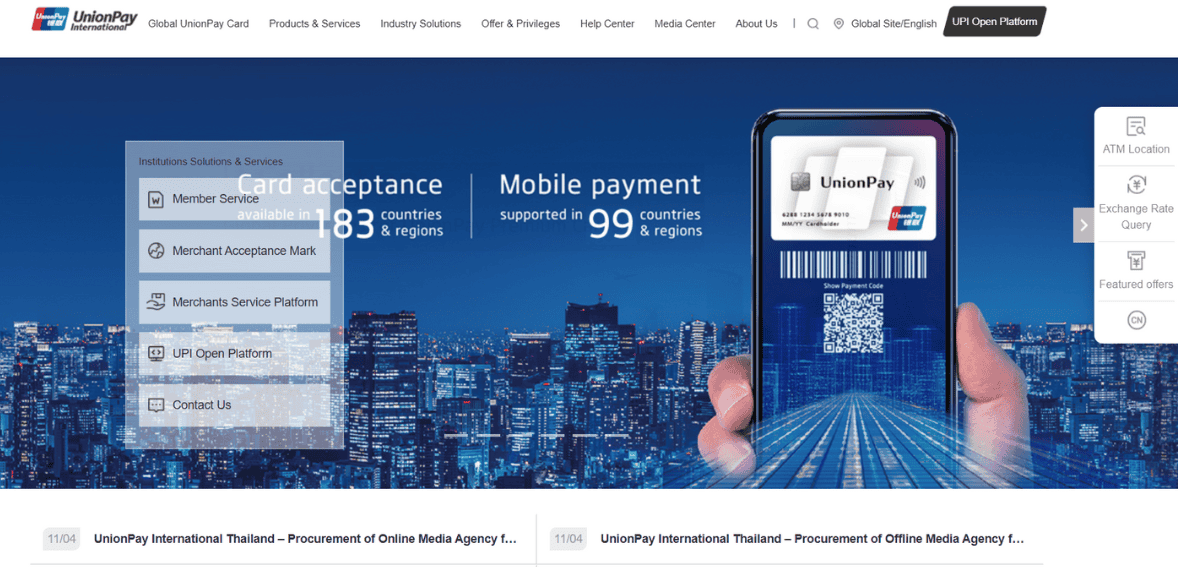
UnionPay has made significant progress in digital transformation through its QuickPass and mobile QR payment ecosystem. QuickPass enables users to make tap-and-go transactions with smartphones, wearables, or contactless cards. This system mirrors similar technologies from Visa PayWave and Mastercard Contactless but integrates deeply with Asian mobile payment preferences.
In China and other Asian markets, QR code payments have become a cornerstone of everyday commerce. UnionPay’s QR solutions support interoperability with other regional networks, enabling merchants to process payments from multiple wallet providers. The company’s mobile payment infrastructure aligns with the global shift toward cashless and contactless experiences, particularly after the pandemic accelerated digital adoption.
It has also integrated with Apple Pay, Huawei Pay, and Samsung Pay in select regions, allowing seamless tokenized transactions. Its emphasis on real-time authentication and encryption ensures secure digital interactions. While mobile payment adoption remains regionally uneven, UnionPay’s continued investments in fintech collaborations and app integrations show its adaptability to emerging digital commerce trends worldwide.
Security Features and Compliance
UnionPay places a strong emphasis on transaction security, regulatory compliance, and consumer protection. Its systems follow international security frameworks, including PCI DSS and EMV chip technology, ensuring encrypted and tamper-resistant transactions. Every card transaction is monitored through a multilayered risk-control system designed to detect fraud in real time.
The network also implements tokenization for mobile and online payments, which replaces sensitive card data with secure digital tokens. This significantly reduces exposure to potential breaches during digital transactions. Additionally, It collaborates with law enforcement and banking partners to strengthen cybersecurity awareness and prevent card-related crimes.
From a compliance standpoint, UnionPay adheres to global AML and KYC regulations. It maintains close relationships with regulators across markets to meet localized data and privacy requirements. Despite these efforts, regional users occasionally report slower dispute resolutions compared to Western networks. Nonetheless, It’s comprehensive security protocols make it a trusted payment system for both consumers and businesses across multiple jurisdictions.
Merchant and Business Solutions
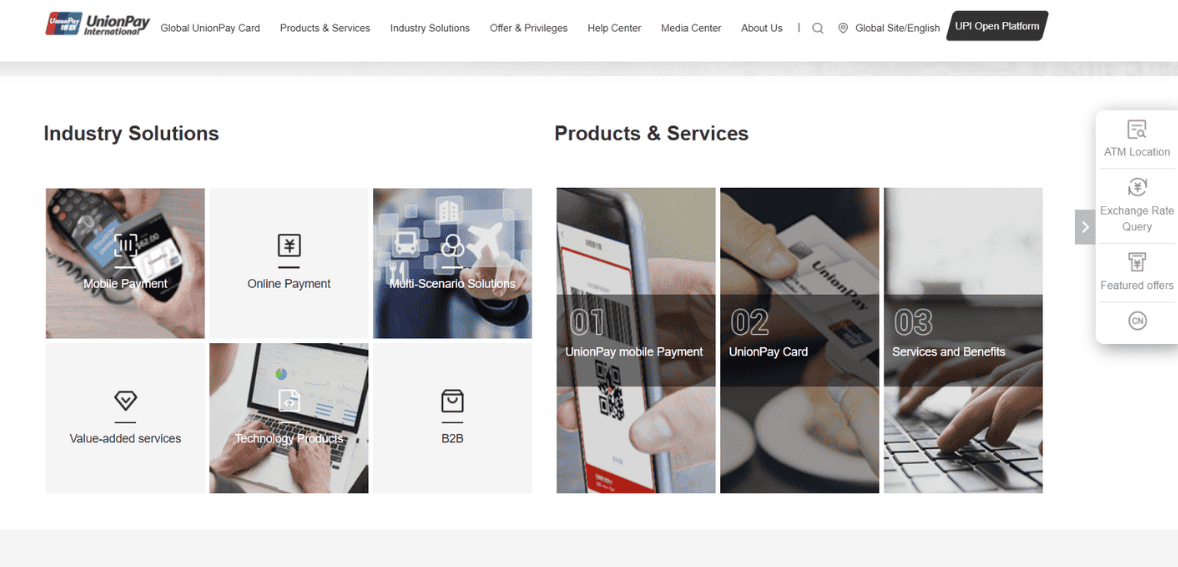
UnionPay provides merchants with a wide range of tools to accept payments across channels. Its POS systems support chip, magnetic stripe, contactless, and QR transactions, ensuring compatibility with existing retail hardware. Merchants can also integrate UnionPay’s e-commerce gateway for online sales, which supports local currencies and multicountry settlements.
For small and medium-sized enterprises, It offers simplified onboarding and affordable processing fees, helping businesses expand their customer base. Many tourism-dependent markets particularly benefit from UnionPay’s acceptance among Chinese travelers, which drives sales for hotels, retailers, and restaurants.
The company’s business solutions extend beyond payment acceptance. It’s data analytics and customer engagement tools help merchants understand consumer spending patterns. Additionally, loyalty programs and promotional integrations provide marketing value. However, UnionPay’s merchant service availability can vary by country, especially in regions with limited banking partnerships. Even so, as global e-commerce continues to grow, UnionPay’s merchant solutions present a viable path to accessing an increasingly digital, cross-border customer base.
UnionPay Online Payment Platform
UnionPay Online Payment serves as the brand’s digital payment gateway, designed for secure e-commerce and mobile transactions. It allows customers to make purchases using their UnionPay cards without sharing sensitive financial information with merchants. The platform employs advanced encryption and multi-factor authentication to safeguard transactions.
UPOP supports multiple currencies, languages, and settlement models, catering to international merchants and cross-border customers. Its integration capabilities enable developers to embed UnionPay into various websites and apps via APIs and SDKs. This makes it an accessible and flexible solution for businesses looking to expand globally.
From a user perspective, UPOP offers a simple checkout experience similar to other digital wallets, but with a strong emphasis on security and speed. It also supports recurring billing and installment payments, appealing to online retailers and subscription-based businesses. While UPOP may not yet match PayPal or Stripe in terms of global adoption, it represents UnionPay’s strong push into the digital payment ecosystem with reliable infrastructure and continuous enhancements.
Pricing, Fees, and Merchant Costs
UnionPay’s pricing structure varies across regions and merchant categories. In general, the company is known for maintaining competitive interchange rates, particularly in Asian markets. Its lower processing costs make it appealing for merchants targeting travelers from China or other Asia-Pacific countries.
Typical fees include transaction processing charges, cross-border surcharges, and exchange rate margins for currency conversion. Compared to global rivals like Visa or Mastercard, it often provides slightly lower overall costs, especially for domestic transactions within Asia. This advantage has supported its widespread adoption among cost-sensitive merchants and regional acquirers.
However, outside Asia, UnionPay’s fee structures can be influenced by local partners and banking networks. In some regions, setup or maintenance costs may offset its lower interchange benefits. Transparency in pricing also depends on third-party processors. Despite these variations, It’s affordability remains one of its key strengths, particularly for small businesses and global e-commerce platforms looking to diversify payment options without significantly increasing costs.
Customer Experience and Support
UnionPay’s customer experience varies depending on region and service channel. In China and much of Asia, users benefit from localized support centers and 24-hour helplines. The company provides multilingual assistance through phone, email, and online chat options, covering card issues, disputes, and fraud claims.
Feedback on responsiveness is generally positive in core markets, though international users sometimes report slower turnaround times. Dispute resolution processes, especially for cross-border payments, can take longer due to varying intermediary banks and regional policies. UnionPay continues to address this through its expanding network of international offices and customer engagement initiatives.
The overall user experience is enhanced by the brand’s intuitive digital platforms and reliable payment systems. For merchants, it provides onboarding assistance and integration support. While its service quality might not yet equal global leaders, steady improvement in global customer relations reflects UnionPay’s commitment to achieving international service standards that align with its growing footprint.
Integration with Global Fintech and Banking Systems
UnionPay’s success in the international arena is partly due to its collaborations with global fintech firms and financial institutions. By partnering with major acquirers and gateway providers, It ensures that its cards are compatible with most modern POS systems and online platforms. These partnerships simplify merchant onboarding and enhance user accessibility.
The company has also explored synergies with fintechs offering mobile wallets, neobanking services, and cross-border remittances. Integration with digital payment ecosystems like Apple Pay, Huawei Pay, and Samsung Pay demonstrates it’s ability to adapt to global technology trends. Additionally, it invests in blockchain-based experiments to streamline settlement and improve transparency.
In banking, it collaborates with more than 2,500 institutions worldwide for card issuance, transaction processing, and payment innovation. This collaborative model helps maintain flexibility in local markets. While regulatory complexity sometimes slows down deployment in certain countries, UnionPay’s openness to co-innovation positions it well within the rapidly evolving global fintech landscape.
trengths and Competitive Advantages
UnionPay’s greatest strengths lie in its scale, affordability, and technological adaptability. Its unparalleled reach across Asia provides a solid foundation for international expansion. The network’s cost-effective fee structure attracts merchants, while partnerships with local financial institutions ensure regional relevance.
The company’s focus on innovation has kept it competitive in a rapidly evolving payment environment. Its mobile and QR-based payment solutions align with consumer preferences in key markets, and the integration of contactless technology allows it to compete directly with established Western networks. Furthermore, UnionPay’s compliance with international standards enhances trust and credibility.
Another core strength is its government support within China, which ensures financial stability and operational resilience. UnionPay’s continuous investment in global partnerships helps bridge market gaps, creating a sustainable presence outside Asia. Together, these advantages make UnionPay a reliable and forward-looking player in the global payment industry, even as it navigates challenges of market perception and competitive maturity.
Limitations and Areas for Improvement
Despite its impressive growth, It faces several limitations. Its brand recognition remains lower in Western markets, where Visa and Mastercard have long-standing dominance. This restricts consumer demand and merchant prioritization. Some merchants in North America or Europe still view UnionPay as a niche option catering mainly to Chinese travelers.
Technical integration challenges also persist in certain regions where banking systems rely on legacy infrastructure. These barriers can delay onboarding or increase costs for smaller merchants. Moreover, the company’s dispute resolution processes and customer support availability outside Asia could benefit from greater localization and responsiveness.
Another constraint is regulatory compliance in diverse markets, which requires adapting to varying data protection and financial laws. it has made progress here but continues to face scrutiny in specific jurisdictions. Overcoming these challenges will be essential for UnionPay’s goal of achieving parity with Western networks and strengthening its image as a truly global payment brand.
Ideal Users and Final Verdict
UnionPay serves a wide range of users, from individual consumers to multinational merchants. It is particularly advantageous for travelers, international students, and businesses operating in Asia or targeting Chinese customers. Merchants seeking to diversify payment acceptance can benefit from It’s competitive fees and growing global reach. The platform is also suitable for fintech startups and e-commerce ventures that value secure cross-border payments and flexibility in settlement options. For consumers, it offers convenience, reliability, and access to a vast acceptance network.
However, users outside Asia may encounter limited acceptance compared to Visa or Mastercard. In conclusion, It stands as a formidable force in global payments; strong in scale, security, and innovation. Its continued growth beyond Asia depends on sustained investment in merchant expansion, brand awareness, and localized customer support. As the global economy moves further toward digital integration, It’s steady progress positions it as a valuable alternative in the evolving world of electronic payments.
FAQs
Is UnionPay accepted worldwide?
It is accepted in over 180 countries and regions. While coverage in Asia is near universal, availability in North America and Europe continues to expand through partnerships with banks and acquirers.
How does UnionPay compare to Visa or Mastercard in transaction fees?
It generally offers competitive pricing, particularly for domestic and regional transactions in Asia. However, fees can vary depending on acquirers and currency conversion policies in different countries.
Can businesses easily integrate UnionPay into their payment systems?
Yes. it provides APIs and SDKs that allow easy integration for both online and offline merchants. Global payment gateways increasingly include UnionPay as part of their supported methods, simplifying adoption.

TransNational Payments Review
By 10topmerchantservices November 6, 2025
TransNational Payments is an established merchant services provider based in Illinois founded in 1999 with a mission to make payment processing simple for small to mid-sized businesses. Over 20+ years the company has grown from a regional processor to a national processor offering in-store, online and mobile payment solutions. Their approach is human centered with technology that enables fast and secure transactions. TransNational serves many industries from retail and hospitality to healthcare and professional services, each requiring reliable payment infrastructure and transparent billing. Lets read more about TransNational Payments Review.
The company’s reputation was built on responsiveness and flexibility. Unlike many payment processors that cater to large businesses, TransNational focuses on creating adaptable tools for smaller merchants. Their services include credit and debit card processing, ACH payments, e-commerce gateways and custom integrations. This breadth helps business owners manage payments as they scale their business. But the effectiveness of these solutions depends on pricing transparency and customer support consistency, areas where merchant feedback has been mixed over time.
Overall TransNational Payments offers a broad feature rich ecosystem that blends traditional reliability with modern digital innovation making them a strong player in the US payments space.
Core Payment Processing Solutions | TransNational Payments Review
At the end of the day TransNational Payments offers payment processing systems that support credit cards, debit cards, contactless and ACH payments. Businesses can process transactions in-store, online or on the go depending on their business model. We use secure gateways to transmit sensitive payment data, meet industry standards and process fast. Whether you need countertop terminals, mobile readers or virtual terminals we have options to fit your transaction volume and customer needs.
Our credit card processing infrastructure is integrated with major card brands and is always up and running for consistent performance. Merchants like our flexibility; whether using a standalone terminal or connecting through a 3rd party POS system. We also offer recurring billing and invoicing tools for service based businesses. While we offer all these benefits, pricing and interchange plus rates can vary depending on the contract and sales rep. But our core product is robust, reliable and can handle all types of businesses that want one provider to manage all types of payments.
POS System Capabilities
TransNational Payments provides several POS options designed for ease of use, flexibility, and integration. Its POS systems combine hardware and software that can handle multiple payment methods, including EMV, contactless, and mobile wallet transactions. Merchants can customize the setup to meet their industry requirements; whether running a restaurant, boutique, or salon. Features such as inventory tracking, employee management, and customer data storage enhance the system’s business management capabilities.
One of the strengths of TransNational’s POS offerings lies in its scalability. Businesses can start with basic setups and add advanced modules as their operations expand. The systems are designed to integrate with various accounting and CRM tools, helping owners maintain a clear overview of their sales and performance. The user interface is intuitive, minimizing the learning curve for staff. However, some users have reported that hardware leasing contracts and upgrade costs can be restrictive, especially for small merchants. Overall, TransNational’s POS solutions strike a balance between functionality and simplicity, making them an appealing choice for businesses seeking unified control over transactions and back-office operations.
E-Commerce and Online Payment Tools
TransNational Payments helps e-commerce businesses with a range of online payment tools. Our payment gateway allows website owners to take credit and debit card payments securely, hosted payment pages make it easy for non-technical merchants to integrate, and our system is compatible with popular shopping carts and e-commerce platforms for seamless checkout. Developers can also use our APIs to build custom payment solutions for their unique business model.
The platform has fraud detection and tokenization to protect customer data during online transactions. Subscription based businesses can use our recurring billing feature for automated payment cycles. Virtual terminals allow merchants to process manual transactions or phone orders through a web interface. While these tools cover the basics for most online sellers, advanced customization and analytics may not be as extensive as the larger global processors. For small to medium e-commerce stores, TransNational Payments provides an easy, stable and secure way to take payments online without the technical headaches.
Security, Compliance, and Fraud Prevention
Security is central to TransNational Payments’ operations. The company adheres to PCI DSS compliance standards, ensuring that merchants’ and customers’ data are protected throughout the payment cycle. Its systems employ end-to-end encryption and tokenization to minimize exposure to sensitive cardholder information. These technologies safeguard data both in transit and at rest, reducing the likelihood of breaches or unauthorized access.
The company also offers support to help merchants achieve their own PCI compliance certification, an essential step for businesses handling customer payments. In addition, built-in fraud detection tools flag suspicious activity and help reduce chargebacks. While its fraud prevention framework is solid for most small and mid-sized merchants, high-risk industries may find the available monitoring options limited compared to dedicated fraud management providers. Still, TransNational’s emphasis on data protection and compliance reflects a strong understanding of today’s regulatory and cybersecurity challenges, giving businesses confidence in the safety of their payment systems.
Merchant Account Setup and Onboarding Experience
Setting up a merchant account with TransNational Payments is generally straightforward, though experiences vary depending on business size and type. Merchants typically go through an application process that includes business verification, credit checks, and documentation of sales volumes. The approval process can take a few business days, which is fairly standard across the industry. Once approved, merchants receive equipment and access credentials for their processing dashboard.
TransNational’s onboarding team provides assistance through phone or email, helping users integrate terminals or online gateways. The company has received positive feedback for its personalized onboarding support, especially for merchants unfamiliar with payment technology. However, some have reported that contract terms and fees were not always clearly explained upfront, leading to confusion later. Transparency during onboarding could therefore be improved. Overall, the process is efficient for businesses that value human guidance over a fully self-service experience, and the setup ensures merchants can begin accepting payments quickly after approval.
Pricing, Fees, and Contract Structure
TransNational Payments uses a pricing model that depends on merchant size, volume, and processing type. Most accounts are set up under interchange-plus or tiered pricing, though the exact structure is often determined by the sales representative. While interchange-plus pricing is generally more transparent, tiered plans can make it harder to estimate true costs. Standard fees include transaction percentages, monthly service fees, and occasional gateway or statement charges.
Some contracts may also include early termination fees or long-term hardware leases, which have been sources of merchant dissatisfaction in the past. TransNational’s contracts typically run for three years with automatic renewal clauses, though merchants can negotiate terms before signing. The company has improved transparency over time by providing clearer documentation and better access to statements. Still, potential customers should request a full breakdown of rates and fees before committing. In terms of competitiveness, TransNational’s pricing is comparable to similar mid-tier processors but may not always be the most cost-efficient for low-volume merchants.

Customer Service and Technical Support
Customer support plays a major role in TransNational Payments’ reputation. The company provides 24/7 technical support via phone and email, as well as dedicated relationship managers for larger accounts. Merchants often highlight the responsiveness of its support staff, particularly during initial setup or when troubleshooting equipment issues. For small business owners with limited technical resources, this human support can be a significant advantage.
That said, some users have reported inconsistent experiences, noting longer wait times during peak hours or delays in resolving billing discrepancies. The company’s online knowledge base covers basic troubleshooting and account management topics but lacks detailed guides for complex integrations. Overall, TransNational’s support system performs well for everyday issues and hardware assistance but could enhance its digital self-help options for more advanced users. Still, its reputation for accessible service remains a key differentiator compared to larger, less personal processors.
Integrations and Compatibility
TransNational Payments integrates with a variety of business software platforms to create a unified workflow for merchants. Its systems connect with accounting tools such as QuickBooks, allowing automatic reconciliation of transactions. The processor also supports e-commerce platforms and industry-specific POS systems, offering flexibility for businesses that rely on multiple tools. Integration with CRMs and inventory management applications helps centralize data, minimizing manual entry and errors.
API access allows developers to customize payment solutions or embed checkout functionality into their applications. This flexibility appeals to businesses seeking to tailor their payment processes rather than rely on generic options. However, the range of prebuilt integrations is somewhat narrower than that of larger competitors that maintain vast partner ecosystems. For small businesses, the available integrations are adequate to ensure efficiency, while tech-savvy merchants may appreciate the open API approach that encourages further customization.
Mobile Payment Processing and App Features
For businesses that operate on the go, TransNational Payments provides a mobile processing solution that turns smartphones or tablets into secure payment terminals. Its mobile app supports card swipes, EMV chip transactions, and contactless payments like Apple Pay or Google Pay. Merchants can issue receipts, track sales, and view transaction history directly from the app. This functionality makes it ideal for food trucks, market vendors, or service professionals who need to accept payments outside a traditional storefront.
The mobile reader connects easily via Bluetooth, and the interface is intuitive enough for quick training. Reporting features within the app provide real-time sales insights, though advanced analytics still require access through the main dashboard. Some merchants have noted that connectivity can vary depending on device compatibility, but overall, the mobile platform delivers dependable performance. TransNational’s mobile payment tools help level the playing field for small businesses by giving them access to enterprise-grade payment flexibility in portable form.
Reporting, Analytics, and Business Insights
TransNational Payments offers reporting tools that allow merchants to track sales performance, monitor transaction trends, and manage chargebacks. The analytics dashboard provides summaries of total volume, payment methods, and customer behavior over time. These insights help businesses make informed decisions about staffing, inventory, and marketing. Reports can be exported for accounting purposes, ensuring accurate recordkeeping.
The system’s user interface is straightforward, though some merchants may find the reporting capabilities basic compared to more advanced analytics platforms. Still, for small and mid-sized businesses, the available data is sufficient for everyday operations. Having centralized access to transaction history and batch settlements helps streamline reconciliation and compliance tracking. TransNational’s focus on functional simplicity rather than data overload suits business owners who prefer actionable summaries over complex visualizations. While not a full analytics powerhouse, it provides dependable visibility into payment activity and financial health.
Strengths and Competitive Advantages
TransNational Payments’ strengths lie in its balance of technology and customer service. Its wide range of processing options, covering in-person, online, and mobile transactions; makes it a one-stop solution for most merchants. The company’s reputation for personalized support is a key differentiator in an industry where many competitors prioritize automation over human contact. Additionally, its emphasis on PCI compliance and security gives merchants confidence in the integrity of their payment systems.
Another advantage is the flexibility of its product lineup. TransNational’s systems integrate smoothly with popular POS setups and accounting platforms, allowing businesses to manage operations more efficiently. The mobile processing tools also add versatility for merchants with hybrid sales models. While not the most inexpensive option, its reliability and human-centric approach make it appealing for small and mid-sized businesses that value stability and service over rock-bottom fees.
Limitations and Potential Drawbacks
Despite its strengths, TransNational Payments has a few areas where improvement is needed. The first is contract transparency. Some merchants have reported confusion over early termination clauses, monthly minimums, or statement fees that were not clearly explained before signing. These issues underline the importance of reviewing contracts carefully. Additionally, long-term equipment leases can increase total costs, especially for businesses that upgrade hardware frequently.
Another limitation is pricing competitiveness. While TransNational offers fair market rates, it may not always match the low fees of newer fintech processors that leverage automated systems to cut costs. Its reporting tools, while functional, lack the advanced customization that some data-driven businesses prefer. Lastly, international merchants or those requiring multi-currency processing may find its capabilities limited to primarily U.S.-based transactions. Nonetheless, for its target demographic of small and medium domestic businesses, TransNational Payments remains a dependable option with room to refine transparency and digital sophistication.
Verdict: Is TransNational Payments Right for Your Business?
TransNational Payments delivers a solid mix of reliability, service quality, and flexibility for small to medium-sized U.S. businesses. It stands out for its hands-on customer support, diverse payment options, and focus on compliance. For merchants seeking a provider that combines traditional account management with modern payment tools, it can be a strong fit. Retailers, restaurants, healthcare providers, and local service businesses benefit most from its tailored support and multi-channel processing.
However, businesses looking for ultra-low pricing or international capabilities might find better fits elsewhere. Transparency during contract negotiation is essential to avoid unexpected fees. Overall, TransNational Payments suits business owners who value dependable service and a personal relationship with their payment processor over fully self-service platforms. It may not be the most cutting-edge solution on the market, but its longevity and customer-centric model have made it a trusted choice for thousands of merchants nationwide.
FAQs
Q1. What types of businesses benefit most from TransNational Payments?
TransNational Payments is best suited for small and mid-sized businesses that require flexible, all-in-one payment solutions. Retailers, restaurants, healthcare providers, and service professionals often benefit from its mix of in-store, online, and mobile options. Its customizable POS systems and responsive support make it ideal for businesses that prioritize reliability and hands-on service over purely automated systems.
Q2. Does TransNational Payments support international transactions?
Currently, TransNational Payments primarily focuses on domestic U.S. processing. It supports major credit and debit card networks within the country but offers limited options for international or multi-currency transactions. Merchants engaged in cross-border commerce may need a secondary processor with global reach.
Q3. Are there any hidden fees to watch for in TransNational’s pricing?
While TransNational Payments provides clear rate information in most cases, some merchants have encountered unexpected statement or cancellation fees. It’s important to request a complete fee disclosure and clarify contract terms before signing. Understanding early termination clauses and hardware leasing details can help avoid surprises later.

SecurePay Review
By 10topmerchantservices October 31, 2025
SecurePay is an Australian-based payment gateway that provides businesses with secure, reliable, and efficient ways to process online and recurring transactions. Founded in 1999 and owned by Australia Post, SecurePay has built a strong reputation in the financial technology sector by focusing on simplicity and safety. It enables businesses to accept payments online through credit and debit cards, digital wallets, and alternative payment methods. Over the years, it has evolved to become one of the country’s most recognized payment processors, catering to a broad range of enterprises; from startups to large corporations. Lets read more about SecurePay Review.
SecurePay’s mission is rooted in enabling seamless payment experiences for both merchants and customers. The platform offers a complete suite of tools that go beyond just accepting payments; it also covers fraud prevention, reporting, and integrations with e-commerce platforms. Its foundation under Australia Post ensures reliability, compliance, and adherence to local regulatory standards, adding a layer of trust to its operations. For many Australian businesses, SecurePay represents a dependable partner that combines technological capability with the credibility of a long-standing national institution.
Company Background and Evolution | SecurePay Review
SecurePay was founded as a payment service provider under Australia Post to simplify online payments for businesses in the early days of digital commerce. Initially focused on online card processing, the company expanded to include recurring billing, tokenization and advanced fraud management. Being part of Australia Post gives us a unique advantage in terms of regulatory confidence and national reach.
As digital commerce grew in Australia, SecurePay adapted by introducing modern APIs, better integration and improved user experiences. We also built compatibility with major e-commerce platforms, because we’re all about scalability and user convenience. Over the years SecurePay has become a key player in Australia’s digital payments infrastructure, servicing both traditional and digital first businesses.
Our evolution shows how a legacy service can remain relevant in a fast changing fintech landscape. SecurePay balances compliance and innovation, our technology stack is aligned to global payment trends but grounded in Australian market needs. This has positioned us as a trusted option for merchants looking for local expertise and international performance.
Product Overview and Key Offerings
SecurePay’s product lineup caters to a wide variety of business needs, ranging from online payment processing to recurring billing solutions. Its Online Payments feature allows businesses to accept Visa, Mastercard, American Express, and other payment methods securely. Additionally, the Virtual Terminal lets merchants process payments manually, offering flexibility for call centers or remote billing scenarios.
The platform also includes Recurring Billing, a key tool for subscription-based businesses that need automated payment cycles. This feature ensures smooth management of customer renewals and reduces manual intervention. SecurePay’s FraudGuard adds an essential security layer, detecting and preventing suspicious transactions before they impact businesses.
Another noteworthy aspect is its compatibility with third-party tools and plug-ins. SecurePay integrates seamlessly with e-commerce platforms like Magento, WooCommerce, and Shopify, providing businesses with multiple avenues to accept payments without complex setups. For developers, it offers detailed API documentation and sandbox environments to customize integrations.
Overall, SecurePay’s offerings strike a balance between ease of use and robust functionality. Businesses can tailor the platform to their needs, whether managing a small online store or operating a large-scale enterprise system. Its emphasis on flexibility and reliability makes it an all-in-one payment solution for merchants looking for a unified approach to payment management.
SecurePay for Online Businesses
SecurePay is a household name among online retailers in Australia for its seamless integration and reliability. The gateway allows for customisable checkout pages so merchants can design customer experiences that reflect their brand while maintaining high security. With support for major credit cards and alternative payment methods, SecurePay lets businesses cater to all customer types.
For e-commerce platforms, SecurePay has plugins that make integration with Shopify, BigCommerce and WooCommerce a breeze. Merchants get quick setup and automatic sync with their online store. Tokenisation and recurring billing are particularly useful for subscription based models, while FraudGuard ensures safe transactions even during peak sales.
SecurePay also supports payment gateways that handle domestic and international transactions so businesses can expand beyond Australian markets. With real-time reporting and reconciliation tools, merchants can see their sales and track payments. For small to medium sized online businesses the platform is reliable and transparent in its fees. It gives you the core of online payment management without the complexity so you can focus on growth and customer engagement.

SecurePay for In-Person and Hybrid Businesses
While SecurePay is primarily known for its online payment capabilities, it also supports hybrid business models that blend physical and digital sales channels. Through its virtual terminal and integration options, merchants can process payments securely without requiring dedicated hardware. This makes it especially useful for service providers, phone order systems, or mobile-based businesses.
Although SecurePay does not specialize in traditional in-person POS terminals, it complements physical sales through integrations with third-party systems that manage in-store payments. Businesses with both retail and online operations can unify their payment data for better financial tracking and reporting. This integrated approach allows for consistent customer experiences across different touchpoints.
For businesses transitioning to omnichannel operations, SecurePay’s flexibility helps reduce the technical friction of managing multiple systems. It simplifies settlement processes, ensuring that payments from all sources are consolidated efficiently. While not a full-scale in-person POS provider, SecurePay effectively bridges the gap between online and offline payment environments. Its tools enable small retailers and service providers to expand their reach without overhauling their payment infrastructure.
Integration and API Capabilities
SecurePay has a documented API for developers who want control and customisation. The API can be integrated with various systems including e-commerce platforms, CRM tools and billing software. Developers can use SecurePay’s RESTful API to manage payments, refunds and recurring payments while keeping data secure with tokenisation and encryption.
The company has a sandbox environment for testing integrations before going live which is super useful for businesses building custom applications. Their integration libraries are available in common programming languages so you can embed payment functionality into your website or mobile app. In addition to APIs SecurePay has plug-ins for popular platforms like Shopify, Magento and WooCommerce. This reduces the need for technical expertise so it’s accessible to startups and established businesses.
While their API documentation is comprehensive some users note that the system may not have the same level of customisation as global providers. But for most Australian businesses SecurePay’s developer ecosystem has all the tools to build a reliable and compliant payment experience. It’s a developer friendly option that fits with local infrastructure.
Security, Compliance, and Fraud Prevention
Security remains one of SecurePay’s strongest pillars. The platform is fully PCI DSS compliant, ensuring that sensitive customer data is encrypted and protected during every transaction. SecurePay employs SSL encryption, tokenization, and secure authentication mechanisms to prevent unauthorized access and data breaches.
One of its standout security features is FraudGuard, an intelligent fraud management tool that helps merchants detect and block suspicious activities. FraudGuard analyzes transactional patterns in real time, reducing the risk of chargebacks and fraudulent orders. For businesses handling high transaction volumes, this feature provides significant peace of mind.
Because SecurePay operates under Australia Post, it is also governed by strict financial and data protection regulations, further reinforcing its reliability. Regular audits and compliance checks ensure that it meets both national and global standards.
While no payment gateway is entirely immune to risks, SecurePay’s layered security measures and proactive fraud detection systems make it one of the safer choices in the market. It combines national regulatory confidence with advanced technological safeguards, giving businesses and customers alike a sense of trust and assurance.
Pricing and Fees
SecurePay follows a transparent pricing model designed to suit different business sizes. It typically charges a flat transaction fee per processed payment, with variations based on card type and payment volume. There are no hidden costs, which helps businesses forecast expenses accurately. The standard pricing includes a setup fee, transaction fees, and a small monthly account charge for ongoing access.
Businesses that process larger volumes may be eligible for custom pricing, negotiated directly with SecurePay’s sales team. The platform’s fee structure is competitive within the Australian market, especially given the backing of Australia Post and its reputation for stability. While the pricing is straightforward, some users note that SecurePay’s fees for international transactions can be slightly higher than global competitors like Stripe or PayPal. However, the benefit lies in its local customer service, domestic settlement, and compliance with Australian banking systems.
Overall, SecurePay offers a fair balance between cost and value. Its transparent approach ensures there are no unexpected surprises for merchants, making it a trustworthy choice for businesses seeking predictable payment processing expenses.
User Experience and Interface Design
SecurePay’s interface is built with simplicity and clarity in mind. The merchant dashboard provides an organized view of transactions, settlements, and reports, making it easy to track business performance. The layout is clean, functional, and optimized for both desktop and mobile use.
For non-technical users, the intuitive navigation and detailed help resources make daily operations straightforward. Reporting tools allow merchants to filter transactions, monitor chargebacks, and export data seamlessly. SecurePay also supports integration with accounting tools, improving financial visibility for business owners.
From a technical standpoint, the interface facilitates smooth interaction with APIs and plug-ins, allowing developers to configure integrations without complications. Although the design might not be as modern as global competitors, its functional reliability and minimal learning curve make it accessible to all user types.
User feedback often highlights SecurePay’s stability and responsiveness over flashy aesthetics. The platform focuses on performance and dependability rather than visual frills, resulting in a consistent and professional user experience that prioritizes function over form.

Customer Support and Service Reliability
SecurePay’s customer support network is one of its key differentiators. Backed by Australia Post, the company offers local support through phone, email, and online ticketing. Merchants appreciate being able to reach a real person within Australian business hours; a feature often missing from international providers.
The platform’s documentation and online help center provide clear, step-by-step guidance for troubleshooting and integration. Additionally, SecurePay ensures high uptime reliability, with robust systems that minimize transaction delays or outages. While users generally report positive experiences, some note that advanced technical inquiries may take longer to resolve. However, the quality of responses and the personalized support make up for these occasional delays.
In terms of service reliability, SecurePay maintains strong performance consistency. It processes payments efficiently and settles funds promptly, ensuring minimal disruption to business operations. The overall reliability of its infrastructure, combined with dedicated support, reinforces its appeal to Australian businesses that value local accountability.
Pros of Using SecurePay
SecurePay’s major advantages stem from its reliability, compliance, and strong local presence. Being part of Australia Post gives it an inherent layer of trust and credibility. The platform’s transparent pricing, PCI DSS compliance, and fraud prevention systems make it suitable for businesses prioritizing safety and simplicity.
Another key strength is its integration ecosystem. Whether through APIs or plug-ins, SecurePay connects easily with popular e-commerce and accounting systems. Its user-friendly dashboard and real-time reporting tools enhance operational visibility, making it easier for merchants to stay on top of financial performance.
Local support is another standout benefit. Businesses can access quick assistance without dealing with timezone gaps or foreign support centers. Additionally, SecurePay’s ability to manage recurring payments and multi-channel transactions provides flexibility across industries. Overall, the platform is best suited for Australian businesses seeking a dependable and compliant gateway with excellent domestic support. It excels in reliability, transparency, and customer trust; three areas that continue to define its long-standing market position.
Cons and Limitations
Despite its strengths, SecurePay is not without limitations. One of the most common concerns among users is its limited focus outside Australia. For businesses operating internationally, transaction fees and settlement times may not be as competitive as those of global payment giants. The interface, while user-friendly, lacks some of the advanced customization options that modern fintech solutions offer. For instance, merchants seeking detailed analytics or API-level modifications might find SecurePay slightly restrictive.
Additionally, the absence of dedicated in-person payment hardware means businesses must rely on third-party POS systems for offline transactions. This could add an extra layer of complexity for those seeking a single unified solution.
Customer feedback also suggests that while support is prompt and helpful, documentation for complex integrations could be improved. Nonetheless, these drawbacks are relatively minor when weighed against its overall dependability. SecurePay remains a solid choice for businesses prioritizing local service and security over global scalability.
Ideal Business Types for SecurePay
SecurePay is particularly well-suited for small to medium-sized businesses, e-commerce retailers, and service providers that operate primarily within Australia. It’s an excellent choice for organizations that value local customer support and straightforward payment management. Subscription-based businesses benefit from its recurring billing tools, while online stores appreciate its seamless platform integrations.
Nonprofits, educational institutions, and membership-based organizations also find value in SecurePay due to its stable processing, transparent pricing, and reliability in handling recurring donations or payments. Businesses that handle sensitive data, such as healthcare or financial services, can rely on its compliance framework to maintain security and trust.
For larger enterprises, SecurePay’s scalability and API access enable deeper integration with internal systems. However, global brands seeking extensive international payment coverage might find its reach limited compared to multinational gateways. Overall, SecurePay fits businesses that want a dependable, regulation-compliant, and easy-to-use payment solution backed by a trusted national brand.
Final Verdict
SecurePay stands as a dependable and secure payment gateway built for Australian businesses that prioritize trust, compliance, and ease of use. Its backing by Australia Post lends unmatched credibility, and its offerings; from online payments to fraud prevention; cater to a wide range of industries. While it may not compete directly with global players on international coverage or advanced analytics, SecurePay’s local expertise, transparent pricing, and responsive support make it a standout option in its market segment.
Its straightforward integration process and reliable infrastructure allow businesses to operate efficiently with minimal disruption. In 2025, as payment technologies evolve rapidly, SecurePay continues to hold relevance by focusing on what matters most to merchants: safety, reliability, and consistent performance. For businesses operating in or targeting the Australian market, it remains one of the most trustworthy choices available.
FAQs
1. Is SecurePay suitable for international businesses?
It primarily serves Australian businesses, but it does support international payments. However, global transaction fees may be higher than competitors like Stripe or PayPal.
2. Does SecurePay integrate with major accounting or e-commerce platforms?
Yes, it integrates with popular platforms like Shopify, WooCommerce, Magento, and accounting tools like Xero, allowing for smooth payment and reconciliation processes.
3. What makes SecurePay different from other Australian payment gateways?
SecurePay’s key differentiators are its ownership by Australia Post, strong compliance framework, reliable local support, and transparent pricing; all of which make it a trusted choice for Australian merchants.

SecurionPay Review
By 10topmerchantservices October 28, 2025
In the fast-changing world of digital payments, businesses are constantly looking for solutions that are fast, reliable, and secure. SecurionPay is one such platform that has made a name for itself by offering smooth online payment processing backed by European-grade compliance and security. Based in Switzerland, the company has become a trusted partner for online merchants, subscription-based services, and SaaS providers seeking efficient payment systems that reduce friction for customers. Its core appeal lies in balancing user-friendly integration with strong protection and conversion-focused tools. Lets read more about SecurionPay Review.
SecurionPay was built with the idea that payment gateways should not complicate transactions. Instead, they should make digital payments faster, easier, and safer for both businesses and their customers. With a developer-friendly API, global card acceptance, and compliance with international data standards, it supports businesses of all sizes. What sets it apart is its emphasis on providing high conversion rates through optimized checkout flows and security measures that do not compromise user experience. As e-commerce and digital platforms expand globally, SecurionPay’s positioning as a modern, secure, and adaptable solution has helped it maintain steady relevance in the competitive payments industry.
Company Background and Core Philosophy | SecurionPay Review
SecurionPay was founded with a clear vision to create an online payment gateway that puts transparency, reliability and simplicity at its heart. Based in Switzerland, the company benefits from the country’s strict data protection and banking regulations which means merchants can trust us. Our mission is to provide secure and easy online payment solutions that can be tailored to any business model, whether retail, digital content or recurring billing.
The philosophy behind SecurionPay is to reduce the friction between businesses and customers. Many online payment systems complicate integration or have hidden fees that hurt smaller companies. SecurionPay offers predictable pricing, a clean API and a strong compliance framework so businesses can focus on growth not payment headaches. We also focus on conversion optimisation so every transaction has the highest chance of success through design simplicity and fast authorisation.
This balance of user centric design and back-end strength has allowed SecurionPay to carve out a niche among European fintech companies. We compete with global players but are smaller and more agile, we offer flexibility and personal attention to businesses that want reliability over scale. The result is a payment processor that is modern yet grounded in trust and performance.
Key Features and Functional Capabilities
SecurionPay offers a comprehensive suite of tools that make it suitable for diverse online business models. Its core features include card payment processing, one-click checkout, recurring billing, and a highly secure tokenization system. Merchants can accept major credit and debit cards globally, providing customers a smooth and intuitive checkout experience regardless of where they are located.
Another standout feature is SecurionPay’s advanced fraud prevention technology. It uses a combination of machine learning and data-driven analysis to flag suspicious transactions without interfering with genuine customer experiences. The platform’s API structure also allows merchants to design payment flows that match their website or application layout, maintaining brand consistency.
Recurring billing is another valuable feature that supports subscription-based services. Businesses can automate payments, send reminders, and manage failed transactions efficiently. Additionally, SecurionPay supports one-click payments, reducing friction for repeat customers and improving conversion rates. The gateway also offers strong chargeback management and real-time reporting tools, enabling merchants to track performance easily.
Together, these features create a flexible ecosystem that empowers developers and businesses alike. By combining payment efficiency with enhanced customization options, SecurionPay delivers both simplicity and control; two qualities essential for modern digital commerce.
User Experience and Interface Design
SecurionPay’s interface is super simple and easy to use. The dashboard is designed to help you manage transactions, see metrics and configure settings without the usual payment system learning curve. The onboarding process is a breeze, guiding you through setup, verification and integration. From a merchant’s perspective the interface is a balance of functionality and design. The transaction logs are tidy and the reporting tools make it easy to see payment summaries, refunds and customer activity. Developers love the organized API documentation which makes integration and testing much faster.
SecurionPay also offers a seamless experience for end customers. The checkout page is fast and flexible, fits in with websites or mobile apps. The responsive design ensures usability across devices and reduces cart abandonment. You can also customize the checkout form to match your brand which helps to build trust with your customer. Overall the user experience reflects SecurionPay’s philosophy of simplicity and efficiency. Whether you’re a small merchant or a large online retailer the interface is clear and accessible without the complexity.

Payment Options and Supported Currencies
SecurionPay provides merchants with a wide range of payment options, helping businesses serve customers across multiple countries. It supports all major credit and debit cards, including Visa, Mastercard, Maestro, and American Express. The platform also offers local payment methods where applicable, catering to customers who prefer regional or alternative payment systems.
Its global focus extends to multi-currency support, enabling merchants to accept payments in several international currencies. This flexibility is especially valuable for businesses operating in Europe, North America, and other global markets. The platform automatically converts and settles transactions in the merchant’s preferred currency, minimizing the complexity of cross-border payments.
While SecurionPay primarily focuses on card payments, it can be integrated with digital wallets and alternative payment methods through custom development. The inclusion of such flexibility reflects its API-driven nature, allowing developers to build hybrid solutions for niche requirements. For customers, the diverse payment choices improve convenience and confidence during checkout. For merchants, it means broader market reach without managing multiple payment providers. Together, this combination enhances conversion potential and provides a truly global payment experience.
API Integration and Developer Tools
SecurionPay is built for developers, so integration is easy and flexible. The RESTful API and documentation allows you to connect payment processing to your website, mobile app or e-commerce platform in no time. Developers can build custom payment forms, subscription workflows and fraud management systems without sacrificing security or performance.
The company provides SDKs for popular programming languages so implementation is smooth no matter what your team’s technical background is. Sandbox environments allow you to test before going live and identify issues early.
SecurionPay’s API also supports advanced customization options so you have control over customer experience and branding. One of the key features is the webhook system which gives you real-time updates on transactions, chargebacks or subscription renewals. This makes it easy to automate workflows and sync payment data with other business tools like CRMs or accounting platforms.
In short, SecurionPay’s integration framework is all about simplicity and flexibility. It’s perfect for startups with limited technical resources and larger companies that need scalable and customizable payment solutions. The developer focused design reinforces the brand’s reputation as a technically sound and user centric gateway.
Security Standards and Compliance
Security remains one of SecurionPay’s strongest selling points. The platform is fully compliant with PCI DSS Level 1 standards, ensuring the highest level of data protection for credit card transactions. It uses tokenization to replace sensitive card data with secure tokens, reducing the risk of breaches. Encryption and SSL protocols safeguard data during transmission, ensuring that both merchants and customers are protected from cyber threats.
As a European company, SecurionPay also adheres to GDPR regulations, maintaining strict control over personal data processing. This commitment to privacy and compliance builds strong trust among users, especially in industries handling sensitive customer information. The platform includes built-in fraud detection and prevention tools that use behavioral analytics and real-time monitoring to identify suspicious activity. By combining automation with manual review capabilities, SecurionPay offers merchants both efficiency and oversight.
In addition, its chargeback management tools help merchants resolve disputes more effectively. With layered security and compliance mechanisms, SecurionPay positions itself as a dependable gateway that does not compromise between safety and convenience.
Pricing and Transaction Fees
SecurionPay follows a transparent pricing model that appeals to businesses looking to avoid hidden costs. While the exact transaction fees vary based on business type, region, and risk level, the company maintains a straightforward fee structure that includes a fixed percentage per transaction and a small additional fee. This makes cost forecasting simpler for merchants.
Unlike some payment processors that charge setup or monthly maintenance fees, SecurionPay generally keeps costs tied to actual usage, making it accessible to startups and growing companies. Its pricing is competitive within the European market, especially given the inclusion of strong security features and conversion tools.
Merchants can access all core features without paying for expensive add-ons. This approach allows smaller companies to benefit from enterprise-grade payment infrastructure without a heavy investment. While not the cheapest option globally, its transparent and fair structure gives businesses predictable financial management. Overall, SecurionPay’s pricing strategy balances affordability with quality. For companies that prioritize reliability, security, and ease of integration, the costs align well with the value offered.
Merchant Support and Account Management
Reliable customer support is crucial for payment platforms, and SecurionPay provides a dependable system for merchants. The company offers email-based and ticketing support channels, with additional developer resources available through its documentation and API guides. Response times are generally prompt, and the support team is knowledgeable about both technical and operational concerns.
Merchants can also access a dedicated dashboard to manage accounts, monitor payments, and handle refunds or chargebacks directly. The dashboard provides useful metrics that help track business performance, settlement timelines, and transaction trends.
While SecurionPay does not offer phone support as extensively as some larger providers, its email and online communication system compensate with thoroughness and professionalism. Its support staff is well-trained to assist with compliance queries, integration troubleshooting, and billing questions. For many merchants, the mix of self-service tools and responsive human support creates a satisfactory experience. It strikes a balance between automation and personalized attention, reinforcing SecurionPay’s image as a practical and merchant-friendly solution.
Performance and Reliability
In payment processing, consistency and uptime are vital, and SecurionPay performs well on both fronts. The platform maintains high uptime rates, ensuring that businesses can process payments without interruptions. Transaction processing is fast, with minimal latency during authorization and settlement, which is essential for maintaining smooth customer experiences.
SecurionPay’s infrastructure is built for scalability, allowing it to handle large transaction volumes during peak times such as sales or promotional events. Its architecture ensures redundancy and resilience, minimizing downtime risks. The system also includes real-time monitoring tools that help identify issues before they impact end users.
For merchants, this means reliability during critical business hours and confidence in maintaining steady cash flow. The stability of SecurionPay’s network, combined with its proactive maintenance approach, enhances its reputation as a dependable partner for online payments. While no system is entirely immune to outages, SecurionPay’s track record demonstrates strong consistency and operational excellence.

Conversion Optimization Tools
One of SecurionPay’s most notable strengths is its focus on improving merchant conversion rates. The platform is designed to reduce friction during checkout, enabling customers to complete payments quickly and easily. Features like one-click payments, optimized checkout layouts, and mobile compatibility all contribute to higher conversion ratios.
The gateway also supports embedded forms and popup checkouts that fit naturally within a merchant’s website design, minimizing customer drop-offs. This reduces the number of redirects and keeps users engaged until payment is complete. The system’s smart retry functionality automatically reattempts failed payments, improving success rates for recurring transactions.
SecurionPay’s analytics tools help merchants monitor performance and identify weak points in their checkout process. By combining data-driven insights with flexible customization, businesses can fine-tune their approach for better results. This focus on conversion optimization makes SecurionPay more than just a payment processor; it becomes a tool for revenue improvement. The gateway’s thoughtful design directly supports business growth by improving how effectively customers complete their purchases.
Ideal Business Types and Industries Served
SecurionPay caters to a wide range of industries, from e-commerce and digital goods to SaaS and subscription services. Its versatile features make it suitable for businesses that rely on recurring billing or global transactions. Online platforms offering memberships, digital courses, or content streaming benefit from the gateway’s secure and automated billing system.
Small and medium-sized businesses appreciate the platform’s simplicity and scalability. Startups can integrate quickly without large technical teams, while established enterprises can use SecurionPay’s APIs to build advanced custom systems. The gateway also works well for companies in regulated sectors that require strong compliance and data protection.
Although it primarily targets online merchants, SecurionPay’s design flexibility allows it to adapt to niche business models. This adaptability is one of its greatest strengths, ensuring it remains relevant across different market segments. By supporting both global expansion and local payments, it delivers a balanced mix of accessibility and sophistication.
Pros and Cons of Using SecurionPay
Like any payment gateway, SecurionPay comes with its advantages and drawbacks. On the positive side, it offers top-tier security, strong compliance with PCI and GDPR, and developer-friendly integration. Its checkout experience is smooth and designed to enhance conversion rates, which is particularly beneficial for online retailers and subscription-based businesses. Transparent pricing and reliable customer support add further appeal.
However, some limitations exist. SecurionPay’s reach, while growing, remains more concentrated in Europe, which might limit its appeal for certain international merchants. It also lacks some of the broader ecosystem integrations found in larger competitors like Stripe or PayPal. Additionally, support options are primarily online, which might not suit businesses requiring immediate phone-based assistance.
Overall, the positives outweigh the negatives for most users. SecurionPay’s balance of usability, performance, and security make it a trustworthy solution for businesses that prioritize stable, transparent, and conversion-focused payment systems.
Final Verdict: Is SecurionPay the Right Choice for Your Business?
SecurionPay stands out as a well-rounded payment gateway that blends strong technical capability with user-centered design. Its transparent pricing, developer-friendly environment, and robust compliance make it ideal for businesses that value reliability and flexibility. The focus on conversion optimization, smooth checkout experiences, and global currency support adds to its practicality. While it may not have the same market share as some global giants, SecurionPay compensates through performance consistency and tailored merchant support.
It is particularly well-suited for small to mid-sized businesses that need a secure, easy-to-integrate payment processor without overpaying for unnecessary features. The platform’s Swiss foundation ensures adherence to some of the strictest data protection standards in the world, making it a trusted choice for those who handle sensitive financial data. Overall, SecurionPay is a solid and forward-thinking payment gateway that delivers on its promise of simplicity, security, and scalability in the digital payments space.
FAQs
What makes SecurionPay different from other payment gateways?
SecurionPay differentiates itself with its European-grade security, intuitive API, and conversion-focused checkout design. It combines simplicity with compliance, making it suitable for businesses that prioritize efficiency and data protection.
Does SecurionPay support recurring payments and subscriptions?
Yes, SecurionPay provides recurring billing features that allow businesses to automate subscription renewals, send payment reminders, and manage failed transactions efficiently through its API-driven system.
Is SecurionPay suitable for small businesses or startups?
Absolutely. Its transparent pricing, simple integration, and flexible infrastructure make it ideal for startups and growing businesses looking for a reliable yet affordable payment solution.

QuickPay Review
By 10topmerchantservices October 26, 2025
QuickPay is a payment gateway solution designed to simplify online transactions for businesses of all sizes. Based in Denmark, it enables merchants to accept payments via cards, wallets, and alternative methods through a single, unified platform. In an era where digital payments dominate global commerce, QuickPay positions itself as a flexible, developer-friendly system that connects businesses to multiple acquirers and payment methods without the complexity of managing separate integrations. Lets read more about QuickPay Review.
The platform has steadily gained recognition across Europe for its transparent approach, wide integration capabilities, and modern API structure. Whether a merchant operates a small online store or a large SaaS business, QuickPay aims to streamline payment acceptance while offering a balance between reliability, affordability, and usability.
History & Background | QuickPay Review
QuickPay was founded in 2004 in Aarhus, Denmark, when e-commerce in Northern Europe was booming. The founders wanted to create a gateway that would make it easy for small and medium sized businesses to handle online payments securely and efficiently. Over the years QuickPay became a well established player in the Nordic payment landscape, working with major acquirers such as Nets, Klarna and Swedbank.
In 2016 QuickPay merged with Clearhaus, a licensed acquirer, creating a strong ecosystem that allowed the company to offer both gateway and acquiring services. This integration gave customers a seamless setup, combining the technical flexibility of QuickPay with the regulatory stability of Clearhaus. Today QuickPay has more than 30,000 merchants and processes millions of transactions every month in multiple currencies and payment types.
QuickPay has a reputation for transparency, especially within the EU regulatory framework, where it complies with PSD2 and PCI-DSS. Its focus on developer centric design and uptime has made it a popular choice for many Scandinavian businesses looking for a lean and flexible payment solution.
Core Features & Functionalities
QuickPay’s core appeal lies in its wide feature set, designed to meet the needs of online stores, subscription businesses, and marketplaces. It supports major payment types, including Visa, Mastercard, MobilePay, PayPal, Apple Pay, Google Pay, and Klarna. Merchants can also accept bank transfers, invoices, and local payment schemes specific to Nordic markets.
Recurring payments are one of QuickPay’s standout features, allowing businesses to automate billing for subscriptions or memberships without re-entering customer details. The invoicing and refund tools simplify day-to-day financial operations. In addition, QuickPay’s API provides developers with full access to integrate payment functions into custom applications or third-party systems.
Another major advantage is its wide range of plug-and-play integrations. QuickPay offers ready-made modules for Shopify, WooCommerce, Magento, PrestaShop, and other popular e-commerce platforms. The dashboard provides a unified view of transactions, settlements, and refunds, helping businesses track payment data effortlessly. These features collectively create a robust foundation for managing digital transactions while minimizing operational friction.
Ease of Integration & Onboarding
QuickPay is well known for its developer-friendly environment and clear documentation. The onboarding process is generally smooth, especially for merchants using major e-commerce platforms with existing QuickPay plugins. Most integrations can be completed within hours, thanks to pre-built modules that eliminate the need for complex coding.
For custom integrations, QuickPay’s RESTful API offers extensive flexibility. It supports multiple programming languages, and the documentation provides practical examples that make implementation straightforward even for smaller teams. Testing can be conducted in a sandbox environment before going live, which reduces the likelihood of errors during launch.
New merchants typically appreciate the simplicity of QuickPay’s dashboard setup, where they can configure payment methods, enable recurring billing, and monitor transactions from one interface. However, businesses without technical staff may find the deeper customization options slightly overwhelming. Overall, QuickPay strikes a good balance between simplicity and control, allowing both novice and experienced users to adapt the platform to their needs without extensive training or support.
User Interface & Usability
QuickPay’s user interface is clean, modern, and focused on functionality. The dashboard presents an at-a-glance summary of recent transactions, pending payments, and settlements. Navigation is intuitive, with clear menus for invoices, refunds, and reports. Users can also apply filters to review specific transaction types or export data in common formats for accounting use.
One area where QuickPay excels is its merchant portal, which centralizes multiple operational tasks into a single screen. Users can generate payment links, view analytics, or update payment settings without toggling between modules. For customers, the checkout flow is optimized for clarity and speed, minimizing the number of steps required to complete a payment.
Mobile responsiveness is also strong; although QuickPay doesn’t offer a dedicated app, the web dashboard works well across devices. Some users, however, have expressed a desire for more advanced visual analytics and customizable reports. Despite this, the system’s overall usability makes it efficient for daily operations, providing merchants with the transparency needed to manage payments confidently.
Reliability, Performance & Uptime
Reliability is key in payment processing and QuickPay delivers on that front. The platform has high uptime, over 99.9% with infrastructure in secure data centers with redundant systems. Payments are fast, once customer authentication is verified, most are done in seconds.
It can handle large volumes of transactions, which is important for businesses with seasonal spikes or flash sales. It has real time monitoring to detect and fix issues before they affect users. Downtime is rare and when it does happen it’s usually fixed quickly and updates are posted on QuickPay’s status page.
That being said some users have reported minor delays when reconciling transactions or updating settlement reports especially during high volume periods. Not a major flaw but can be an issue for merchants who need instant updates for bookkeeping. Overall QuickPay’s reliability is one of its strongest suits, giving merchants peace of mind for transaction continuity.
Fees, Pricing & Cost Structure
It operates on a transparent pricing model, separating gateway fees from acquiring fees. The basic plan usually includes a small monthly fee for access to the gateway, plus a per-transaction fee that varies based on payment method and volume. Merchants who process payments through Clearhaus, its partner acquirer, may benefit from bundled pricing that reduces overall cost.
There are no setup fees, and merchants can cancel without long-term contracts, which is appealing for startups. However, additional costs may apply for premium features like recurring billing or advanced fraud filters. While QuickPay’s rates are competitive in the European market, some businesses find it slightly more expensive than newer fintech solutions that operate on flat-rate models.
Overall, QuickPay balances flexibility with transparency; though merchants must read the fine print to fully understand costs related to currency conversion or refunds. Larger merchants can negotiate better rates, but for smaller businesses, the total expense may depend heavily on transaction volume and selected payment methods.
Security, Compliance & Trustworthiness
Security is one of QuickPay’s strengths. The platform is PCI-DSS Level 1 compliant, so payment data is encrypted and tokenized throughout the transaction process. It also supports 3D Secure 2.0 for cardholder authentication, in line with the EU’s PSD2 directive for strong customer authentication. QuickPay uses TLS encryption for data transmission and has fraud monitoring tools to detect suspicious behavior before it becomes a chargeback or loss. Merchants can configure risk management settings to block high risk transactions or set country specific restrictions.
As for reputation, it is generally seen as a trusted and compliant operator within the European Economic Area. The partnership with Clearhaus adds to that, as Clearhaus is regulated by the Danish Financial Supervisory Authority. A few reviews have mentioned limited global regulatory oversight outside the EU, but within Europe QuickPay is seen as a secure and reliable processor.
Customer Support & Service Quality
QuickPay has multiple support channels including email, live chat and a knowledge base. The documentation and FAQs are well organized and often resolve technical issues without human intervention. For more complex issues merchants can contact support directly and typically get a response within 1 business day.
Customer feedback on support is mixed but leans positive. Many users praise the professionalism and patience of the QuickPay team especially during integration or settlement issues. Others have reported slower responses during high volume periods or account specific issues. A big plus is QuickPay’s open communication style; they have an active status page and keep users informed of maintenance schedules or performance issues. This level of transparency has earned trust even when things go wrong. Not perfect but QuickPay’s support is trying to be responsive and clear.
Strengths & Advantages
QuickPay’s biggest strength lies in its balance between flexibility and reliability. It provides a rich set of payment options, strong developer tools, and easy integration with leading e-commerce platforms. For European merchants, especially those operating in Denmark, Sweden, and Germany, it offers local payment compatibility that global providers often lack.
Another significant advantage is its transparent documentation and open API, which give developers full control over the integration process. Its consistent uptime and high transaction success rate make it dependable for businesses with continuous online sales. The partnership with Clearhaus simplifies merchant onboarding and settlements by connecting gateway and acquiring services under one umbrella.
Finally, QuickPay’s pricing model is transparent, and its fraud prevention features are robust. The overall user experience is smooth, with a focus on functionality over flash. These combined strengths make it a solid, dependable payment gateway for growing businesses seeking simplicity without sacrificing control or compliance.
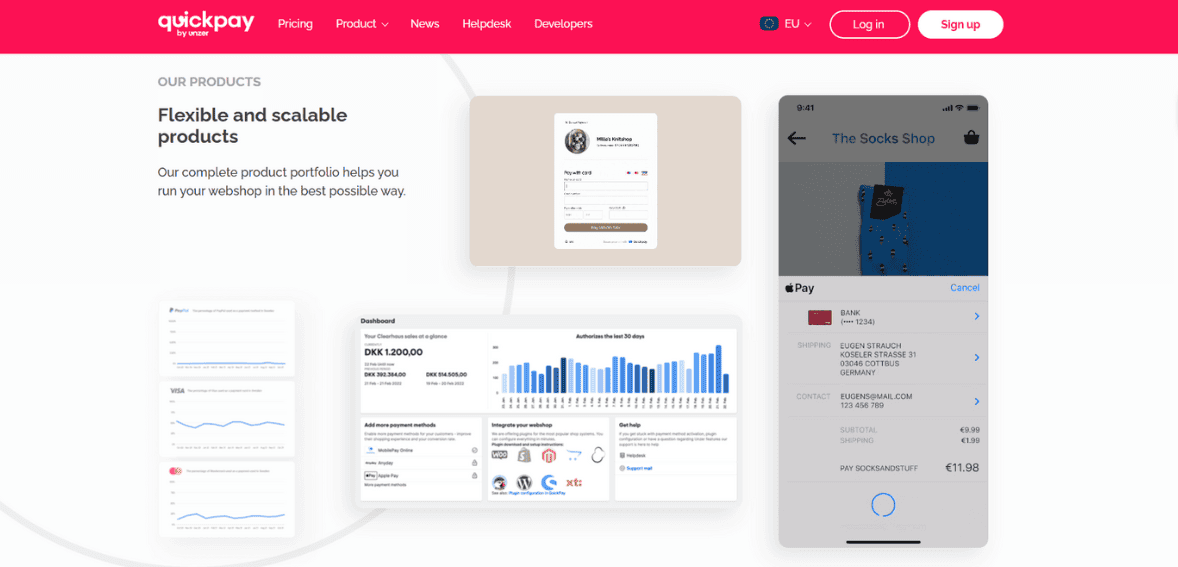
Weaknesses, Limitations & Criticisms
It’s not all good though. One of the biggest criticisms is that QuickPay is not very international. It supports international payments but its infrastructure and acquirer partners are EU based so it’s not ideal for merchants with operations in North America or Asia. Some users also find the reporting tools basic compared to the bigger guys. No mobile app means you can’t monitor in real time on the go. The API is powerful but non technical users will struggle to use it without external help.
Another point of contention is pricing. It is upfront with costs but the combination of gateway and acquirer fees can be confusing for new merchants. A few Trustpilot reviews mention delayed settlements or unclear refund timelines but these seem to be isolated. These aren’t deal breakers but show where the platform could evolve to stay competitive in a rapidly changing payments landscape.
Comparative Landscape & Alternatives
In the global payment gateway market, QuickPay competes with providers like Stripe, Adyen, PayPal, and Mollie. While QuickPay focuses primarily on the European SME segment, competitors such as Stripe and Adyen target broader global audiences with more advanced analytics and enterprise-grade solutions.
QuickPay’s advantage lies in its simplicity and regional optimization; it supports local payment methods like MobilePay and Dankort, which are essential for Scandinavian customers. However, for merchants with multi-regional operations or complex subscription models, platforms like Stripe may offer more scalability.
Mollie serves as QuickPay’s closest competitor in terms of target market and pricing structure, while PayPal remains the easiest entry-level solution for small businesses. Ultimately, QuickPay fills an important niche: it’s not the largest or most feature-heavy, but for businesses focused on reliability, compliance, and ease of setup within Europe, it stands out as a strong contender.
Recommended Use Cases & Ideal Scenarios
QuickPay is best suited for small and medium-sized businesses, particularly those in Europe that require local payment support and straightforward integration. E-commerce stores, subscription platforms, and service providers can benefit from its recurring billing, invoice management, and API customization capabilities.
Startups with limited IT resources can rely on its pre-built modules for quick deployment, while more advanced companies can use the API to develop tailored payment solutions. Merchants that value transparency, uptime, and compliance over elaborate analytics will find QuickPay’s design appealing.
However, it may not be ideal for enterprises needing global reach or deep reporting functionality. In such cases, pairing QuickPay with third-party analytics tools or considering hybrid setups with other processors might deliver better outcomes. For its core audience, though, QuickPay remains an efficient, secure, and cost-effective choice that aligns with practical business realities.
Conclusion & Overall Assessment
QuickPay successfully blends simplicity with technical robustness. It offers an extensive feature set, strong compliance standards, and a developer-friendly environment that makes it easy to adapt to diverse business needs. For European merchants, its integration with local acquirers and support for regional payment methods give it a clear competitive edge.
While it doesn’t match the global scale of giants like Stripe or Adyen, its focused approach delivers reliability and affordability without unnecessary complexity. Its limitations; such as basic analytics and limited global expansion; are outweighed by its consistent performance, transparent pricing, and user-oriented design.
Overall, QuickPay stands as a dependable and well-rounded payment gateway that balances flexibility, security, and value. Businesses seeking a stable, regulation-compliant, and easily deployable solution will find it a practical choice for managing online payments efficiently.
FAQs
Is QuickPay safe to use for processing payments?
Yes. QuickPay adheres to PCI-DSS Level 1 standards, employs encryption and tokenization, and follows PSD2 regulations for strong customer authentication. Its security record is strong, with additional fraud detection tools to safeguard merchants and customers alike.
Who is QuickPay best suited for?
QuickPay works best for small and medium-sized European businesses that need a reliable and compliant payment gateway. It’s ideal for e-commerce retailers, SaaS platforms, and service providers operating in Denmark, Sweden, or neighboring markets.
How does QuickPay’s pricing compare to competitors?
QuickPay’s pricing is competitive for European users but may not always be the cheapest. It separates gateway and acquiring fees, which adds flexibility but can confuse first-time users. Larger merchants often negotiate better rates depending on transaction volumes and payment methods.

ProPay Review
By 10topmerchantservices October 22, 2025
ProPay has been in the digital payments space for a long time, offering simple and secure payment processing to individuals and businesses of all sizes. Founded in 1997 and later acquired by TSYS (now part of Global Payments), the company has built a reputation for providing easy and affordable services for small merchants to accept electronic payments. Unlike many bigger providers that focus on enterprise clients, ProPay’s main goal is to empower entrepreneurs, nonprofits and small businesses to manage transactions without complex setups or long term contracts. Lets read more about ProPay Review.
Over the years ProPay has grown from a niche provider to a global payment platform offering card processing, mobile payments and online transaction support. Its ability to integrate with multiple industries has made it very popular among service professionals and independent sellers. By balancing simplicity with compliance ProPay allows merchants to accept payments securely while focusing on growing their business.
Today ProPay is an alternative for businesses that want flexibility in how they manage and receive payments. It may not have all the features of enterprise level systems but it’s a reliable choice for merchants who prioritize ease of use, affordability and good customer support. This review will go through every aspect of ProPay’s service offering, pricing, security and overall value for businesses considering it as their payment processor.
Company Overview and Background | ProPay Review
ProPay started in the late 1990s with a mission to make payment acceptance easier for small to midsize businesses. They knew traditional merchant accounts came with long approval times, complex pricing models and technical requirements that many small businesses couldn’t afford or manage. To fill that gap ProPay created a model that allowed businesses to start accepting credit and debit cards quickly through online enrollment and minimal equipment needs.
After being acquired by TSYS in 2012 and later integrated under Global Payments, it gained access to a broader network of financial technology resources, improving their infrastructure, security and reliability. The partnership allowed them to scale their offerings and compliance without losing focus on their core customer.
ProPay’s product line serves small retail stores, home-based businesses and nonprofits. Their unique value proposition is cost effective payment solutions with no long term contracts or excessive fees. Their Utah headquarters is the hub for operations, technical support and innovation in merchant services. By staying customer centric ProPay has established themselves in the competitive payments space. They are the go to solution for businesses that need secure payment options without the overhead of a large merchant processor. That combination of scalability and simplicity is what ProPay is all about.
Account Setup and Onboarding Experience
Getting started with ProPay is easy, especially for small business owners and independent professionals who are new to merchant accounts. The online application process is quick and takes only a few minutes. You’ll provide basic business info, verify your identity and choose your account type. Unlike some processors that require in-person verification or bank guarantees, ProPay simplifies the onboarding process by approving most users who meet basic criteria.
Once approved you’ll get access to your ProPay dashboard which is the central hub for transactions, fund transfers and reporting. The company also provides training materials and tutorials to help first time users get familiar with the tools. For merchants who prefer mobile transactions the onboarding includes setting up the ProPay JAK card reader and linking it to your smartphone or tablet for seamless point of sale functionality.
No long term contracts or monthly minimums makes the onboarding process even more attractive for small merchants who value flexibility. However some users report that initial account verification and identity confirmation can take longer if additional documentation is required. Overall ProPay’s onboarding process is easy and transparent so you can start accepting payments quickly with minimal hassle.
Payment Processing Features
ProPay’s core strength lies in its range of payment processing features tailored for small to midsize businesses. It supports credit and debit card payments, ACH transfers, recurring billing, and mobile transactions. Merchants can process transactions through a virtual terminal, mobile app, or integrated e-commerce platform. This variety allows businesses to operate across multiple channels, whether online, on-the-go, or at physical locations.
Recurring billing capabilities make ProPay suitable for subscription-based businesses, while ACH functionality provides a cost-effective way to handle direct deposits or recurring client payments. The platform also supports payment links and hosted payment pages, making it easier for customers to complete transactions without the merchant needing advanced website integrations.
One of the noteworthy features is the flexibility in transaction management. Merchants can view real-time payment activity, issue refunds, and manage deposits from a single dashboard. The interface is clean and user-friendly, enabling even non-technical users to navigate easily. ProPay’s systems are designed to handle both low- and moderate-volume transactions efficiently, though it may not be ideal for enterprises processing thousands of payments daily. In essence, ProPay’s processing toolkit combines functionality and simplicity, giving smaller merchants the tools they need to manage payments securely and effectively.
Mobile and Online Payment Solutions
In an era where mobility defines modern business, ProPay has invested significantly in mobile and online payment functionality. Its mobile application, available on both iOS and Android, allows merchants to process payments anywhere using a smartphone or tablet. The app supports the JAK card reader, which connects via audio jack or Bluetooth, providing a convenient way for small vendors, event sellers, or service professionals to accept card payments on the spot.
The online payment features are equally strong. Merchants can integrate ProPay with their websites or shopping carts to accept payments through secure checkout pages. These hosted pages are PCI-compliant, ensuring that customer data remains encrypted during transactions. For businesses without an online store, ProPay offers simple payment links that can be shared through email or social media, making remote payments effortless.
While its mobile interface focuses on simplicity rather than complex analytics, it provides essential insights like transaction history and settlement summaries. The app is responsive and reliable, though some users note occasional connection issues with certain mobile devices. Despite these minor limitations, ProPay’s mobile and online solutions remain a valuable asset for small businesses that need affordable, flexible payment acceptance without relying on traditional terminals.
Hardware and POS Options
ProPay’s hardware solutions are minimalistic yet functional, catering primarily to small businesses and individual sellers. The flagship product, the ProPay JAK card reader, is a compact mobile device that plugs directly into a smartphone or tablet, enabling users to swipe or dip cards for secure payments. The reader supports EMV chip technology, ensuring compliance with modern card security standards.
The system is ideal for professionals who travel frequently or operate outside traditional retail environments, such as vendors at trade shows, consultants, and service technicians. The ProPay JAK integrates with the company’s mobile app, offering quick transaction approval and receipt generation.
For in-person transactions requiring more structured setups, ProPay also supports integration with third-party POS systems. However, unlike full-service payment providers that offer complete hardware bundles, ProPay’s hardware catalog is limited. This may not meet the needs of high-traffic retail stores that require robust terminals with barcode scanners or inventory management features.
Nevertheless, the available options are reliable, easy to set up, and affordable. The focus remains on simplicity and accessibility, aligning with ProPay’s mission to empower small merchants without imposing heavy infrastructure costs.

Security, Encryption, and Compliance
Security has always been a central focus for ProPay, given the sensitivity of payment data handled daily. The company adheres to PCI DSS requirements, ensuring that all transactions are processed in a secure environment. Data transmitted through ProPay’s system is encrypted using industry-standard protocols, reducing the risk of breaches or unauthorized access.
ProPay also employs tokenization, which replaces sensitive card information with unique identifiers. This approach ensures that even if transaction data were intercepted, it would be useless to potential attackers. The company’s compliance with Visa and Mastercard regulations further strengthens its credibility among merchants and consumers.
Additionally, ProPay offers fraud prevention tools such as transaction monitoring and verification systems that detect suspicious activity. Merchants can view detailed reports of their transactions and flag irregular patterns for review.
Although the platform’s security framework is robust, it does not offer as many advanced risk management tools as enterprise-grade processors. Nonetheless, for small businesses seeking a secure and compliant payment partner, ProPay delivers dependable protection without overcomplicating the user experience.
Integrations and API Support
ProPay’s ability to integrate with external systems enhances its versatility. The platform supports APIs that allow developers to embed payment capabilities into websites, mobile apps, and business management systems. This is particularly valuable for companies that want to automate payment collection or build customized checkout solutions.
In addition to direct API access, ProPay offers pre-built integrations with popular platforms used by nonprofits, e-commerce merchants, and service providers. These include shopping carts, accounting software, and fundraising platforms. The integration process is designed to be straightforward, with clear documentation and support for developers.
While ProPay’s integration ecosystem is not as extensive as some major processors, it covers essential use cases for small and medium-sized enterprises. Businesses with more complex requirements, such as multi-currency settlement or advanced analytics, may need to rely on third-party middleware solutions. Overall, ProPay’s API and integration framework strikes a good balance between simplicity and flexibility. It provides enough customization for most small businesses without overwhelming users with technical complexity.
Pricing and Fee Structure
ProPay’s pricing model is one of its most appealing aspects, particularly for small businesses and independent professionals. Unlike traditional merchant accounts that involve lengthy contracts or hidden fees, ProPay offers transparent and straightforward pricing. Merchants typically pay an annual fee to maintain their account, along with transaction-based rates that vary depending on card type and processing method.
Transaction fees usually range between 2.5% and 3.5%, which aligns with industry averages for low-volume processors. There are no setup fees or monthly minimums, making it an attractive option for occasional sellers or businesses with seasonal operations. ProPay also provides cost savings through its ACH transfer capabilities, which offer lower per-transaction costs compared to card payments. The only downside is that some add-on services, such as expedited funding or hardware purchases, may come with additional charges.
While the pricing structure is competitive, larger businesses processing high volumes may find the rates less economical compared to interchange-plus pricing offered by advanced processors. For its target market, however, ProPay’s simplicity and predictable costs make it a practical and transparent choice.
Customer Support and Service Quality
Customer support is an essential factor when evaluating any payment processor, and it performs reasonably well in this area. The company offers phone and email support during business hours, along with an online help center containing FAQs, guides, and troubleshooting resources.
The support team is knowledgeable and generally responsive, though some users have reported delays during peak times. ProPay’s affiliation with Global Payments ensures that its support infrastructure is reliable and professionally managed. The company’s online resources are particularly helpful for first-time users learning how to process refunds, manage deposits, or integrate new devices.
However, ProPay does not currently provide 24/7 live chat support, which may be a drawback for businesses operating outside standard U.S. hours. Despite this, the available support channels cover most common issues effectively. In summary, ProPay’s customer service framework emphasizes clarity, accessibility, and user education. While there is room for improvement in response time and around-the-clock assistance, its current support offerings are adequate for the majority of small and midsize users.
Pros of Using ProPay
One of the biggest advantages of using ProPay is its simplicity. The platform is designed for quick setup and easy management, making it ideal for entrepreneurs who prefer minimal technical involvement. The transparent pricing model with no long-term commitments also allows users to maintain control over costs.
ProPay’s support for multiple payment types; credit, debit, ACH, and mobile; ensures flexibility across industries. The ability to integrate with websites, CRMs, and mobile apps further enhances its utility. Security compliance is another strong point, as the company adheres to PCI DSS standards and implements encryption and tokenization to protect data.
Additionally, ProPay’s reputation for reliability and its backing by a major payment processing company provide reassurance to users concerned about stability and trustworthiness. The straightforward onboarding process and portable hardware options make it especially appealing to small vendors, consultants, and nonprofit organizations that need convenient, affordable ways to process payments.
Cons and Limitations
While ProPay offers numerous benefits, it also has some limitations that potential users should consider. The first drawback is its limited hardware selection, which may not be sufficient for larger businesses requiring advanced POS systems. Its mobile reader works well for basic transactions but lacks some modern features such as contactless payment or tap-to-pay functionality.
The second concern lies in transaction fees. Although the pricing structure is transparent, businesses processing large volumes may find the flat percentage rates higher than interchange-plus alternatives. Similarly, the annual account fee can be inconvenient for those who only process payments occasionally. Another limitation is the absence of round-the-clock customer service. Businesses that experience issues after hours may have to wait until the next business day for assistance.
Finally, ProPay’s feature set, while sufficient for small merchants, may fall short for enterprises seeking advanced analytics, multi-currency options, or deep customization. These trade-offs are reasonable given the company’s focus on accessibility, but they may limit its appeal to larger organizations.
Ideal Users and Business Types
ProPay’s design and pricing make it particularly well-suited for small businesses, independent contractors, and nonprofits. Its easy onboarding, transparent pricing, and flexible processing options cater to users who need dependable payment tools without high overhead costs. Freelancers, event organizers, and home-based businesses benefit from its mobile capabilities, while charities and associations appreciate the platform’s secure donation processing features.
Retail shops with low to moderate transaction volumes also find value in ProPay’s straightforward setup. The ability to accept payments via card readers, virtual terminals, or hosted checkout pages ensures versatility for various industries.
However, businesses that process international payments, require advanced POS features, or handle very high transaction volumes may find ProPay limiting. In such cases, enterprise-level processors with more complex infrastructures might be better suited. For its intended audience; small, cost-conscious merchants; ProPay offers a balanced mix of security, reliability, and affordability that aligns well with modern payment needs.
Final Verdict
ProPay stands out as a reliable, user-friendly payment processor tailored for small to midsize businesses that value simplicity over complexity. It provides essential tools for card and ACH processing, offers mobile and online flexibility, and ensures compliance with modern security standards. Its transparent pricing and lack of long-term commitments make it appealing for startups and independent sellers.
However, ProPay is not without limitations. Businesses seeking sophisticated POS systems, detailed analytics, or advanced reporting may find the platform somewhat basic. Its customer support availability and hardware options could also be improved to meet the evolving needs of modern merchants. Overall, ProPay delivers solid value for its target users. It strikes a good balance between cost, functionality, and ease of use, making it a dependable choice for small merchants, service professionals, and nonprofits seeking a straightforward way to accept payments securely and efficiently.
FAQs
Is ProPay suitable for high-volume businesses?
It is best suited for small to midsize businesses. While it can handle moderate transaction volumes efficiently, larger enterprises may find its pricing and feature set less competitive than enterprise-focused processors.
Does ProPay support international payments?
It supports limited international transactions, but availability depends on the merchant’s account type and regional restrictions. It is primarily focused on domestic U.S. processing.
How long does it take to receive funds from ProPay?
It typically deposits funds into merchant accounts within one to two business days. The exact time may vary based on transaction type and the merchant’s financial institution.

PaymentCloud Review
By 10topmerchantservices October 17, 2025
PaymentCloud has a reputation in the merchant services industry as a provider that works with high-risk and low-risk businesses. Many payment processors focus on mainstream merchants and leave businesses in industries like CBD, supplements, subscription services or adult entertainment with limited options. PaymentCloud bridges that gap and creates a space where businesses of all profiles can get reliable payment processing. Lets read more about PaymentCloud Review.
At its core, PaymentCloud allows merchants to accept credit and debit card transactions, ACH payments, eChecks and recurring billing. It services e-commerce businesses and physical stores with payment gateways, terminals and POS solutions. The company also focuses on compliance and fraud prevention which is key for merchants in regulated industries.
For high-risk merchants, PaymentCloud is a lifeline. Many providers decline accounts based on risk exposure but PaymentCloud has partnerships with multiple acquiring banks and third-party processors to find a match. Low-risk merchants benefit from its strong customer support and wide integration ecosystem. This dual appeal is why it’s so popular.
In today’s competitive market, PaymentCloud’s willingness to work with tough industries without neglecting traditional businesses makes it a versatile choice. By balancing flexibility, compliance and customer service it has created a unique reputation among payment processors.
Company Overview and History | PaymentCloud Review
PaymentCloud was founded to solve a common problem in the payments industry: lack of support for high risk merchants. While most processors avoid businesses in high risk industries, PaymentCloud started by working with them directly. This early focus quickly set the company apart and made it a go to name for merchants with limited options.
Over time PaymentCloud expanded beyond high risk services to offer solutions for low risk and mid risk businesses as well. By partnering with acquiring banks, payment gateways and hardware providers it created an ecosystem that serves a wide range of merchant needs. This inclusive approach has been a key to its growth.
Based in California the company operates nationwide and serves e-commerce businesses and traditional storefronts. The team is often praised for taking a consultative approach, guiding merchants through the application process and helping them understand the complexities of payment acceptance.
What really sets PaymentCloud apart is its flexibility. While most processors have rigid guidelines, PaymentCloud’s network of banking partners allows it to create custom solutions. This flexibility has allowed it to grow steadily and become a well known name in the industry. Today PaymentCloud is a bridge between merchants and financial institutions, enabling commerce for businesses that would otherwise not have access to banking services. Its reputation is built on inclusivity, flexibility and a customer first model.
Merchant Account Types Offered
One of the strengths of PaymentCloud is the variety of merchant accounts they offer for different business models. For low risk merchants they offer standard credit and debit card processing with competitive pricing and easy integration. Retail shops, professional services and restaurants can use these accounts to run their business.
The real differentiator is PaymentCloud’s high risk merchant accounts. Many industries are challenged because traditional banks consider them high risk due to regulatory scrutiny, high chargeback potential or reputational risk. PaymentCloud specialises in these accounts and works with businesses in industries such as adult entertainment, nutraceuticals, CBD, firearms and subscription based services.
For medium risk merchants such as travel services or online coaching platforms PaymentCloud offer accounts that balance oversight with flexibility. Their strong relationships with banking partners means they can place merchants in the right bucket, reducing the chance of account termination. In addition to physical merchant accounts PaymentCloud also offers e-commerce accounts for online stores to process payments securely. These accounts often include access to fraud prevention tools, chargeback management and recurring billing.
By offering accounts across risk levels PaymentCloud creates an inclusive environment. Merchants that would otherwise be declined can find a solution and traditional businesses can still get reliable payment processing. This multi-tiered account structure is at the heart of PaymentCloud’s value proposition.
Payment Processing Features
PaymentCloud delivers a comprehensive suite of payment processing features designed to meet the needs of modern merchants. For credit and debit card acceptance, it supports both card-present and card-not-present transactions, ensuring businesses can serve in-person and online customers alike. The platform also accommodates ACH payments and eChecks, which are particularly valuable for subscription services or businesses handling large transactions. These methods often reduce processing costs and provide an alternative to card payments.
Recurring billing is another feature that stands out. Merchants running subscription services or installment payment plans can set up automated schedules, reducing administrative burdens and ensuring timely payments. This feature integrates well with PaymentCloud’s fraud prevention systems, minimizing chargeback risks.
PaymentCloud also integrates with mobile payment solutions, allowing merchants to accept Apple Pay, Google Pay, and other digital wallets. As consumer preferences shift toward contactless and mobile payments, this flexibility ensures businesses remain competitive. For reporting, the platform provides detailed analytics, enabling merchants to monitor transaction volumes, settlement timelines, and chargeback activity. These insights are critical for making informed business decisions and improving cash flow management.
Overall, PaymentCloud’s payment features extend beyond basic processing. By including recurring billing, ACH, and mobile wallet support, it creates a versatile environment suitable for a range of industries. This functionality, paired with fraud tools and compliance features, makes the platform adaptable to both traditional and high-risk merchants.
Hardware and POS Options
For brick-and-mortar businesses, PaymentCloud offers a variety of hardware and POS solutions. Merchants can access countertop terminals, mobile readers, and fully integrated POS systems depending on their operational needs. These devices are EMV-compliant, ensuring secure chip card transactions, and many also support contactless payments like Apple Pay and Google Pay.
Mobile readers are particularly useful for businesses on the go, such as food trucks, service providers, and event vendors. These devices pair with smartphones or tablets, providing flexibility without sacrificing functionality. For larger retail operations or restaurants, PaymentCloud supports advanced POS systems that combine payment acceptance with inventory management, reporting, and customer relationship tools. This integration streamlines operations and reduces the need for multiple third-party systems.
The company also provides virtual terminals for phone or mail-order transactions, enabling businesses to manually enter card details through a secure platform. This feature is valuable for service providers or merchants with recurring clients. One consideration for merchants is that PaymentCloud’s hardware options are typically supplied through partnerships, meaning costs and compatibility may vary. However, this also allows for flexibility, as businesses are not tied to a single device type.
Overall, PaymentCloud’s hardware solutions align with industry standards, offering the security and convenience needed for today’s payment environment. Whether a small mobile operation or a large retail store, merchants can find hardware that fits their specific needs.
E-Commerce and Online Payment Gateways
PaymentCloud places strong emphasis on supporting online businesses through its e-commerce and payment gateway solutions. The company integrates with popular shopping cart platforms such as Shopify, WooCommerce, BigCommerce, and Magento. This compatibility makes it easier for online retailers to set up and manage their stores.
Its payment gateway supports secure credit card processing, recurring billing, and tokenization. Tokenization replaces sensitive card details with unique identifiers, reducing the risk of data breaches. This is particularly valuable for merchants handling recurring transactions. PaymentCloud also offers APIs that allow developers to customize payment solutions. Businesses with unique needs, such as marketplaces or specialized platforms, can integrate payment functionality directly into their systems.
Fraud prevention is integrated into the gateway, with tools to detect suspicious activity, monitor chargebacks, and flag risky transactions. These safeguards are crucial for online merchants, especially those in high-risk industries. For global e-commerce, PaymentCloud supports multi-currency acceptance, allowing merchants to expand internationally. While cross-border processing can involve higher fees, the availability of this feature opens doors for businesses looking to reach new markets.
In essence, PaymentCloud’s e-commerce support is designed to balance flexibility, security, and scalability. By offering robust gateway integrations and fraud protection, it provides merchants with the tools to compete in a rapidly growing online marketplace.
High-Risk Merchant Services Specialization
High-risk merchant services are at the heart of PaymentCloud’s identity. Many businesses are classified as high-risk due to chargeback potential, regulatory requirements, or industry reputation. Examples include CBD, nutraceuticals, adult entertainment, firearms, subscription services, and debt collection.
Traditional processors often refuse to work with these industries, leaving merchants with few options. PaymentCloud has built a niche by embracing them, forming partnerships with banks and processors that are open to high-risk accounts. Its team helps merchants prepare thorough applications, highlighting compliance measures and risk management strategies to improve approval chances.
The company also provides chargeback mitigation tools, fraud monitoring, and guidance on reducing transaction disputes. These services are essential for high-risk businesses, as excessive chargebacks can lead to account termination. While fees for high-risk accounts may be higher due to increased risk exposure, PaymentCloud’s willingness to work with these businesses makes it a valuable partner. It often becomes a lifeline for merchants who have been declined elsewhere.
At the same time, PaymentCloud does not solely focus on high-risk industries. Its ability to balance high-risk specialization with low-risk support creates a more inclusive platform than many competitors. For high-risk merchants, however, this specialization remains its defining feature.
Security, Fraud Prevention, and Compliance
Security is a critical concern for any payment processor, and PaymentCloud integrates several measures to protect merchants and their customers. The company is PCI DSS compliant, ensuring that merchants meet industry standards for data security. Tokenization and encryption are standard features, protecting cardholder information during transactions and storage. These tools are especially valuable for businesses handling recurring billing, where sensitive data is stored for future payments.
Fraud prevention tools include transaction monitoring, velocity filters, and alerts for unusual activity. These systems help merchants identify suspicious behavior before it leads to chargebacks or losses. For high-risk merchants, these safeguards are particularly important, given the industries they operate in. PaymentCloud also provides chargeback management services, guiding merchants through disputes and helping them reduce their frequency. While chargebacks cannot be eliminated entirely, proactive monitoring and dispute handling can significantly mitigate their impact.
Compliance support is another area of focus. For industries subject to regulatory scrutiny, PaymentCloud helps ensure that payment practices align with relevant laws and banking requirements. This reduces the risk of sudden account closures or fines. Overall, PaymentCloud’s emphasis on security and compliance reflects its understanding of the challenges merchants face. By combining PCI compliance, fraud detection, and chargeback management, it creates a safer environment for businesses across both high-risk and traditional sectors.
Pricing and Fees Structure
Pricing with PaymentCloud varies depending on the merchant’s risk profile, industry, and processing volume. Unlike some processors that advertise flat-rate pricing, PaymentCloud often uses interchange-plus or tiered pricing models. This allows for flexibility but can make it harder for merchants to predict exact costs.
For low-risk merchants, rates are generally competitive with industry standards, covering transaction fees, monthly fees, and possible setup costs. For high-risk merchants, fees tend to be higher due to increased risk exposure. These may include higher per-transaction rates, rolling reserves, or longer contract terms.
One common concern among merchants is transparency. Because pricing is customized, businesses must work directly with PaymentCloud to receive quotes. While this ensures tailored solutions, it can create uncertainty for merchants comparing providers. In addition to processing fees, merchants may encounter costs for hardware, chargeback handling, and PCI compliance. Understanding the full scope of fees is important before signing a contract.
Overall, PaymentCloud’s pricing reflects its positioning in the market. It is not the cheapest option available, but for many high-risk merchants, access to reliable processing outweighs cost concerns. For low-risk merchants, competitive rates and strong service can make the value proposition worthwhile.
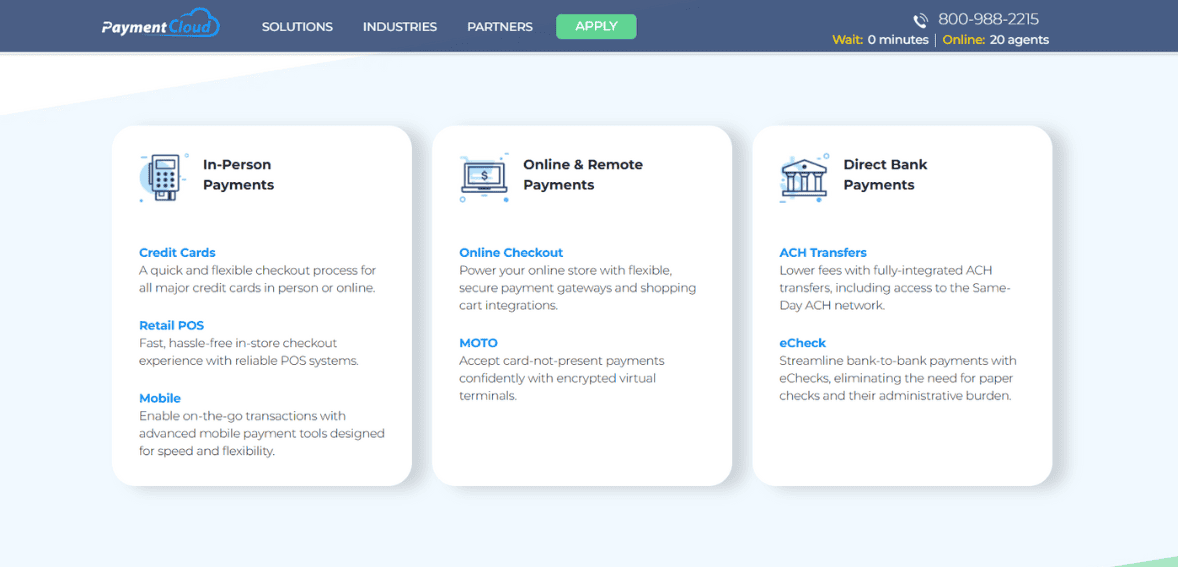
Integrations and Third-Party Compatibility
PaymentCloud’s value extends through its integrations with third-party platforms. For e-commerce, it connects with Shopify, WooCommerce, Magento, and BigCommerce, allowing merchants to seamlessly manage online stores. In terms of business software, it integrates with accounting tools like QuickBooks and CRMs such as Salesforce. This helps businesses streamline financial management and customer relationships.
Its payment gateway and APIs provide developers with flexibility to build custom integrations. This is particularly useful for marketplaces, SaaS providers, or businesses with unique workflows. For merchants using POS systems, PaymentCloud supports integration with widely used hardware and software providers. This ensures that businesses can choose solutions tailored to their industry without being locked into a single vendor.
Overall, the integration ecosystem is designed to make PaymentCloud adaptable. Whether a small retailer, an online subscription service, or a global e-commerce operation, merchants can connect their preferred platforms. This flexibility adds to its appeal, particularly for growing businesses looking for scalable solutions.
Customer Support and Service Quality
Customer support is a significant factor in evaluating a payment processor, and PaymentCloud receives generally positive feedback in this area. The company provides phone, email, and chat support, with a reputation for responsiveness and attentiveness.
Merchants often highlight the onboarding experience, noting that PaymentCloud’s team takes a consultative approach. This is particularly valuable for high-risk businesses navigating the complex approval process. Guidance on preparing applications, compliance, and integration reduces friction and increases approval chances.
Ongoing support includes assistance with technical issues, chargeback disputes, and hardware troubleshooting. The availability of dedicated account managers further enhances the experience for some merchants, ensuring personalized attention. That said, like many processors, PaymentCloud does receive occasional criticism regarding delays in issue resolution or a lack of transparency in pricing. These concerns are not unique to PaymentCloud and are common in the industry, especially among providers handling high-risk accounts.
On balance, PaymentCloud’s reputation for support is above average. Its willingness to guide merchants through challenges and maintain consistent communication contributes to its credibility as a merchant services provider.
Pros and Cons of PaymentCloud
Every payment processor has strengths and weaknesses, and PaymentCloud is no exception.
Pros:
Specializes in high-risk merchant accounts, serving industries often turned away by others.
Wide range of integrations with e-commerce, accounting, and CRM platforms.
Strong emphasis on compliance, fraud prevention, and chargeback management.
Good reputation for customer service and onboarding support.
Cons:
Pricing transparency is limited since fees are customized.
High-risk accounts can involve higher rates, rolling reserves, or restrictive contracts.
Hardware is sourced through partners, which can mean variable costs and compatibility.
No simple flat-rate pricing model for merchants seeking predictability.
Overall, PaymentCloud offers strong benefits, especially for high-risk businesses, but merchants should carefully review contract terms and pricing before committing.
Ideal Business Types for PaymentCloud
PaymentCloud is particularly suited for merchants who fall into industries classified as high-risk, such as CBD, nutraceuticals, subscription services, and adult entertainment. For these businesses, its expertise, banking relationships, and risk management tools are invaluable. At the same time, PaymentCloud also works well for low-risk and mid-risk businesses. Retail shops, restaurants, service providers, and online stores can benefit from its integrations, customer support, and competitive pricing structures.
Startups may find PaymentCloud appealing due to its consultative approach during onboarding. Guidance on compliance, fraud prevention, and chargeback management is especially useful for businesses new to payment processing. Large enterprises may also consider PaymentCloud, particularly if they operate across multiple risk categories. Its ability to tailor solutions and scale with business needs makes it flexible enough for growth.
In short, PaymentCloud is best for businesses that need reliability, risk tolerance, and integration options. While high-risk merchants are its core audience, the platform’s inclusive approach makes it suitable for a broad range of businesses.
Final Verdict
PaymentCloud stands out in the payment industry for serving both high-risk and mainstream merchants. It helps businesses often rejected by traditional processors while offering robust tools like ACH processing, recurring billing, fraud prevention, and numerous integrations. Its consultative onboarding and strong support enhance value, especially for high-risk clients. However, pricing transparency is limited, with customized quotes and variable hardware costs posing challenges. Despite this, PaymentCloud’s inclusivity, security, and adaptability make it a solid choice; providing reliability for low-risk merchants and crucial access for high-risk ones; offering a strong balance of flexibility, compliance, and customer service across diverse business types.
FAQs
Q1. Is PaymentCloud suitable only for high-risk businesses?
No. While PaymentCloud is best known for high-risk specialization, it also serves low-risk and mid-risk merchants, offering flexible solutions across industries.
Q2. Does PaymentCloud require long-term contracts?
Contract terms vary depending on the merchant’s risk profile and banking partner. Some accounts involve multi-year agreements, while others may offer more flexible terms.
Q3. What payment methods can businesses accept with PaymentCloud?
Merchants can accept credit and debit cards, ACH payments, eChecks, and mobile wallets. The platform also supports recurring billing for subscription-based businesses.

PayAnywhere Review
By 10topmerchantservices October 14, 2025
PayAnywhere is a payment processing solution that gives merchants flexibility when accepting payments in-store and on the go. Part of North American Bancard’s portfolio, it’s designed for small to medium-sized businesses that need affordability without sacrificing features. Unlike big name competitors that dominate the payment space, PayAnywhere bridges the gap between mobility and full-service point-of-sale. Lets read more about PayAnywhere Review.
The platform offers hardware like card readers and terminals, software to track sales, issue invoices and manage business operations. Its biggest selling point is simplicity; merchants can get started quickly with no technical background. This is why it’s attractive to independent vendors, mobile service providers and small retail stores.
But PayAnywhere isn’t a one-size-fits-all solution. While it has many features small businesses love, it also has limitations that larger more complex businesses will find restrictive. This review looks at the features, pricing, pros and cons to give you a balanced view of how it stacks up in the bigger payments picture.
Company Overview and Market Position | PayAnywhere Review
PayAnywhere was created by North American Bancard, a long time payment processor in the US. NAB has been serving merchants for years and PayAnywhere was designed to target businesses that needed a user friendly, mobile first payment solution. This was a smart move as mobile commerce and portable payment systems are a growing demand in today’s retail and service industries.
Market wise PayAnywhere competes with Square, Clover and Stripe. It positions itself as a versatile yet cost conscious option, especially for merchants who can’t justify higher equipment costs or complex system integrations. Its branding has always been around simplicity, giving business owners tools that don’t require heavy training or upfront investment.
But PayAnywhere’s market perception is mixed. Many users love the low barrier to entry and convenience while others have concerns about fee transparency and customer service. Unlike competitors that have built strong ecosystems of 3rd party apps and integrations, PayAnywhere is more modest in its offerings. This puts it in a unique position: attractive to merchants who want simple payment acceptance but less so for businesses that want customizations.
Onboarding and Setup Process
One of the best things about PayAnywhere is the simple onboarding process. Merchants can sign up online and fill out basic business info and then be guided through the account setup. Once approved, you can order hardware like mobile readers or POS terminals. No IT support required.
The equipment once received pairs with smartphones, tablets or operates as a standalone POS. For mobile readers, you just download the PayAnywhere app, connect the reader to your device and start processing payments. The software will walk you through the first few transactions. Account verification is usually quick but some merchants have reported delays in approval depending on underwriting requirements. PayAnywhere, like most processors, still applies standard risk assessment procedures so businesses in high risk industries may have a stricter review.
Overall the onboarding process is designed to be easy. No extensive training or system configuration required which is a big plus for small businesses that want to start accepting payments right away. But merchants should review the contract terms during setup as some have pointed out that the fine print on fees or equipment leases can be missed in the rush to get started.
Hardware and Mobile POS Solutions
PayAnywhere offers a range of hardware designed to accommodate both mobile and stationary businesses. The simplest option is a mobile card reader that connects to smartphones or tablets. These devices accept EMV chip cards, magnetic stripe cards, and contactless payments such as Apple Pay or Google Pay. This versatility ensures merchants don’t miss out on customers who prefer newer digital wallet technologies.
For more established setups, PayAnywhere provides POS terminals and smart solutions with touchscreens, receipt printers, and built-in software. These terminals are designed for retail counters, restaurants, and service providers who prefer a more traditional checkout experience. The company also offers portable terminals that combine mobility with full features, allowing merchants to carry them within a store or take them to pop-up events.
The hardware is generally easy to use, though its design and durability may not rival that of higher-priced systems. Merchants who require advanced inventory management, customer loyalty features, or extensive customizations may find the hardware somewhat limited. Still, for small businesses and mobile vendors, it strikes a good balance between affordability and functionality. Ultimately, PayAnywhere’s hardware strategy aligns with its target audience: businesses that want to accept multiple payment types without significant upfront investment in POS technology.
Software Features and Dashboard
The PayAnywhere software is centered on its mobile app and web-based dashboard, providing business owners with tools to track transactions and manage operations. The app allows users to process payments, issue digital receipts, and view sales activity in real time. For merchants using terminals, the same features are integrated into the device interface.
The dashboard gives a broader view of business performance. Merchants can analyze sales trends, generate reports, and track activity across locations. Invoicing functionality is available, enabling merchants to send digital invoices directly to customers and accept payments online. Recurring billing options are also provided, making it useful for service-based businesses that rely on subscriptions or repeat clients.
While the software covers core needs, it is not as advanced as larger POS ecosystems that integrate deep accounting or inventory features. Some businesses may find themselves needing additional software for specialized operations. However, for its target market, the platform remains functional, straightforward, and practical. In short, PayAnywhere’s software provides enough for small to medium merchants to run day-to-day payment activities, though it doesn’t aspire to be a full-scale enterprise resource system.
Payment Processing Capabilities
PayAnywhere supports a wide range of payment types, which is essential for modern merchants. It accepts all major credit and debit cards, EMV chip transactions, and contactless payments via NFC-enabled wallets. This flexibility ensures customers can pay the way they prefer, enhancing convenience and customer satisfaction.
The system also accommodates keyed-in transactions, useful when merchants need to process payments without a physical card present. Online payments are possible through invoicing and virtual terminals, giving businesses a way to expand beyond face-to-face interactions. Recurring billing options further add to its versatility, particularly for subscription-based businesses. Processing speeds are competitive, with funds typically deposited within one to two business days. Same-day funding is sometimes available, though it may incur additional costs. This quick access to funds can be a lifeline for small businesses managing tight cash flow.
The main limitation lies in customization. While PayAnywhere handles the basics well, it doesn’t provide as many specialized features as enterprise-level processors. For example, integrations with advanced e-commerce systems are limited compared to competitors like Stripe or Square. Nonetheless, for small businesses prioritizing straightforward payment acceptance, the capabilities are more than adequate.
Security and Compliance
Security is a critical concern in payment processing, and PayAnywhere follows industry standards to protect merchants and customers alike. The platform is PCI-compliant, ensuring transactions meet the Payment Card Industry’s data security requirements. It also uses encryption and tokenization to safeguard sensitive card data during processing, reducing exposure to fraud and data breaches.
Fraud prevention features include monitoring tools that flag suspicious transactions, giving merchants the ability to review or decline high-risk sales. These measures are especially important for businesses that deal with card-not-present transactions, which are more vulnerable to fraud.
While PayAnywhere provides the core compliance features expected of a processor, it does not stand out as an innovator in this area. Competitors often advertise more advanced fraud management systems or broader compliance certifications. Still, for most small and medium businesses, the protections offered are sufficient to maintain security and build customer trust. Merchants should remain proactive, however, by regularly reviewing PayAnywhere’s policies and ensuring their own business practices align with compliance requirements.
Integrations and Compatibility
One of PayAnywhere’s limitations is its relatively modest range of integrations. While it provides essential features within its own ecosystem, it doesn’t offer the same extensive compatibility with third-party software as some competitors.
For example, accounting integrations with platforms like QuickBooks may not be as seamless as those offered by Square or Stripe. E-commerce support also exists but is not as expansive, making PayAnywhere better suited for physical or mobile-based businesses than for online-first retailers. That said, the platform is compatible with common operating systems and mobile devices, allowing merchants to use their existing smartphones or tablets without issue. This makes it versatile in terms of device support, but less so in terms of advanced business software connectivity.
Merchants seeking a lightweight, standalone solution may not find this limiting. However, those planning to scale operations and integrate across multiple platforms may eventually outgrow PayAnywhere’s capabilities.
Pricing and Fees
Pricing is one of the most scrutinized aspects of PayAnywhere. The company advertises competitive transaction rates, often using flat-rate pricing as a simple entry point. However, fees can vary depending on the type of business and transaction volume. In some cases, interchange-plus pricing may be applied.
The most common charges include transaction fees per swipe, tap, or keyed-in payment. While advertised rates seem straightforward, some merchants have reported hidden or unexpected charges. Equipment leasing, in particular, has drawn criticism, as the long-term costs of leasing can outweigh the benefits compared to purchasing hardware outright.
Monthly fees are not always required, but certain plans may include service charges depending on the features selected. Early termination fees have also been noted in some contracts, despite marketing that emphasizes flexibility. Overall, PayAnywhere can be cost-effective for small businesses with moderate transaction volumes. However, merchants should carefully review contract terms and ask detailed questions about potential charges before committing. Transparency in pricing has been a common area of feedback among users.
Customer Support and Service Quality
Customer service is an area where PayAnywhere receives mixed reviews. The company offers phone, email, and online support, along with documentation and FAQs on its website. For basic inquiries and setup assistance, these resources are generally adequate.
However, some merchants report difficulty reaching knowledgeable representatives, particularly during high-volume times. Resolution speed has also been noted as a concern, with some issues taking longer to address than expected. This can be especially frustrating for businesses that depend on reliable processing to maintain daily operations.
On the positive side, many users have found the support team helpful during onboarding and hardware setup. The challenge seems to lie more in resolving complex account or funding issues, which sometimes require persistence from the merchant. As with many payment processors, customer support experiences can vary widely. For some, the service is satisfactory; for others, it falls short. Prospective merchants should weigh this factor carefully, especially if they place a high priority on responsive support.
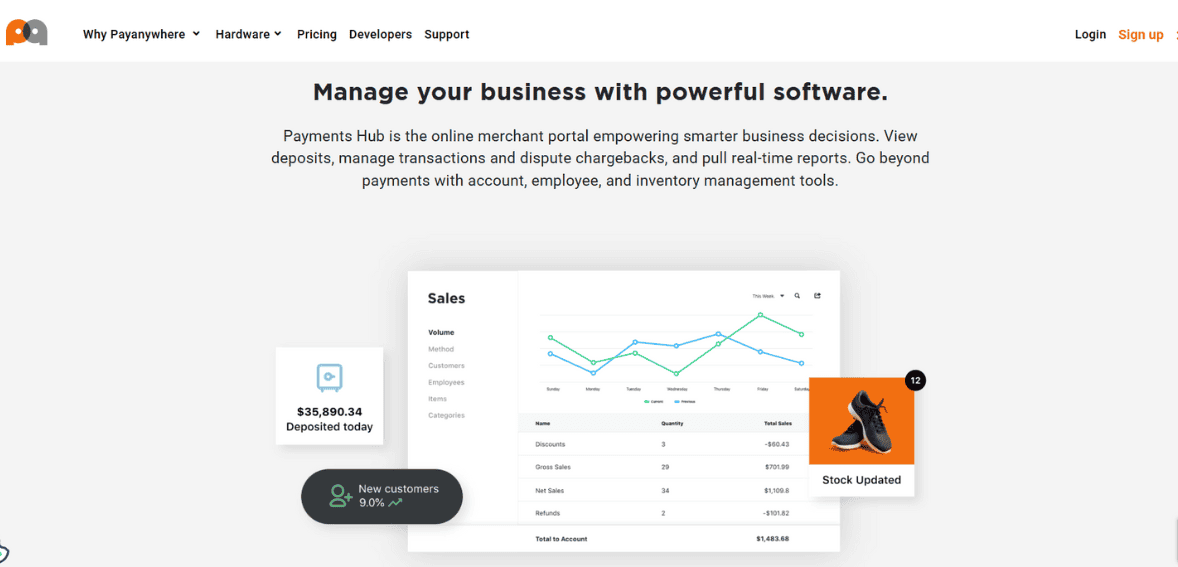
User Experience and Usability
PayAnywhere’s design emphasizes simplicity and accessibility. The mobile app has a straightforward interface, allowing merchants to process payments with minimal clicks. Receipts can be emailed or printed, and reports are easy to generate through the dashboard. The hardware, while functional, is designed more for practicality than aesthetics. It gets the job done, but users who value premium design or advanced customizability may find it basic. That said, many small businesses appreciate that it “just works” without requiring lengthy tutorials.
Usability is a strong point, particularly for merchants who are new to payment processing. The learning curve is minimal, making it suitable for staff training and day-to-day use. Some limitations exist for businesses that want to go beyond the basics, but within its intended scope, PayAnywhere delivers a solid user experience.
Pros of Using PayAnywhere
PayAnywhere has several advantages that make it appealing to small and medium businesses. The first is its accessibility; merchants can start processing payments quickly with minimal setup. The availability of mobile readers and affordable hardware options adds to this appeal. Another benefit is its support for multiple payment types, including EMV and contactless options, which ensures compatibility with modern consumer preferences. The software also provides useful tools like invoicing and recurring billing, covering core needs for many service providers.
Cost can be competitive for businesses with moderate transaction volumes. The straightforward app design and usability further strengthen its case for merchants who don’t want to spend excessive time managing technology. In short, PayAnywhere’s strengths lie in simplicity, affordability, and flexibility for small businesses.
Cons and Limitations of PayAnywhere
Despite its benefits, PayAnywhere is not without drawbacks. A frequent concern is transparency in pricing and fees. Some merchants report unexpected charges or find that equipment leasing terms are less favorable than advertised. Customer service is another area of criticism, with inconsistent experiences reported by users. This can be problematic for businesses that rely on fast support during payment disruptions.
Additionally, PayAnywhere lacks the depth of integrations found in competitors’ ecosystems. Businesses that need advanced inventory systems, loyalty programs, or seamless accounting integrations may find it limiting. Finally, while the hardware works well for basic needs, it doesn’t offer the advanced features or polish of higher-end POS solutions. These factors make PayAnywhere better suited for smaller operations rather than large, complex enterprises.
Best Suited Business Types
PayAnywhere is particularly beneficial for small businesses that prioritize mobility, affordability, and ease of use. Examples include mobile vendors, service professionals, food trucks, pop-up retailers, and small storefronts. The platform provides just enough functionality to support their daily operations without requiring major investment.
For businesses that need advanced customization, large-scale integrations, or enterprise-grade systems, PayAnywhere may not be the best fit. In such cases, competitors like Square or Clover may offer more robust ecosystems. Still, within its target segment, PayAnywhere delivers solid value. It is well-suited for entrepreneurs who want to focus on their business rather than spend excessive time learning complex software.
Conclusion: Is PayAnywhere Worth It?
PayAnywhere offers an attractive mix of affordability, simplicity, and essential features for small to medium-sized businesses. Its mobile-first approach makes it appealing for merchants who operate outside of traditional retail environments, while its POS terminals provide enough flexibility for storefronts. The platform’s strengths include straightforward setup, broad payment acceptance, and competitive pricing for certain users. However, limitations in transparency, customer service consistency, and integration options cannot be ignored. Ultimately, PayAnywhere is a solid option for smaller businesses seeking a reliable payment solution without the overhead of more complex systems. For those who require advanced customization or long-term scalability, exploring alternative providers may be worthwhile.
FAQs
Q1. Does PayAnywhere work for both online and in-person payments?
Yes, PayAnywhere supports in-person transactions through mobile readers and terminals, as well as online payments via invoices and virtual terminals.
Q2. Are there long-term contracts with PayAnywhere?
PayAnywhere often promotes flexible terms, but merchants should review agreements carefully. Equipment leasing and certain pricing plans may involve longer commitments.
Q3. What types of businesses benefit most from PayAnywhere?
Small retailers, mobile vendors, service professionals, and businesses that prioritize affordability and ease of use benefit most from PayAnywhere.

North American Bancard Review
By 10topmerchantservices October 11, 2025
North American Bancard (NAB) has steadily grown from a regional merchant services provider to one of the more recognizable names in U.S. payment processing. Established in 1992 and headquartered in Troy, Michigan, the company now supports hundreds of thousands of merchants across retail, food service, healthcare, and professional sectors. Over three decades of expansion have allowed NAB to position itself as a comprehensive provider, capable of supporting everything from neighborhood coffee shops to multi-location enterprises.
What distinguishes NAB is its ability to combine the stability of traditional merchant account services with a willingness to adopt newer, digital-first tools. This adaptability has kept it competitive in an industry that demands innovation in order to keep pace with changing consumer payment behaviors. Lets read more about North American Bancard Review.
The company’s market presence benefits greatly from its distribution partnerships, agent network, and white-label collaborations. Through these channels, NAB has built significant reach in both small business and enterprise-level accounts. At the same time, its reputation has not been without challenges. Some merchants appreciate the scalability of its services, while others have voiced concerns over transparency of fees or customer support.
These mixed reviews reflect a broader trend across the payments industry, where providers must balance advanced technology with fair pricing and service commitments. NAB’s longevity demonstrates that it has found a workable balance for many merchants, though it is not universally the best fit. Understanding both the strengths and limitations of NAB is essential for businesses evaluating whether it meets their operational needs.
Core Payment Processing Services | North American Bancard Review
At the foundation of NAB’s offerings is its payment processing service, which enables businesses to accept major credit and debit cards, ACH transfers, and electronic checks. This breadth of acceptance allows companies to serve customers in physical stores, through mobile channels, or online environments. The processing is built for speed and reliability, which are crucial for businesses that cannot afford downtime during peak hours. Whether a merchant operates a high-volume retail store or a small professional service with periodic invoices, NAB’s infrastructure is designed to scale to the volume without major disruptions.
Another valuable feature is its support for recurring billing and subscription models. Service-based industries, membership organizations, or SaaS providers benefit from automated payments that reduce administrative overhead while ensuring consistent cash flow. NAB also supports electronic benefit transfer (EBT) acceptance, which is vital for grocery and convenience store operators. Tools like batch settlement and flexible payment acceptance methods provide merchants with a degree of customization that helps streamline their daily operations.
Despite these advantages, businesses must carefully evaluate the costs of processing with NAB. The company employs multiple pricing structures, which can lead to complexity in understanding the true cost of transactions. While interchange-plus pricing may provide more transparency, tiered pricing could obscure expenses depending on card types and transaction volumes. Ultimately, NAB’s core processing services are comprehensive, but the value proposition depends on how well a merchant navigates its fee structures and contract conditions. For many, the benefits of reliable processing outweigh the complications, but others may find competitors offer simpler options.
Point-of-Sale (POS) Solutions
NAB enhances its merchant services portfolio through a partnership with Payanywhere, which powers its range of POS solutions. These systems are not limited to card acceptance but extend to comprehensive business management. Options include countertop terminals, portable handheld readers, and full-featured POS stations suitable for restaurants and retailers. These solutions integrate both hardware and software, allowing merchants to process payments, manage inventory, track employee performance, and generate sales reports within a unified environment.
For small businesses, entry-level handheld readers provide an affordable path to digital payments. Larger businesses can deploy multi-station setups that handle multiple registers, order management, and customer relationship features. All devices are equipped with EMV chip and NFC contactless compatibility, ensuring compliance with modern security standards. The systems are cloud-based, enabling merchants to monitor sales and generate reports in real time from anywhere. This scalability is one of NAB’s greatest strengths, as it allows businesses to expand POS functionality as they grow rather than overcommitting upfront.
Nevertheless, there are drawbacks worth considering. Some merchants report that ongoing updates and equipment leases can increase long-term costs. Hardware rental contracts, in particular, can lock businesses into commitments that are less flexible than buying equipment outright. While the functionality of NAB’s POS portfolio is strong, potential users should review pricing and contract terms carefully. When implemented thoughtfully, however, NAB’s POS solutions give merchants the ability to modernize operations, improve efficiency, and deliver smoother checkout experiences to customers.
Mobile and Contactless Payments
As consumer behavior shifts toward digital-first payment methods, NAB has kept pace with mobile and contactless technologies. Through dedicated apps and mobile card readers, merchants can accept payments directly on smartphones and tablets. This makes NAB especially relevant for businesses on the move, such as food trucks, contractors, event vendors, or delivery services. Contactless capabilities extend to popular wallets like Apple Pay, Google Pay, and Samsung Pay, giving customers the flexibility to use their preferred methods.
QR code acceptance is another feature that caters to modern retail and dining trends. These solutions reduce friction at checkout, speed up transaction times, and increase customer satisfaction. NAB’s mobile systems also include basic reporting tools so that merchants can track sales without having to invest in separate software. This blend of convenience and functionality makes mobile payments attractive for businesses prioritizing agility and customer convenience.
However, the benefits come with caveats. Processing fees for mobile or contactless payments may vary based on the card network or wallet provider. Additionally, merchants operating in areas with limited internet connectivity may face disruptions in service. Hardware compatibility can also be a limiting factor, especially for older devices. Despite these limitations, NAB’s mobile solutions remain competitive within the industry. They provide merchants with a viable way to keep up with evolving customer preferences, provided that the associated costs and technical requirements align with the business model.
E-Commerce and Online Payment Gateways
For merchants selling online, NAB offers a secure payment gateway that integrates with websites and e-commerce platforms. This solution supports acceptance of credit and debit cards, digital wallets, and recurring billing. The gateway’s strength lies in its flexibility—businesses can integrate via APIs for custom solutions or connect with popular platforms such as Shopify, WooCommerce, and Magento. This dual approach allows both tech-savvy developers and small business owners to benefit.
Security is a key focus, with features like tokenization and fraud prevention tools built into the gateway. These protect sensitive cardholder information and reduce the risks of chargebacks. Automated billing is another advantage for subscription-based businesses, streamlining customer retention while ensuring consistent revenue streams. Customizable checkout pages further improve customer experience, giving businesses the opportunity to align payment flows with their branding.
On the other hand, NAB’s gateway is not always as intuitive as leading providers like Stripe or PayPal. Some users report a steeper learning curve, and integration may require additional technical expertise or third-party support. Costs associated with setup or advanced configurations can also add up, depending on the complexity of the merchant’s online environment. Nonetheless, NAB’s online gateway represents a solid choice for businesses seeking security, flexibility, and scalability in their e-commerce operations. It offers a strong alternative to standalone third-party processors, particularly for merchants already using NAB’s in-person systems.
Security, Compliance, and Fraud Prevention
Handling sensitive customer data makes security a critical part of any payment processor’s responsibility, and NAB emphasizes its commitment to compliance. The company maintains full PCI DSS compliance, which ensures merchants are aligned with industry standards for protecting payment data. Encryption and tokenization safeguard cardholder information during transmission and storage, reducing the risk of data breaches.
Fraud prevention is another area of focus. NAB provides merchants with monitoring tools that can detect unusual transaction patterns and flag potentially fraudulent activity. These features are particularly important for businesses operating in industries with higher fraud risk or those handling large transaction volumes. Real-time monitoring, role-based access controls, and secure login protocols further enhance the overall safety of merchant accounts.
Despite these protections, merchants must still take proactive measures to ensure best practices. Some fraud prevention tools may involve extra costs, and compliance processes can be complex without guidance. Smaller businesses may find the requirements overwhelming, especially if they lack in-house technical expertise. Still, NAB’s emphasis on data security and regulatory compliance positions it as a trustworthy partner in a market where customer trust hinges on safe transaction handling. For businesses that prioritize data protection, NAB offers the necessary safeguards to meet industry expectations.
Pricing and Fee Structure
Pricing is one of the most scrutinized aspects of NAB’s services. The company offers both interchange-plus and tiered pricing, each with its own advantages and disadvantages. Interchange-plus is generally favored for transparency, as it passes card network rates to merchants with a fixed markup. Tiered pricing, while simpler on the surface, groups transactions into categories that may not always align with a business’s needs, sometimes resulting in higher effective rates.
NAB also charges additional fees for services like chargeback handling, PCI compliance, and monthly account maintenance. Early termination fees are another factor, especially for merchants who enter into long-term agreements but later decide to switch providers. Equipment leasing can further complicate the cost equation, with recurring payments that may outweigh the price of outright hardware purchases.
The biggest challenge merchants face is clarity. Many report difficulty understanding their monthly statements or encountering unexpected fees. This lack of upfront transparency can frustrate smaller businesses that operate on tight budgets. On the positive side, NAB’s flexibility in pricing models allows businesses to negotiate terms that fit their circumstances, though this requires diligence. Overall, NAB’s pricing is competitive in the industry but not always the most straightforward. Businesses must conduct careful reviews of contracts and request detailed fee breakdowns before committing.
Merchant Account Features
Merchant accounts form the backbone of NAB’s services. The setup process involves underwriting, where the company reviews business type, transaction volume, and perceived risk. Once approved, the account provides businesses with the ability to accept card payments and manage settlement. NAB’s accounts can be tailored for recurring billing, subscription services, high-volume retail, or specialized acceptance such as EBT. This versatility is attractive to businesses across sectors.
Approval times vary, with low-risk businesses often experiencing faster onboarding, while high-risk industries may face delays or restrictions. NAB is open to working with certain high-risk businesses, but acceptance is subject to strict underwriting guidelines. Account features include reporting dashboards, settlement management, and access to support for account-related issues. These tools ensure merchants have visibility into their financial flows and can manage operations more effectively.
Contractual terms are where merchants need to exercise caution. Reserve requirements may be imposed on businesses with higher risk profiles, and early termination fees can apply. While these practices are standard across the industry, they can present obstacles for businesses seeking flexibility. Ultimately, NAB’s merchant account services provide the infrastructure necessary for reliable payment acceptance, though the obligations tied to contracts require careful consideration.
Reporting, Analytics, and Business Insights
Access to data is increasingly important in business decision-making, and NAB provides merchants with reporting and analytics capabilities through its dashboards and portals. These systems offer real-time transaction tracking, customizable sales reports, and multi-location overviews. For small and medium-sized businesses, these insights can help identify sales trends, monitor employee performance, and optimize inventory management.
The reports balance simplicity with functionality. High-level summaries allow owners to gauge performance quickly, while detailed transaction breakdowns provide deeper insights when needed. Customization options give businesses the ability to tailor reports to their unique metrics, whether daily sales totals or customer purchasing habits. Multi-location reporting is particularly valuable for enterprises that want centralized visibility across outlets.
However, NAB’s analytics tools may not reach the depth of specialized business intelligence platforms. Advanced forecasting, predictive modeling, or integration with external analytics systems may require additional investment. Still, for many businesses, NAB’s reporting tools strike a useful balance by offering actionable insights without overwhelming users with complexity. For merchants seeking accessible, data-driven decision-making, these features provide meaningful support in day-to-day management.
Customer Support and Service Experience
Customer support is often a decisive factor in merchant satisfaction, and NAB’s service receives mixed feedback. The company provides support via 24/7 phone lines, email, and online resources, which is valuable for businesses operating outside standard hours. Self-service materials, FAQs, and documentation supplement live assistance, offering merchants multiple avenues for troubleshooting.
Positive feedback often highlights responsive staff and effective resolutions for technical issues. However, some merchants report frustration with long wait times, inconsistent responses, or challenges in resolving billing disputes. Such variability is common in the payment processing industry, but it emphasizes the importance of setting realistic expectations. The complexity of billing and contractual issues may require multiple follow-ups before resolution, which can strain smaller businesses without dedicated administrative staff.
NAB’s broad support network is an asset, but consistency is an area for improvement. Businesses evaluating NAB should consider customer service as part of their decision-making, recognizing that experiences can vary widely. Ultimately, NAB’s support framework is comprehensive in structure, though outcomes depend on execution. For businesses where round-the-clock availability is critical, the presence of 24/7 support remains a reassuring feature.
Integrations and Third-Party Compatibility
Modern businesses rely on seamless software integration, and NAB recognizes this need by offering compatibility with numerous third-party platforms. Merchants can integrate NAB’s systems with accounting tools like QuickBooks, e-commerce platforms such as WooCommerce and Shopify, and CRM applications. API access extends customization capabilities, giving developers the freedom to create specialized connections tailored to unique workflows.
The ability to unify payment data with accounting and customer management systems reduces manual entry and improves operational efficiency. For larger businesses with complex setups, these integrations streamline reporting and ensure smoother coordination across departments. NAB’s integrations are particularly beneficial for businesses that rely on multi-channel sales, as they enable centralized management of transactions and customer data.
However, technical expertise may be required to fully implement certain integrations. Some merchants may find that setup costs or third-party developer involvement add to overall expenses. Additionally, while NAB offers broad compatibility, not every integration is as seamless as plug-and-play alternatives from certain competitors. Still, the overall breadth of supported systems enhances NAB’s appeal as a versatile processor capable of fitting into diverse business ecosystems.
Advantages of Choosing NAB
The appeal of North American Bancard lies in its versatility and comprehensive service offering. Merchants gain access to solutions that cover in-person, mobile, and online transactions, providing a one-stop shop for payment acceptance. Scalability ensures that businesses can expand features as they grow, without needing to switch providers. Security and compliance measures, including PCI DSS adherence and fraud prevention tools, give merchants confidence in handling sensitive data.
NAB’s mobile and contactless payment capabilities also make it future-ready, aligning with growing consumer preferences for speed and convenience. Reporting tools support informed decision-making, while third-party integrations expand operational efficiency. Around-the-clock support availability adds another layer of reassurance for businesses that require assistance at any time.
In short, NAB’s primary advantages are its breadth of services, scalability, and commitment to security. Businesses seeking an all-in-one processor with flexible options will likely find NAB attractive, provided they are comfortable navigating its pricing and contractual frameworks.
Limitations and Considerations
Despite its many strengths, NAB comes with limitations that businesses must weigh carefully. Pricing transparency is a recurring concern, with some merchants reporting confusion over statements or encountering hidden fees. Contractual commitments, such as early termination fees and equipment leases, can also present challenges for businesses that need flexibility.
Customer support, though broadly available, can vary in quality. Inconsistent experiences with billing or technical issues may undermine confidence for some merchants. Additionally, while NAB’s tools are functional, they may lack the polish or advanced analytics of competitors specializing in specific niches. Businesses requiring intuitive systems or deep forecasting capabilities may find NAB’s offerings insufficient.
These considerations are not unique to NAB but are common across the industry. However, they underscore the importance of thorough due diligence before committing. By reviewing contracts carefully, clarifying fee structures, and assessing support expectations, businesses can better determine whether NAB is the right fit for their payment needs.
Who Should Use NAB?
North American Bancard is best suited for businesses seeking a versatile, scalable payment processor that covers multiple transaction channels. Small businesses can benefit from entry-level POS and mobile solutions, while larger enterprises can leverage multi-location reporting and integrations. Industries like retail, dining, healthcare, and professional services gain from its security features and broad acceptance capabilities.
Businesses with recurring billing models or subscription services may find NAB particularly valuable, given its invoicing and automated payment features. Those prioritizing customer convenience will also appreciate its support for contactless and mobile wallets. However, NAB may not be the ideal fit for merchants seeking ultra-transparent pricing or minimal contractual obligations. High-risk businesses should also confirm eligibility before applying, as acceptance varies by industry type.
Overall, NAB is a strong choice for businesses that value breadth and flexibility. For merchants willing to scrutinize contracts and manage pricing structures carefully, NAB can serve as a reliable long-term partner.
Conclusion
North American Bancard has established itself as a significant force in U.S. payment processing, offering a wide spectrum of services from basic merchant accounts to advanced POS, mobile, and e-commerce solutions. Its strengths lie in versatility, scalability, and security, making it appealing to businesses across many industries. At the same time, challenges around pricing transparency, contract commitments, and support consistency should not be overlooked. NAB is not universally the best fit, but for businesses that prioritize flexibility and are willing to conduct thorough reviews, it can provide a comprehensive and effective solution. The decision ultimately comes down to whether the balance of features, costs, and contractual terms aligns with a merchant’s operational goals.
FAQs
Q1. Is North American Bancard suitable for small businesses?
Yes, NAB offers entry-level POS, mobile, and merchant account solutions that suit small businesses. However, it is important to carefully review contracts and pricing details to ensure affordability. Some fees or terms may be less favorable for very small operations.
Q2. Does North American Bancard support high-risk industries?
NAB does extend services to some high-risk businesses, but approval depends on underwriting guidelines. Not all industries will qualify, so companies in high-risk sectors should confirm eligibility before applying.
Q3. How does NAB ensure secure transactions?
NAB maintains PCI DSS compliance and incorporates encryption, tokenization, and fraud monitoring into its systems. These measures safeguard sensitive payment data and reduce fraud risks, though merchants should also implement best practices in their operations.