
Bank of America Merchant Services Review
30
Dec 2025

No Comments
Bank of America Merchant Services Review
Bank of America Merchant Services operates as part of Bank of America’s broader business banking ecosystem rather than as an independent fintech processor. This structure strongly influences how the service works, who it suits best, and what merchants should realistically expect. Instead of prioritizing speed or minimal setup, the platform focuses on stability, compliance, and long-term merchant relationships. Lets read more about Bank of America Merchant Services Review.
At a fundamental level, the service allows businesses to accept card payments across physical locations, online stores, and mobile environments. It supports standard credit and debit card processing alongside digital wallets and contactless payments. Merchants also gain access to reporting tools, risk management features, and settlement services designed to align closely with banking operations.
One of the defining characteristics of this service is its conservative and structured approach. Account approval, onboarding, and pricing discussions typically involve direct interaction with a representative rather than instant self-service enrollment. For some businesses, this feels reassuring, especially those that value predictability and institutional support. For others, especially smaller merchants or startups, this approach may feel slower and less transparent compared to modern software-first processors.
Overall, Bank of America Merchant Services positions itself as a dependable, bank-aligned payment solution rather than an innovation-driven platform. It is designed for businesses that prefer financial consistency, regulatory oversight, and integrated banking over rapid deployment or simplified pricing structures.
Types of Businesses Bank of America Merchant Services Is Designed For
Bank of America Merchant Services is primarily built for businesses that operate at a stable or growing scale rather than those just starting out. Its structure and approval process tend to align better with established merchants that have predictable transaction volumes, clear operating histories, and long-term processing needs.
Retail stores, professional service firms, restaurants, and franchise operations often find the platform suitable, especially when they operate multiple locations or maintain steady monthly revenue. Mid-sized businesses that require formal reporting, consistent settlement schedules, and structured account management are also well aligned with how the service is designed.
Larger organizations and enterprises tend to benefit the most. These businesses often appreciate centralized reporting, customized pricing discussions, and deeper alignment with banking services such as treasury management or cash flow tools. The platform’s scalability supports businesses that process higher volumes without needing frequent account adjustments.
Smaller businesses, sole proprietors, and startups can still use the service, but the experience may feel more complex than necessary. Requirements such as underwriting reviews, documentation, and contractual terms can be more demanding compared to lightweight processors aimed at micro-merchants.
In practical terms, this service works best for businesses that value reliability and long-term consistency over flexibility or rapid setup. Merchants that expect to grow gradually and maintain stable processing volumes are more likely to feel comfortable with the platform’s structure.
Payment Processing Capabilities and Accepted Payment Types | Bank of America Merchant Services Review
Bank of America Merchant Services understands and facilitates various payment options to meet contemporary consumer demands. They accept all major forms of credit and debit cards as well as contactless payment services. This allows merchants to handle all forms of transactions, both offline and online, with few restrictions.
Handling for mobile payments is integrated to enable payment processing via popular tap-and-pay payment options. Such is especially important for business merchants in the retail as well as service industry, with consumers choosing faster, touch-and-pay payments. It can also be used for card-present transactions via the use of EMV-enabled terminals.
The service offers the following payment options that are convenient for merchants when making online and remote payments. These options include card-not-present transactions that allow merchants to process payments using websites, virtual terminals, or invoicing systems.
Although the number of payment types is very comprehensive, the system is not emphasizing customization and experimental payment methods. Companies that seek unique payment solutions, speed in rolling out features, and innovative checkout processes may appreciate that this system takes a conservative approach.
Bank of America Merchant Services, overall, brings a known and stable payment processing option rather than an experimental new way of accepting payments. The service is oriented towards stability, compatibility, and universality of payment acceptance, rather than flexibility and customizability of point of sale.
Point-of-Sale and Hardware Options
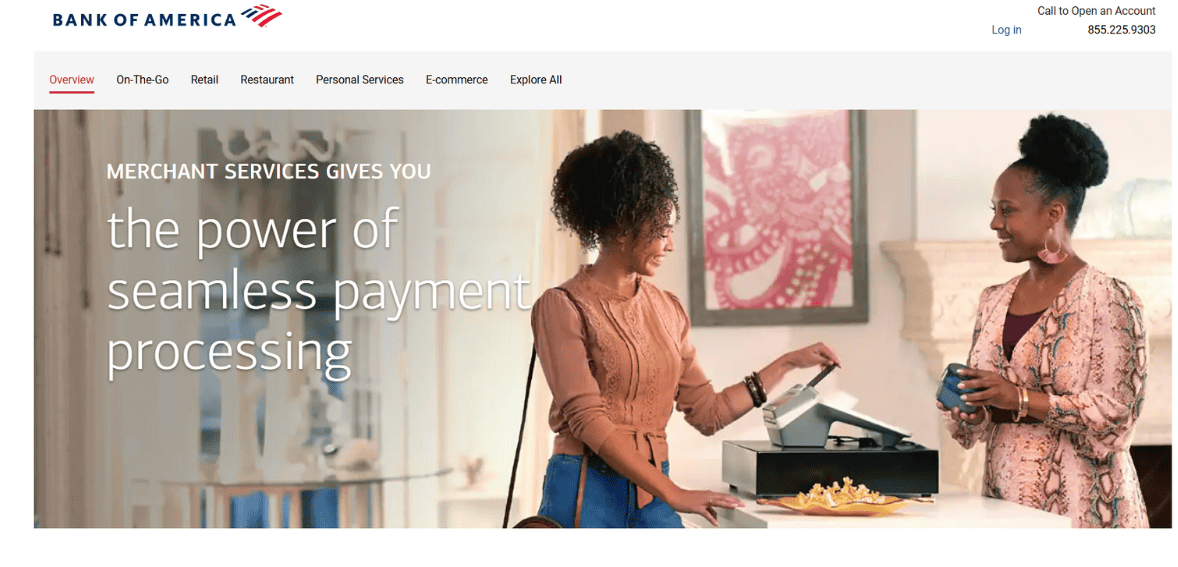
Bank of America offers hardware solutions through Bank of America Merchant Services that mainly consider durability, compliance, and functionality, but not necessarily aesthetics and complex softwares. There are solutions available like countertop terminals, wireless card readers, and standard point-of-sale solutions that cater to the retail and service industry.
Most of these hardware solutions are EMV compliant, as well as contactless, which provides compatibility with the current standard of security and convenience. Since these are multi-shift and high volume, these terminals are suited for merchants who value functionality over customization. Hardware can be bought or leased, depending on the agreement reached. Leasing may help in reducing the costs incurred, but it may also lead to incurring higher aggregate costs in the long run, meaning the merchant should understand the agreement well before engaging in it.
The system does not function like mobile POS solutions which incorporate robust inventory, analytical, or marketing capabilities right into the terminal software. Businesses looking for integrated POS solutions would require additional solutions or integrations. Essentially, the hardware approach focuses on the reliability of transaction processing as opposed to the capabilities of point-of-sale management. This would be ideal in situations whereby the business already uses other operational systems.
Online and Ecommerce Payment Solutions
Bank of America Merchant Services offers web payment solutions that can be easily utilized to facilitate business entities that wish to conduct their sales through the online payment system. The merchant service allows customers to make payments through hosted checkout pages, virtual terminals, and payment gateways that support various web payment platforms.
The system offers secured card-not-present transactions and fraud and charge-back protection. These security and fraud protection tools are very useful when businesses are switching from offline to online operations or have offline and online sales operations simultaneously.
Options for customization are more function-oriented and less flexible. A company can provide an easy way to make a payment, but it might be less flexible and less custom-friendly as a solution for a developer or a rapidly growing e-commerce business. For existing businesses, which focus on stability and not experimentation, their ecommerce solution is adequate. It enables merchants to have an online presence and does not require any third-party payment provider.
Nonetheless, if their business focuses extensively on ecommerce growth, subscription business models, and internationalization, they might just not get much use out of this platform. This platform will provide the best experience if online payments represent a supplementary business process in their existing business models.
Pricing Structure and Fee Transparency
Pricing within Bank of America Merchant Services is not presented as a standardized, self-serve model. Instead, costs are typically discussed during onboarding or sales conversations, with pricing influenced by transaction volume, business type, and risk profile.
Most accounts use an interchange-plus pricing structure, which separates interchange fees from processor markups. While this model can be cost-effective for some businesses, the lack of upfront published rates makes comparison shopping more difficult. Merchants should expect monthly account fees, processing fees, and potential additional charges for services such as PCI compliance, equipment, or chargeback handling. These costs vary depending on the agreement and account setup.
Transparency depends heavily on the clarity of the initial discussion and contract review. Businesses that take the time to fully understand fees are less likely to be surprised later. Overall, pricing can be competitive for higher-volume businesses but may not be ideal for smaller merchants seeking simplicity or predictable flat rates.
Contract Terms and Account Commitments
Bank of America Merchant Services typically operates under formal contracts rather than month-to-month arrangements. These contracts may include multi-year commitments, auto-renewal clauses, and early termination fees.
For businesses planning long-term processing relationships, this structure can provide stability and negotiated pricing. However, businesses with changing needs or uncertain growth trajectories may find the commitments restrictive. Early termination fees can increase the cost of switching providers, making it important for merchants to review contract length and exit terms carefully. The service is best suited for businesses confident in their processing needs and comfortable committing to a structured agreement rather than maintaining flexibility.
Settlement Speed and Funding Timeframes
Settlement schedules with Bank of America Merchant Services are generally predictable but not aggressively fast. Funds are typically deposited within standard timeframes rather than offering instant or same-day settlement by default. Businesses using Bank of America for banking may experience smoother reconciliation and fewer funding delays. However, merchants prioritizing immediate access to funds may find faster options elsewhere. Funding reliability is a strength, even if speed is not the main focus.
Security, Fraud Prevention, and Compliance Tools
Security is a core strength of Bank of America Merchant Services. The platform supports PCI compliance, EMV standards, and fraud monitoring tools designed to reduce risk and protect cardholder data. Chargeback management and dispute handling are integrated into the system, giving merchants visibility into transaction issues. These features are especially valuable for businesses with higher transaction volumes or regulatory exposure. The emphasis on compliance makes the platform well-suited for risk-averse businesses.
Reporting, Analytics, and Business Insights
The reporting tools provided focus on transaction accuracy, reconciliation, and financial clarity rather than advanced analytics. Merchants can track sales, review settlements, and export data for accounting purposes. While the tools are reliable, they may feel basic to businesses seeking real-time insights or predictive analytics. The reporting system prioritizes dependability over innovation.
Integration with Bank of America Banking Services
One of the platform’s strongest advantages is its integration with Bank of America business accounts. Merchants can align payment processing with banking, cash management, and treasury tools. This integration simplifies daily operations for businesses already using Bank of America services, reducing administrative friction.
Customer Support and Account Management Experience
Support is typically structured through dedicated representatives and formal service channels. Businesses may appreciate having assigned contacts, though response times can vary. The experience favors larger or established merchants over micro-businesses needing immediate assistance.
Pros of Bank of America Merchant Services
One of the most meaningful strengths of Bank of America Merchant Services is its deep integration with traditional banking infrastructure. For businesses already using Bank of America for business checking or treasury services, this alignment simplifies reconciliation, settlement tracking, and overall cash flow management. Payments and banking do not operate as separate systems, which reduces administrative friction for accounting teams.
Another advantage is institutional reliability. The platform benefits from the operational discipline, compliance standards, and risk controls expected from a large U.S. bank. Businesses processing higher volumes or operating in regulated industries may find comfort in this conservative, risk-aware approach.
The service also offers scalability without frequent restructuring. Merchants that grow steadily can often remain on the same platform without needing to migrate systems, renegotiate technical setups, or retrain staff. This long-term continuity appeals to multi-location businesses and enterprises.
Security is another notable strength. Robust PCI compliance support, EMV standards, and fraud monitoring tools are built into the service. While these features may not be flashy, they are reliable and well-suited for businesses prioritizing transaction integrity over experimentation. Overall, the platform performs best for businesses that value stability, predictability, and banking alignment more than speed or flexibility.
Cons and Practical Limitations to Consider
The most common limitation cited by merchants is limited pricing transparency. Rates and fees are usually discussed during sales conversations rather than published upfront, which makes quick comparisons difficult. Businesses that prefer flat-rate or fully visible pricing may find this frustrating. Contract commitments are another concern. Multi-year agreements, auto-renewal clauses, and early termination fees reduce flexibility. For businesses with uncertain growth plans or changing sales models, these terms can feel restrictive.
The onboarding process is also more formal and slower than modern fintech processors. Documentation requirements and underwriting reviews may delay activation, particularly for new or smaller businesses. From a technology perspective, the platform feels functionally solid but not innovative. Reporting tools are reliable but basic, and POS or ecommerce tools lack the agility seen in software-first payment platforms. Merchants seeking rapid feature development or advanced customization may feel limited.
Finally, customer support quality can vary. While dedicated account management exists, response speed and accessibility may not always match the expectations of small businesses needing immediate resolution.
Overall Verdict and Who Should Consider This Service
Bank of America Merchant Services is best viewed as a bank-first merchant processing solution, not a fintech disruptor. Its strengths lie in financial stability, compliance rigor, and seamless integration with Bank of America’s broader business services.
The platform is well suited for established businesses, mid-sized companies, and enterprises that prioritize reliability, structured reporting, and long-term consistency over flexibility. Merchants with predictable volumes, traditional operating models, and existing Bank of America relationships are likely to experience the most value.
However, very small businesses, startups, and fast-scaling ecommerce brands may find the service less appealing. Slower onboarding, contractual commitments, and limited pricing visibility can become obstacles for merchants seeking speed, simplicity, or experimentation. In short, Bank of America Merchant Services is a safe, dependable choice for businesses that value stability and institutional support, but it may not be the right fit for those who prioritize agility, transparency, or rapid innovation.
FAQs
Is Bank of America Merchant Services suitable for small businesses?
It can work for small businesses with stable revenue, but the structure may feel complex for early-stage merchants.
How transparent is pricing?
Pricing is discussed during onboarding rather than publicly listed, requiring careful review.
Does it support both in-store and online payments?
Yes, the platform supports both environments with consistent processing tools.
Best Product & Services
Recent Posts


